 19
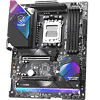
ASRock Phantom Gaming X870 Riptide Wi-Fi Review
(19 Comments) »Value and Conclusion
- The ASRock Phantom Gaming X870 Riptide Wi-Fi is currently available for US$180
- Good SSD cooling
- Excellent value
- USB 3.2 Gen 2x2 20 Gbps Type-C front panel header
- Wi-Fi 7
- USB4
- Above average number of Type-A USB ports
- Thermistor header
- Minimal bandwidth sharing
- EFI feels dated and lacks features compared to competition
- Software needs an update
- Mediocre VRM temperatures
- Only one tool-free heatsink
- No CMOS clear, power or reset buttons
- Minimal accessories
- No LED POST code display
- No enhanced GPU release
As with a number of options out there right now, whether the ASRock Phantom Gaming X870 Riptide Wi-Fi is a good deal depends on where you are. It's readily available for less than $200 in the US, but bucks the trend here and is much more expensive in Europe, to the extent that in the UK for example, it costs the same as some decent and better-featured X870 and X870E boards. Those include the likes of the ASUS ROG Strix X870-A, Gigabyte X870E Aorus Elite Wi-Fi, and MSI MAG X870 Tomahawk Wi-Fi, all of which have more features and much better EFIs. Consider it off limits if that's the case, until it receives the same kind of price cut as it has stateside. In the USA the situation is flipped, as it's one of the cheapest X870 boards out there.
Competition is relatively slim if you must have X870 and its benefits too, and where it does exist for a similar price, the fact that ASRock has done a decent job of balancing the specifications and not including X870 for the sake of it means that it's usually better featured. Take the ASUS Prime X870-P Wi-Fi for example. It's suitably cheap and overall a decent affordable X870 option, but it failed to tame our PCIe Gen 5 SSD and has inferior on board audio, as well as lacking any tool-free M.2 heatsinks. Other competition doesn't fare much better either. The Gigabyte X870 Gaming Wi-Fi6, as its name suggests, lacks Wi-Fi 7 and again has inferior audio, as does the MSI X870 Gaming Plus Wi-Fi. In raw value and future proofing terms, the Phantom Gaming X870 Riptide Wi-Fi is hard to beat, ticking the most important boxes that ensure you'll be happy with your purchase as long as Socket AM5 sticks around, and we're all making more use of PCIe 5 and Wi-Fi 7.
The fact that it has solid SSD and VRM cooling reinforces its credentials here as the board is just as happy dealing with PCIe Gen 5 SSDs and 16-core, 170 W TDP CPUs as it is with much cheaper, cooler-running hardware. A USB 3.2 Gen 2x2 20 Gbps Type-C front panel header and thermistor header are very welcome additions given the price too, rounding off a balanced set of features.
There are of course some niggles as no product is perfect. Thankfully they are few, and mainly relate to the EFI and software, which are dated, lack features the competition includes on nearly all of its motherboards, and for some will also mean a frustrating and time-consuming PC building process. The fact that the main fan control page lacks the majority of settings other than the actual fan curve means that fine-tuning your fans and cooling is tedious as you have to continuously flick between pages. The EFI itself feels very dated and there are a bunch of modern features the competition includes that make life easier, especially for newcomers. The software is in need of a revamp too, but as it's slightly more capable than the EFI in terms of fan tuning, we have fewer complaints other than it not being thoroughly updated in probably more than a decade.
All of these issues won't be a problem for all would-be owners, because if you just apply a pre-set fan profile or adjust the fan curve a bit and spend 60 seconds in the EFI before never using it or the software again, you'll be oblivious to their flaws. With this in mind, so long as you're not really into spending weekends fine-tuning your PC cooling or overclocking, then the Phantom Gaming X870 Riptide Wi-Fi has everything you need, performs well and best of all leaves you with change from $200.


Competition is relatively slim if you must have X870 and its benefits too, and where it does exist for a similar price, the fact that ASRock has done a decent job of balancing the specifications and not including X870 for the sake of it means that it's usually better featured. Take the ASUS Prime X870-P Wi-Fi for example. It's suitably cheap and overall a decent affordable X870 option, but it failed to tame our PCIe Gen 5 SSD and has inferior on board audio, as well as lacking any tool-free M.2 heatsinks. Other competition doesn't fare much better either. The Gigabyte X870 Gaming Wi-Fi6, as its name suggests, lacks Wi-Fi 7 and again has inferior audio, as does the MSI X870 Gaming Plus Wi-Fi. In raw value and future proofing terms, the Phantom Gaming X870 Riptide Wi-Fi is hard to beat, ticking the most important boxes that ensure you'll be happy with your purchase as long as Socket AM5 sticks around, and we're all making more use of PCIe 5 and Wi-Fi 7.
The fact that it has solid SSD and VRM cooling reinforces its credentials here as the board is just as happy dealing with PCIe Gen 5 SSDs and 16-core, 170 W TDP CPUs as it is with much cheaper, cooler-running hardware. A USB 3.2 Gen 2x2 20 Gbps Type-C front panel header and thermistor header are very welcome additions given the price too, rounding off a balanced set of features.
There are of course some niggles as no product is perfect. Thankfully they are few, and mainly relate to the EFI and software, which are dated, lack features the competition includes on nearly all of its motherboards, and for some will also mean a frustrating and time-consuming PC building process. The fact that the main fan control page lacks the majority of settings other than the actual fan curve means that fine-tuning your fans and cooling is tedious as you have to continuously flick between pages. The EFI itself feels very dated and there are a bunch of modern features the competition includes that make life easier, especially for newcomers. The software is in need of a revamp too, but as it's slightly more capable than the EFI in terms of fan tuning, we have fewer complaints other than it not being thoroughly updated in probably more than a decade.
All of these issues won't be a problem for all would-be owners, because if you just apply a pre-set fan profile or adjust the fan curve a bit and spend 60 seconds in the EFI before never using it or the software again, you'll be oblivious to their flaws. With this in mind, so long as you're not really into spending weekends fine-tuning your PC cooling or overclocking, then the Phantom Gaming X870 Riptide Wi-Fi has everything you need, performs well and best of all leaves you with change from $200.
Nov 22nd, 2026 19:39 CST
change timezone
Latest GPU Drivers
New Forum Posts
- DTS DCH Driver for Realtek HDA [DTS:X APO4 + DTS Interactive] (2818)
- Honestly, do you care about GTA VI? (266)
- Increasing Power Limit? (6)
- What are you playing? (26240)
- UPS what one to get? (48)
- Your PC ATM (36458)
- Gacha Games - Discussions, Pulls, Updates, etc. (1157)
- Last game you purchased? (1414)
- Making a game in Godot engine (19)
- Intel D270 (5)
Popular Reviews
- Microsoft Surface Laptop Ultra Review - The Next-gen Arm Laptop
- Corsair RM1200e (Second Generation) Review
- Upcoming Hardware Launches 2027 (Updated Nov 2026)
- Pulsar Office Tour & First Look at P1 Dual-Sensor Mouse
- Ugreen NASync DXP4800 GT Review
- AMD Ryzen 7 9800X3D Review - The Best Gaming Processor
- AMD Zen 6 Technical Deep Dive
- AMD Ryzen 7 5800X3D 10th Anniversary Review
- Phantom Blade Zero Performance Benchmark Review - 35 GPUs Tested
- Biwin Black Opal NV7400 2 TB Review
TPU on YouTube
Controversial News Posts
- NVIDIA Co-Founder and CEO Jensen Huang Officially Resigns (492)
- Report: Jensen Huang Eyes NVIDIA Comeback (266)
- Open Letter Asking NVIDIA to Reinstate Jensen Huang Passes 115,000 Signatures (184)
- OpenAI CEO Argues Home PCs Waste the World's Limited DRAM Supply (152)
- NVIDIA Launches Investigation Into Jensen Huang's Relationship With Suspected Chinese Spy (136)
- Intel "Raptor Lake Next" 16-Core and 20-Core CPUs Surface (130)
- NVIDIA GeForce RTX 50-Series Scheduled for up to $500 Price Hike This Week (89)
- Intel Razor Lake Gets a 12 P-Core bLLC Chip With No E-Cores, Per Leak (86)