 31
ASRock RX 590 Phantom Gaming X 8 GB Review
(31 Comments) »Introduction

In November last year, AMD announced its Radeon RX 590 graphics card, which was an unexpected surprise at the time. It is based on the "Polaris 30" silicon, which is essentially a "Polaris 10" die built on the latest 12 nm FinFET node at GlobalFoundries, yielding significant energy-efficiency dividends AMD is cashing in on to increase clock speeds by 15 percent. The engine clock has been dialed up to 1545 MHz compared to the 1340 MHz of the RX 580.
Unlike the RX 580, the RX 590 only comes with 8 GB of video memory (no 4 GB variant), and the card's memory setup is unchanged: 8 Gbps GDDR5 over a 256-bit wide memory interface, which yields 256 GB/s of bandwidth. The "Polaris 30" silicon features the same core configuration as its predecessors with 2,304 stream processors spread across 36 compute units, 144 TMUs, and 32 ROPs. There's no ray-tracing machinery to rival RTX, or other new features.

In this review, we're taking a look at the ASRock Radeon RX 590 Phantom Gaming X, which is is a highly cost-optimized variant of the RX 590 that still comes with a factory overclock to 1560 MHz Boost, which is comparable to other RX 590 cards on the market. The card draws power from a single 8-pin PCIe power connector.
Priced at $250, the ASRock RX 590 Phantom Gaming X is the most affordable RX 590 on the market at this time.
| Price | Shader Units | ROPs | Core Clock | Boost Clock | Memory Clock | GPU | Transistors | Memory | |
|---|---|---|---|---|---|---|---|---|---|
| GTX 1050 | $140 | 640 | 32 | 1354 MHz | 1455 MHz | 1752 MHz | GP107 | 3300M | 2 GB, GDDR5, 128-bit |
| GTX 1050 Ti | $170 | 768 | 32 | 1290 MHz | 1392 MHz | 1752 MHz | GP107 | 3300M | 4 GB, GDDR5, 128-bit |
| RX 570 | $150 | 2048 | 32 | 1168 MHz | 1244 MHz | 1750 MHz | Ellesmere | 5700M | 4 GB, GDDR5, 256-bit |
| RX 580 | $185 | 2304 | 32 | 1257 MHz | 1340 MHz | 2000 MHz | Ellesmere | 5700M | 8 GB, GDDR5, 256-bit |
| GTX 1060 3 GB | $185 | 1152 | 48 | 1506 MHz | 1708 MHz | 2002 MHz | GP106 | 4400M | 3 GB, GDDR5, 192-bit |
| GTX 1060 | $200 | 1280 | 48 | 1506 MHz | 1708 MHz | 2002 MHz | GP106 | 4400M | 6 GB, GDDR5, 192-bit |
| RX 590 | $260 | 2304 | 32 | 1469 MHz | 1545 MHz | 2000 MHz | Polaris 30 | 5700M | 8 GB, GDDR5, 256-bit |
| ASRock RX 590 Phantom Gaming X | $250 | 2304 | 32 | 1469 MHz | 1560 MHz | 2000 MHz | Polaris 30 | 5700M | 8 GB, GDDR5, 256-bit |
| GTX 1070 | $310 | 1920 | 64 | 1506 MHz | 1683 MHz | 2002 MHz | GP104 | 7200M | 8 GB, GDDR5, 256-bit |
| RX Vega 56 | $370 | 3584 | 64 | 1156 MHz | 1471 MHz | 800 MHz | Vega 10 | 12500M | 8 GB, HBM2, 2048-bit |
| GTX 1660 Ti | $280 | 1536 | 48 | 1500 MHz | 1770 MHz | 1500 MHz | TU116 | 6600M | 6 GB, GDDR6, 192-bit |
| GTX 1070 Ti | $450 | 2432 | 64 | 1607 MHz | 1683 MHz | 2000 MHz | GP104 | 7200M | 8 GB, GDDR5, 256-bit |
Packaging and Contents
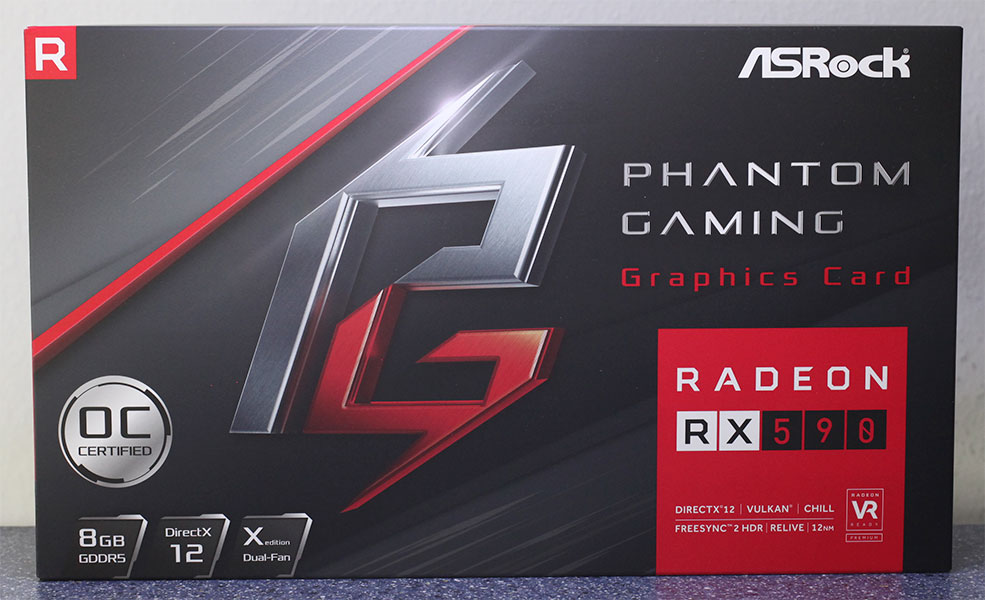


You will receive:
- Graphics card
- Driver disc
- Documentation
The Card


The ASRock RX 590 uses a fairly long board design that is dominated by black and gray, with red highlights, and a metal backplate is included, too. Dimensions of the card are 27.0 x 11.5 cm.

Installation requires two slots in your system.

Display connectivity options include two DisplayPort 1.4, two HDMI 2.0b, and a dual-link DVI-D. The DVI connector has no analog wiring, so D-Sub dongles won't work and an active adapter has to be used.

The board uses a single 8-pin power connector. This input configuration is specified for up to 225 watts of power draw.

The Radeon RX 590, like every other current AMD GPU, supports up to 4-way CrossFire X via PCIe.
Disassembly


ASRock's heatsink provides cooling for all important components: GPU, memory, and VRM circuitry. It uses three heatpipes to quickly move heat away from the GPU surface.


The backplate is made out of metal and protects the card against damage during installation and handling.
On the next page, we dive deep into the PCB layout and VRM configuration.
Our Patreon Silver Supporters can read articles in single-page format.
Nov 15th, 2026 16:56 CST
change timezone
Latest GPU Drivers
New Forum Posts
- WarpCoreBench scores! (53)
- What are you playing? (26223)
- Folding Pie and Milestones!! (10205)
- Asus Rog Maximus Z890 Extreme. (Various questions). (25)
- Power supply noise stops when I move the mouse (9)
- TPU's Nostalgic Hardware Club (22165)
- HP Office Jet 7740 Pro - Supply system problem with replacement cartridge (3)
- Recommendations Wanted - Affordable Enterprise SSD for Boot (9)
- What can the FX 8320 do today? Here is the answer. (59)
- How do you get games for PC? (59)
Popular Reviews
- AMD Zen 6 Technical Deep Dive
- ASUS ROG Strix B850-I Gaming Wi-Fi7 W Review
- Corsair HX1000i Shift Crystal Review
- Upcoming Hardware Launches 2027 (Updated Nov 2026)
- Montech King 95 3D PRO Review
- NZXT C1200 Platinum Review
- NZXT H7 RGB+ Review
- NZXT H5 Review
- Phantom Blade Zero Performance Benchmark Review - 35 GPUs Tested
- AMD Ryzen 7 9800X3D Review - The Best Gaming Processor
TPU on YouTube
Controversial News Posts
- NVIDIA Co-Founder and CEO Jensen Huang Officially Resigns (421)
- Open Letter Asking NVIDIA to Reinstate Jensen Huang Passes 115,000 Signatures (184)
- OpenAI CEO Argues Home PCs Waste the World's Limited DRAM Supply (152)
- NVIDIA Launches Investigation Into Jensen Huang's Relationship With Suspected Chinese Spy (136)
- Intel "Raptor Lake Next" 16-Core and 20-Core CPUs Surface (130)
- Legendary Game Studio BioWare Shuts Down Following EA Layoffs (104)
- Dell CEO Says the Memory Shortage Will Get Worse in 2027 (95)
- NVIDIA GeForce RTX 50-Series Scheduled for up to $500 Price Hike This Week (89)