 48
ASRock X79 Extreme11 Intel LGA 2011 Review
(48 Comments) »Introduction

Over the past several weeks I have reviewed many products from ASRock, covering both Intel X79 and Intel Z77 chipsets. My first impression of their products has been pretty good, and I now understand why so many people have requested that TPU cover ASRock products. It was very easy to recognize, right from the get-go, that one of the biggest things setting ASRock apart from other board makers is the software package; one that really appeals to me on a personal level. I have also found overall performance and overclocking to be similar to what other board makers offer, although different in ASRock's own way. Delving deeper into the hardware side of things, I've found that many board-level components ASRock uses are quite different from what other OEMs offer, including the majority of high-end ASRock products sporting Creative Audio CODECs. When it comes to the highest of the high-end, however, ASRock definitely does do some things differently.
While speaking to my ASRock rep about the hardware I reviewed recently, my rep sent me a special package containing none other than the ASRock X79 Extreme11. The ASRock X79 Extreme11 is a high-end halo product with a high price tag, incorporating some technologies purely meant to show off ASRock's engineering skill. Technologies here include an LSI RAID card built right into the board, and multiple PLX PCIe bridge chips, raising offered X79 Express PCIe bandwidth to out-of-this-world levels. Few have the need for such technology, but I have spoken to many users with large data libraries spanning across many disks, and there has been a unanimous cry for more SATA ports, especially for workstation-focused builds. Being a multi-gpu user myself, PCIe bandwidth is something I am keen for in a board. Is the ASRock X79 Extreme11 the board that finally meets all my needs?
Specifications
| Specifications | |
|---|---|
| CPU SUPPORT: | 2nd Gen Intel Core i7 processor family for the LGA 2011 Socket |
| POWER DESIGN: | CPU Power: 24+2 Phase PCH Power: 1 Phase Memory Power: 2+2 Phase |
| CHIPSET: | Intel X79 Express |
| INTEGRATED GRAPHICS: | Not Applicable |
| MEMORY: | 8 x DIMM, Max. 64 GB, DDR3 1066 to DDR3 2400 |
| BIOS: | AMI EFI BIOS with 64 Mb Flash ROM |
| SLOTS: | 7 x PCIe 3.0 x16 slots |
| HDD CONNECTIVITY: | 2 x SATA 6.0 Gb/s (Intel X79) 4 x SATA 3.0 Gb/s (Intel X79) 8 x SAS2/SATA3 6.0 Gb/s (LSI SAS2308) |
| NETWORKING: | 2x Broadcom BCM57781 PCIe Gigabit LAN |
| PORTS: | 14 x USB 2.0 ports (8 at back panel, 6 at front panel) 8 x USB 3.0 ports (4 at back panel, 4 at front panel) 2 x RJ45 LAN connectors 1 x Audio port with 5 audio jacks 1 x SPDIF Output(Optical) 2 x eSATA3 ports 1 x IEEE 1394 port 1 x Clear CMOS Button 1 x PS/2 keyboard port |
| AUDIO: | Creative Recon3Di HD CODEC |
| FAN HEADERS: | 4 x 3-pin, 2 x 4-pin |
| FORM FACTOR: | CEB Form Factor (305 mm x 267 mm) |
| EXCLUSIVE FEATURES: |
|
Intel X79 Express Chipset

Launched November 14th, 2011, the Intel X79 Express chipset is very similar to the Intel P67 Express and Intel Z68 Express chipsets launched earlier in 2011. The Intel X79 Express platform supports 40 PCIe 3.0 lanes via the CPU for graphics, while the Intel Z68/P67 Express chipsets support only 16 lanes. The Intel X79 Express PCH itself supports eight lanes of PCIe 2.0 connectivity for external devices, as well as housing all of the I/O functionality via dual SATA 6 Gb/s ports and quad SATA 3 Gb/s ports, all of which are managed via Intel Rapid Storage Technology 3.0 for RAID support. USB 2.0/3.0 and HD Audio are also supported as is eSATA and Gigabit Ethernet connectivity.

The SKT2011 CPUs that the platform supports are very similar to the previously released SKT1155 CPUs, but nearly everything offered in the SKT1155 platform has been doubled, including cache and core count. Going by the marketing material given out by Intel, the SB-E CPUs (as they are referred to in enthusiast circles) feature eight total processing cores with two having been disabled to keep power in check. Rather than a total of eight active cores we find six, but they appear, as these cores feature Hyper-Threading, as twelve separate cores to the OS.
The PCIe on the CPU can be split many ways, including dual x16 links and a single x8 link at the same time, a single x16 link with triple x8 links, or a single x16 link with dual x8 and dual x4 links. Together these options offer a lot of flexibility for multi-card GPU configurations while supporting up to five total devices connected directly to the CPU. While only four discrete GPUs maximum are supported in current multi-GPU rendering options, the 5th link can be used for an external RAID controller or other PCIe devices that are commonly found in high-end builds.
The ASRock X79 Extreme11 does, of course, take advantage of those possibilities, and has a RAID card built right into the board's PCB!!! Not only that, it also features two PLX PEX8747 PCIe 3.0 bridge chips to expand those four remaining PCIe links into full PCIe x16 links, instead of four PCIe x8 links.

Packaging


ASRock has sent me some very large packages recently, far larger than what I am used to. The packaging for the ASRock X79 Extreme11 follows ASRock's traditional "look" for current products with a large black box sporting only ASRocks's own "555" technology logo on the front as its main focus. The back of the box goes into a bit more detail, and there is a fair bit of info here with all that ASRock has crammed into the X79 Extreme11.


With the X79 Extreme11 capable of so much, there are a few more technological descriptions hidden behind a flap on the front of the box, which, when opened, also reveals the board itself through a plastic window. I slid everything out of the box, and found that there were two boxes inside; one for the board, and one for included accessories. The tray the board sits in has a thick foam border that helps keep the board in place during shipping. It wasn't until I removed it that I noticed the many SATA ports on one side, and a bright red Creative CODEC staring back at me from the other.
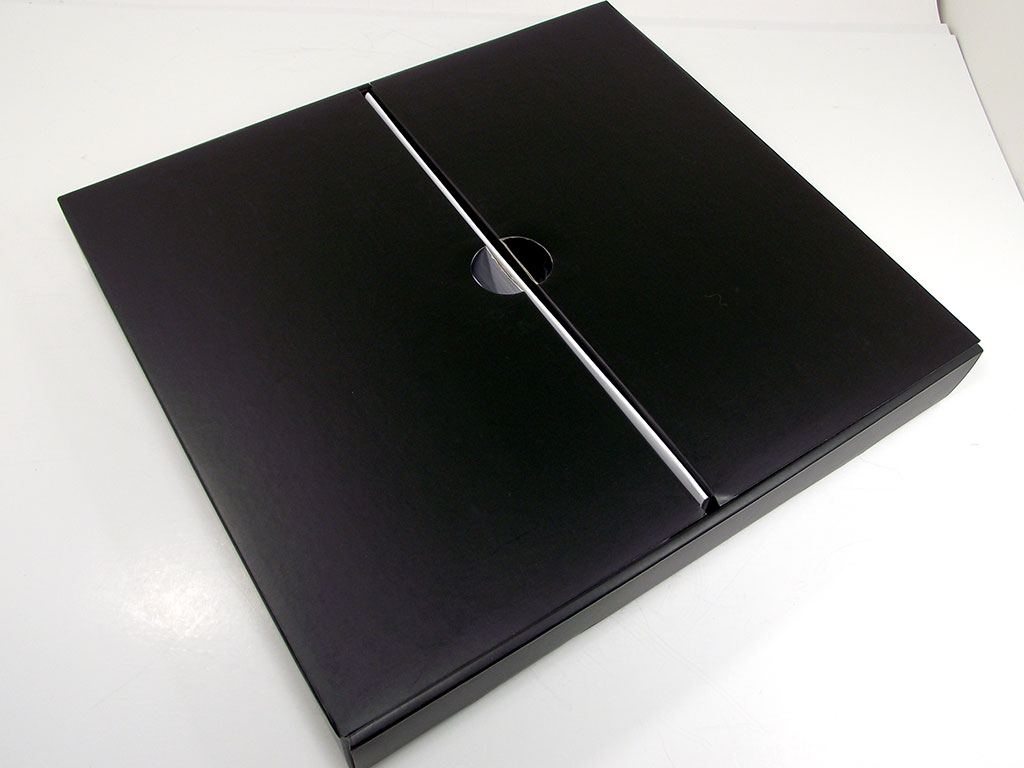
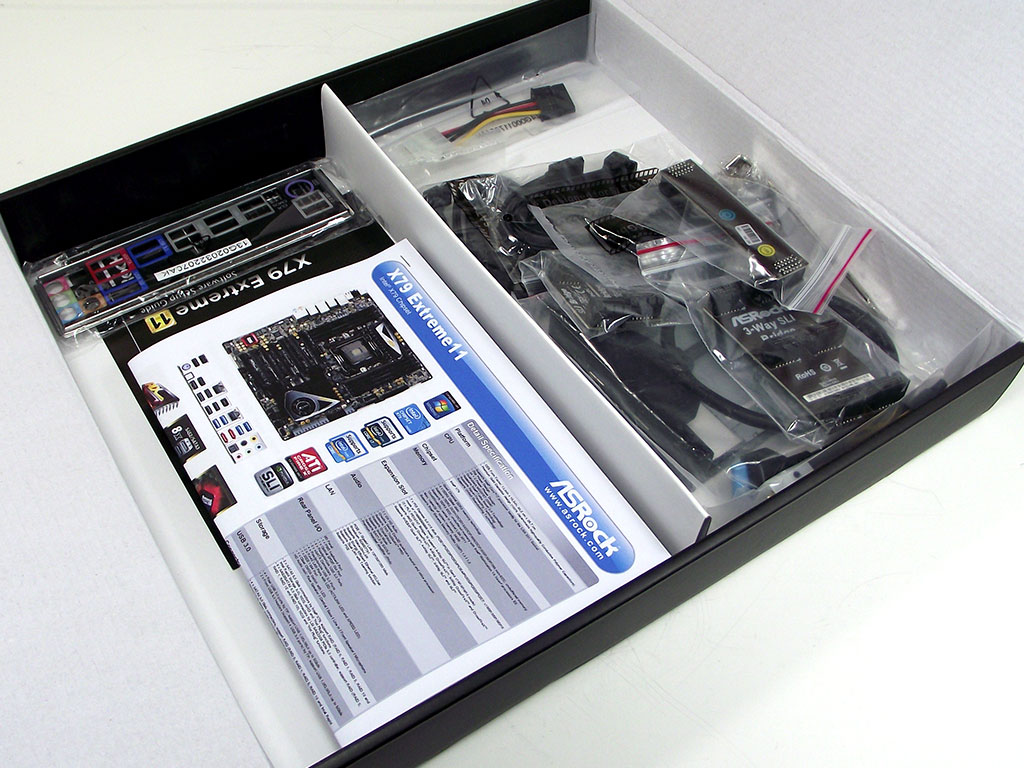
The accessories box is fairly standard, clad in high-quality cardboard. It opens to reveal two compartments, one for paper stuff like the manual, and another for everything else.
Our Patreon Silver Supporters can read articles in single-page format.
Nov 19th, 2026 06:22 PST
change timezone
Latest GPU Drivers
New Forum Posts
- Time to upgrade CPU and MOBO (71)
- WarpCoreBench scores! (69)
- [Poll] 12V-2x6 Connector Protection: What Are You Using? (WireView / Ampinel / Equalizer / Other / Nothing) (46)
- Will zen 6 mobos have anything extra vs current ones? (61)
- Very unusual two gaming-pc scenarios. (15)
- Windows HDR on = Tinted colors (7)
- 12V-2x6 load imbalance (10)
- Cpu waterblock water shows some tinting = Bad? (15)
- How much does an RTX 5090 cost in your area? (70)
- Dell Precision 7560 (i7-11850H) stuck at base clock under load after GPU upgrade. (1)
Popular Reviews
- Acemagic Retro X3 Review
- Ugreen NASync DXP4800 GT Review
- Upcoming Hardware Launches 2027 (Updated Nov 2026)
- AMD Zen 6 Technical Deep Dive
- Pulsar Office Tour & First Look at P1 Dual-Sensor Mouse
- Biwin Black Opal NV7400 2 TB Review
- Sapphire Radeon RX 7700 XT Pure Review
- Sapphire Radeon RX 7700 XT Pulse Review
- Chieftec Iceberg PRO 360 DARK Review
- AMD Ryzen 7 9800X3D Review - The Best Gaming Processor
TPU on YouTube
Controversial News Posts
- NVIDIA Co-Founder and CEO Jensen Huang Officially Resigns (484)
- Report: Jensen Huang Eyes NVIDIA Comeback (216)
- Open Letter Asking NVIDIA to Reinstate Jensen Huang Passes 115,000 Signatures (184)
- OpenAI CEO Argues Home PCs Waste the World's Limited DRAM Supply (152)
- NVIDIA Launches Investigation Into Jensen Huang's Relationship With Suspected Chinese Spy (136)
- Intel "Raptor Lake Next" 16-Core and 20-Core CPUs Surface (130)
- Legendary Game Studio BioWare Shuts Down Following EA Layoffs (104)
- Dell CEO Says the Memory Shortage Will Get Worse in 2027 (95)