 27
ASUS GeForce RTX 3060 Ti STRIX OC Review
(27 Comments) »Introduction

The ASUS Republic of Gamers (ROG) STRIX GeForce RTX 3060 Ti OC is the company's top of the line custom-design graphics card based on the newly launched GeForce RTX 3060 Ti Ampere GPU by NVIDIA. Launching at the same price points as the RTX 2060 Super, the new RTX 3060 Ti is designed to offer 1440p AAA gaming with RTX raytracing enabled. NVIDIA's RTX real-time raytracing technology combines traditional raster 3D graphics with certain raytraced elements, such as lighting, shadows, reflections, illumination, etc., which significantly ups realism. Even these few effects are extremely compute-intensive to pull off in real time, so NVIDIA innovated fixed-function hardware to handle them.
Compared to the RTX 20-series Turing, the design focus with the RTX 30-series Ampere has been to improve performance in games with RTX enabled, which means the GPU's conventional raster 3D performance is significantly better, with NVIDIA claiming that the RTX 3060 Ti beats the RTX 2080 Super—a $700 previous-generation card for the same use case. The 2nd generation RTX technology combines new Ampere CUDA cores with concurrent FP32+INT32 math performance, 2nd generation RT cores which double the intersection performance over the previous generation, and add hardware for raytraced motion-blur effects; and 3rd generation Tensor cores that leverage the sparsity phenomenon in neural nets to increase AI inference performance significantly.

NVIDIA carved the RTX 3060 Ti out of the same 8 nm GA104 silicon as the RTX 3070. While the RTX 3070 nearly maxes it out, the RTX 3060 Ti is significantly cut down, featuring 38 out of 48 streaming multiprocessors physically present on the chip; 152 Tensor cores, 38 RT cores, 152 TMUs, and 80 ROPs. The memory setup is identical, with the card featuring 8 GB of GDDR6 memory across a 256-bit wide memory interface clocked at 14 Gbps. ASUS has significantly overclocked the RTX 3060 Ti from its reference 1665 MHz up to 1860 MHz.
The ROG STRIX RTX 3060 Ti features the company's latest generation ROG STRIX DirectCU III cooling solution, which looks like it's capable of cooling a GPU two segments above the RTX 3060 Ti. A large triple-slot aluminium fin-stack heatsink is ventilated by three Axial-Tech fans designed to guide all their airflow axially, onto the heatsink. The card features a much stronger VRM solution than reference, capable of supporting high power limits. The card is longer than the PCB underneath, which means much of the airflow form the third fan is guided through the card and directly out the vents on the backplate. ASUS is pricing the RTX 3060 Ti ROG STRIX OC at a steep $500, a 25% premium over the $400 baseline price, and exactly the same price as the RTX 3070 baseline. In this review, we explore whether the ASUS ROG STRIX RTX 3060 Ti is worth such a large premium.
| Price | Shader Units | ROPs | Core Clock | Boost Clock | Memory Clock | GPU | Transistors | Memory | |
|---|---|---|---|---|---|---|---|---|---|
| RTX 2060 | $300 | 1920 | 48 | 1365 MHz | 1680 MHz | 1750 MHz | TU106 | 10800M | 6 GB, GDDR6, 192-bit |
| RX 5700 | $330 | 2304 | 64 | 1465 MHz | 1625 MHz | 1750 MHz | Navi 10 | 10300M | 8 GB, GDDR6, 256-bit |
| GTX 1080 | $330 | 2560 | 64 | 1607 MHz | 1733 MHz | 1251 MHz | GP104 | 7200M | 8 GB, GDDR5X, 256-bit |
| RTX 2060 Super | $380 | 2176 | 64 | 1470 MHz | 1650 MHz | 1750 MHz | TU106 | 10800M | 8 GB, GDDR6, 256-bit |
| RX Vega 64 | $400 | 4096 | 64 | 1247 MHz | 1546 MHz | 953 MHz | Vega 10 | 12500M | 8 GB, HBM2, 2048-bit |
| GTX 1080 Ti | $650 | 3584 | 88 | 1481 MHz | 1582 MHz | 1376 MHz | GP102 | 12000M | 11 GB, GDDR5X, 352-bit |
| RX 5700 XT | $370 | 2560 | 64 | 1605 MHz | 1755 MHz | 1750 MHz | Navi 10 | 10300M | 8 GB, GDDR6, 256-bit |
| RTX 2070 | $340 | 2304 | 64 | 1410 MHz | 1620 MHz | 1750 MHz | TU106 | 10800M | 8 GB, GDDR6, 256-bit |
| RTX 2070 Super | $450 | 2560 | 64 | 1605 MHz | 1770 MHz | 1750 MHz | TU104 | 13600M | 8 GB, GDDR6, 256-bit |
| Radeon VII | $680 | 3840 | 64 | 1802 MHz | N/A | 1000 MHz | Vega 20 | 13230M | 16 GB, HBM2, 4096-bit |
| RTX 2080 | $600 | 2944 | 64 | 1515 MHz | 1710 MHz | 1750 MHz | TU104 | 13600M | 8 GB, GDDR6, 256-bit |
| RTX 2080 Super | $690 | 3072 | 64 | 1650 MHz | 1815 MHz | 1940 MHz | TU104 | 13600M | 8 GB, GDDR6, 256-bit |
| RTX 3060 Ti | $400 | 4864 | 80 | 1410 MHz | 1665 MHz | 1750 MHz | GA104 | 17400M | 8 GB, GDDR6, 256-bit |
| ASUS RTX 3060 Ti STRIX OC | $500 | 4864 | 80 | 1410 MHz | 1860 MHz | 1750 MHz | GA104 | 17400M | 8 GB, GDDR6, 256-bit |
| RTX 2080 Ti | $1000 | 4352 | 88 | 1350 MHz | 1545 MHz | 1750 MHz | TU102 | 18600M | 11 GB, GDDR6, 352-bit |
| RTX 3070 | $500 | 5888 | 96 | 1500 MHz | 1725 MHz | 1750 MHz | GA104 | 17400M | 8 GB, GDDR6, 256-bit |
| RX 6800 | $580 | 3840 | 96 | 1815 MHz | 2105 MHz | 2000 MHz | Navi 21 | 23000M | 16 GB, GDDR6, 256-bit |
| RX 6800 XT | $650 | 4608 | 128 | 2015 MHz | 2250 MHz | 2000 MHz | Navi 21 | 23000M | 16 GB, GDDR6, 256-bit |
| RTX 3080 | $700 | 8704 | 96 | 1440 MHz | 1710 MHz | 1188 MHz | GA102 | 28000M | 10 GB, GDDR6X, 320-bit |
Packaging


The Card


The ASUS ROG STRIX RTX 3060 Ti uses a huge triple-slot, triple-fan cooling solution. Unlike past generations, the bulk of the card's RGB bling has been moved towards the top-edge of the card as those parts of the card are more readily visible in a typical windowed case. When viewed from the front, you'll feel like the shroud is smothering the heatsink underneath. This is intentional as the three Axial-Tech fans direct all of their airflow axially, onto the heatsink. The shroud opens up along the sides and top, while the backplate has large vents that guide airflow from one of the fans straight through.


Dimensions of the card are 32 x 14.5 cm, and it weighs 1828 g.


Installation requires three slots in your system.

Display connectivity options include three standard DisplayPort 1.4a and two HDMI 2.1—an additional HDMI over the FE. Interestingly, the USB-C port for VR headsets, which NVIDIA introduced on the Turing Founders Editions, has been removed—guess it didn't take off as planned. The DisplayPort 1.4a outputs support Display Stream Compression (DSC) 1.2a, which lets you connect 4K displays at 120 Hz and 8K displays at 60 Hz. Ampere can drive two 8K displays at 60 Hz with just one cable per display.
Ampere is the first GPU to support HDMI 2.1, which increases bandwidth to 48 Gbps to support higher resolutions, like 4K144 and 8K30, with a single cable. With DSC, this goes up to 4K240 and 8K120. NVIDIA's new NVENC/NVDEC video engine is optimized to handle video tasks with minimal CPU load. The highlight here is added support for AV1 decode. Just like on Turing, you may also decode MPEG-2, VC1, VP8, VP9, H.264, and H.265 natively, at up to 8K@12-bit.
The encoder is identical to Turing. It supports H.264, H.265, and lossless at up to 8K@10-bit.

Unlike the Founders Edition, which uses the NVIDIA 12-pin power connector, ASUS uses standard PCIe power plugs. The card uses two 8-pin power inputs, which are specified to provide up to 375 W in power.

The GeForce RTX 3060 Ti does not support SLI. Only the RTX 3090 has very limited SLI support.

This BIOS switch lets you toggle between the default (Performance) BIOS and a "quiet" BIOS, which runs the fans much quieter, at slower speeds with higher temperature, and also reduces clocks slightly.

Two fan headers near the back of the card can be used to connect case fans to the graphics card. These fans will now run in sync with the graphics card fans—stopped when idle and at increasing speed correlating to the GPU temperature. Since the graphics card is the primary heat source in most computers, this makes a lot of sense and helps keep noise levels down.
Teardown


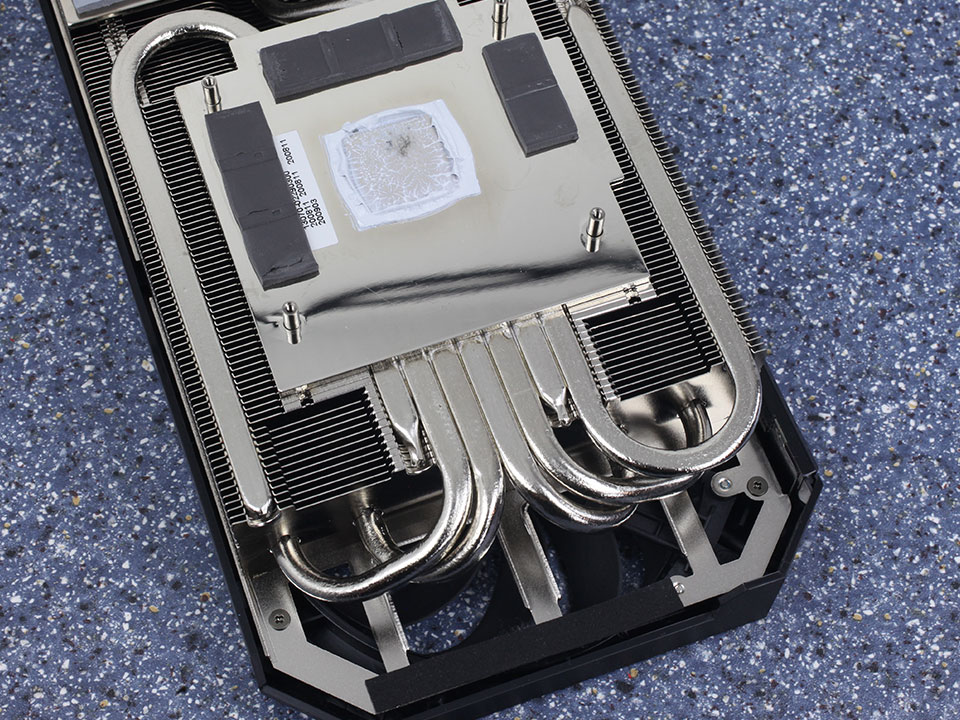
ASUS's thermal solution uses seven heatpipes. The main heatsink not only cools the GPU, but also provides cooling for memory chips and VRM circuitry.

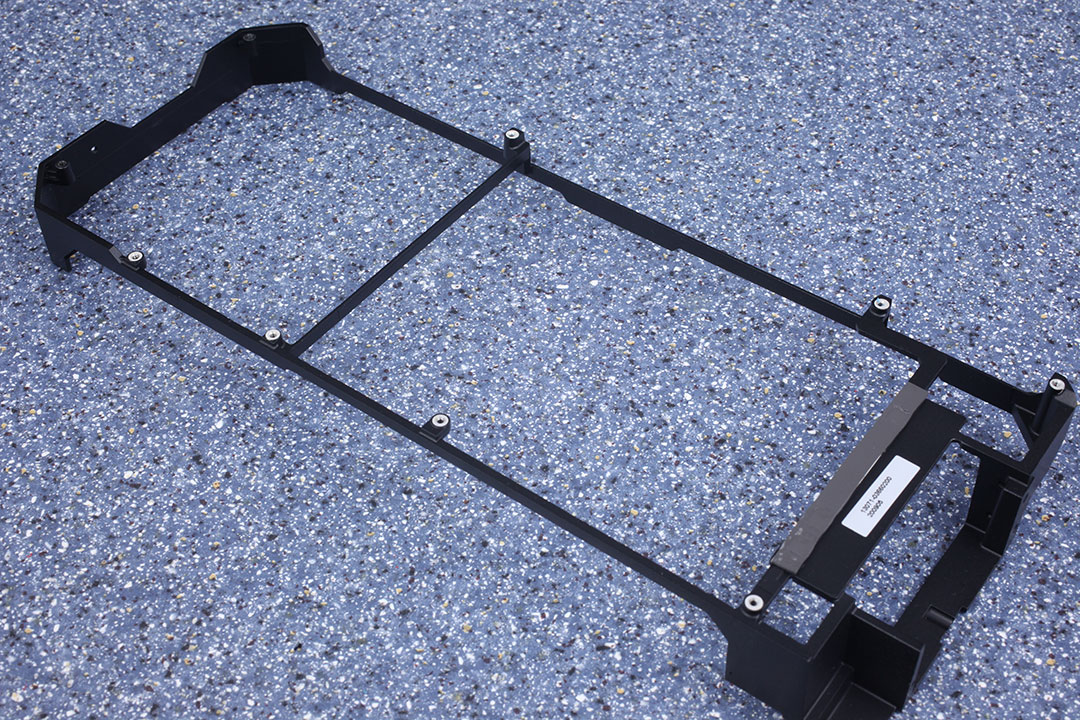
To protect against sagging, a metal frame provides additional stability for the card.

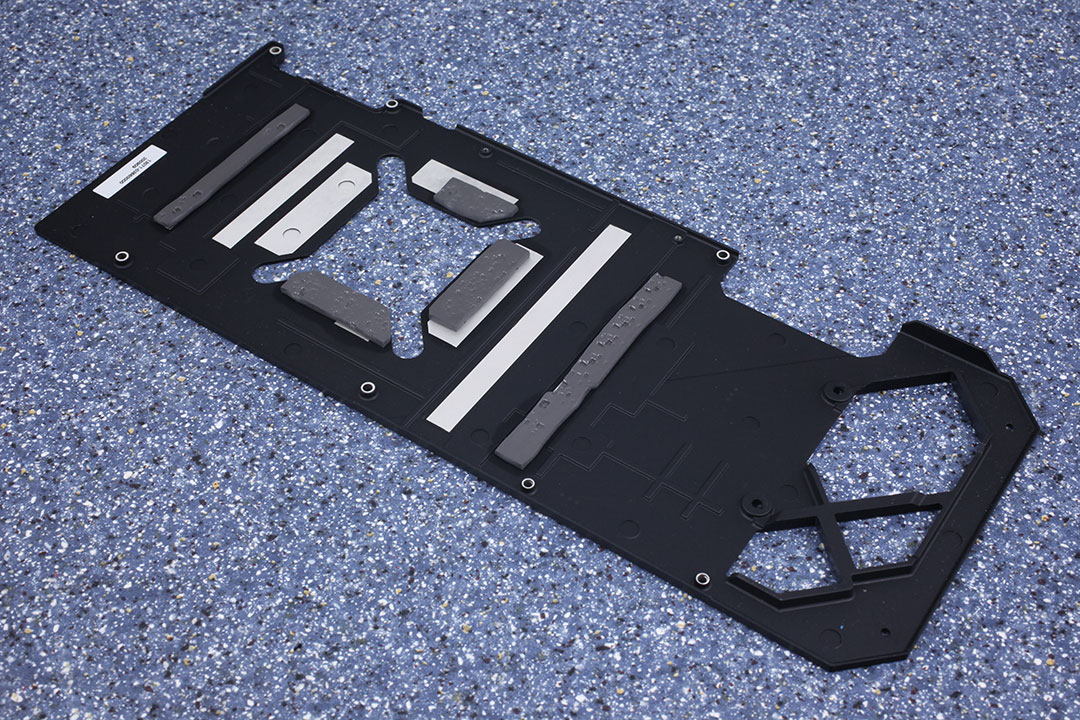
The backplate is made out of metal and protects the card against damage during installation and handling.
High-resolution PCB Pictures
These pictures are for the convenience of volt modders and people who would like to see all the finer details on the PCB. Feel free to link back to us and use these in your articles or forum posts.

High-res versions are also available (front, back).
Our Patreon Silver Supporters can read articles in single-page format.
Nov 21st, 2026 13:42 PST
change timezone
Latest GPU Drivers
New Forum Posts
- UPS what one to get? (23)
- Ryzen or Intel system (0)
- Local LLM General Discussion (694)
- Can you guess Which game it is? (345)
- GeekMagic Ultra Smart WiFi Weather Station (10)
- RX 580 2048SP 8GB - SK Hynix - Ardiyes - BIOS Needed (1)
- Zen 3 IF/IMC degradation (243)
- State of the HPC-AI Market 2026: Processing Elements (0)
- 1 - 5 person file storage server equivalent accasible from anywhere + general VM server. (3)
- Honestly, do you care about GTA VI? (225)
Popular Reviews
- Microsoft Surface Laptop Ultra Review - The Next-gen Arm Laptop
- Ugreen NASync DXP4800 GT Review
- Corsair RM1200e (Second Generation) Review
- Pulsar Office Tour & First Look at P1 Dual-Sensor Mouse
- Upcoming Hardware Launches 2027 (Updated Nov 2026)
- Acemagic Retro X3 Review
- Biwin Black Opal NV7400 2 TB Review
- AMD Ryzen 7 9800X3D Review - The Best Gaming Processor
- AMD Zen 6 Technical Deep Dive
- Chieftec Iceberg PRO 360 DARK Review
TPU on YouTube
Controversial News Posts
- NVIDIA Co-Founder and CEO Jensen Huang Officially Resigns (492)
- Report: Jensen Huang Eyes NVIDIA Comeback (260)
- Open Letter Asking NVIDIA to Reinstate Jensen Huang Passes 115,000 Signatures (184)
- OpenAI CEO Argues Home PCs Waste the World's Limited DRAM Supply (152)
- NVIDIA Launches Investigation Into Jensen Huang's Relationship With Suspected Chinese Spy (136)
- Intel "Raptor Lake Next" 16-Core and 20-Core CPUs Surface (130)
- NVIDIA GeForce RTX 50-Series Scheduled for up to $500 Price Hike This Week (89)
- Intel Razor Lake Gets a 12 P-Core bLLC Chip With No E-Cores, Per Leak (86)