 16
ASUS HD 7790 Direct CU II OC 1 GB Review
(16 Comments) »Introduction

AMD announced its first new desktop graphics product of the year: the Radeon HD 7790. The company recently made it clear to us that it won't be introducing a new GPU family any time soon, at least not before October, but that doesn't mean it can't do patchwork to its existing product stack. The company seems least bothered with NVIDIA's recent GTX Titan Launch and finds that its "Never Settle Reloaded" bundles gives its products an edge over NVIDIA's offerings, and with a bouquet of game titles under development that are optimized for its GPUs, things look like smooth sailing. In all the noise, AMD conveniently neglected the sub-$200 market.

The $100-200 market segment is a particularly high-volume one. AMD's current offerings include the Radeon HD 7850 1 GB around $179, the Radeon HD 7770 GHz Edition at $109, and practically nothing in between, unless you want to buy near-EOL new old-stocks of previous-generation AMD offerings such as the Radeon HD 6870. NVIDIA targeted this gap with its GeForce GTX 650 Ti they aptly priced at $149 (now $139). The HD 7770 GHz Edition may convincingly beat the GTX 650 (non-Ti), but isn't powerful enough in comparison to the GTX 650 Ti. Playing current games at 1080p using the HD 7770 is asking for much.
AMD finally got down to do the patchwork, but may have realized that its 2.8 billion-transistor "Pitcairn" GPU can't be sold at price points lower than what the HD 7850 1 GB commands, and it could certainly not offer any cushioning for further price-cuts. AMD's solution? Build "Bonaire," a spanking new ASIC with just 2.08 billion transistors, but with a clever component layout. The chip allows AMD to price the Radeon HD 7790 exactly at $149, with room for future price-cuts.


Built on the 28 nm silicon fab process, Bonaire's component hierarchy has more in common with "Pitcairn" and "Tahiti" than with "Cape Verde," although all four are based on AMD's Graphics CoreNext micro-architecture. It features 14 compute units, which works out to 896 stream processors, two independent geometry engines, and two rasterizers. In comparison, Cape Verde may have 10 compute units (640 stream processors), but just the single geometry engine and rasterizer. AMD's approach with Bonaire may yield dividend with tessellation performance, so enabling tessellation shouldn't tax the GPU as much. AMD didn't widen the memory bus any further than 128-bit, but took advantage of falling 7 GT/s chip prices to clock the memory at 6.00 GHz (GDDR5 effective), which results in 96 GB/s of memory bandwidth (a 33% increase). The core remains at 1.00 GHz, but is augmented with an improved dynamic clock technology.


The new dynamic clock technology, which AMD no longer refers to as "boost," promises higher sustained clock speeds and better energy efficiency. The core clock speed mentioned by AMD in its specs sheets, 1.00 GHz, is the GPU's maximum (unless you manually overclock), which most applications shouldn't have a problem accessing. An improved dynamic-clock algorithm gauges graphics processing load, power limits, and temperatures at a higher polling rate of 10 ms to switch the clock speed, as needed, between 8 power states.

In this review, we're testing the ASUS HD 7790 using the company's famous Direct CU II cooler. The card uses a close-to-reference design and offers factory-overclocked speeds of 1075 MHz core and 6.40 GHz memory for a premium of just $10 over AMD's suggested reference design retail price of $149.
| Radeon HD 6850 | Radeon HD 7770 | GeForce GTX 460 | GeForce GTX 650 Ti | GeForce GTX 560 | Radeon HD 6870 | Radeon HD 7790 | ASUS Radeon HD 7790 | GeForce GTX 560 Ti | Radeon HD 6950 | GeForce GTX 570 | Radeon HD 6970 | Radeon HD 7850 | GeForce GTX 660 | Radeon HD 7870 | |
|---|---|---|---|---|---|---|---|---|---|---|---|---|---|---|---|
| Shader Units | 960 | 640 | 336 | 768 | 336 | 1120 | 896 | 896 | 384 | 1408 | 480 | 1536 | 1024 | 960 | 1280 |
| ROPs | 32 | 16 | 32 | 16 | 32 | 32 | 16 | 16 | 32 | 32 | 40 | 32 | 32 | 24 | 32 |
| Graphics Processor | Barts | Cape Verde | GF104 | GK106 | GF114 | Barts | Bonaire | Bonaire | GF114 | Cayman | GF110 | Cayman | Pitcairn | GK106 | Pitcairn |
| Transistors | 1700M | 1500M | 1950M | 2540M | 1950M | 1700M | 2080M | 2080M | 1950M | 2640M | 3000M | 2640M | 2800M | 2540M | 2800M |
| Memory Size | 1024 MB | 1024 MB | 1024 MB | 1024 MB | 1024 MB | 1024 MB | 1024 MB | 1024 MB | 1024 MB | 2048 MB | 1280 MB | 2048 MB | 2048 MB | 2048 MB | 2048 MB |
| Memory Bus Width | 256 bit | 128 bit | 256 bit | 128 bit | 256 bit | 256 bit | 128 bit | 128 bit | 256 bit | 256 bit | 320 bit | 256 bit | 256 bit | 192 bit | 256 bit |
| Core Clock | 775 MHz | 1000 MHz | 675 MHz | 925 MHz | 810 MHz | 900 MHz | 1000 MHz | 1075 MHz | 823 MHz | 800 MHz | 732 MHz | 880 MHz | 860 MHz | 980 MHz+ | 1000 MHz |
| Memory Clock | 1000 MHz | 1125 MHz | 900 MHz | 1350 MHz | 1002 MHz | 1050 MHz | 1500 MHz | 1600 MHz | 1002 MHz | 1250 MHz | 950 MHz | 1375 MHz | 1200 MHz | 1502 MHz | 1200 MHz |
| Price | $135 | $120 | $140 | $140 | $170 | $170 | $150 | $160 | $200 | $170 | $250 | $380 | $180 | $215 | $220 |
Packaging


Contents
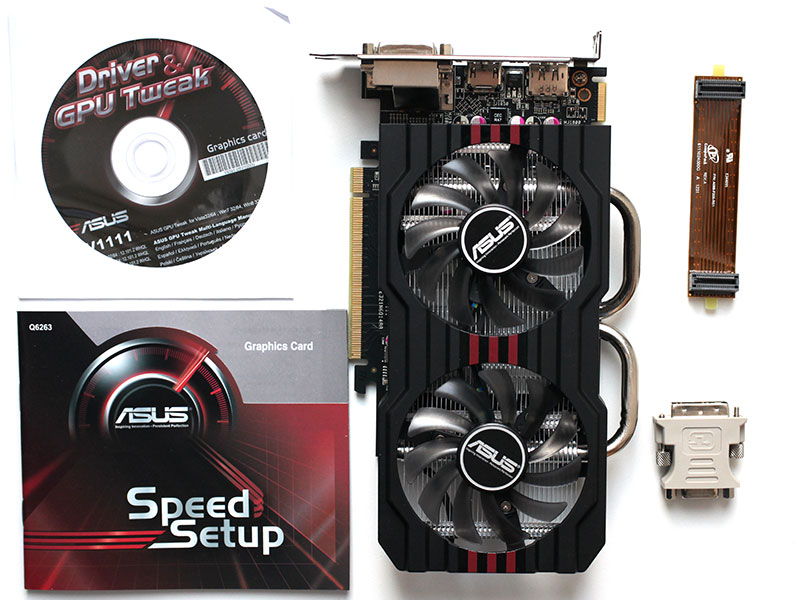
You will receive:
- Graphics card
- Driver CD + documentation
- DVI adapter
- CrossFire bridge
The Card


We've seen the ASUS Direct CU II cooler on many cards from the company before. It is well known for its good cooling performance and low noise levels.

Installing the card requires two slots in your system.

Display connectivity options include two DVI ports, one full-size DisplayPort, and one full-size HDMI port. You may use all outputs at the same time, so triple-monitor surround gaming is possible with one card.
The GPU also includes an HDMI sound device. It is HDMI 1.4a compatible, which includes HD audio and Blu-ray 3D movies support.

A single CrossFire connector is available, which allows you to pair up two Radeon HD 7790s in a multi-gpu configuration.


Pictured above are the front and back, showing the disassembled board. High-res versions are also available (front, back). If you choose to use these images for voltmods, etc., please include a link back to this site, or let us post your article.
Our Patreon Silver Supporters can read articles in single-page format.
Nov 15th, 2026 17:11 CST
change timezone
Latest GPU Drivers
New Forum Posts
- Local LLM General Discussion (691)
- WarpCoreBench scores! (54)
- What are you playing? (26223)
- Folding Pie and Milestones!! (10205)
- Asus Rog Maximus Z890 Extreme. (Various questions). (25)
- Power supply noise stops when I move the mouse (9)
- TPU's Nostalgic Hardware Club (22165)
- HP Office Jet 7740 Pro - Supply system problem with replacement cartridge (3)
- Recommendations Wanted - Affordable Enterprise SSD for Boot (9)
- What can the FX 8320 do today? Here is the answer. (59)
Popular Reviews
- AMD Zen 6 Technical Deep Dive
- ASUS ROG Strix B850-I Gaming Wi-Fi7 W Review
- Corsair HX1000i Shift Crystal Review
- Upcoming Hardware Launches 2027 (Updated Nov 2026)
- Montech King 95 3D PRO Review
- NZXT C1200 Platinum Review
- NZXT H7 RGB+ Review
- NZXT H5 Review
- Phantom Blade Zero Performance Benchmark Review - 35 GPUs Tested
- AMD Ryzen 7 9800X3D Review - The Best Gaming Processor
TPU on YouTube
Controversial News Posts
- NVIDIA Co-Founder and CEO Jensen Huang Officially Resigns (422)
- Open Letter Asking NVIDIA to Reinstate Jensen Huang Passes 115,000 Signatures (184)
- OpenAI CEO Argues Home PCs Waste the World's Limited DRAM Supply (152)
- NVIDIA Launches Investigation Into Jensen Huang's Relationship With Suspected Chinese Spy (136)
- Intel "Raptor Lake Next" 16-Core and 20-Core CPUs Surface (130)
- Legendary Game Studio BioWare Shuts Down Following EA Layoffs (104)
- Dell CEO Says the Memory Shortage Will Get Worse in 2027 (95)
- NVIDIA GeForce RTX 50-Series Scheduled for up to $500 Price Hike This Week (89)