 15
ASUS NUC 16 Pro Review
Value & Conclusion »Power and Noise Levels
Power and efficiency can be just as important as raw performance in a compact system, so I measured how much the system draws under CPU stress, during GPU-heavy tests, while gaming, and during a 24-hour idle period. Noise readings add context for how noticeable the cooling system becomes during light use and sustained workloads.24-Hour Idle Power Draw
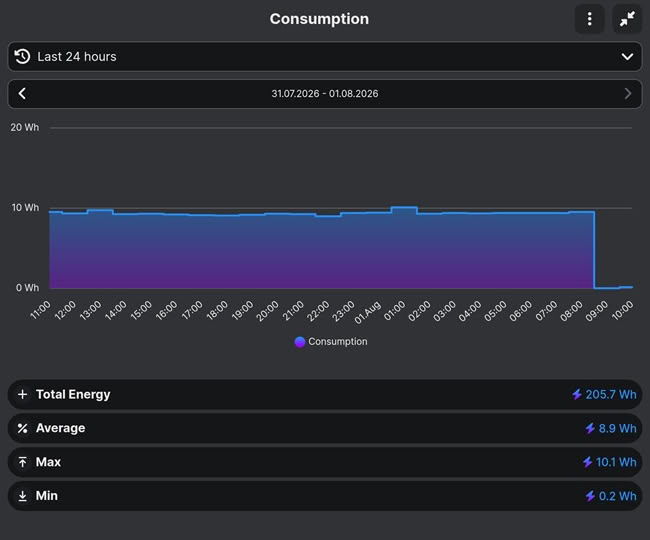
Over the 24-hour idle test, the NUC 16 Pro averaged 8.9 W and used 205.7 Wh, with a recorded maximum of 10.1 W. The 0.2 W minimum occurred after the system powered down near the end of the logging window, so it does not represent normal idle operation. Leaving the PC idle all year would use about 78.0 kWh, or roughly $12 to $16 annually at electricity rates of $0.15 to $0.20 per kWh; normal ownership will cost more when work and gaming are added.
System Power Draw Under CPU and GPU Workloads
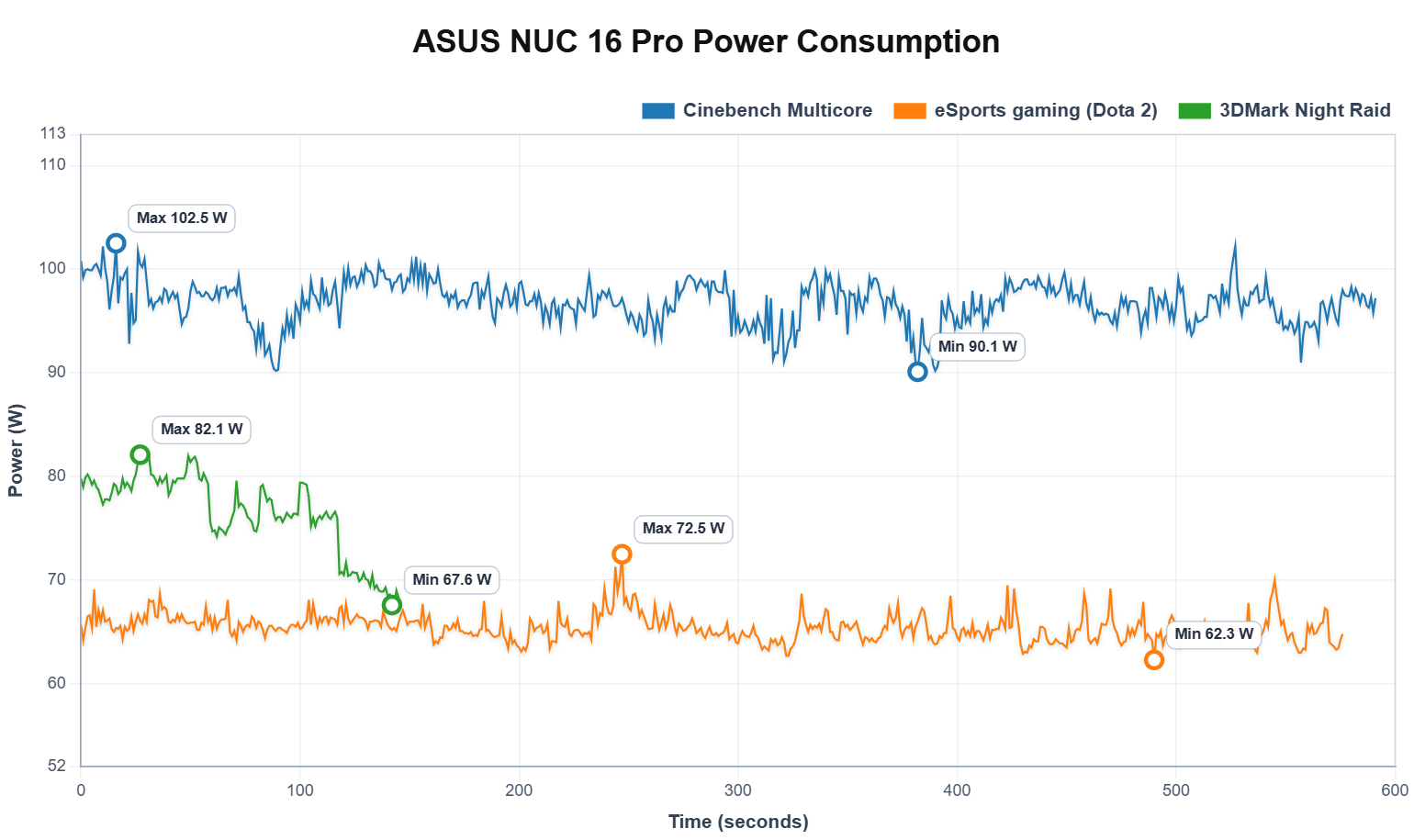
During the Cinebench multicore loop, total system power averaged 96.8 W, with readings between 90.1 W and 102.5 W. Wall power stayed within a relatively narrow range throughout the CPU workload.Dota 2 gameplay averaged 65.4 W at the outlet, with a 62.3 W minimum and 72.5 W maximum. This profile varied very little during the run, which fits an esports workload that does not keep every CPU and GPU resource fully occupied at the same time.
Night Raid averaged 76.4 W, with readings ranging from 67.6 W to 82.1 W. Its wider variation follows the changing graphics load during the benchmark, but the 82.1 W peak stayed well below the adapter's 150 W rating.
Here's a detailed rundown of the ASUS NUC 16 Pro's system power draw across all three test profiles:
Noise Levels
Measured from 30 cm with the fan controls left at their default automatic setting, the NUC 16 Pro produced 32.6 dBA at idle, 35 dBA under a light workload, and 43 dBA under a heavy workload. It is quiet during office use and becomes easy to hear during sustained CPU or graphics work, but the heavy-load reading is moderate for a compact system drawing close to 100 W at the outlet.
Nov 27th, 2026 01:59 CST
change timezone
Latest GPU Drivers
New Forum Posts
- Mouse Pad advice - Shidenkai out of production? (3)
- What's your main Black Friday / Cyber Monday purchase? (27)
- Wireless Internet sharing between PC and router both-ways, is it possible? (28)
- X79 and/or rampage IV OC'ing thread for those of us still left.... (2461)
- Will zen 6 mobos have anything extra vs current ones? (63)
- Using sodimm+adapter instead of full size dimm DDR5? (102)
- Dell Dimension E510 Retro Gaming PC Upgrade & Modification (3)
- Gacha Games - Discussions, Pulls, Updates, etc. (1166)
- WarpCoreBench scores! (116)
- Can you guess Which game it is? (371)
Popular Reviews
- VZMORE AX9 Max Review
- Upcoming Hardware Launches 2027 (Updated Nov 2026)
- ASRock X870E Challenger Wi-Fi White Review
- AMD Ryzen 7 9800X3D Review - The Best Gaming Processor
- Microsoft Surface Laptop Ultra Review - The Next-gen Arm Laptop
- AMD Zen 6 Technical Deep Dive
- Montech CyberFlow ARGB 360 Review
- Phantom Blade Zero Performance Benchmark Review - 35 GPUs Tested
- Corsair RM1200e (Second Generation) Review
- Pulsar Office Tour & First Look at P1 Dual-Sensor Mouse
TPU on YouTube
Controversial News Posts
- Jensen Huang Reinstated as CEO of NVIDIA (617)
- NVIDIA Co-Founder and CEO Jensen Huang Officially Resigns (492)
- Report: Jensen Huang Eyes NVIDIA Comeback (281)
- Open Letter Asking NVIDIA to Reinstate Jensen Huang Passes 115,000 Signatures (184)
- OpenAI CEO Argues Home PCs Waste the World's Limited DRAM Supply (152)
- NVIDIA Launches Investigation Into Jensen Huang's Relationship With Suspected Chinese Spy (136)
- Intel Razor Lake Gets a 12 P-Core bLLC Chip With No E-Cores, Per Leak (94)
- NVIDIA GeForce RTX 50-Series Scheduled for up to $500 Price Hike This Week (89)