 18
ASUS Radeon RX 5600 XT STRIX TOP Review
(18 Comments) »Introduction

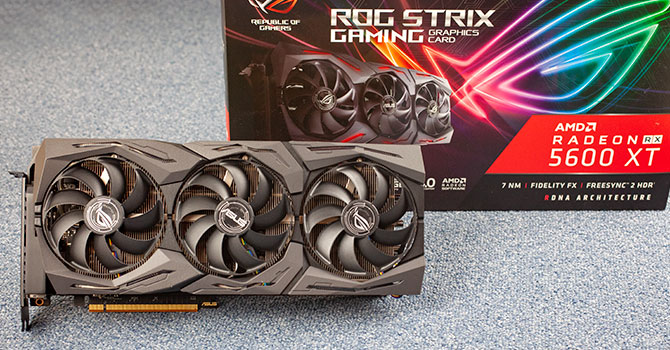
The AMD Radeon RX 5600 XT is available starting today, and we have with us the ASUS ROG STRIX RX 5600 XT TOP we will take for a spin. The Radeon RX 5600 XT is AMD's entrant to the "premium 1080p experience" segment NVIDIA mastered with its GeForce GTX 1660 Ti and GTX 1660 Super. With a starting price of $279, the RX 5500 XT is already capable of 1080p gaming at up to 60 FPS, but the RX 5600 XT is packed with a lot more muscle: 900 more stream processors to increase frame-rates significantly. The mandate for the RX 5600 XT is to then offer maxed out 1080p gaming with frame-rates of around 90 FPS to ensure that even 2-3 years down the line, the games of tomorrow are more than playable at 1080p. The card can also play at 1440p with high details, but you'll have to be clever with your game's graphics settings.
The Radeon RX 5600 XT is cut from the same cloth as the RX 5700-series, down to the 7 nm "Navi 10" silicon. It has the same 2,304 stream processor count as the $349 RX 5700, but its memory bus is narrowed to 192-bit, and memory amount lowered to 6 GB. The ROG STRIX RX 5600 XT TOP comes with clock speeds of 1750 MHz boost and 14 Gbps memory, which is a significant step up from the reference clocks of 1650 MHz boost and 12 Gbps memory. It's not just that ASUS got very creative with its overclocking, but that AMD made a last-minute decision to dial up clock speeds of factory-overclocked RX 5600 XT cards to improve the SKU's competitive positioning against the GeForce RTX 2060.
In its 2020 CES keynote, AMD put out performance guidance for the RX 5600 XT, in which it claims that the card is faster than the entire GTX 16-series, including the GTX 1660 Ti and GTX 1660 Super. Lowering prices of the GTX 16-series SKUs could cause chaos in the already crowded $200-$300 segment, and so NVIDIA decided to lower the prices of its RTX 2060 to $299. This is mainly because the GTX 16-series lacks ray-tracing hardware and squares off against AMD purely on gaming performance without ray-tracing. Bringing the RTX 2060 in at $299 could lure some RX 5600 XT series buyers away. In response to exactly this, AMD revised the clock speeds of at least some RX 5600 XT cards at the last minute, which we'll touch on more later in this review.
The ASUS ROG STRIX is the company's top-dog RX 5600 XT offering, and comes with a large DirectCU III triple-slot, triple-fan cooling solution which offers idle-fan stop and quite some RGB LED bling. The card puts out additional RGB and 4-pin fan-headers, so you can sync your case fans to the GPU. At a price of $330-$340, the ROG STRIX RX 5600 XT commands a large premium over the $279 MSRP.
You might be wondering why this review's name was updated from "STRIX OC" to "STRIX TOP" after posting. ASUS just informed us that the sample they originally sent was the "STRIX OC" (1560 MHz Game, 1620 MHz Boost, 12 Gbps memory), but with the new BIOS the card became the "STRIX TOP" (1670 MHz Game, 1750 MHz Boost, 14 Gbps memory), which is a new SKU specifically for overclocking the memory. The "STRIX OC" regular users buy will also receive a BIOS update (1670 MHz Game, 1750 MHz Boost, 12 Gbps memory), so GPU clocks match the TOP as only memory speed remains at 12 Gbps. The STRIX TOP will ship to retailers with the correct BIOS preinstalled after Chinese New Year.
| Price | Shader Units | ROPs | Core Clock | Boost Clock | Memory Clock | GPU | Transistors | Memory | |
|---|---|---|---|---|---|---|---|---|---|
| RX 590 | $200 | 2304 | 32 | 1469 MHz | 1545 MHz | 2000 MHz | Polaris 30 | 5700M | 8 GB, GDDR5, 256-bit |
| GTX 1660 | $200 | 1408 | 48 | 1530 MHz | 1785 MHz | 2000 MHz | TU116 | 6600M | 6 GB, GDDR5, 192-bit |
| GTX 1070 | $300 | 1920 | 64 | 1506 MHz | 1683 MHz | 2002 MHz | GP104 | 7200M | 8 GB, GDDR5, 256-bit |
| RX Vega 56 | $260 | 3584 | 64 | 1156 MHz | 1471 MHz | 800 MHz | Vega 10 | 12500M | 8 GB, HBM2, 2048-bit |
| GTX 1660 Super | $230 | 1408 | 48 | 1530 MHz | 1785 MHz | 1750 MHz | TU116 | 6600M | 6 GB, GDDR6, 192-bit |
| GTX 1660 Ti | $270 | 1536 | 48 | 1500 MHz | 1770 MHz | 1500 MHz | TU116 | 6600M | 6 GB, GDDR6, 192-bit |
| GTX 1070 Ti | $450 | 2432 | 64 | 1607 MHz | 1683 MHz | 2000 MHz | GP104 | 7200M | 8 GB, GDDR5, 256-bit |
| RX 5600 XT | $280 | 2304 | 64 | 1375 MHz | 1560 MHz | 1500 MHz | Navi 10 | 10300M | 6 GB, GDDR6, 192-bit |
| ASUS RX 5600 XT STRIX TOP | $335 | 2304 | 64 | 1670 MHz | 1750 MHz | 1750 MHz | Navi 10 | 10300M | 6 GB, GDDR6, 192-bit |
| RTX 2060 | $300 | 1920 | 48 | 1365 MHz | 1680 MHz | 1750 MHz | TU106 | 10800M | 6 GB, GDDR6, 192-bit |
| RX 5700 | $330 | 2304 | 64 | 1465 MHz | 1625 MHz | 1750 MHz | Navi 10 | 10300M | 8 GB, GDDR6, 256-bit |
| GTX 1080 | $500 | 2560 | 64 | 1607 MHz | 1733 MHz | 1251 MHz | GP104 | 7200M | 8 GB, GDDR5X, 256-bit |
| RTX 2060 Super | $400 | 2176 | 64 | 1470 MHz | 1650 MHz | 1750 MHz | TU106 | 10800M | 8 GB, GDDR6, 256-bit |
| RX Vega 64 | $375 | 4096 | 64 | 1247 MHz | 1546 MHz | 953 MHz | Vega 10 | 12500M | 8 GB, HBM2, 2048-bit |
| GTX 1080 Ti | $700 | 3584 | 88 | 1481 MHz | 1582 MHz | 1376 MHz | GP102 | 12000M | 11 GB, GDDR5X, 352-bit |
| RX 5700 XT | $380 | 2560 | 64 | 1605 MHz | 1755 MHz | 1750 MHz | Navi 10 | 10300M | 8 GB, GDDR6, 256-bit |
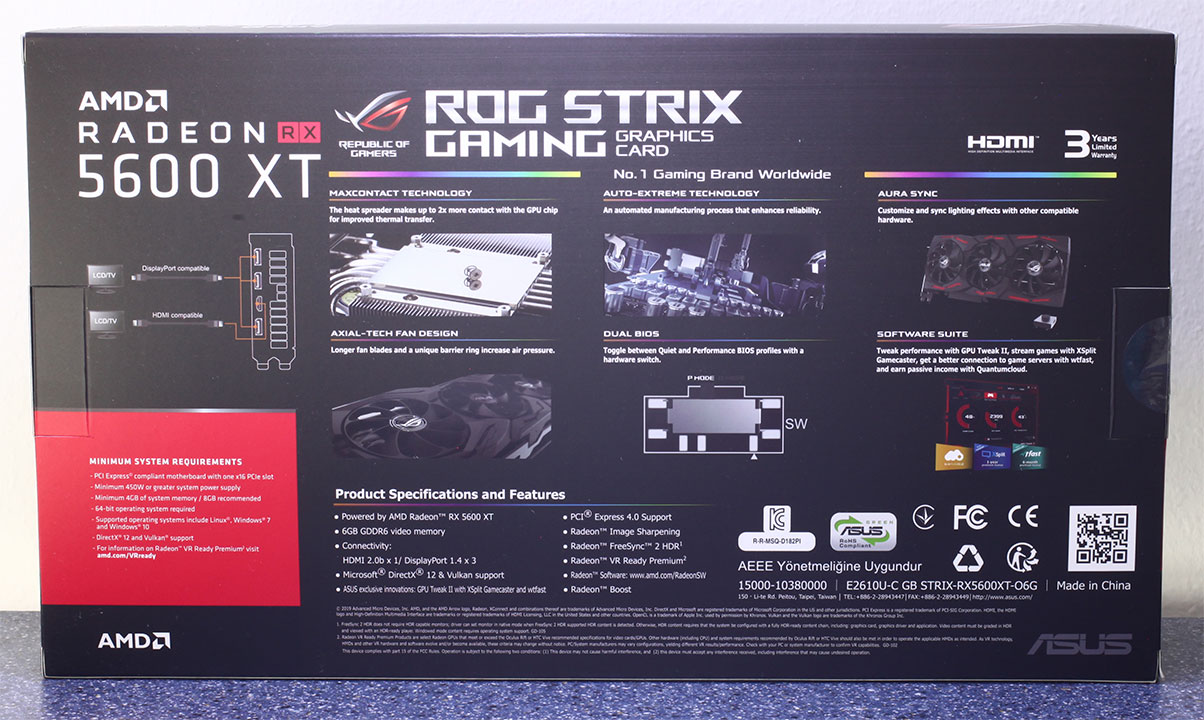
Packaging

The Card


The ASUS RX 5600 XT STRIX follows the design theme set forth by other ASUS STRIX cards, using mostly black with various shades of gray as highlights.

Dimensions of the card are 30.0 cm x 13.0 cm.


Installation requires three slots in your system.

Display connectivity options include three standard DisplayPort 1.4a and an HDMI 2.0b.
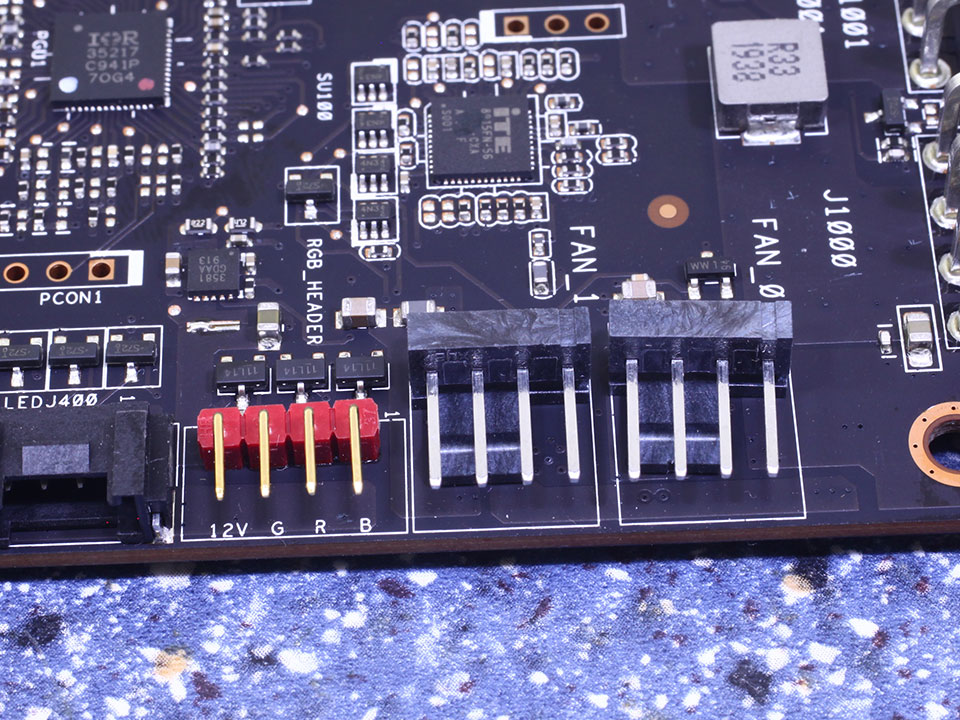
You also get two 4-pin PWM fan headers to sync your case fans to the graphics card's fans and an addressable RGB header other RGB components can be connected to.

The board uses one 8-pin and one 6-pin power connector. This input configuration is specified for up to 300 watts of power draw.

AMD's Navi generation of GPUs no longer supports CrossFire. DirectX 12 does include its own set of multi-GPU capabilities, but the implementation requires game developers to put serious development time into a feature only a tiny fraction of their customers might ever use.
In this area, you'll also find a push button which lets you enable/disable the card's RGB lighting without any software. Right next to that is a dual-BIOS switch with the default setting being "Performance" and the other BIOS "Quiet."
Disassembly


ASUS is using an elaborate system of six heatpipes on their cooler. This is the exact same thermal solution as on the RX 5700 XT STRIX TOP.


Once the main heatsink is removed, a black baseplate becomes visible, which provides cooling for the VRM circuitry and memory chips.


The backplate is made out of metal and protects the card against damage during installation and handling.
High-resolution PCB Pictures
These pictures are for the convenience of volt modders and people who would like to see all the finer details on the PCB. Feel free to link back to us and use these in your articles or forum posts.

High-res versions are also available (front, back).
Our Patreon Silver Supporters can read articles in single-page format.
Nov 20th, 2026 05:39 PST
change timezone
Latest GPU Drivers
New Forum Posts
- Intel Core Ultra 5 processor 250K Plus (8)
- What is in your fleet, size and contents? (29)
- Windows 11 General Discussion (7741)
- TPU's Nostalgic Hardware Club (22173)
- Making a game in Godot engine (11)
- GTA VI (16)
- What are you playing? (26237)
- Honestly, do you care about GTA VI? (183)
- AI generated images... (229)
- Anime Nation (13188)
Popular Reviews
- AMD Zen 6 Technical Deep Dive
- Ugreen NASync DXP4800 GT Review
- Acemagic Retro X3 Review
- Corsair RM1200e (Second Generation) Review
- Upcoming Hardware Launches 2027 (Updated Nov 2026)
- Pulsar Office Tour & First Look at P1 Dual-Sensor Mouse
- Biwin Black Opal NV7400 2 TB Review
- Chieftec Iceberg PRO 360 DARK Review
- AMD Ryzen 7 9800X3D Memory Performance Scaling
- AMD Ryzen 7 9800X3D Review - The Best Gaming Processor
TPU on YouTube
Controversial News Posts
- NVIDIA Co-Founder and CEO Jensen Huang Officially Resigns (490)
- Report: Jensen Huang Eyes NVIDIA Comeback (233)
- Open Letter Asking NVIDIA to Reinstate Jensen Huang Passes 115,000 Signatures (184)
- OpenAI CEO Argues Home PCs Waste the World's Limited DRAM Supply (152)
- NVIDIA Launches Investigation Into Jensen Huang's Relationship With Suspected Chinese Spy (136)
- Intel "Raptor Lake Next" 16-Core and 20-Core CPUs Surface (130)
- Legendary Game Studio BioWare Shuts Down Following EA Layoffs (104)
- Dell CEO Says the Memory Shortage Will Get Worse in 2027 (95)