 24
ASUS ROG Crosshair X870E Apex Review
BIOS Overview »VRM Overview


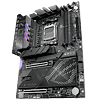
The 18+2+2 power phase design is cooled by two large heatsinks with a portion of diffusing material between fins that catches RGB lighting from below. The heatsinks actually have a comparatively small volume compared to other expensive boards we've seen recently, and it's surprising not to see some kind of active cooling here. The peak load VRM temperature of 57°C was indeed not that impressive either, but the board is aimed at those dabbling with extreme cooling—whereby the user would be removing these heatsinks anyway—so anything excessive and complicated here would likely be counterproductive.


The heatsinks do at least have a large heatpipe running through them to even out the heat load. Doing the same job from the rear of the board is the backplate, which cools both banks of VRMs. There's no thermal pads doing the same for the chipsets like on the ROG Crosshair X870E Extreme, but if you're desperate, it's an easy fix as the backplate is simple to remove.


The VRMs themselves comprise 20 stages in a teamed solution of Vishay SiC850A rated at 110 A, and deal with vCore (18 stages) and SOC (2 stages), with two more for MISC, also from Vishay, but just 80 A SiC629. This is an identical setup to the ASUS ROG Crosshair X870E Hero, with the Extreme gaining a couple of extra vCore stages.


For PWM controllers we have a DIGI+ branded ASP2205 and Richtek RT3672, which is again a match to what is used on the Extreme and Hero boards.
Nov 24th, 2026 09:27 CST
change timezone
Latest GPU Drivers
New Forum Posts
- Power supply noise stops when I move the mouse (11)
- Primary DisplayPort Monitor Not Waking After Driver Updates 621.01 and 621.14 (10)
- HP ZBook 17 G3 i7 – black screen and fans running at max speed after switching SSD to GPT (2)
- Your PC ATM (36490)
- Increasing Power Limit? (31)
- GTA VI (33)
- I forced a 16 Year Old 64GB SSD to write 1 PETABYTE (And it didn't die) (194)
- Games at first startup always worse why? (0)
- Strange PC issues with Z690 setup (2)
- How to prevent OLED burn damage due to PC freezes or power outtages? (58)
Popular Reviews
- Microsoft Surface Laptop Ultra Review - The Next-gen Arm Laptop
- ASRock X870E Challenger Wi-Fi White Review
- Upcoming Hardware Launches 2027 (Updated Nov 2026)
- Corsair RM1200e (Second Generation) Review
- AMD Ryzen 7 9800X3D Review - The Best Gaming Processor
- AMD Zen 6 Technical Deep Dive
- AMD Ryzen 7 7700X3D Review
- Pulsar Office Tour & First Look at P1 Dual-Sensor Mouse
- Phantom Blade Zero Performance Benchmark Review - 35 GPUs Tested
- Ugreen NASync DXP4800 GT Review
TPU on YouTube
Controversial News Posts
- NVIDIA Co-Founder and CEO Jensen Huang Officially Resigns (492)
- Jensen Huang Reinstated as CEO of NVIDIA (457)
- Report: Jensen Huang Eyes NVIDIA Comeback (281)
- Open Letter Asking NVIDIA to Reinstate Jensen Huang Passes 115,000 Signatures (184)
- OpenAI CEO Argues Home PCs Waste the World's Limited DRAM Supply (152)
- NVIDIA Launches Investigation Into Jensen Huang's Relationship With Suspected Chinese Spy (136)
- Intel "Raptor Lake Next" 16-Core and 20-Core CPUs Surface (130)
- Intel Razor Lake Gets a 12 P-Core bLLC Chip With No E-Cores, Per Leak (89)