 13
ASUS ROG Crosshair X870E Hero BTF Review
(13 Comments) »Value and Conclusion
- The ASUS ROG Crosshair X870E Hero BTF is currently listed online for $738
- Superb SSD temperatures
- Excellent VRM temperatures
- Three PCIe Gen 5 M.2 ports
- Attractive design
- BTF case and GC_HPWR GPU compatible
- Tool-free SSD heatsinks
- Useful software
- Cutting-edge EFI
- Thermistor header
- RGB lighting
- Very expensive
- Fewer features than standard model
- Cheaper models offer more features
- Mediocre number of rear Type-A USB ports
- Second and third PCIe Gen 5 M.2 ports share bandwidth with GPU
- Majority of fan headers only 12 W/1 A
- No fan headers near rear case fan location
- Four of five M.2 ports require GPU removal
- Limited case compatibility
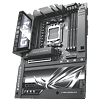
The rear motherboard connector community just got a massive feather in its cap with the ASUS ROG Crosshair X870E Hero BTF, which shows that ASUS is serious about the standard going forwards by adding one of its flagship motherboards to its ever-increasing BTF options. It's a bold statement and both this and its Z890 BTF equivalent stamp their authority on the rear connector motherboard range as by far the most premium options out there. This unfortunately means that there's very little by way of competition when it comes to high-end rear connector motherboards.
One option, aside from other BTF models from ASUS of course, is MSI's MAG X870E Tomahawk Max Wi-Fi PZ. This costs less than half the price, so isn't quite as lavish in some areas, but it does have the ability to use two PCIe Gen 5 SSDs without stealing PCIe lanes from your graphics card, instead sacrificing its USB4 ports. It also has 27 W power delivery over its front panel Type-C header for fast charging your mobile devices - the standard Crosshair X870E Hero has 60 W power delivery, but ASUS removed this from the BTF model. Gigabyte has its X870 Aorus Stealth Ice, which again costs around half as much and like MSI, splits bandwidth between the USB4 ports and second PCIe Gen 5 M.2 port, meaning your graphics card remains unscathed if you want dual PCIe Gen 5 SSDs. With both Gigabyte and MSI alternatives, there are similar core specifications too, such as Wi-Fi 7, 5 Gbps Ethernet and tool-free M.2 heatsinks.
ASUS of course goes the extra mile with its GC-HPWR connector and BTF 2.0 standard and power cable-free graphics cards for the ultimate in rear connector design. While the Gigabyte alternative gives it a run for its money in the aesthetics department, the ROG Crosshair X870E Hero BTF looks and feels every bit like its worth the cash in the flesh. It's also worth mentioning that the BTF 2.5 standard adds standard motherboard compatibility to BTF graphics cards with a removable GC-HPWR connector, so if you get this board and a BTF 2.5 GPU today, but want to switch back to standard cases and motherboards in the future, you can. As its 800-series BTF boards are its first to offer the rear connector design on AMD's Socket AM5, there aren't many other options to choose from other than the excellent ASUS TUF Gaming B850-BTF Wi-Fi W, but at less than half the price, it isn't in the same league in terms of features. You might not have thought about Arrow Lake, which would mean considering the similarly-priced ROG Maximus Z890 Hero BTF.
As usual, a flagship motherboard—an ASUS one at that—is not a cheap item. In fact, we'd be surprised if ASUS wasn't adding a little prestige pricing here given how few of these boards it may sell, with that figure likely even lower due to limited case support and how the standard Crosshair X870E Hero now costs just $600. You'll be lucky if you see any change from $700 with the BTF model, which puts this board out of reach for many. As with many late arrivals to AMD's 800-series chipsets, this is partly thanks to them focusing on Intel's somewhat ill-received LGA1851, but with solid mid-range and now high-end options for reverse connector motherboards for AMD's latest chipsets, ASUS clearly means business when it comes to BTF.
The board in question does have some advantages over the original version we looked at a year ago too. SSD temperatures, for example, seem to be improved, likely due to tweaks to the heatsink design. However, while we have the benefit of rear connectors and GC-HPWR support, we also see Slim SAS and enhanced Type-C front panel power delivery absent from the specifications, and there's still no 10 Gbps Ethernet. At this price you'll likely be expecting all of these features, unfortunately the ASUS ROG Crosshair X870E Hero BTF doesn't quite deliver in the way the ROG Crosshair X870E Extreme does. Still, if you have your heart set on a BTF system and want the best motherboard for it to show off to your friends, then currently the ROG Crosshair X870E Hero BTF is the only ultra high-end option for AMD owners.
For most of us, there are far cheaper reverse connector motherboards that have many of the same features. It might just be ASUS stamping its authority on reverse connector motherboards, but thankfully the ASUS ROG Crosshair X870E Hero BTF also a great performer and is still bristling with features that will delight very deep-pocketed enthusiasts who are content to have a limited range of cases to choose from.


One option, aside from other BTF models from ASUS of course, is MSI's MAG X870E Tomahawk Max Wi-Fi PZ. This costs less than half the price, so isn't quite as lavish in some areas, but it does have the ability to use two PCIe Gen 5 SSDs without stealing PCIe lanes from your graphics card, instead sacrificing its USB4 ports. It also has 27 W power delivery over its front panel Type-C header for fast charging your mobile devices - the standard Crosshair X870E Hero has 60 W power delivery, but ASUS removed this from the BTF model. Gigabyte has its X870 Aorus Stealth Ice, which again costs around half as much and like MSI, splits bandwidth between the USB4 ports and second PCIe Gen 5 M.2 port, meaning your graphics card remains unscathed if you want dual PCIe Gen 5 SSDs. With both Gigabyte and MSI alternatives, there are similar core specifications too, such as Wi-Fi 7, 5 Gbps Ethernet and tool-free M.2 heatsinks.
ASUS of course goes the extra mile with its GC-HPWR connector and BTF 2.0 standard and power cable-free graphics cards for the ultimate in rear connector design. While the Gigabyte alternative gives it a run for its money in the aesthetics department, the ROG Crosshair X870E Hero BTF looks and feels every bit like its worth the cash in the flesh. It's also worth mentioning that the BTF 2.5 standard adds standard motherboard compatibility to BTF graphics cards with a removable GC-HPWR connector, so if you get this board and a BTF 2.5 GPU today, but want to switch back to standard cases and motherboards in the future, you can. As its 800-series BTF boards are its first to offer the rear connector design on AMD's Socket AM5, there aren't many other options to choose from other than the excellent ASUS TUF Gaming B850-BTF Wi-Fi W, but at less than half the price, it isn't in the same league in terms of features. You might not have thought about Arrow Lake, which would mean considering the similarly-priced ROG Maximus Z890 Hero BTF.
As usual, a flagship motherboard—an ASUS one at that—is not a cheap item. In fact, we'd be surprised if ASUS wasn't adding a little prestige pricing here given how few of these boards it may sell, with that figure likely even lower due to limited case support and how the standard Crosshair X870E Hero now costs just $600. You'll be lucky if you see any change from $700 with the BTF model, which puts this board out of reach for many. As with many late arrivals to AMD's 800-series chipsets, this is partly thanks to them focusing on Intel's somewhat ill-received LGA1851, but with solid mid-range and now high-end options for reverse connector motherboards for AMD's latest chipsets, ASUS clearly means business when it comes to BTF.
The board in question does have some advantages over the original version we looked at a year ago too. SSD temperatures, for example, seem to be improved, likely due to tweaks to the heatsink design. However, while we have the benefit of rear connectors and GC-HPWR support, we also see Slim SAS and enhanced Type-C front panel power delivery absent from the specifications, and there's still no 10 Gbps Ethernet. At this price you'll likely be expecting all of these features, unfortunately the ASUS ROG Crosshair X870E Hero BTF doesn't quite deliver in the way the ROG Crosshair X870E Extreme does. Still, if you have your heart set on a BTF system and want the best motherboard for it to show off to your friends, then currently the ROG Crosshair X870E Hero BTF is the only ultra high-end option for AMD owners.
For most of us, there are far cheaper reverse connector motherboards that have many of the same features. It might just be ASUS stamping its authority on reverse connector motherboards, but thankfully the ASUS ROG Crosshair X870E Hero BTF also a great performer and is still bristling with features that will delight very deep-pocketed enthusiasts who are content to have a limited range of cases to choose from.
Nov 21st, 2026 19:03 PST
change timezone
Latest GPU Drivers
New Forum Posts
- Your PC ATM (36444)
- Ryzen or Intel system (9)
- Honestly, do you care about GTA VI? (233)
- TPU's Nostalgic Hardware Club (22187)
- DTS DCH Driver for Realtek HDA [DTS:X APO4 + DTS Interactive] (2817)
- repair an NVIDIA Quadro M4000 (0)
- 1 - 5 person file storage server equivalent accasible from anywhere + general VM server. (4)
- Windows 11 General Discussion (7748)
- RX 580 2048SP 8GB - SK Hynix - Ardiyes - BIOS Needed (2)
- UPS what one to get? (23)
Popular Reviews
- Microsoft Surface Laptop Ultra Review - The Next-gen Arm Laptop
- Corsair RM1200e (Second Generation) Review
- Pulsar Office Tour & First Look at P1 Dual-Sensor Mouse
- Upcoming Hardware Launches 2027 (Updated Nov 2026)
- Ugreen NASync DXP4800 GT Review
- AMD Ryzen 7 9800X3D Review - The Best Gaming Processor
- Biwin Black Opal NV7400 2 TB Review
- AMD Zen 6 Technical Deep Dive
- Phantom Blade Zero Performance Benchmark Review - 35 GPUs Tested
- Acemagic Retro X3 Review
TPU on YouTube
Controversial News Posts
- NVIDIA Co-Founder and CEO Jensen Huang Officially Resigns (492)
- Report: Jensen Huang Eyes NVIDIA Comeback (262)
- Open Letter Asking NVIDIA to Reinstate Jensen Huang Passes 115,000 Signatures (184)
- OpenAI CEO Argues Home PCs Waste the World's Limited DRAM Supply (152)
- NVIDIA Launches Investigation Into Jensen Huang's Relationship With Suspected Chinese Spy (136)
- Intel "Raptor Lake Next" 16-Core and 20-Core CPUs Surface (130)
- NVIDIA GeForce RTX 50-Series Scheduled for up to $500 Price Hike This Week (89)
- Intel Razor Lake Gets a 12 P-Core bLLC Chip With No E-Cores, Per Leak (86)