 23
Biwin Black Opal DW100 RGB DDR5-6000 32 GB CL28 Review
AMD Ryzen 9950X Frametimes: Baldur's Gate 3 »Ryzen 9950X Frametimes: Counter-Strike 2
We present a more in-depth analysis than just average FPS to show how the framerate changes over time, which helps highlight FPS drops. Minimum FPS at both the 95th and 99th percentile are reported in these charts, too. A second chart, a histogram, shows shape and spread for the frametime data—how tightly grouped the measurements are. The "IQR" result is called "Interquartile Range," which is an outlier-resistant statistical value that tells us the range in the middle of the frametime distribution.In the following charts, we are comparing two retail memory kits. By doing so, the game benchmarks reveal where the limits lie for a top of the line AMD or Intel computer in 2025. For both memory kits, the respective EXPO/XMP profiles are loaded, and all sub-timings are based on those individual profiles. These are not adjusted further.
Tests are conducted with the following components:
CPU: AMD Ryzen 9 9950X (Stock PBO)
GPU: PNY GeForce RTX 4090 XLR8 VERTO
Memory (1): Biwin Black Opal DW100 RGB DDR5-6000 BXL53260DW1-D28FB (28-35-35-72) (EXPO) - FCLK 2000 MHz - 1:1 Ratio
Memory (2): DDR5-6400 32 GB (32-39-39-89) (EXPO) - FCLK 2000 MHz - 1:1 Ratio
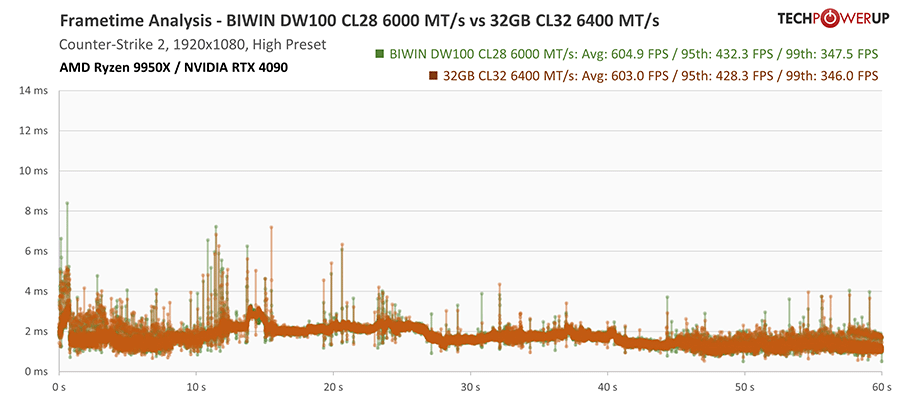
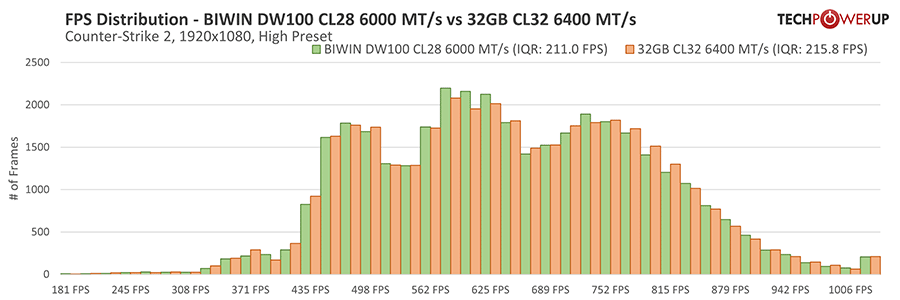
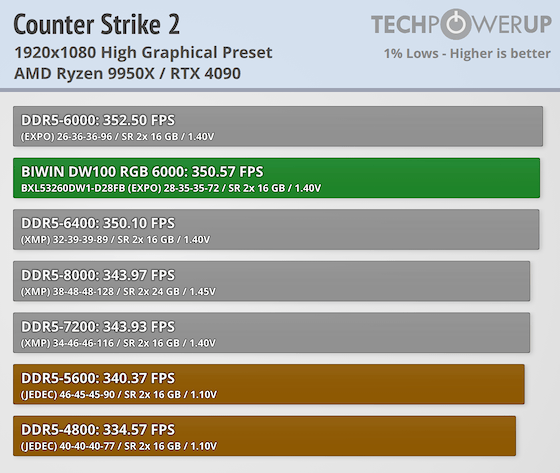
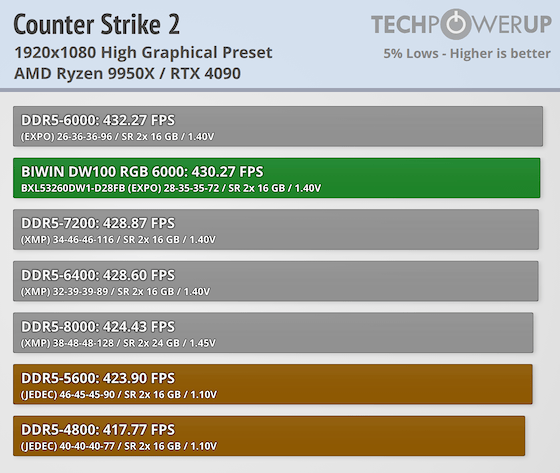
Counter-Strike 2 demands high frame rates and rapid response times, putting memory performance at the forefront for competitive gamers. In a head-to-head comparison, the Biwin Black Opal DW100 6000 MT/s kit holds its own against the CL32 6400 MT/s. When looking at AMD's Ryzen 7000 and 9000 series, the ideal memory speed lands between 6000 MT/s and 6400 MT/s, often referred to as the "sweet spot." The memory kits we're examining fall comfortably within this range, ensuring they can take full advantage of the performance capabilities these processors offer. The primary timings of the BIWIN kit are finely tuned, maintaining low latency that effectively counters the advantages typically offered by higher bandwidth memory. When examining the 1% lows, the CL26 kit edges out slightly faster performance, but the difference is minimal.
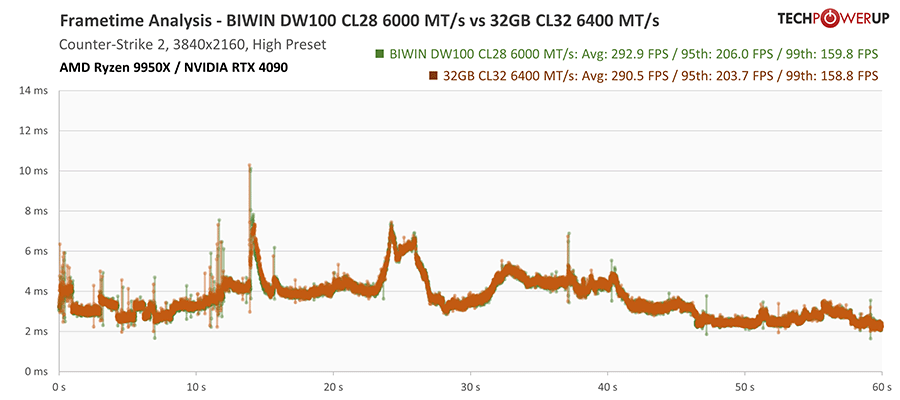
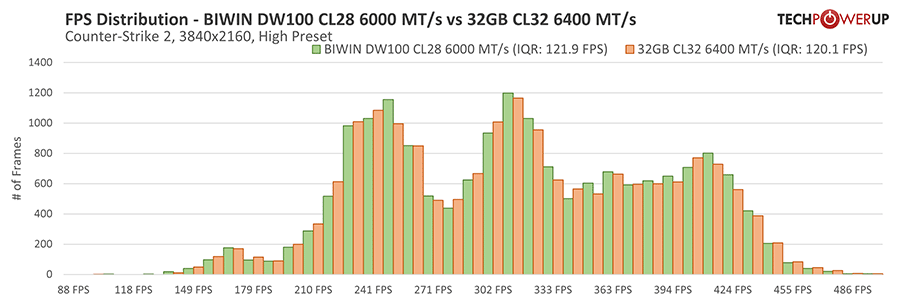
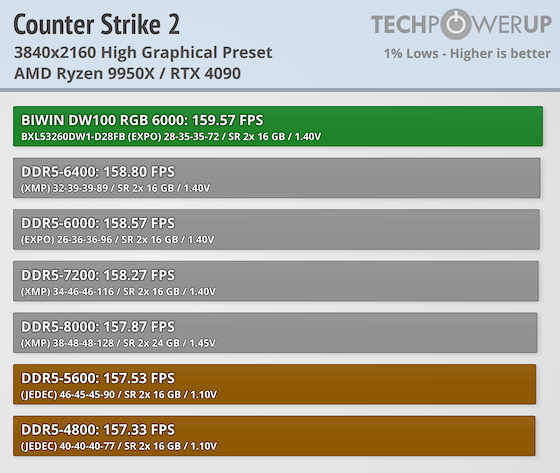
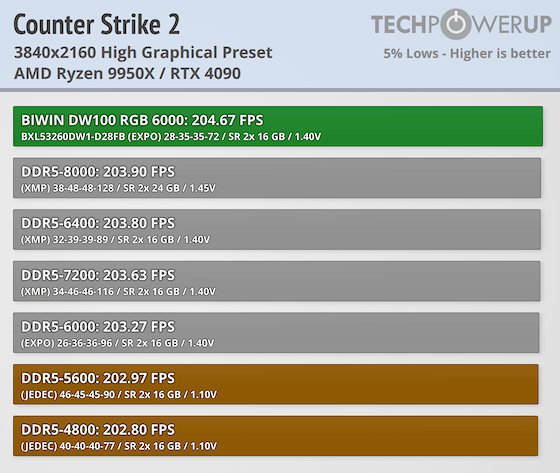
When it comes to gaming at 4K, we've arrived at a point where the memory choice doesn't make much of a difference, as it's no longer the limiting factor. That said, you might notice minor fluctuations in the 99th and 95th percentile frame rates depending on memory frequency and latency, though these are well within the margin of error.
Nov 26th, 2026 11:49 CST
change timezone
Latest GPU Drivers
New Forum Posts
- TPU's WCG/BOINC Team (34806)
- ASUS Prime 5060 ti 16gb x4 instead of x8 PCIe (1)
- What's your main Black Friday / Cyber Monday purchase? (22)
- WarpCoreBench scores! (108)
- Radeon driver death (5)
- Making a game in Godot engine (22)
- Current Sales, Bundles, Giveaways (10452)
- Can you guess Which game it is? (368)
- Free Games Thread (5385)
- Post your CrystalDiskMark speeds (659)
Popular Reviews
- ASRock X870E Challenger Wi-Fi White Review
- VZMORE AX9 Max Review
- Upcoming Hardware Launches 2027 (Updated Nov 2026)
- Microsoft Surface Laptop Ultra Review - The Next-gen Arm Laptop
- AMD Ryzen 7 9800X3D Review - The Best Gaming Processor
- AMD Zen 6 Technical Deep Dive
- Corsair RM1200e (Second Generation) Review
- Phantom Blade Zero Performance Benchmark Review - 35 GPUs Tested
- Montech CyberFlow ARGB 360 Review
- Pulsar Office Tour & First Look at P1 Dual-Sensor Mouse
TPU on YouTube
Controversial News Posts
- Jensen Huang Reinstated as CEO of NVIDIA (596)
- NVIDIA Co-Founder and CEO Jensen Huang Officially Resigns (492)
- Report: Jensen Huang Eyes NVIDIA Comeback (281)
- Open Letter Asking NVIDIA to Reinstate Jensen Huang Passes 115,000 Signatures (184)
- OpenAI CEO Argues Home PCs Waste the World's Limited DRAM Supply (152)
- NVIDIA Launches Investigation Into Jensen Huang's Relationship With Suspected Chinese Spy (136)
- Intel "Raptor Lake Next" 16-Core and 20-Core CPUs Surface (130)
- Intel Razor Lake Gets a 12 P-Core bLLC Chip With No E-Cores, Per Leak (94)