 0
Biwin Black Opal NV7400 2 TB Review
(0 Comments) »Introduction

BIWIN Storage has been building DRAM and SSDs for many years. While their own name hasn't been visible much in retail, they've been building and selling SSDs for famous brands such as Acer and HP. More recently, they've begun a push to establish their brand everywhere and are very prominent on stores like Amazon.

We've tested plenty of BIWIN hardware over the years, for example the Acer FA300, the Acer Predator GM9000 and the Acer MA200. All these are BIWIN drives sold under an Acer license. The NV7400 is different: it's part of "Black Opal," the company's own consumer brand, which also covers the Black Opal DW100 DDR5-6000 memory we looked at previously.
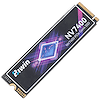
The NV7400 is a mainstream PCI-Express 4.0 drive—yes, no Gen 5—and it's built the way almost every mainstream drive is built today: four flash channels, no DRAM chip, but support for HMB that borrows a small slice of system RAM for the mapping tables. The controller is Maxio's famous MAP1602, which powers a lot of popular drives like the Lexar NM790, Team Group MP44, and Zhitai TiPlus7100. That means the NV7400 shares the same hardware platform as the Acer Predator GM7, which is also made by BIWIN. What seems to be different though, is the TLC NAND flash, which is the newer YMTC X4-9070 with 128 layers. While 128-layer doesn't sound like much, our results definitely confirm a more modern, faster NAND is used, with much better write rates than even the older X3-9060 232-layer.
The BIWIN NV7400 is available in capacities of 512 GB, 1 TB, 2 TB and 4 TB, with endurance set to 500 TBW, 1000 TBW, 2000 TBW and 4000 TBW respectively. BIWIN includes a five-year warranty.
Pricing has changed a lot since launch: the 2 TB started at around $120, and the ongoing NAND shortage has pushed it to $341 in the US, or $170 per TB. Europe gets off lighter—German listings sit at €280 including 19% VAT, which works out to roughly $263 without tax. It stings either way, but every drive in our test group has moved the same direction—and the NV7400 has come out of it better than most, at least on this side of the Atlantic.
| Specifications: Biwin Black Opal NV7400 2 TB SSD | |
|---|---|
| Brand: | Biwin |
| Model: | Black Opal NV7400 2 TB BNV740002TB-RGX |
| Capacity: | 2048 GB (1907 GB usable) |
| Controller: | Maxio MAP1602A |
| Flash: | YMTC 128-Layer 3D TLC X4-9070 Rebranded as BWN09TF1B1JCAE |
| DRAM: | N/A, but 40 MB HMB |
| Endurance: | 2000 TBW |
| Form Factor: | M.2 2280, single-sided |
| Interface: | PCIe Gen 4 x4, NVMe 2.0 |
| Device ID: | BIWIN NV7400 2TB |
| Firmware: | SN18302 |
| Warranty: | Five Years |
| Price at Time of Review: | $341 / $170 per TB |
Packaging


The Drive


The drive is designed for the M.2 2280 form factor, which makes it 22 mm wide and 80 mm long.

PCI-Express 4.0 x4 is used as the host interface to the rest of the system.


On the PCB you'll find the controller and four flash packages, 512 GB each. There is no DRAM cache, the drive uses HMB instead. Everything sits on the front side—the back of the card is completely clean.


BIWIN's sticker is really a sticker, there is no copper core or other exotic materials used. It does look mighty good, thanks to a shiny logo print on top.
Chip Component Analysis

MaxioTech's MAP1602A controller is produced on TSMC's 12 nanometer node and uses several Arm Cortex R5 CPU cores. It's a DRAM-less PCI-Express 4.0 design.

The four flash chips are YMTC 232-layer 3D TLC NAND. Each chip has a capacity of 512 GB.
Test Setup
| Test System SSD 2026 | |
|---|---|
| Processor: | AMD Ryzen 7 9800X3D Zen 5, 5.2 GHz, 8 cores/16 threads |
| Motherboard: | ASUS ROG STRIX X870E-E BIOS 2202 |
| Memory: | 2× 16 GB DDR5-6000 |
| Graphics: | Zotac GeForce RTX 5070 Solid |
| Cooling: | Valkyrie Syn 360 mm AIO |
| Thermal Paste: | Arctic MX-6 |
| Power Supply: | Thermaltake Toughpower PT 850 W ATX 3.1 / 16-pin 12VHPWR |
| Case: | darkFlash DRX70 White |
| Operating System: | Windows 11 Professional 64-bit 25H2 VBS enabled (Windows 11 default) |
| Drivers: | NVIDIA: 610.47 WHQL |


Synthetic Testing
- Tests are run with a 20-second-long warm-up time (result recording starts at second 21).
- Between each test, the drive is left idle for 60 seconds, to allow it to flush and reorganize its internal data.
- All write requests contain random, incompressible data.
- Disk cache is flushed between all tests.
- During these tests, M.2 drives are tested with additional active fan-cooling, to ensure thermal throttling can't happen.
Real-life Testing
- After initial configuration and installation, a disk image is created; it is used to test every drive.
- Automated updates are disabled for the OS and all programs. This ensures that—for every review—each drive uses the same settings, without interference from previous testing.
- Our disk image consumes around 1.5 TB—partitions are resized to fill all available space on the drive.
- All drives are filled with random data to 80% of their capacity. This is intentional, to run the drive in realistic operating conditions—nobody uses a nearly-empty SSD in their system. It also puts additional stress on the pseudo-SLC cache subsystem, because there is less free NAND space to work with.
- 1 TB drives are tested in three independent runs, applications first, then 2x games, each filled to 80% capacity, with secure erase between.
- Partitions are aligned properly.
- Disk cache is flushed between all tests.
- In order to minimize random variation, each real-life performance test is run several times, with reboots between tests to minimize the impact of disk cache.
- All application benchmarks run the actual application and do not replay any disk traces.
- During these tests, M.2 drives are running with additional active fan cooling, to entirely prevent thermal throttling.
This article is not public yet. Patreon Gold Supporters can read it early.
Nov 17th, 2026 12:38 CST
change timezone
Latest GPU Drivers
New Forum Posts
- Voltage glitch hack to unlock fuse off part of GPU core ? (2)
- What are you playing? (26229)
- [Poll] 12V-2x6 Connector Protection: What Are You Using? (WireView / Ampinel / Equalizer / Other / Nothing) (15)
- Without Jensen, PC gaming will be (27)
- Honestly, do you care about GTA VI? (127)
- AAF Optimus Modded Driver For Windows 10 & 11 - Only for HDAUDIO Chips [WINDOWS 11 RECOMMENDED] (1154)
- 9070 GRE 3.9ghz validation reached. (14)
- The Official Linux/Unix Desktop Screenshots Megathread (916)
- The site is responsive again! (3)
- Cpu waterblock water shows some tinting = Bad? (14)
Popular Reviews
- Acemagic Retro X3 Review
- Corsair HX1000i Shift Crystal Review
- AMD Zen 6 Technical Deep Dive
- Upcoming Hardware Launches 2027 (Updated Nov 2026)
- ASUS ROG Strix B850-I Gaming Wi-Fi7 W Review
- Phantom Blade Zero Performance Benchmark Review - 35 GPUs Tested
- AMD Ryzen 7 9800X3D Review - The Best Gaming Processor
- Montech King 95 3D PRO Review
- Chieftec Iceberg PRO 360 DARK Review
- NZXT C1200 Platinum Review
TPU on YouTube
Controversial News Posts
- NVIDIA Co-Founder and CEO Jensen Huang Officially Resigns (449)
- Open Letter Asking NVIDIA to Reinstate Jensen Huang Passes 115,000 Signatures (184)
- OpenAI CEO Argues Home PCs Waste the World's Limited DRAM Supply (152)
- NVIDIA Launches Investigation Into Jensen Huang's Relationship With Suspected Chinese Spy (136)
- Report: Jensen Huang Eyes NVIDIA Comeback (131)
- Intel "Raptor Lake Next" 16-Core and 20-Core CPUs Surface (130)
- Legendary Game Studio BioWare Shuts Down Following EA Layoffs (104)
- Dell CEO Says the Memory Shortage Will Get Worse in 2027 (95)