 12
Bosgame M5 Review
AI Performance »Workstation Performance
SPECviewperf measures professional viewport and visualization performance using workloads based on applications such as 3ds Max, CATIA, Maya, and SolidWorks. The test shows how responsive a system is when working with complex models in CAD, animation, and visualization. Higher scores point to better viewport performance in those workloads. Here is a rundown of what each viewset is testing:SPECviewperf showed a smaller and more workload-dependent response: 3ds Max improved 4.5%, CATIA 2.9%, Maya 1.5%, and Medical 7.8%, while Creo and SolidWorks changed slightly in the opposite direction, so Performance Mode can help certain professional graphics workloads but is not universally faster.
- 3dsmax-06: based on Autodesk 3ds Max, this stresses general 3D modeling and rendering performance, such as moving large objects around in a scene.
- catia-05: derived from Dassault CATIA, widely used in aerospace and automotive design, this highlights CAD-style precision modeling.
- creo-02: from PTC Creo, another engineering design package, this is heavy on assemblies and parametric models.
- maya-05: mirrors Autodesk Maya, which focuses on animation, rigging, and visual effects, making it a test of real-time artistic workflows.
- medical-02: simulates medical imaging and visualization, such as rotating MRI or CT scans.
- sw-04: short for SolidWorks, this represents mechanical CAD and engineering visualization used heavily in product design.
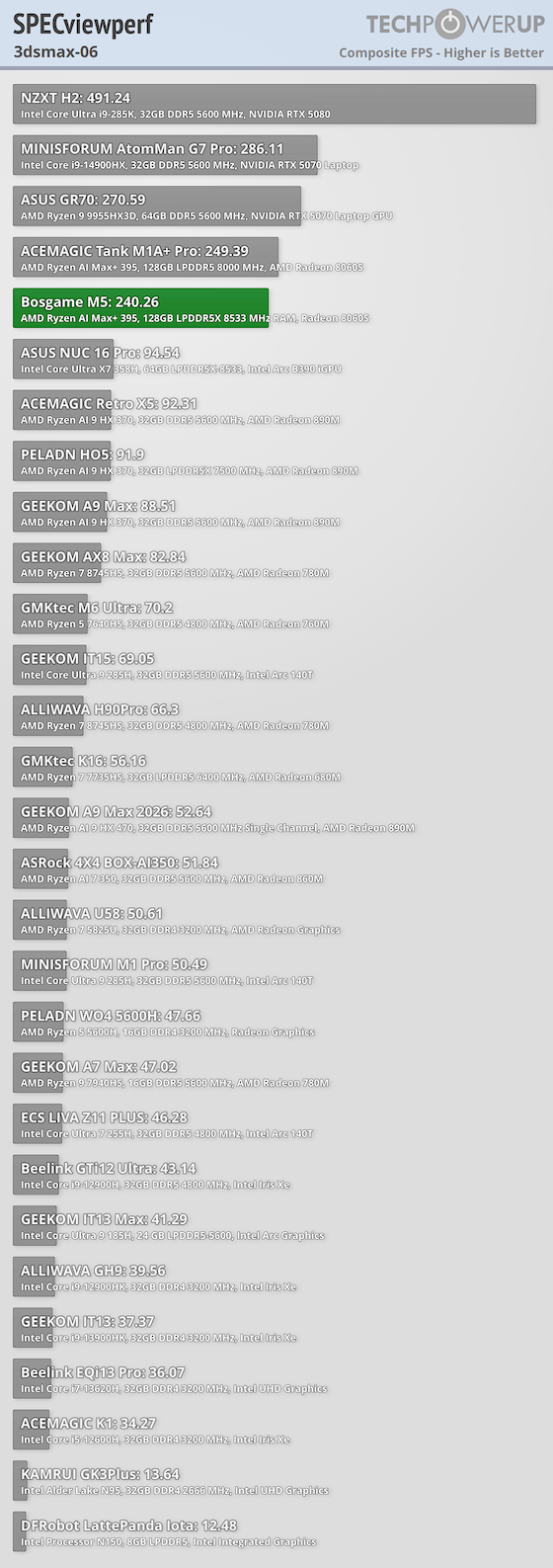
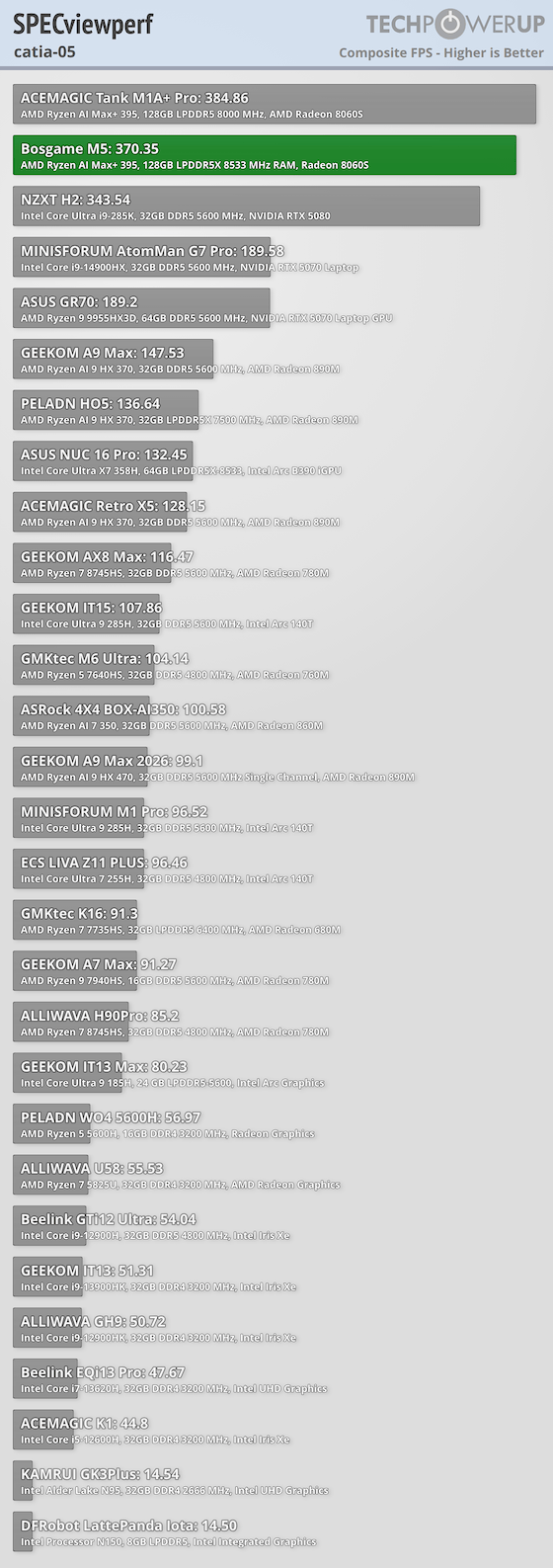
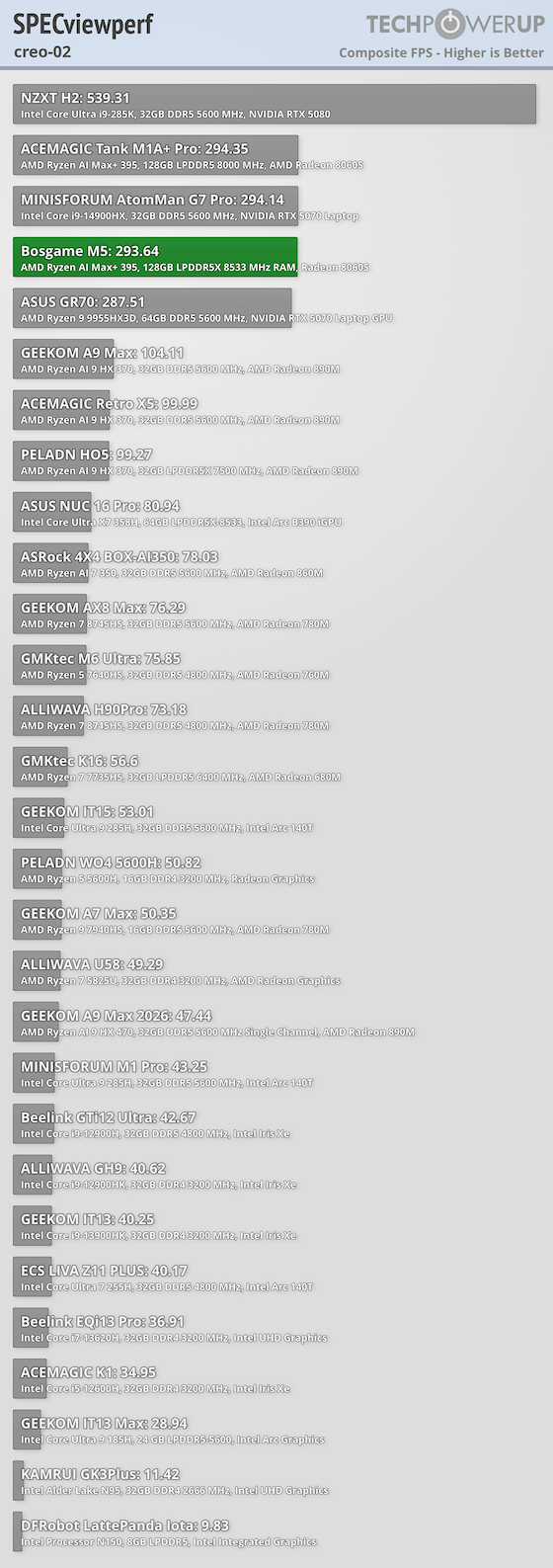
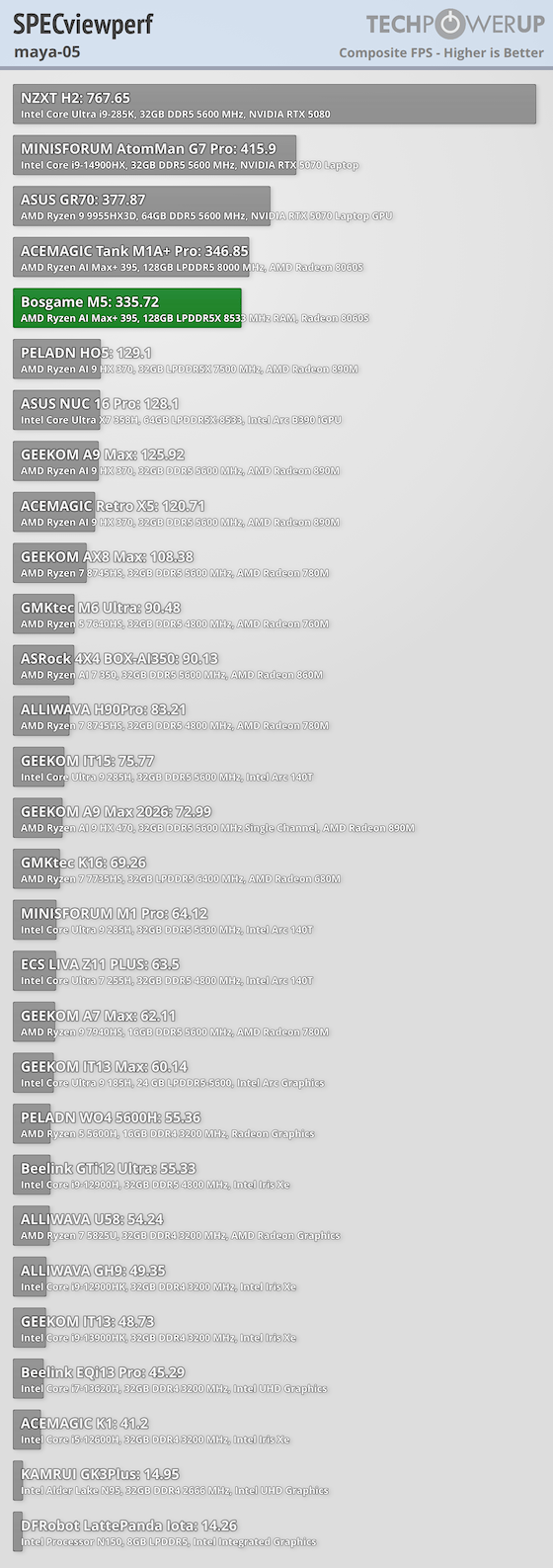
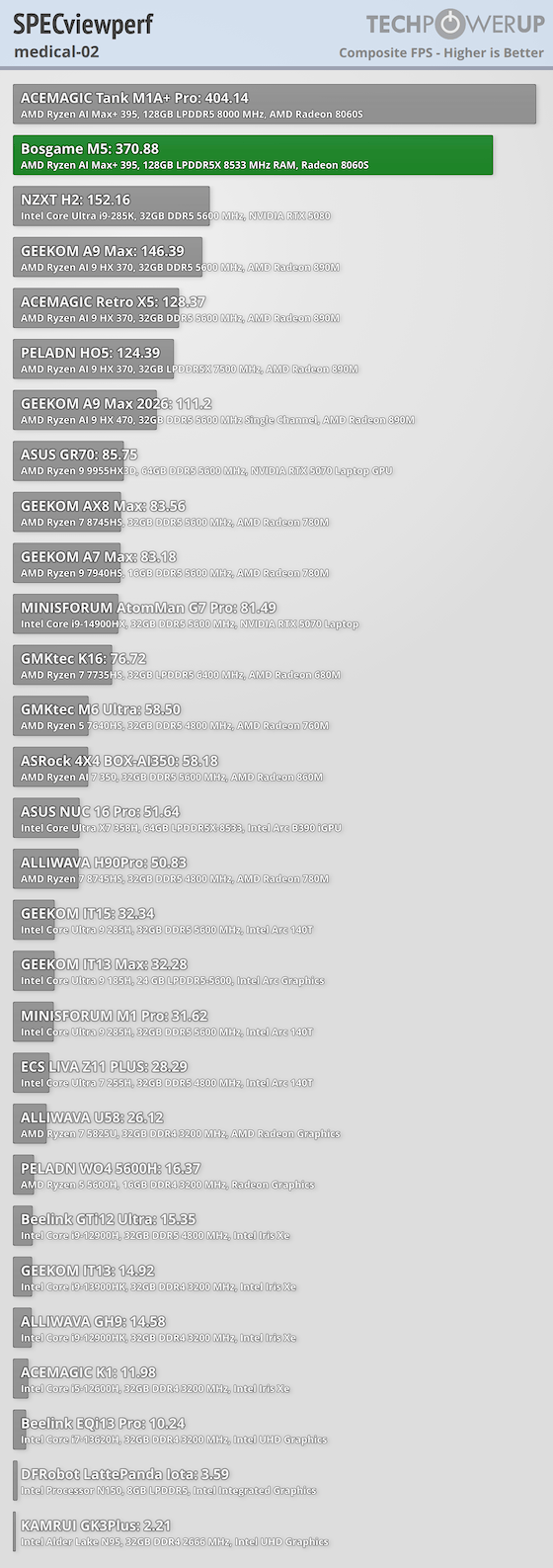
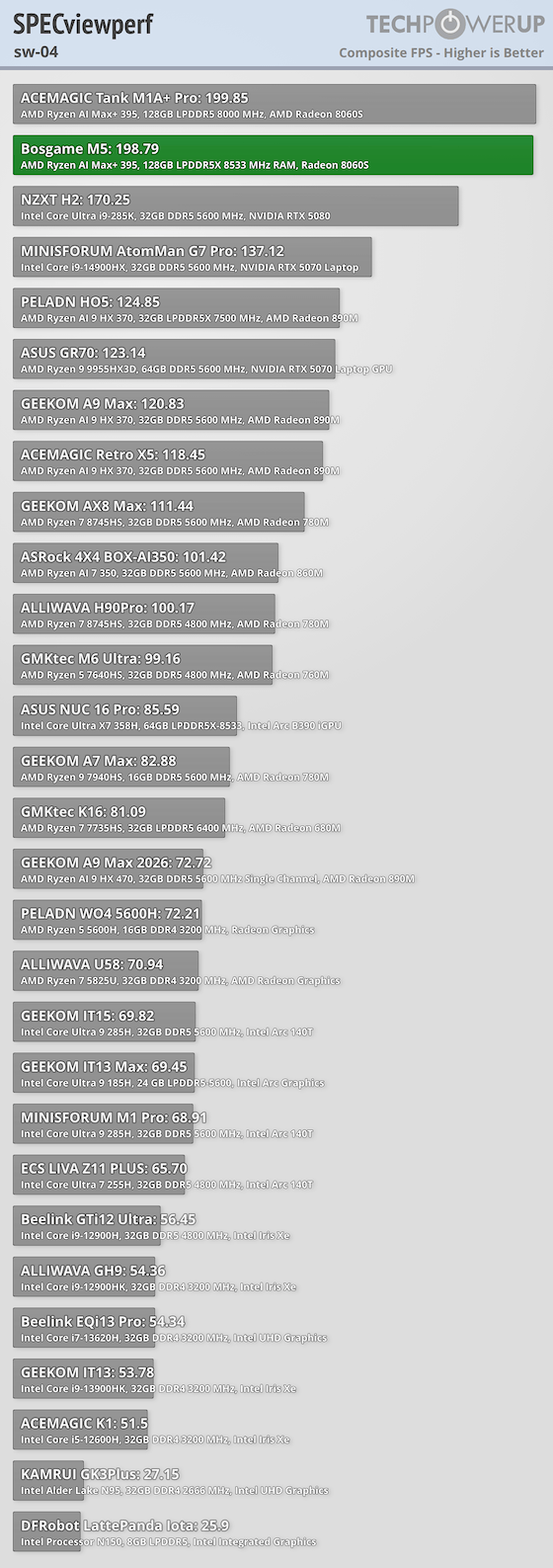
The M5 reached 370.35 FPS in CATIA and 293.64 FPS in Creo, putting the Radeon 8060S far above most conventional integrated graphics in these professional viewsets. The Tank M1A+ Pro records 384.86 and 294.35 FPS in the same tests, leaving the two Ryzen AI Max+ 395 systems very close in Creo while BOSGAME trails by a wider amount in CATIA.
Nov 19th, 2026 16:14 CST
change timezone
Latest GPU Drivers
New Forum Posts
- Honestly, do you care about GTA VI? (164)
- Windows 11 General Discussion (7736)
- Current Sales, Bundles, Giveaways (10448)
- Last game you purchased? (1409)
- WarpCoreBench scores! (76)
- Got the EOL 32GB TridentZ 6000 CL26 1.4V (12)
- Dell Workstation Owners Club (3516)
- Making a game in Godot engine (4)
- DTS DCH Driver for Realtek HDA [DTS:X APO4 + DTS Interactive] (2815)
- Security Apps (2)
Popular Reviews
- Acemagic Retro X3 Review
- Ugreen NASync DXP4800 GT Review
- Upcoming Hardware Launches 2027 (Updated Nov 2026)
- Pulsar Office Tour & First Look at P1 Dual-Sensor Mouse
- AMD Zen 6 Technical Deep Dive
- Biwin Black Opal NV7400 2 TB Review
- Sapphire Radeon RX 7700 XT Pure Review
- Sapphire Radeon RX 7700 XT Pulse Review
- AMD Ryzen 7 9800X3D Review - The Best Gaming Processor
- Chieftec Iceberg PRO 360 DARK Review
TPU on YouTube
Controversial News Posts
- NVIDIA Co-Founder and CEO Jensen Huang Officially Resigns (489)
- Report: Jensen Huang Eyes NVIDIA Comeback (223)
- Open Letter Asking NVIDIA to Reinstate Jensen Huang Passes 115,000 Signatures (184)
- OpenAI CEO Argues Home PCs Waste the World's Limited DRAM Supply (152)
- NVIDIA Launches Investigation Into Jensen Huang's Relationship With Suspected Chinese Spy (136)
- Intel "Raptor Lake Next" 16-Core and 20-Core CPUs Surface (130)
- Legendary Game Studio BioWare Shuts Down Following EA Layoffs (104)
- Dell CEO Says the Memory Shortage Will Get Worse in 2027 (95)