 1
Colorful GeForce RTX 5080 Vulcan OC Review
Overclocking & Power Limits »Energy Efficiency
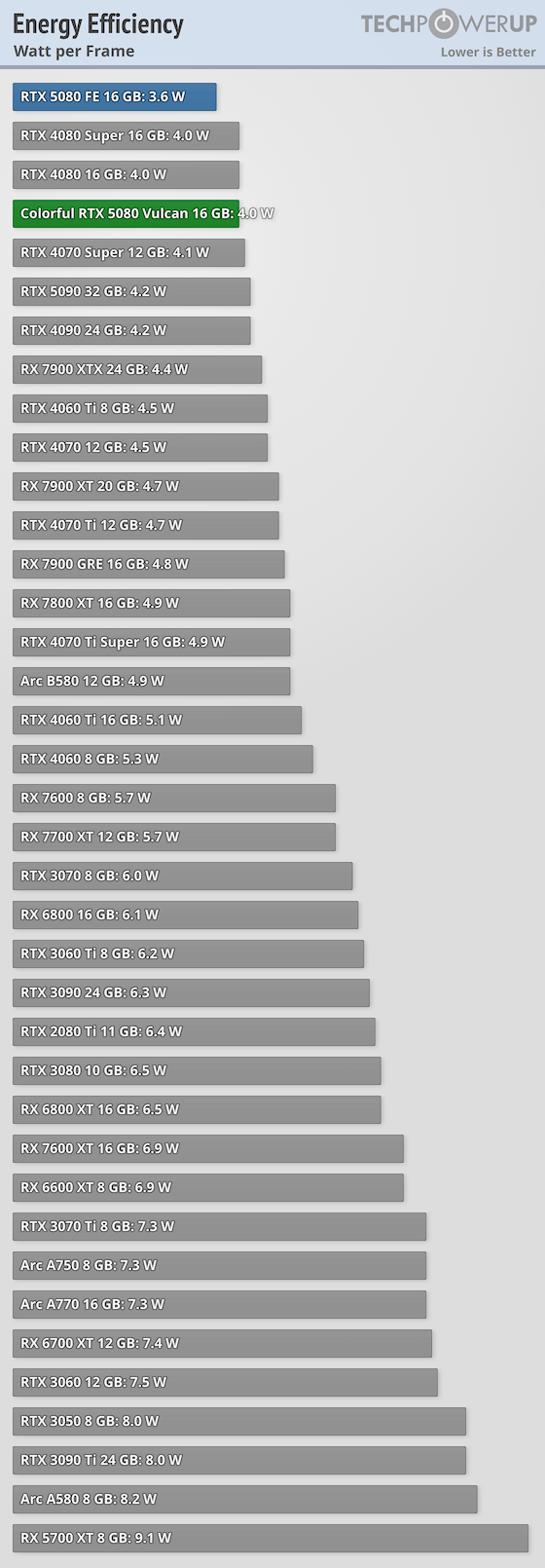
Energy Efficiency calculations are based on measurements using Cyberpunk 2077. We record power draw and FPS rate to calculate the energy efficiency of the graphics card as it operates.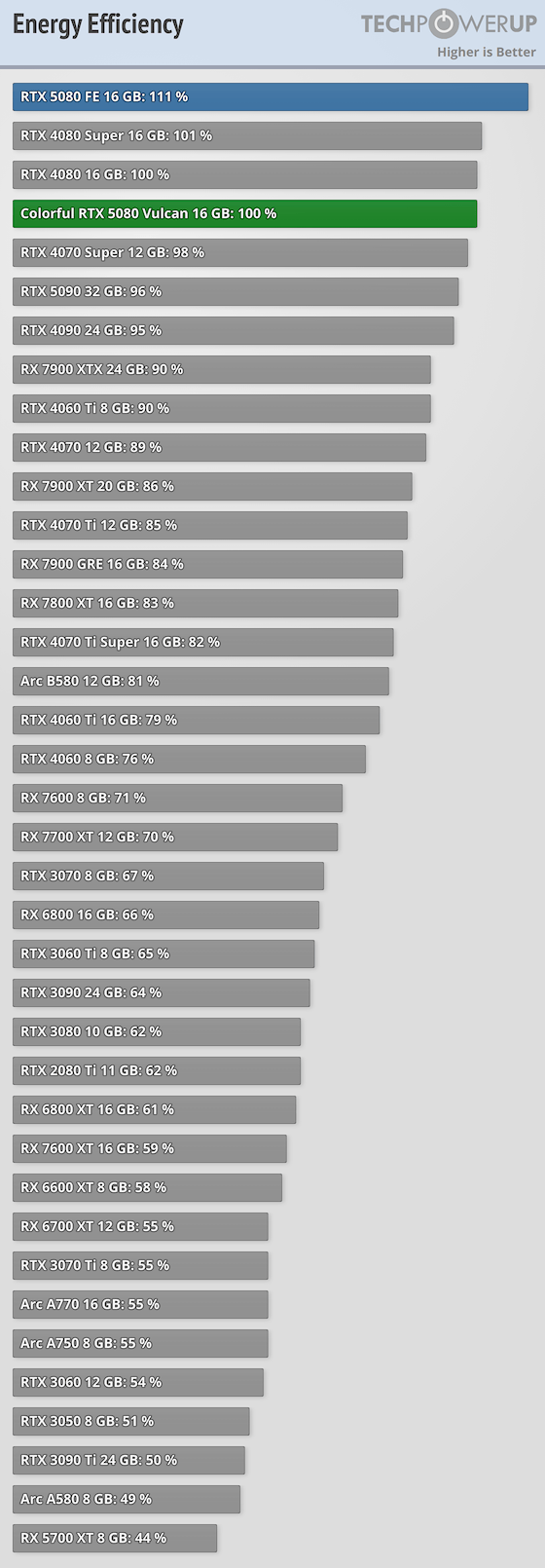
Voltage Frequency Curve
The card will dynamically adjust clocks and voltage based on render load, temperature, and other factors.For the graph below, we recorded all GPU clock and GPU voltage combinations of our 1440p resolution benchmarking suite. The plotted points are transparent, which allows them to add up to indicate more often used values. A light color means the clock and voltage combination is rarely used, and a dark color means it's active more often. The minimum and maximum values are 99th and 1st percentile, so outliers are excluded.

Clock States
| Clock Frequencies & Voltage | |||
|---|---|---|---|
| GPU Clock | Memory Clock | GPU Voltage | |
| Idle | 180 MHz | 51 MHz | 0.800 V |
| Multi-Monitor | 183 MHz 180 to 210 MHz | 51 MHz | 0.800 V |
| Video Playback | 486 MHz 450 to 510 MHz | 51 MHz | 0.817 V 0.815 to 0.820 V |
| Furmark | 2427 MHz 2415 to 2535 MHz | 1875 MHz | 0.905 V 0.905 to 0.910 V |
| Gaming (Cyberpunk 2077) | 2790 MHz | 1875 MHz | 1.035 V 1.030 to 1.035 V |
| Ray Tracing (Cyberpunk 2077) | 2678 MHz 2640 to 2700 MHz | 1875 MHz | 0.982 V 0.975 to 0.990 V |
| V-Sync (Cyberpunk 2077) | 1778 MHz 1762 to 1807 MHz | 875 MHz | 0.880 V |
| Gaming (25 Games) | 2822 MHz 2040 to 2955 MHz | 1875 MHz | 1.008 V 0.810 to 1.060 V |
Nov 20th, 2026 13:35 PST
change timezone
Latest GPU Drivers
New Forum Posts
- Honestly, do you care about GTA VI? (206)
- WarpCoreBench scores! (80)
- GTA VI (20)
- Anthrophics IPO (25)
- GeekMagic Ultra Smart WiFi Weather Station (8)
- Very unusual two gaming-pc scenarios. (35)
- Can i play GTA 6 now? (Joke) (14)
- How to prevent OLED burn damage due to PC freezes or power outtages? (47)
- Zen 3 IF/IMC degradation (239)
- The Final Upgrade for Legacy AiO's (10)
Popular Reviews
- AMD Zen 6 Technical Deep Dive
- Ugreen NASync DXP4800 GT Review
- Microsoft Surface Laptop Ultra Review - The Next-gen Arm Laptop
- Corsair RM1200e (Second Generation) Review
- Acemagic Retro X3 Review
- Upcoming Hardware Launches 2027 (Updated Nov 2026)
- Pulsar Office Tour & First Look at P1 Dual-Sensor Mouse
- Biwin Black Opal NV7400 2 TB Review
- AMD Ryzen 7 9800X3D Memory Performance Scaling
- AMD Ryzen 7 9800X3D Review - The Best Gaming Processor
TPU on YouTube
Controversial News Posts
- NVIDIA Co-Founder and CEO Jensen Huang Officially Resigns (490)
- Report: Jensen Huang Eyes NVIDIA Comeback (254)
- Open Letter Asking NVIDIA to Reinstate Jensen Huang Passes 115,000 Signatures (184)
- OpenAI CEO Argues Home PCs Waste the World's Limited DRAM Supply (152)
- NVIDIA Launches Investigation Into Jensen Huang's Relationship With Suspected Chinese Spy (136)
- Intel "Raptor Lake Next" 16-Core and 20-Core CPUs Surface (130)
- Legendary Game Studio BioWare Shuts Down Following EA Layoffs (104)
- Dell CEO Says the Memory Shortage Will Get Worse in 2027 (95)