 12
Colorful iGame Shadow II DDR5-6000 32 GB CL28 Review
Intel Core Ultra 285K Frametimes: Baldur's Gate 3 »Intel Core Ultra 285K Frametimes: Counter-Strike 2
We present a more in-depth analysis than just average FPS to show how the framerate changes over time, which helps highlight FPS drops. Minimum FPS at both the 95th and 99th percentile are reported in these charts, too. A second chart, a histogram, shows shape and spread for the frametime data—how tightly grouped the measurements are. The "IQR" result is called "Interquartile Range," which is an outlier-resistant statistical value that tells us the range in the middle of the frametime distribution.In the following charts, we are comparing two retail memory kits. By doing so, the game benchmarks reveal where the limits lie for a top of the line AMD or Intel computer in 2025. For both memory kits, the respective EXPO/XMP profiles are loaded, and all sub-timings are based on those individual profiles. These are not adjusted further.
Tests are conducted with the following components:
CPU: Intel Core Ultra 9 285K (P-Core @ 5.4 GHz, E-Core @ 4.6 GHz)
GPU: PNY GeForce RTX 4090 XLR8 VERTO
Memory (1): Colorful iGame Shadow II DDR5-6000 IG16G6000D5YP28W (28-38-38-76) (XMP)
Memory (2): DDR5-7200 32 GB (34-46-46-116) (XMP)
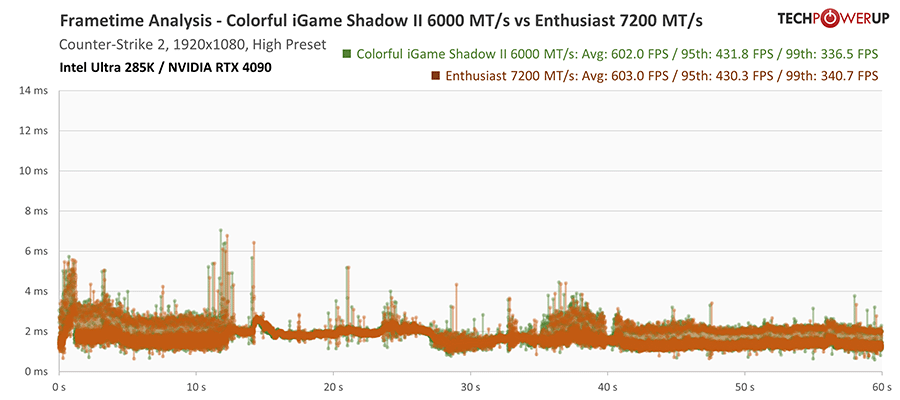
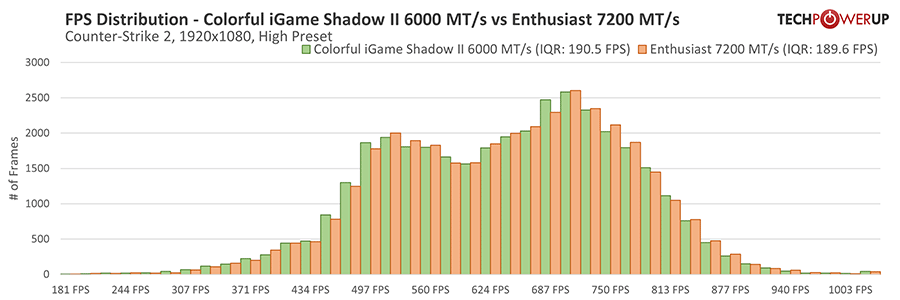
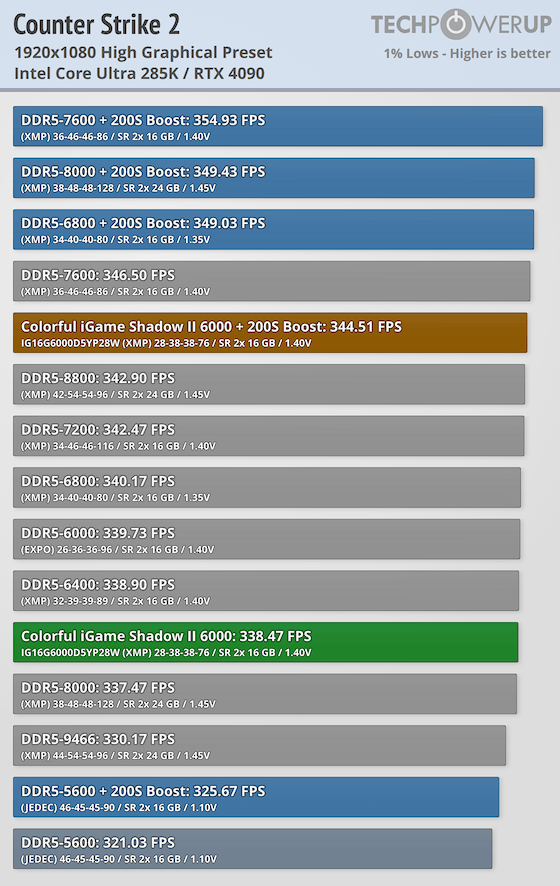
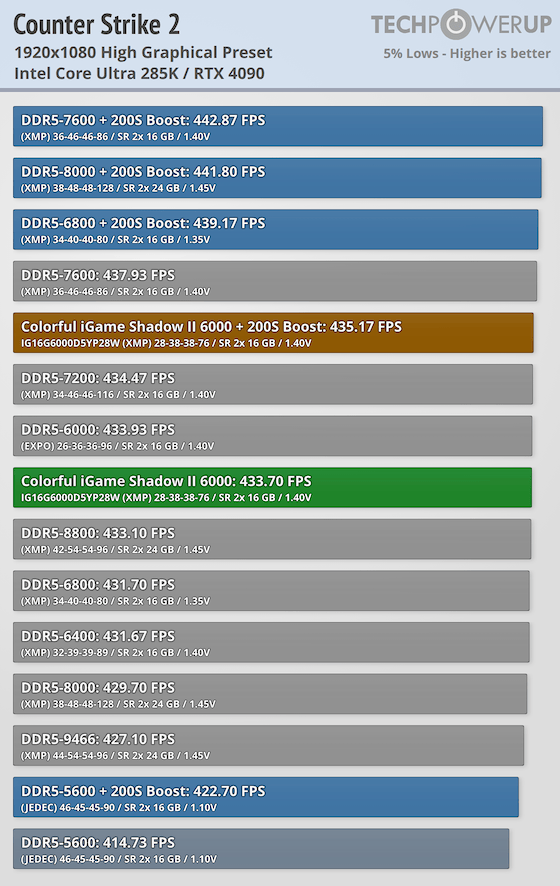
Intel CPUs have long been known for their performance improvements tied to higher memory bandwidth or reduced memory latency. However, the Ultra 200 series architecture takes a different approach with its innovative Die-to-Die (D2D) setup. This redesign emphasizes lower latency over raw bandwidth, unless the Intel 200S Boost feature is activated. With this feature enabled, memory speeds ranging from 6800 MT/s to 8000 MT/s show significant performance gains due to the increased D2D ratio. On the other hand, lower frequencies in the 6000 MT/s to 6400 MT/s range might only see a modest increase in frames per second.
When comparing memory kits without Intel 200S Boost enabled, the average frame rates remain relatively close across different speeds. However, the 7200 MT/s kit stands out when looking at the 99th percentiles, showing improved performance in this metric despite having an average FPS similar to 6000 MT/s. This suggests that while the overall average might not differ significantly, the higher speed memory can provide a smoother experience in more demanding scenarios.
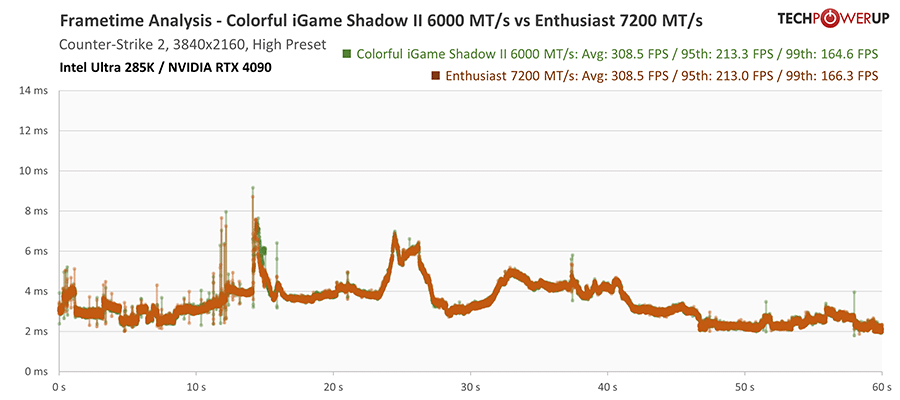
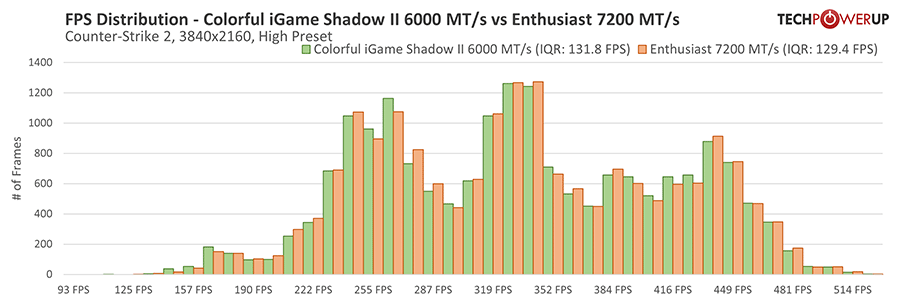
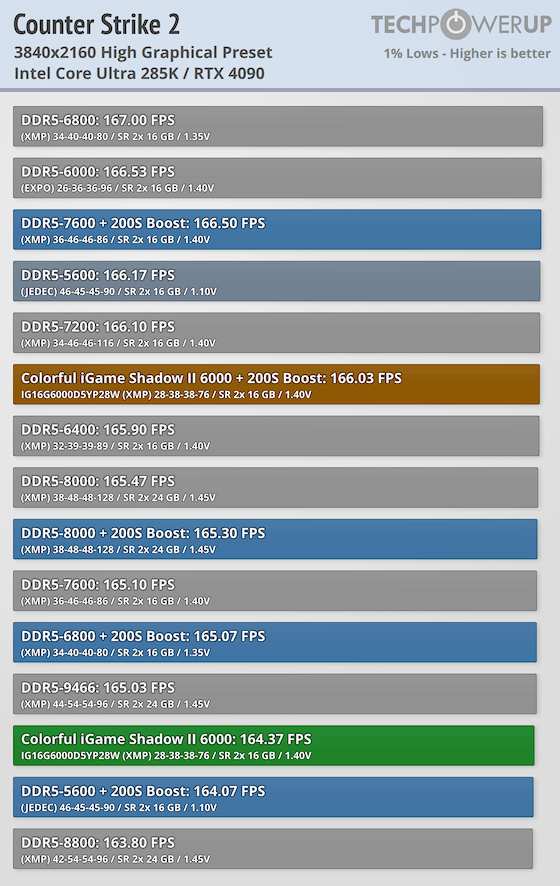
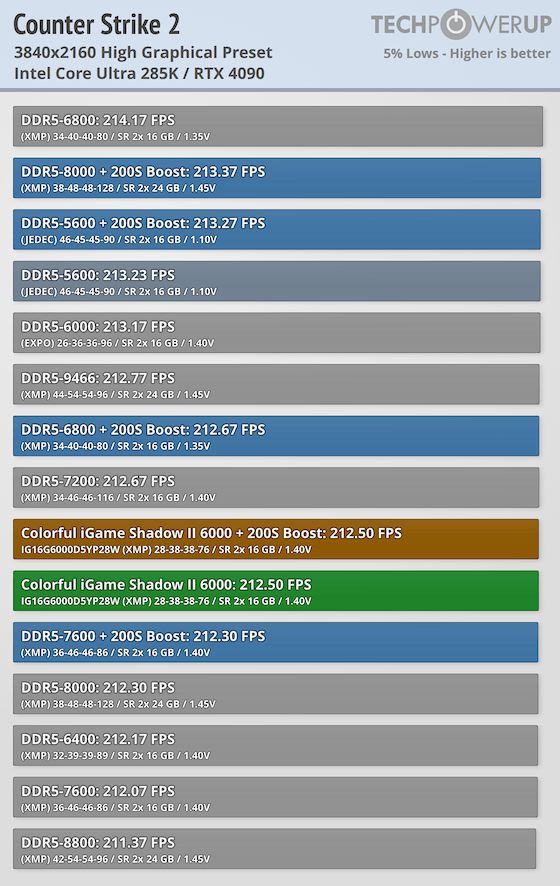
As we increase the resolution, the gap between memory kits narrows, with the average FPS remaining consistent, leaving only a small difference in the 1% and 5% lows. This occurs because the system becomes GPU-bound, bringing all the memory kits closer in performance.
Nov 21st, 2026 08:10 PST
change timezone
Latest GPU Drivers
New Forum Posts
- Windows 11 General Discussion (7745)
- UPS what one to get? (4)
- TPU's Nostalgic Hardware Club (22180)
- Cpu waterblock water shows some tinting = Bad? (19)
- Anthrophics IPO (33)
- Bought MAX-P495 - Which model? (33)
- RX 9000 series GPU Owners Club (2250)
- Honestly, do you care about GTA VI? (221)
- GeekMagic Ultra Smart WiFi Weather Station (9)
- What's your latest tech Freebie? (87)
Popular Reviews
- Microsoft Surface Laptop Ultra Review - The Next-gen Arm Laptop
- Ugreen NASync DXP4800 GT Review
- Corsair RM1200e (Second Generation) Review
- Pulsar Office Tour & First Look at P1 Dual-Sensor Mouse
- Upcoming Hardware Launches 2027 (Updated Nov 2026)
- Acemagic Retro X3 Review
- Biwin Black Opal NV7400 2 TB Review
- AMD Ryzen 7 9800X3D Review - The Best Gaming Processor
- AMD Zen 6 Technical Deep Dive
- Chieftec Iceberg PRO 360 DARK Review
TPU on YouTube
Controversial News Posts
- NVIDIA Co-Founder and CEO Jensen Huang Officially Resigns (492)
- Report: Jensen Huang Eyes NVIDIA Comeback (259)
- Open Letter Asking NVIDIA to Reinstate Jensen Huang Passes 115,000 Signatures (184)
- OpenAI CEO Argues Home PCs Waste the World's Limited DRAM Supply (152)
- NVIDIA Launches Investigation Into Jensen Huang's Relationship With Suspected Chinese Spy (136)
- Intel "Raptor Lake Next" 16-Core and 20-Core CPUs Surface (130)
- Legendary Game Studio BioWare Shuts Down Following EA Layoffs (104)
- NVIDIA GeForce RTX 50-Series Scheduled for up to $500 Price Hike This Week (89)