 13
Corsair AXi Series 1600 W Review
(13 Comments) »Introduction

We would like to thank Corsair for supplying the review sample.

Say you have deep pockets and want to buy the best PSU available on the market. Thus far, that PSU has been the Corsair AX1500i, which, although it has by now been around for several years, still hasn't been dethroned, achieving a higher overall performance score than any other PSU. Yet the performance gap with such top competitors as the mighty EVGA SuperNova 1600 T2 based on an excellent Super Flower platform has started to narrow, which had Corsair decide that it is time to introduce something even better, the AX1600i, which not only performs better but is 100 W stronger, which has it go toe to toe with the SuperNova 1600 T2.
With a price tag of $450 (the AX1500i's street pricing is currently $50 less), the AX1600i surely isn't a PSU that will be sold in huge numbers, so one is right to ask why Corsair would spend so much time and money on creating it in the first place. The answer to this question is fairly simple: because it can, along with Flextronics' help, and this does again let everyone around the globe know that Corsair is the king of the PSU game since its flagship offering stands above all other competitive high-end offerings. As we see it, the AX1600i is a prestigious product, like Formula One cars are for their respective manufacturers, with the only difference being that you can actually buy this PSU if you can afford it. The major innovation with the fully digital platform the AX1600i uses is a new type of FET based on a material called Gallium Nitride (GaN) - instead of common Silicon. Due to its extremely low gate charge and output capacitance, GaN FETs can be switched at extremely high speeds with reduced switching losses and improved efficiency when compared to silicon FETs. GaN FETs, or MODFETs as they are also called, also offer up to 40% more power density than their silicon counterparts, and their faster switching speeds help minimize the dimensions of other components, especially transformers.
The use of GaN FETs is essential for the innovative totem-pole bridgeless PFC converter the AX1600i uses to achieve its considerably higher efficiency with its multi-rail output architecture. A typical bridgeless APFC converter in a high-end PSU like the 1600 T2 is able to offer up to 96% efficiency, while a totem-pole bridgeless PFC can reach up to 99% efficiency! A difference of 3% might look small to some of you, but is not, especially in a PSU with such a gargantuan capacity, as such a percentile difference can translate into a thermal load that is reduced by up to 50 W when it comes to cooling this PSU.
Specifications
| Corsair AX1600i - Features & Specs | |
|---|---|
| Max. DC Output | 1600W |
| PFC | Active PFC |
| Efficiency | ETA-A+ (91-94%) & 80 Plus Titanium |
| Noise | LAMBDA-A- |
| Modular | ✓ (fully) |
| Intel C6/C7 Power State Support | ✓ |
| Operating temperature | 0°C - 50°C |
| Protections | Over Voltage Protection Under Voltage Protection Over Power Protection Over Temperature Protection Over Current Protection Short Circuit Protection |
| Cooling | 140 mm Fluid Dynamic Bearing Fan (NR140P) |
| Semi-passive operation | ✓ (selectable) |
| Dimensions | 150 mm (W) x 90 mm (H) x 200 mm (D) |
| Weight | 2.6 kg |
| Compliance | ATX12V v2.31, EPS 2.92 |
| Warranty | 10 years |
| Price at time of review (exc. VAT) | $449.99 |
This is a top-spec'd PSU featuring Titanium and ETA-A+ efficiency and a LAMBDA-A- noise rating, which is a difficult feat for such a high-capacity PSU since thermal loads are inevitably also increased at such a capacity. These very high efficiency levels are also a major factor when it comes to keeping noise output low since the higher the efficiency, the less energy is wasted as heat, which means the PSU's cooling system can also more readily cope with the task at hand. Corsair chose a 140 mm FDB fan; its speed profile can also be adjusted through the Corsair Link app.
20 cm deep, this is not a compact PSU; however, it is much smaller than the AX1500i that is 22.5 cm long! It's heavier as well, and Corsair set the warranty to an incredible ten years. Currently, only Seasonic provides an even longer warranty period with its Prime models. However, any more than five years is somewhat unrealistic for PSUs that are constantly being put through some rather tough conditions (e.g. mining). Companies should, as such, be careful with what they cover in their warranties. The easiest solution would obviously be to offer a realistic warranty that covers every possible usage scenario.
| Corsair AX1600i Power Specs | |||||||
|---|---|---|---|---|---|---|---|
| Rail | 3.3V | 5V | 12V | 5VSB | -12V | ||
| Max. Power | 30A | 30A | 133.3A | 3.5A | 0.8A | ||
| 180W | 1600W | 17.5W | 9.6W | ||||
| Total Max. Power | 1600W | ||||||
The minor rails are very strong, which seems weird for a modern PSU since contemporary systems only use those two rails (5V and 3.3V) lightly. The +12V rail is heavily utilized, and we are very pleased to see that the AX1600i can deliver its full power on this rail alone. Finally, the 5VSB rail is set to 3.5 A maximum current output, which looks rather low for a 1.6 kW PSU; however, its maximum current output will suffice since its OCP triggering point is set much higher.
Cables And Connectors
| Modular Cables | ||||
|---|---|---|---|---|
| Description | Cable Count | Connector Count (Total) | Gauge | In Cable Capacitors |
| ATX connector 20+4 pin (600 mm) | 1 | 1 | 16-22AWG | Yes |
| 4+4 pin EPS12V (650 mm) | 2 | 2 | 16AWG | Yes |
| 6+2 pin PCIe (650 mm) | 6 | 6 | 16-18AWG | Yes |
| 6+2 pin PCIe (680 mm+100 mm) | 2 | 4 | 16-18AWG | Yes |
| SATA (450 mm+110 mm+110 mm+110 mm) | 3 | 12 | 18AWG | No |
| SATA (550 mm+110 mm) | 2 | 4 | 18AWG | No |
| 4 pin Molex (450 mm+100 mm+100 mm) | 3 | 9 | 18AWG | No |
| FDD Adapter (+105 mm) | 2 | 2 | 20AWG | No |
| USB Mini to Motherboard Header Cable (+800 mm) | 1 | 1 | 24-28AWG | No |
| AC Power Cord (1400 mm) - C19 coupler | 1 | 1 | 14AWG | - |
Plenty of cables and connectors are provided since 1600 W of power takes a ton of wiring to be passed on smoothly, without there being huge voltage drops or, worse, melted gauges. You get a total of ten PCIe connectors, which might look low compared to the twelve or more other PSUs of similar capacity have, but here, six are on dedicated cables. Installing two PCIe connectors on the same cable might be a great solution when it comes to increasing the number of PCIe connectors, but should a VGA draw lots of power with a high load on the PSU such a cable might also get dangerously hot, and to where it might even melt under extreme conditions. The second PCIe connector on such a cable will also suffer from higher voltage drops because it is chained to the first connector via 18AWG gauges at best since thicker ones just wouldn't fit. This is why dedicated PCIe cables are suggested for mining with higher power consumption VGAs, and if you have the option to use nothing but dedicated PCIe cables with a gaming system, I suggest you do so there as well.
Power Distribution
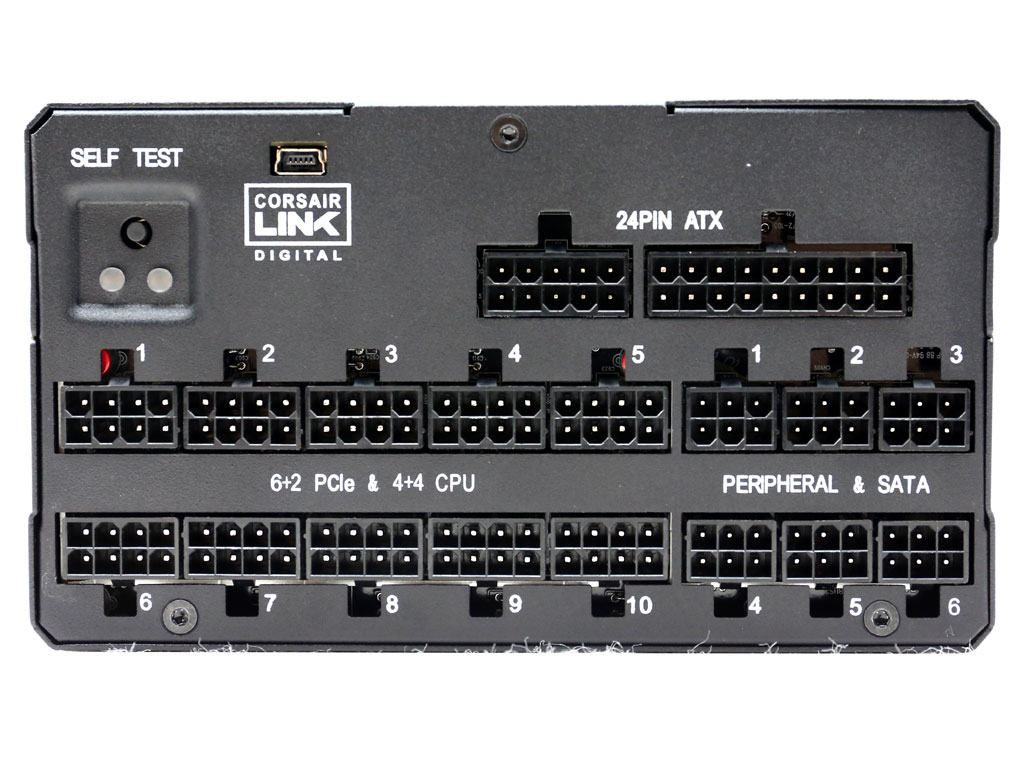
The Corsair Link application has an option over which you can enable OCP for each of the ten 8-pin sockets into which the PCIe and EPS cables are plugged. You can also enable OCP for the other sockets used by the 24-pin ATX, peripheral, and SATA connectors. Power distribution is optimal due to the many 12V virtual rails, and you can set a custom OCP level, though the maximum is 40 A for each virtual rail.
Unboxing Video
The following video footage shows an unboxing of the AX1600i:Our Patreon Silver Supporters can read articles in single-page format.
Nov 14th, 2026 12:56 CST
change timezone
Latest GPU Drivers
New Forum Posts
- Tell me about your favourite graphics card (64)
- Your PC ATM (36415)
- What can the FX 8320 do today? Here is the answer. (33)
- auto-closed by somethings by actions (1)
- What card do I get for VR? (30)
- no "PhysX" workable (10)
- TPU's Nostalgic Hardware Club (22162)
- Slow SSD read speeds - help! (7)
- Ddr4 instead of ddr5 for 9060xt 8 gb over 5060 8 gb (7)
- Microsoft Exchange/365 outages? (62)
Popular Reviews
- AMD Zen 6 Technical Deep Dive
- ASUS ROG Strix B850-I Gaming Wi-Fi7 W Review
- Corsair HX1000i Shift Crystal Review
- NZXT C1200 Platinum Review
- Upcoming Hardware Launches 2027 (Updated Nov 2026)
- Montech King 95 3D PRO Review
- NZXT H7 RGB+ Review
- NZXT H5 Review
- Phantom Blade Zero Performance Benchmark Review - 35 GPUs Tested
- XPG NIMBUS PLUS Review - Mid-range Chair With Strong Competitors
TPU on YouTube
Controversial News Posts
- NVIDIA Co-Founder and CEO Jensen Huang Officially Resigns (400)
- OpenAI CEO Argues Home PCs Waste the World's Limited DRAM Supply (152)
- NVIDIA Launches Investigation Into Jensen Huang's Relationship With Suspected Chinese Spy (136)
- Intel "Raptor Lake Next" 16-Core and 20-Core CPUs Surface (130)
- Legendary Game Studio BioWare Shuts Down Following EA Layoffs (104)
- Dell CEO Says the Memory Shortage Will Get Worse in 2027 (95)
- NVIDIA GeForce RTX 50-Series Scheduled for up to $500 Price Hike This Week (89)
- Modder Fits RTX 5090 With Four 8-Pin Connectors, Halving Current per Wire (80)