 39
Corsair AX 860 W Review
(39 Comments) »Introduction

We would like to thank Corsair for supplying the review sample.
Corsair recently commenced a large-scale foray into the high-end category that left their competitors behind to wonder what sort of a strong hit would come next (who knows, they may decide to enter the 600W or lower wattage category with high-end models next). The AXi and the fresh AX models did, indeed, easily take the top spots of their respective categories, and they are almost left alone in the field to fight amongst each other for the performance crown. As we already stated in the AX760 review, the AXi models are all being made by Flextronics, and they feature digital control; it offers the best possible performance along with the ability for software control/monitoring. The AX models, on the other hand, are made by Seasonic, and they utilize a more conventional platform that doesn't use digital control, but it still exploits cutting-edge technology and a sophisticated design devised by Seasonic’s highly experienced R&D team, which allows for ground-breaking performance. We already found out that the AX760's performance is on par with that of the AX760i, so we are expecting pretty much the same from the AX860 unit.
Before we skip to the main review, let’s take a brief look at the main characteristics of the AX860. For starters, as its model number implies, it has 860 W capacity and is certified for 80 Plus Platinum efficiency. It also utilizes a fully-modular cabling design with stealth cables, which means that all of its cables are black, and many of them are also flat. Moreover, the AX860, like its smaller brother, has the ability to operate in fanless mode at lower loads/ambient, which minimizes its output noise. Now, Seasonic provided for those that prefer the fan to spin constantly in order to avoid increased temperatures inside the PSU via a small switch on the rear of the PSU; it allows you to toggle between normal and hybrid operation. Like all Corsair high-end PSUs, the AX860 enjoys a seven-year warranty, which is a clear indication of how confident they are in their product. So far, its only downside seems to be the stiff price.

Specifications
| Corsair AX860 Features & Specs | |
|---|---|
| Max. DC Output | 860W |
| PFC | Active PFC |
| Efficiency | 80 PLUS Platinum |
| Operating temperature | 0°C - 50°C |
| Protections | Over Voltage Protection Under Voltage Protection Over Current Protection Over Power Protection Short Circuit Protection |
| Cooling | 120 mm Double Ball-Bearing Fan (9S1212F404) |
| Dimensions | 150 mm (W) x 86 mm (H) x 160 mm (D) |
| Weight | 2.1 kg |
| Compliance | ATX12V v2.31, EPS 2.92 |
| Warranty | 7 years |
| Price at time of review (exc. VAT) | $199.99 |
Efficiency of the new AX units has been upgraded to Platinum, but its operating temperature has, thankfully, remained the same as previous AX models. Its protection features include the basic ones; OTP is missing since Seasonic most likely considered it redundant to this platform. Still, we would like OTP to be included because this PSU operates in fanless mode most of the time, and a possible fan failure would be catastrophic. This is, however, a highly unlikely scenario since the fan is of high quality. It uses ball bearings for additional longevity.
The dimensions of the unit are pretty compact given its capacity, and the seven-year warranty does, to a degree, justify such a stiff price.
| Corsair AX860 Power Specs | |||||||
|---|---|---|---|---|---|---|---|
| Rail | 3.3V | 5V | 12V | 5VSB | -12V | ||
| Max. Power | 25A | 25A | 71.6A | 3A | 0.6A | ||
| 125W | 859.2W | 15W | 6W | ||||
| Total Max. Power | 860W | ||||||
Seasonic preferred a single +12V rail for their new platform and, considering their huge experience, they must have a good reason for it. The unit's +12V rail is powerful and can almost deliver 72 A, which is the maximum power this PSU can deliver. The minor rails are pretty strong as well. They can output 125 W combined, which is more than enough power for every system out there. Finally, the 5VSB rail has 3 A maximum current output, so it will suffice in most cases.
Cables & Connectors, Power Distribution
| Modular Cables | |
|---|---|
| ATX connector (610mm) | 20+4 pin |
| 4+4 pin EPS12V (650mm) | 2 |
| 6+2 pin PCIe (600mm+150mm) | 4 |
| 6+2 pin PCIe (750mm+150mm) | 2 |
| SATA (400mm+100mm+100mm+100mm) | 8 |
| SATA (540mm+100mm+100mm+100mm) | 4 |
| 4 pin Molex (450mm+100mm+100mm+100mm) | 8 |
| FDD adapter (+100mm) | 2 |
The cable configuration of the AX860 is exactly the same as that of the AX760 model, so it is perfect because it boosts the usability of the PSU considerably. Owners of the AX860 will have six PCIe, two EPS, twelve SATA, and eight peripheral connectors at their disposal. What more could someone ask of an 860 W unit? Also, all cables are stealth, and the SATA and peripheral connectors are installed on flat cables, which allows for easier cable management. All the other cables - ATX, PCIe and EPS - are, of course, fully sleeved. The length of all cables is sufficient and our only objection here is the small distance amongst peripheral connectors since it may prove troublesome. Finally, all gauges are of 18AWG size, which is the minimum allowed by ATX specification.
Since this PSU features a single +12V rail, we do not have anything to comment on about its power distribution.
Packaging


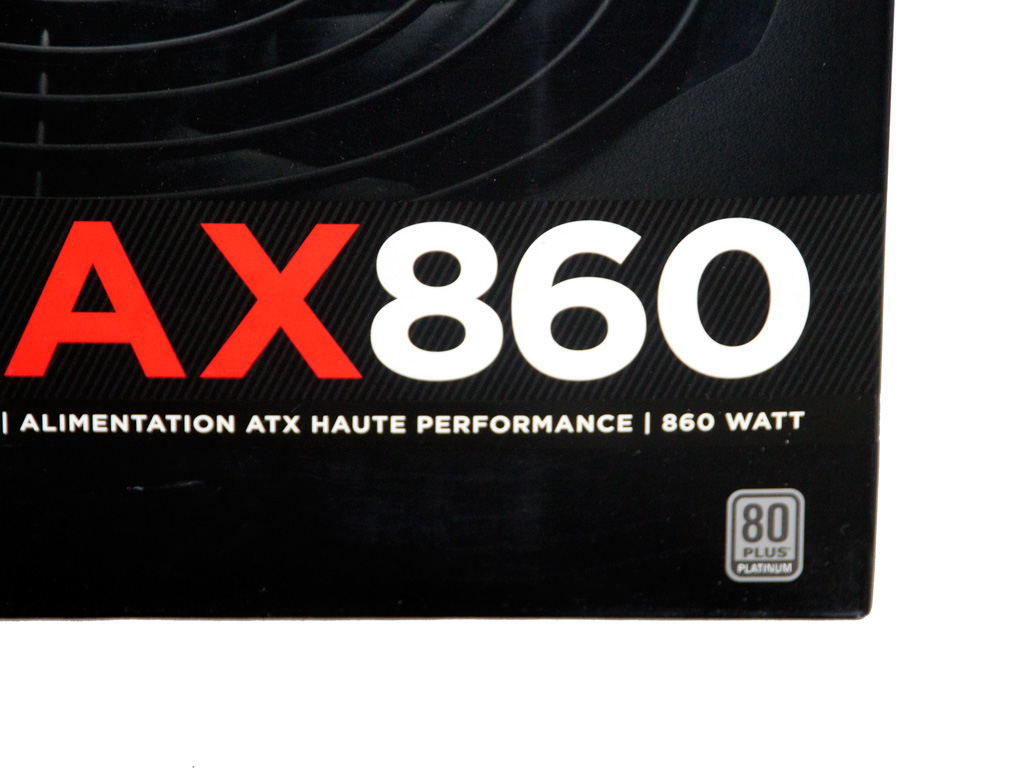
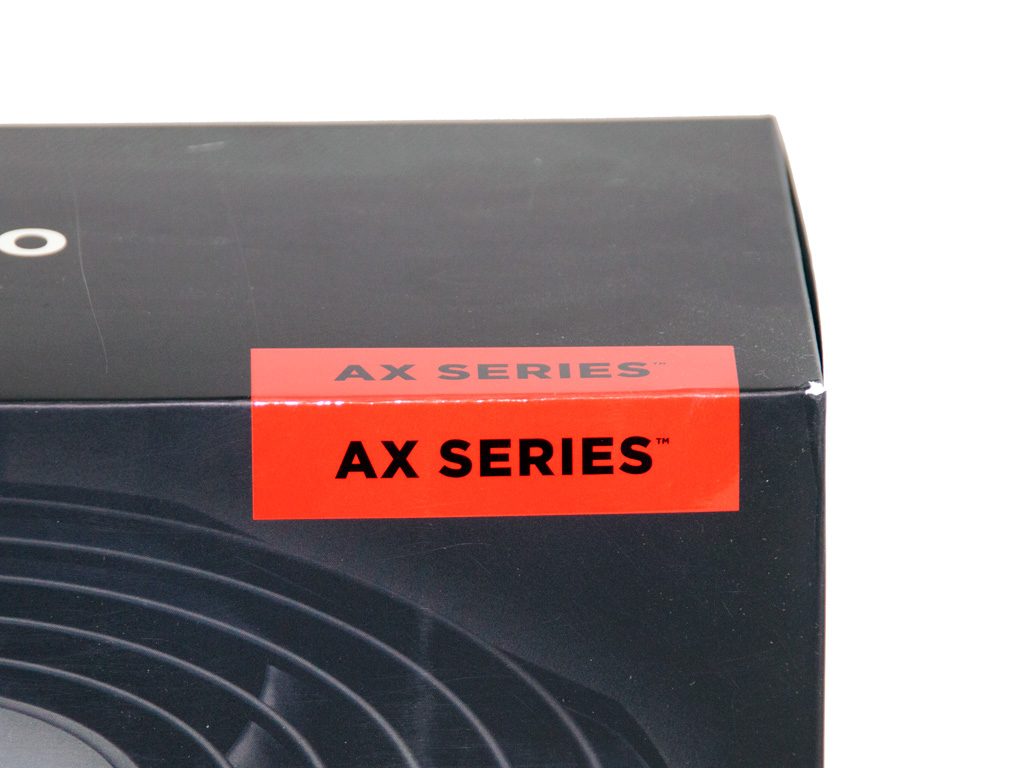
The packaging is identical to that of the AX760 unit, so its front is mostly occupied by a close shot of the fan grill that doesn't follow the unique design of the AXi line-up. The model description is given in large red and white letters, and the Platinum efficiency bade, which is strangely small, resides right below the model description.
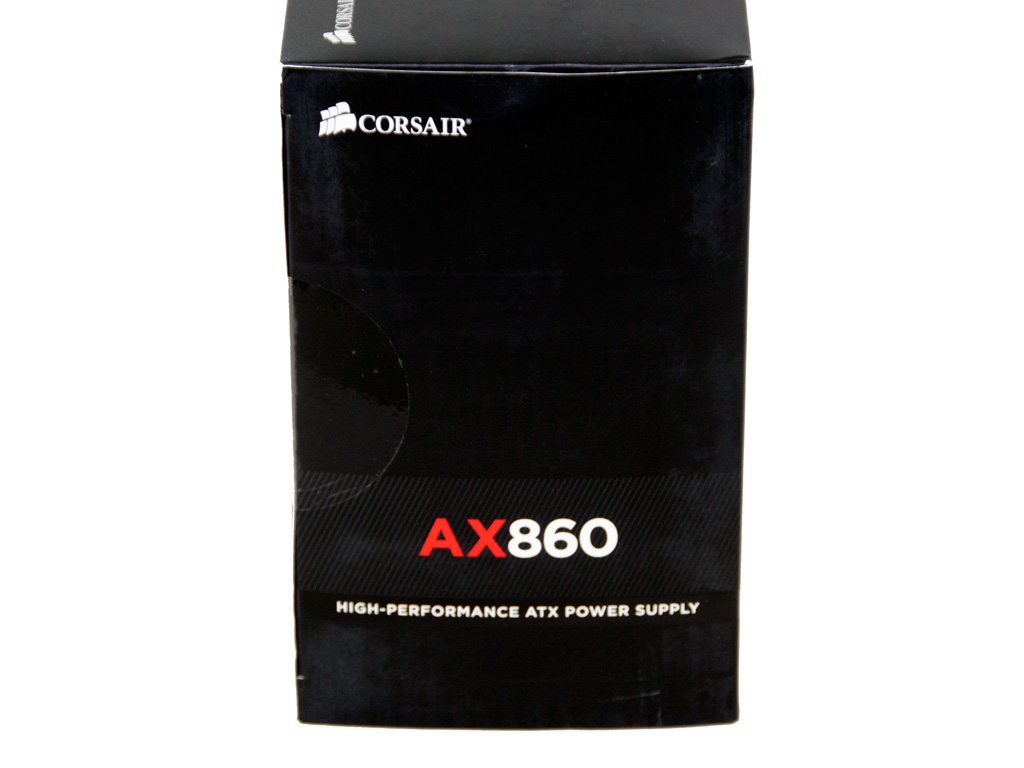
There is, as you can see, nothing of interest on this side.

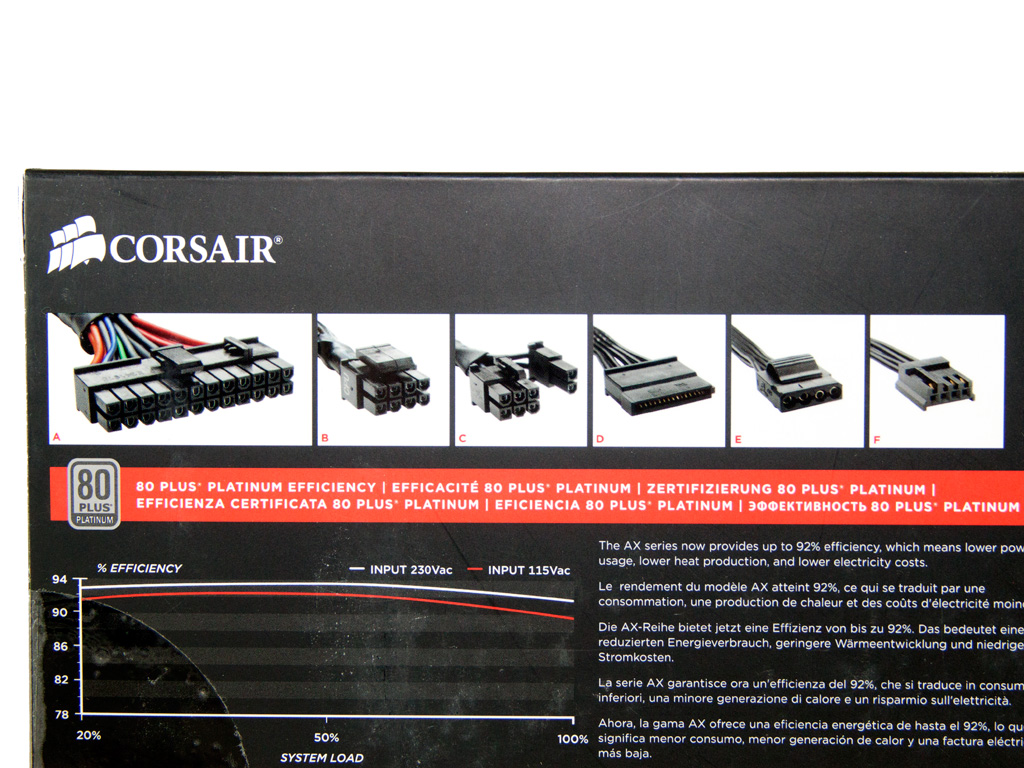
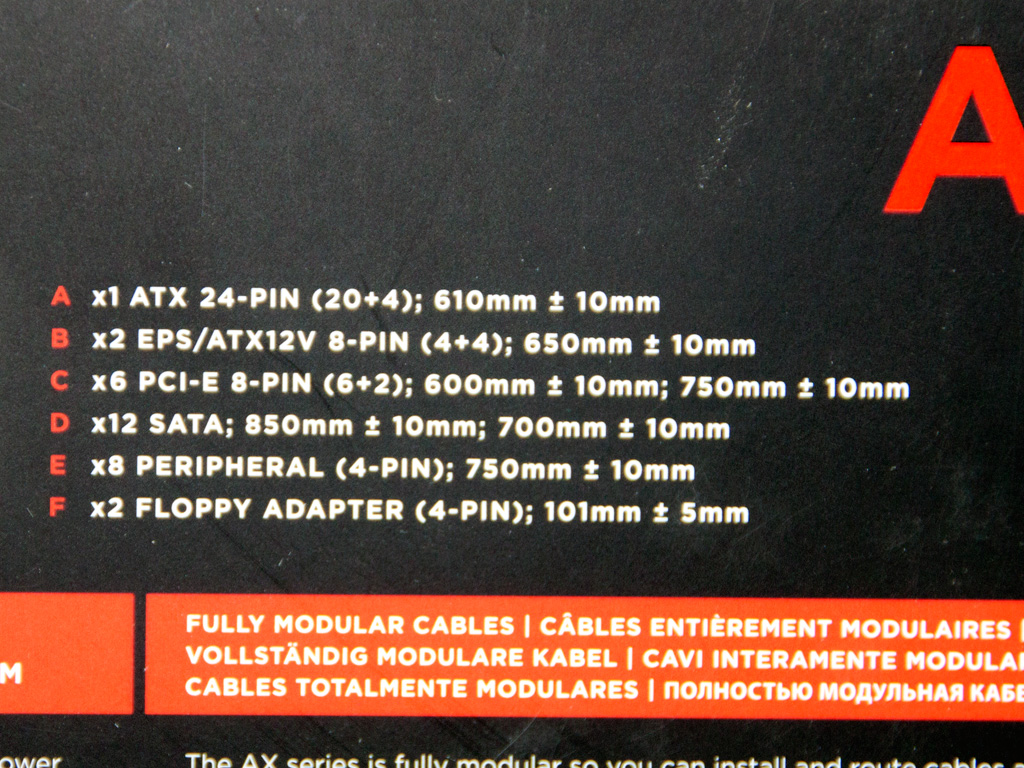
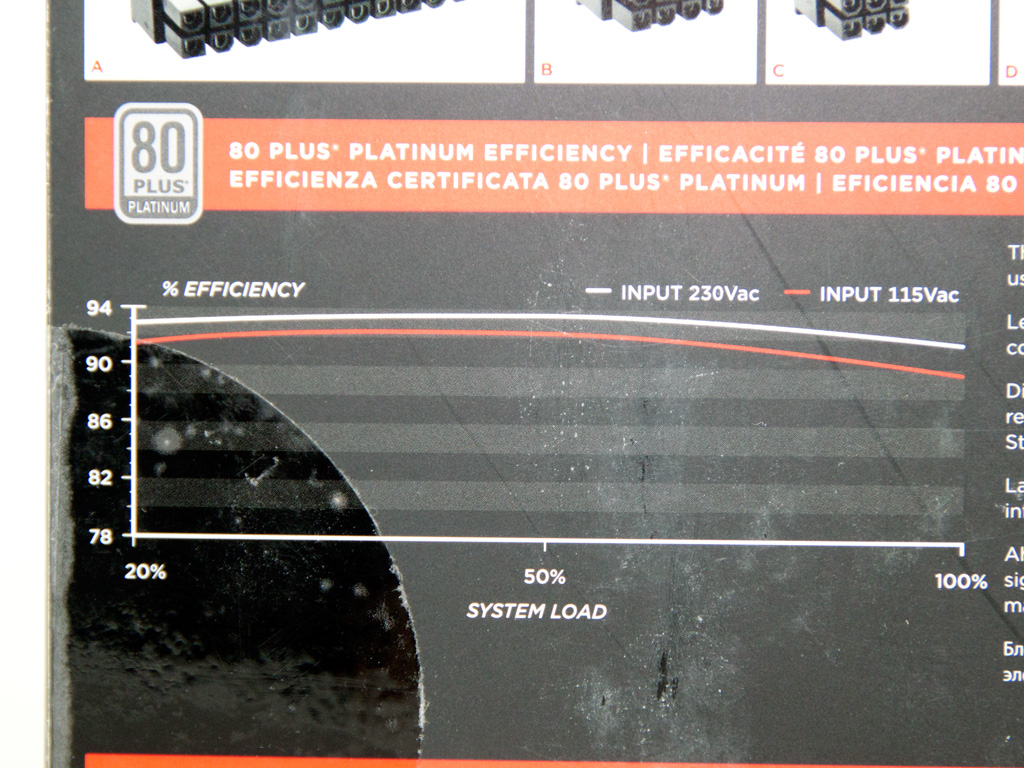
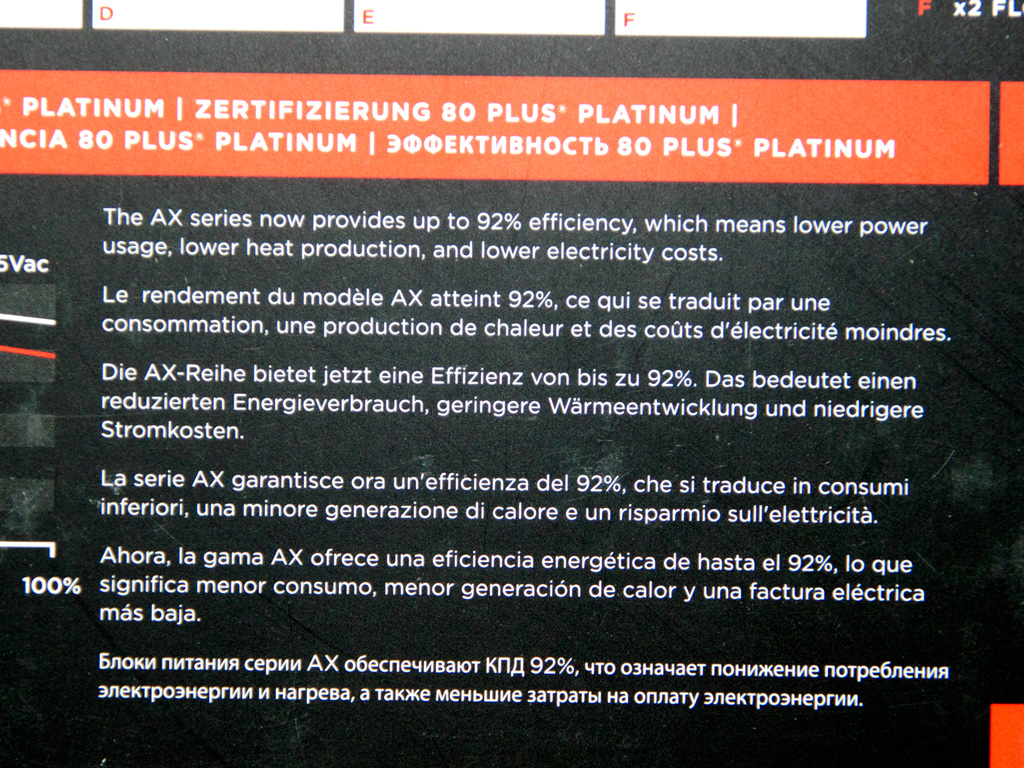
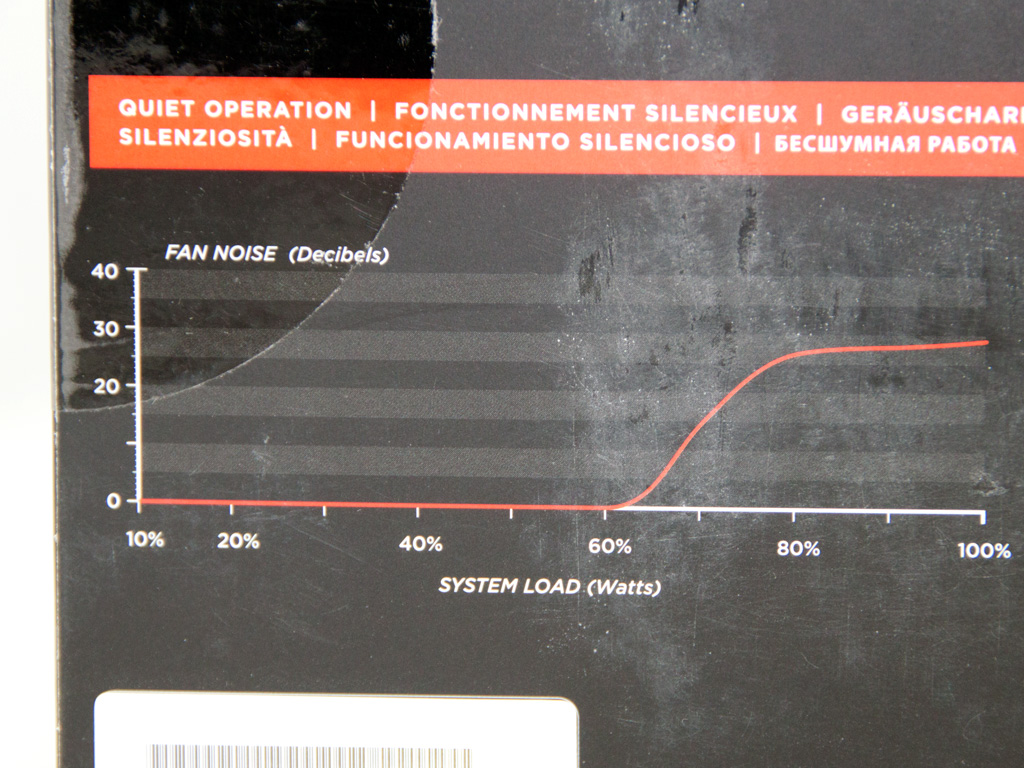
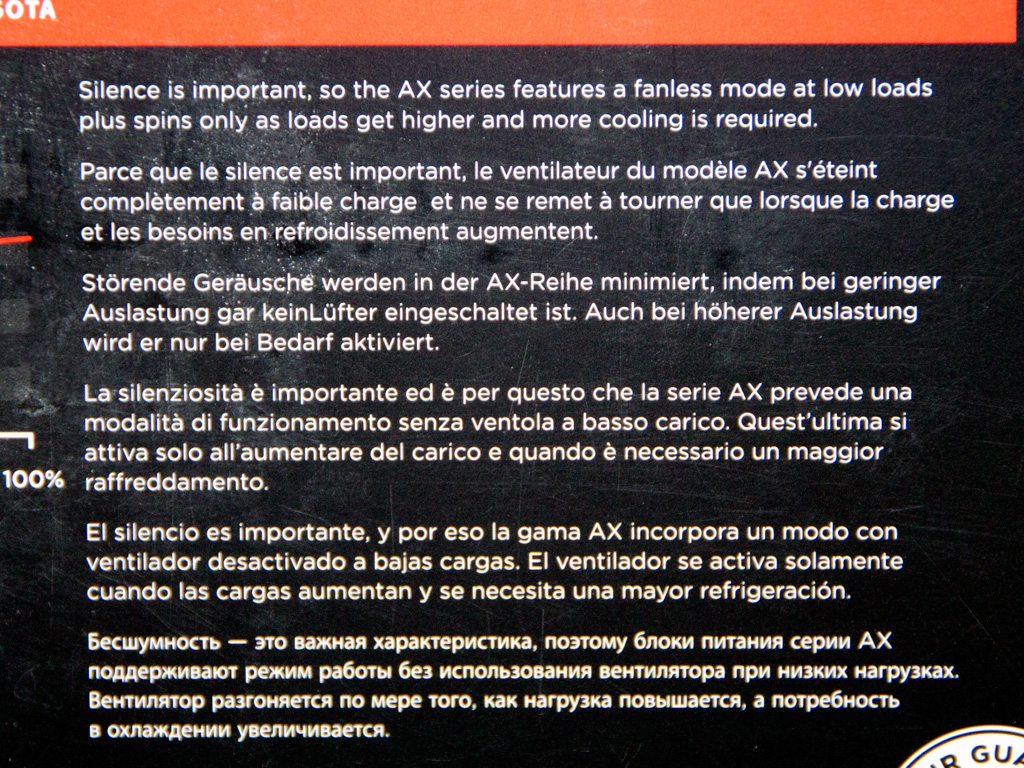
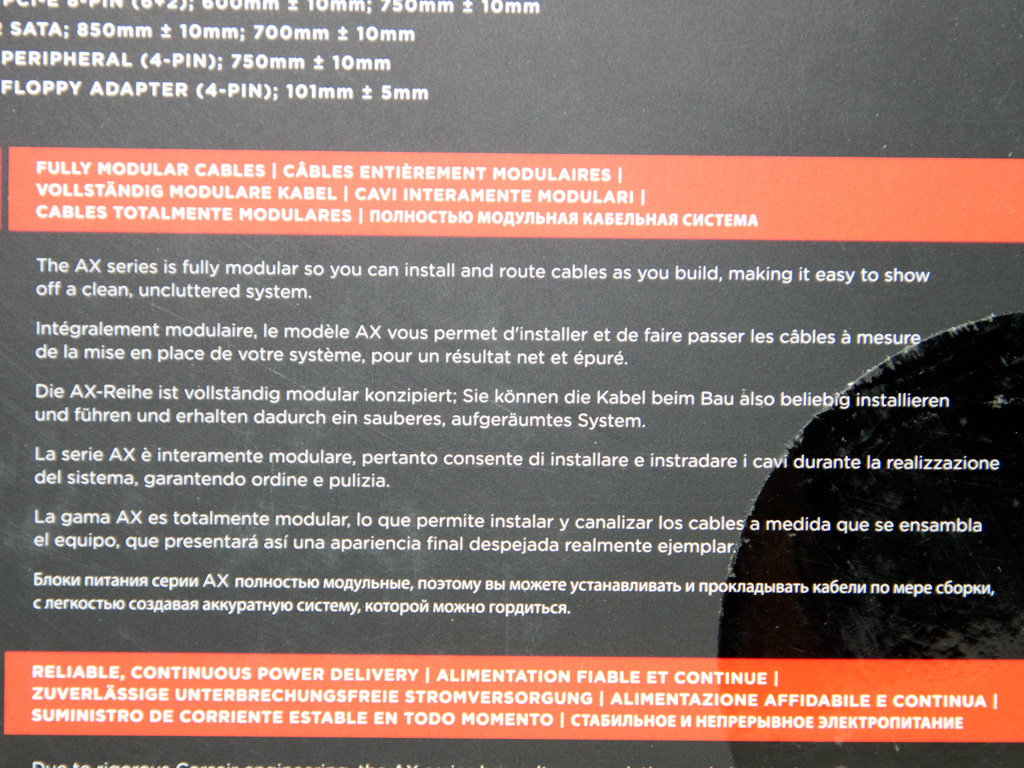
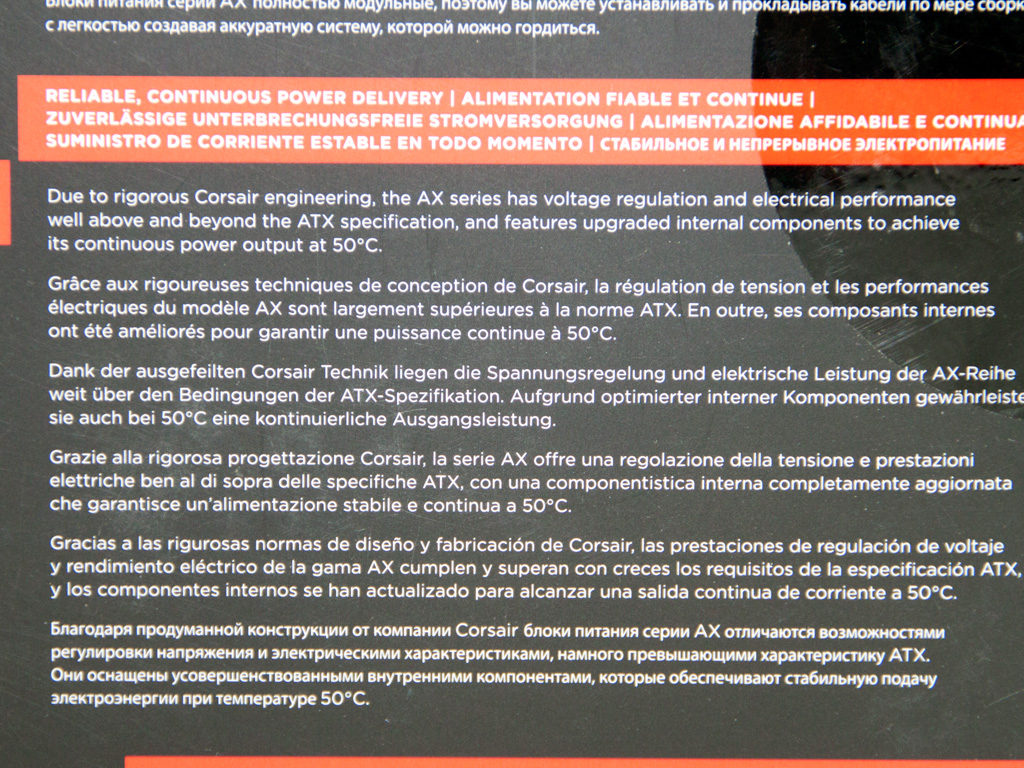
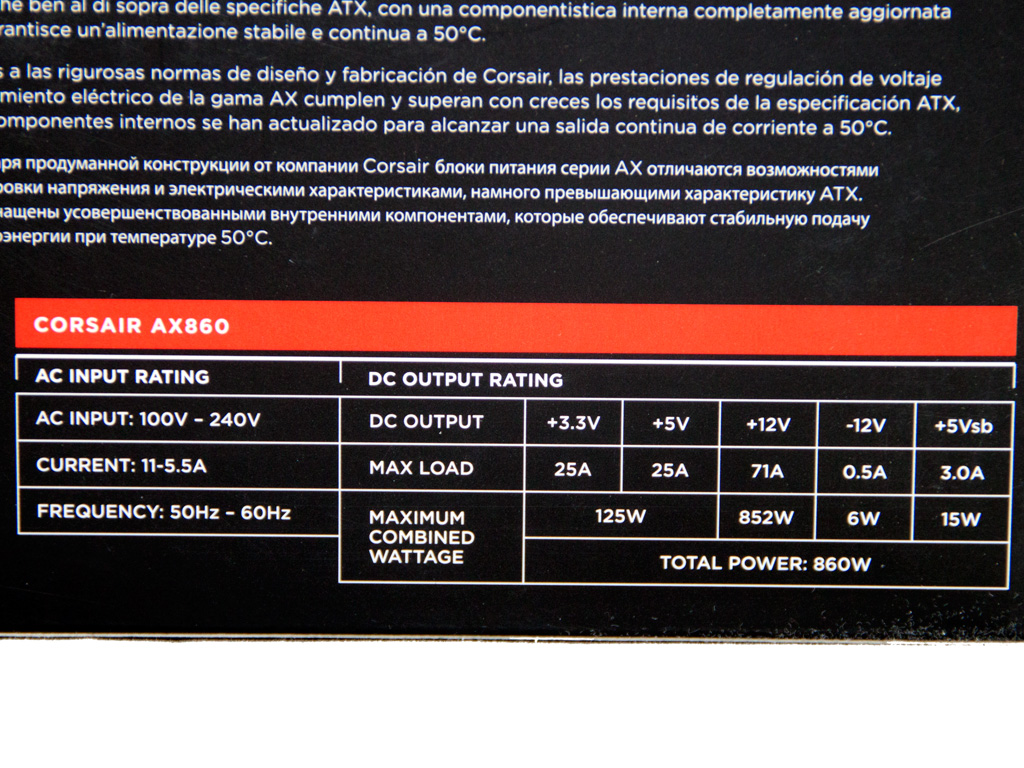
The rear has a description of connectors and a useful cable-length list. There are also two graphs illustrating the unit's efficiency and the noise of the fan. According to the latter graph, the fan engages after 60% of the PSU's maximum-rated-capacity load, so the PSU will spend most of its operational time in fanless mode inside a normal system; that is, if that specification stands. Finally, the power-specifications table is given in the bottom, right corner. It also provides information about the power input the PSU is compatible with.
Our Patreon Silver Supporters can read articles in single-page format.
Nov 15th, 2026 23:01 CST
change timezone
Latest GPU Drivers
New Forum Posts
- The Official Thermal Interface Material thread (2301)
- Asus Rog Maximus Z890 Extreme. (Various questions). (26)
- GPU Temperatures Rise Very Quickly in FurMark – Is This Normal? (7)
- Will zen 6 mobos have anything extra vs current ones? (46)
- Your PC ATM (36435)
- It’s been fascinating times in Retro agian r36s isn’t even worth 50-65 dollars no more and newly listed Rm36 64gb 4in IPS models for only 34 dollars. (6)
- Power supply noise stops when I move the mouse (10)
- Can you guess Which game it is? (320)
- What is the latest game you finished or 100% (203)
- HP Office Jet 7740 Pro - Supply system problem with replacement cartridge (4)
Popular Reviews
- ASUS ROG Strix B850-I Gaming Wi-Fi7 W Review
- Corsair HX1000i Shift Crystal Review
- AMD Zen 6 Technical Deep Dive
- Upcoming Hardware Launches 2027 (Updated Nov 2026)
- Montech King 95 3D PRO Review
- NZXT C1200 Platinum Review
- Phantom Blade Zero Performance Benchmark Review - 35 GPUs Tested
- AMD Ryzen 7 9800X3D Review - The Best Gaming Processor
- NZXT H5 Review
- NZXT H7 RGB+ Review
TPU on YouTube
Controversial News Posts
- NVIDIA Co-Founder and CEO Jensen Huang Officially Resigns (430)
- Open Letter Asking NVIDIA to Reinstate Jensen Huang Passes 115,000 Signatures (184)
- OpenAI CEO Argues Home PCs Waste the World's Limited DRAM Supply (152)
- NVIDIA Launches Investigation Into Jensen Huang's Relationship With Suspected Chinese Spy (136)
- Intel "Raptor Lake Next" 16-Core and 20-Core CPUs Surface (130)
- Legendary Game Studio BioWare Shuts Down Following EA Layoffs (104)
- Dell CEO Says the Memory Shortage Will Get Worse in 2027 (95)
- NVIDIA GeForce RTX 50-Series Scheduled for up to $500 Price Hike This Week (89)