 2
Corsair Force LS 240 GB SSD Review
(2 Comments) »Introduction

Corsair is most well-known for their excellent memory modules, but they've recently also ventured into several other fields. One of their strongest endeavors was entering the SSD market where they are now a key players, providing solid-state drives covering the whole price and performance spectrum.
Their latest addition is the Force LS Series designed to be a value-oriented alternative without compromising on quality.
Corsair is using a Phison PS3108 as the controller—a cost-effective solution with decent performance. It is paired with 19 nanometer Toshiba toggle NAND for quick data transfers.
The Corsair Force LS is available in capacities of 60 GB, 120 GB, and 240 GB. Today, we are reviewing the Force LS 240 GB available for $200 online. According to Corsair, the Force LS Series is not available in the United States at this time, but you'll be able to find it in Europe and rest of the world.
| Specifications: Corsair Force LS 240 GB | |
|---|---|
| Brand: | Corsair |
| Model: | Force LS 240 GB CSSD-F240GBLS |
| Controller: | Phison PS3108-S8 |
| Flash Type: | Toshiba 19 nm, MLC |
| Form Factor | SATA 2.5" |
| Thickness: | 7 mm (Ultrabook compatible) |
| Capacity | 240 GB (223.6 GB usable) 16 GB overprovisioning |
| Interface: | SATA 6 Gbps |
| Firmware: | S8MF05.8 |
| TRIM supported: | Yes |
| NCQ supported: | Yes |
| Warranty: | 3 Years |
Packaging


The Drive


The drive conforms to the dimensions set forth by the 2.5" form factor. It is made of metal, which improves its durability. Its height is only 7 mm, which makes it compatible with Intel's Ultrabook specification.

Like most recent SSDs, the Corsair Force LS uses the SATA 6 Gbps interface. It is compatible with any older SATA standard, but will in such a case work at reduced performance.


You will find the SSD controller and 16 flash chips on the PCB. A DRAM chip next to the flash controller provides operating memory for the controller.
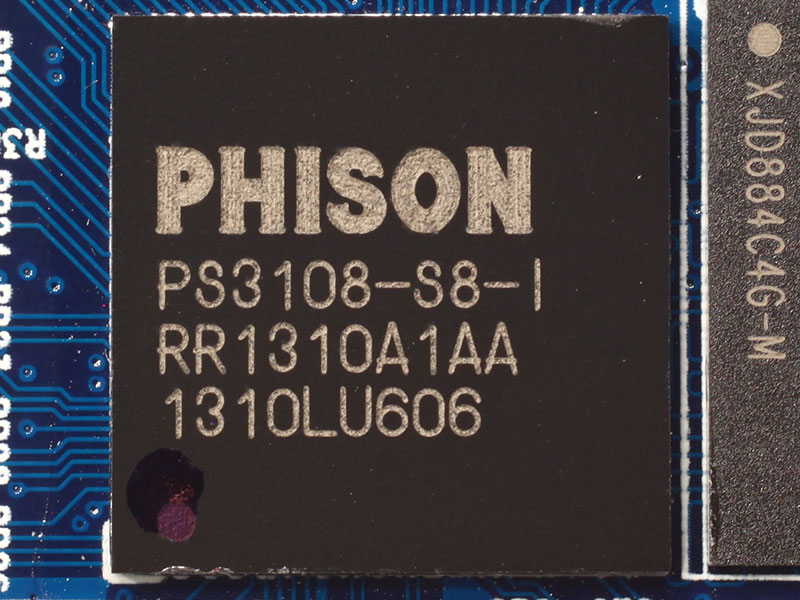
Corsair uses a Phison PS3108-S8 controller with eight channels.

The 16 flash chips are produced by Toshiba on a 19 nanometer process and have been rebranded by Phison.

A DDR3 memory chip, made by Powerchip is also installed on the PCB to provide RAM for the SSD controller.
Our Patreon Silver Supporters can read articles in single-page format.
Nov 24th, 2026 21:25 CST
change timezone
Latest GPU Drivers
New Forum Posts
- AMD ULL settings tinkering thread - post settings and Zen pics (90)
- TPU's F@H Team (20570)
- Can you guess Which game it is? (352)
- The time has come to upgrade...my desktop (13)
- Ryzen Owners Zen Garden (8562)
- WarpCoreBench scores! (99)
- Asus Rog Maximus Z890 Extreme. (Various questions). (34)
- What are you playing? (26253)
- Which ryzen am5 cpu ? (210)
- Your PC ATM (36503)
Popular Reviews
- ASRock X870E Challenger Wi-Fi White Review
- Microsoft Surface Laptop Ultra Review - The Next-gen Arm Laptop
- Upcoming Hardware Launches 2027 (Updated Nov 2026)
- VZMORE AX9 Max Review
- AMD Ryzen 7 9800X3D Review - The Best Gaming Processor
- Corsair RM1200e (Second Generation) Review
- AMD Zen 6 Technical Deep Dive
- Phantom Blade Zero Performance Benchmark Review - 35 GPUs Tested
- Pulsar Office Tour & First Look at P1 Dual-Sensor Mouse
- Ocypus lota P1000 Review
TPU on YouTube
Controversial News Posts
- Jensen Huang Reinstated as CEO of NVIDIA (534)
- NVIDIA Co-Founder and CEO Jensen Huang Officially Resigns (492)
- Report: Jensen Huang Eyes NVIDIA Comeback (281)
- Open Letter Asking NVIDIA to Reinstate Jensen Huang Passes 115,000 Signatures (184)
- OpenAI CEO Argues Home PCs Waste the World's Limited DRAM Supply (152)
- NVIDIA Launches Investigation Into Jensen Huang's Relationship With Suspected Chinese Spy (136)
- Intel "Raptor Lake Next" 16-Core and 20-Core CPUs Surface (130)
- Intel Razor Lake Gets a 12 P-Core bLLC Chip With No E-Cores, Per Leak (94)