 17
Creative Pebble Nova Review
Value & Conclusion »Sound Quality
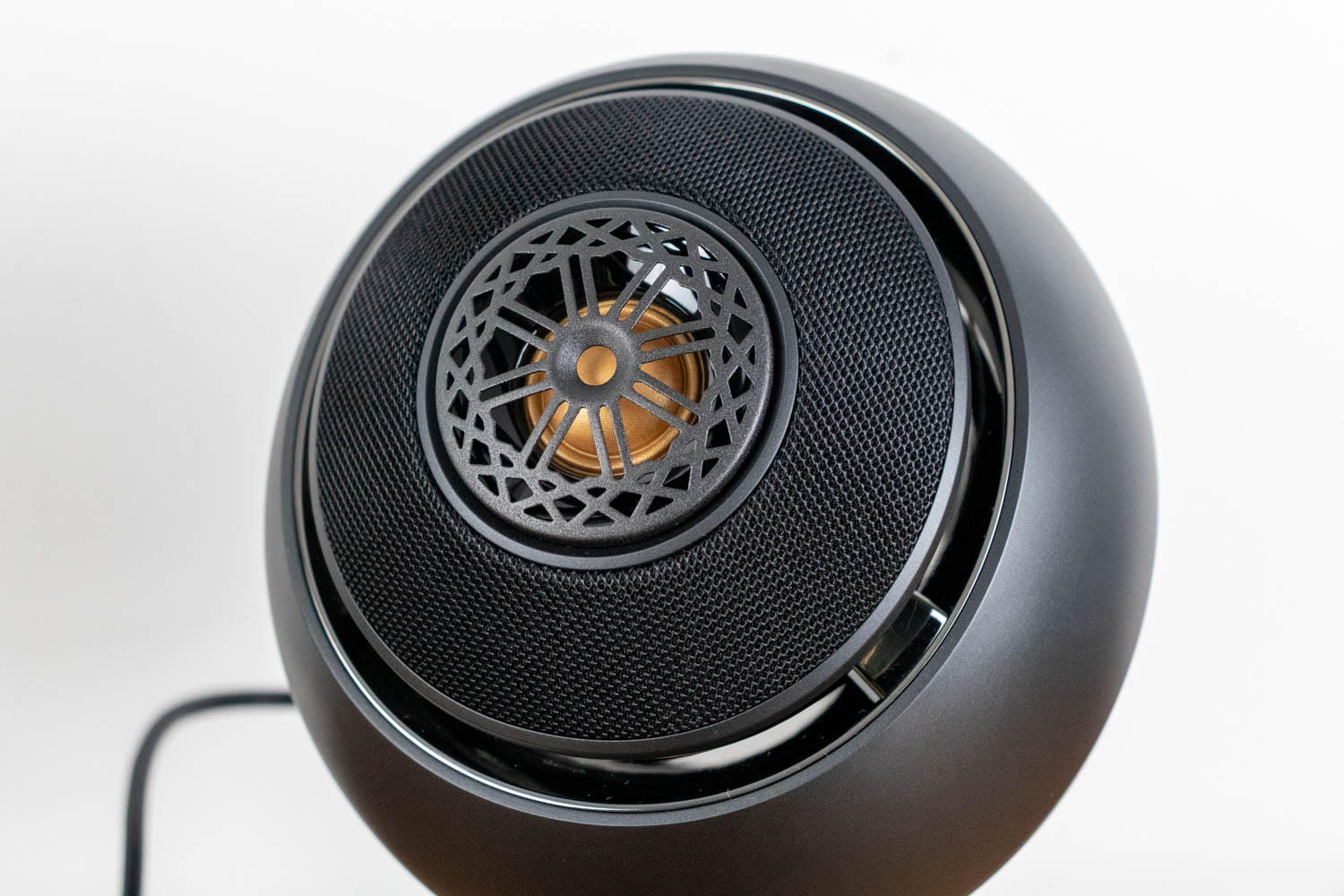
The Creative Pebble Nova is a 2.0 speaker system, meaning there's no subwoofer - bass duties are handled entirely by the 3-inch woofers and the rear-firing passive radiators. Each speaker uses a coaxial driver layout, pairing a 3-inch woofer with a 1-inch tweeter on the same axis. This is the Pebble Nova's biggest technical talking point, so it's worth explaining what it actually means. In a conventional two-way speaker, the woofer and tweeter are mounted separately, one above the other. The problem with that arrangement is that the sound from each driver originates from a different point in space, which can lead to phase inconsistencies and a less coherent soundstage, especially off-axis. A coaxial design solves this by mounting the tweeter concentrically within the woofer, so that both drivers share the same acoustic center. The result, at least in theory, is better time alignment, improved coherence across the frequency spectrum, and a more consistent listening experience regardless of your exact position relative to the speaker. Coaxial drivers aren't a new idea; they've been used in car audio for decades and in high-end home speakers by the likes of KEF, Tannoy, Genelec and many others. Seeing them in a $280 desktop speaker is interesting, but the implementation matters far more than the topology itself.
The specified power output is 50 W RMS (2× 25 W) with a peak of 100 W, making these the most powerful speakers in the Pebble family. The specified frequency range is 55-20,000 Hz, and the signal-to-noise ratio is rated at 93 dB or better. The built-in Bluetooth 5.3 chip supports only the SBC codec. The playback resolution when connected via USB-C is locked at 16-bit/48 kHz.
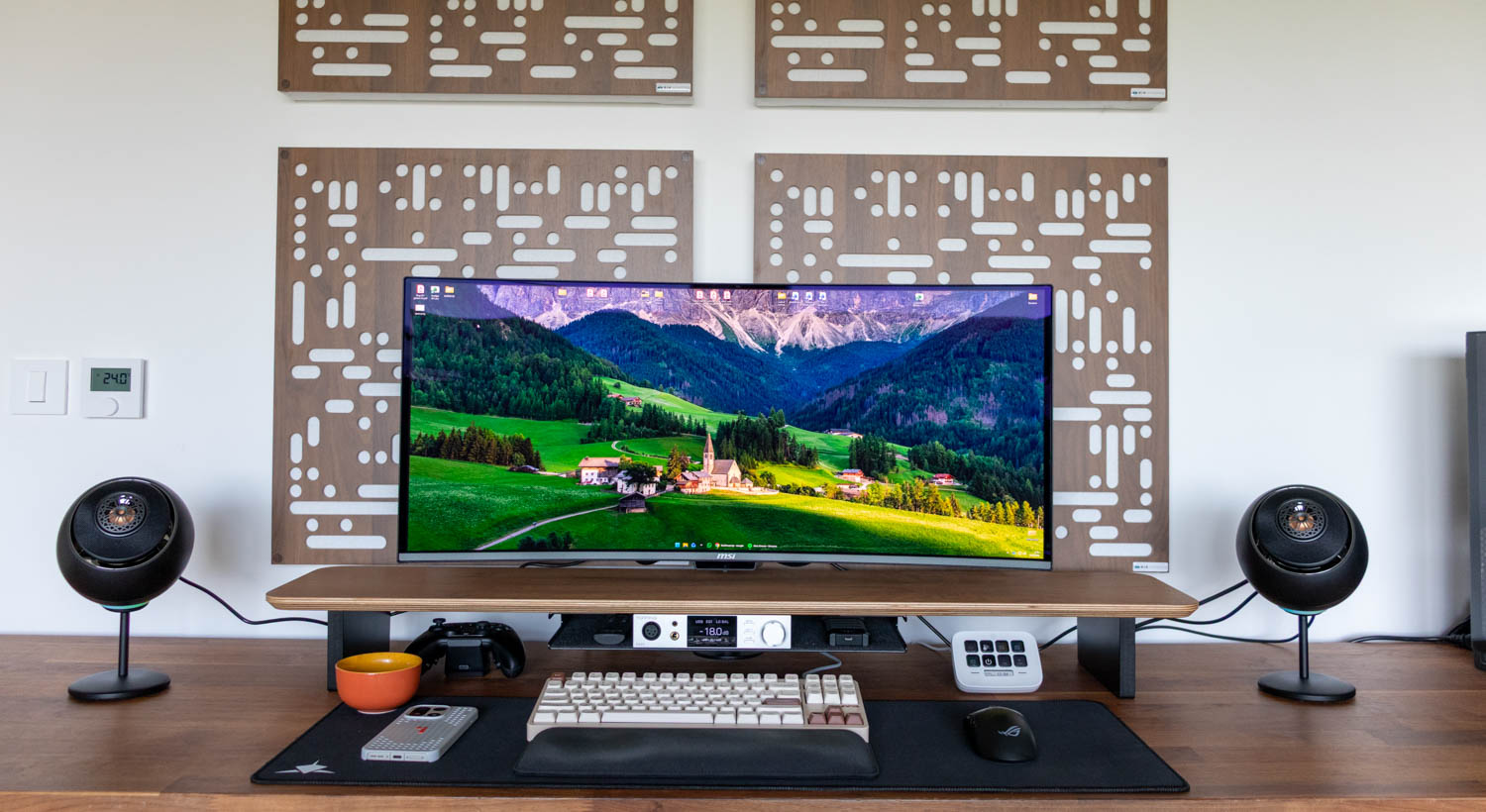
My performance impressions are based on the Pebble Nova being connected to a desktop computer via USB-C and powered by the supplied 65 W USB-C PD adapter, in an acoustically treated home office.
Let's start with what's most obviously missing: deep, impactful bass. The Pebble Nova is a 2.0 system, and it sounds like one. The passive radiators do their best to reinforce the low end, and there's a certain degree of bass presence – you're not listening to a completely thin, hollow speaker. However, anyone expecting the kind of punch and depth that a larger-diameter woofer or a dedicated subwoofer provides will be disappointed. The bass is there, but it's neither deep nor particularly rich. It fills in the lower midrange and gives the sound some body, but it falls short of being satisfying for genres that lean heavily on low-end impact, such as electronic music, hip-hop, or action movie soundtracks. If you're a basshead, the Pebble Nova is simply not the right choice for you.
The midrange is the strongest aspect of the Pebble Nova's performance. Vocals, both male and female, come through with decent clarity and good presence. I wouldn't describe the overall tonality as warm – it's more neutral-leaning than the Pebble X Plus, which had a distinctly warm character. Detail retrieval is decent, though nothing that would impress you if you've spent any meaningful time with proper studio monitors or Hi-fi bookshelf speakers in this price range. It's adequate for casual listening, gaming, and multimedia consumption, but it doesn't stand out as a highlight of the system.
The dedicated 1-inch tweeter, one of the Pebble Nova's marquee features, delivers higher frequencies smoothly enough, but is tuned fairly conservatively – never shrill or fatiguing, but also not very exciting. Given the $280 price tag and the presence of a separate tweeter, I expected more energy and definition in the upper registers than what's on offer here. The good news is that the EQ options in the Creative App (at least the mobile version) allow you to boost the treble to taste, which does help, without introducing distortion.
The soundstage isn't particularly wide, which is somewhat expected from a pair of spherical speakers sitting on a desk. What's more interesting is the phantom center imaging – the sound seems to originate from the monitor itself rather than from the speakers on either side of it. That's a neat trick, and it works consistently enough to be considered a genuine positive. The 45 ° driver angle continues to do its job here, as it did on the Pebble X Plus, directing the sound toward the listener's ears effectively.
One issue that bugged me during the review was the volume ceiling. When connected via USB-C, I often found myself pushing the volume all the way to 100 and wishing the speakers could go a little louder. To be clear, the Pebble Nova isn't quiet – it can fill a small room. But with quieter recordings or when I wanted to feel genuinely immersed in the music at my desk, I was running out of headroom. For a system with 50 W RMS of specified output, I expected more gain than what's available. Do keep in mind my room is acoustically treated and therefore more dampened than an average living space; in a livelier room, this may be less of an issue.
Comparison to Creative Pebble X Plus
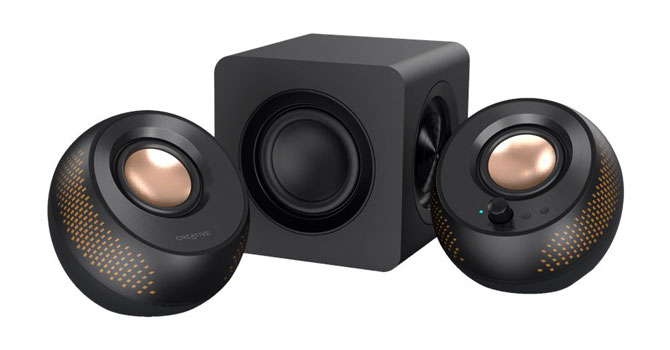
The Pebble X Plus is a 2.1 system retailing for $130 – less than half the price of the Pebble Nova. It comes with a compact subwoofer, 2.75-inch full-range drivers, and the same connectivity options minus the coaxial drivers and metal stands. Here's the thing: the Pebble X Plus, with its subwoofer, delivers a fuller and more satisfying overall sound for the money. The subwoofer adds punch and depth that the Nova's passive radiators can't match, and the X Plus has a warmer, more forgiving tonal balance that's easy to enjoy for extended listening sessions. The Pebble Nova does come out ahead in build quality, particularly thanks to the metal stands, the included PD power adapter, and the coaxial drivers that contribute to better coherence between the tweeter and woofer. The Nova has better midrange clarity and a more refined driver arrangement on paper, but in the end, the real-world difference in sound quality does not justify the $150 price gap.
It's also worth putting the Pebble Nova's $280 price into a broader context. At that price point, you're in the territory of well-established nearfield monitors and powered bookshelf speakers. The IK Multimedia iLoud Micro Monitor ($300), for example, packs a similar 3" woofer and 3/4" tweeter into an even smaller enclosure, but with a 56-bit DSP, Bluetooth, and a reputation for punching absurdly far above its weight in sound quality - it's a staple in home studios for a reason. The JBL One Series 104-BT ($250) is an especially interesting comparison because it also uses a coaxial driver design, so if it's the coaxial concept that appeals to you, JBL offers it for less money with arguably better tuning. Then there are options like the Audioengine A2+ ($269), ($350, but often discounted), and the Onkyo GX-30ARC ($300), all of which offer a more traditional speaker form factor with proven acoustic designs. If your priority is sound quality above all else, these alternatives deserve serious consideration. The Pebble Nova's unique selling points—the striking spherical design, compact footprint, and all-in-one USB-C connectivity—are real, but they're lifestyle features, not audio ones.
Nov 20th, 2026 14:47 PST
change timezone
Latest GPU Drivers
New Forum Posts
- Logitech Headsets Modded Driver — Unlock Dolby in G HUB (23)
- 1 - 5 person file storage server equivalent accasible from anywhere + general VM server. (1)
- WarpCoreBench scores! (81)
- How to prevent OLED burn damage due to PC freezes or power outtages? (48)
- RX 9000 series GPU Owners Club (2247)
- Honestly, do you care about GTA VI? (208)
- When you could finally run Crysis maxed out? (63)
- GTA VI (20)
- Anthrophics IPO (25)
- GeekMagic Ultra Smart WiFi Weather Station (8)
Popular Reviews
- AMD Zen 6 Technical Deep Dive
- Microsoft Surface Laptop Ultra Review - The Next-gen Arm Laptop
- Ugreen NASync DXP4800 GT Review
- Corsair RM1200e (Second Generation) Review
- Acemagic Retro X3 Review
- Upcoming Hardware Launches 2027 (Updated Nov 2026)
- Pulsar Office Tour & First Look at P1 Dual-Sensor Mouse
- Biwin Black Opal NV7400 2 TB Review
- AMD Ryzen 7 9800X3D Memory Performance Scaling
- AMD Ryzen 7 9800X3D Review - The Best Gaming Processor
TPU on YouTube
Controversial News Posts
- NVIDIA Co-Founder and CEO Jensen Huang Officially Resigns (490)
- Report: Jensen Huang Eyes NVIDIA Comeback (256)
- Open Letter Asking NVIDIA to Reinstate Jensen Huang Passes 115,000 Signatures (184)
- OpenAI CEO Argues Home PCs Waste the World's Limited DRAM Supply (152)
- NVIDIA Launches Investigation Into Jensen Huang's Relationship With Suspected Chinese Spy (136)
- Intel "Raptor Lake Next" 16-Core and 20-Core CPUs Surface (130)
- Legendary Game Studio BioWare Shuts Down Following EA Layoffs (104)
- Dell CEO Says the Memory Shortage Will Get Worse in 2027 (95)