 55
Crucial CUDIMM DDR5-6400 128 GB CL52 Review
Value & Conclusion »So much memory!


Crucial generously provided a second set of 128 GB (2x 64 GB) for review. However, this substantial amount of system memory necessitated a departure from our traditional review format. The standard benchmark suite, which primarily focuses on gaming performance, doesn't adequately capture the benefits of such a large amount of RAM. To provide a more nuanced understanding, we'll be taking a different approach in this review, adopting an editorial style that shares our personal, real-world experience with large media projects in a professional workflow. Followed by a quick look into LLMs and the absurdity that is 256 GB of system memory.
Benchmarks
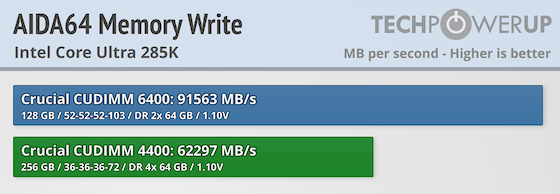
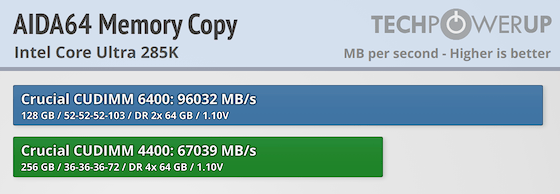
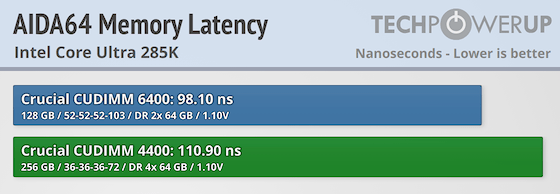
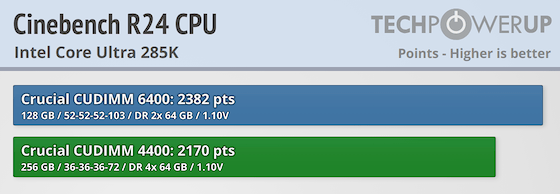
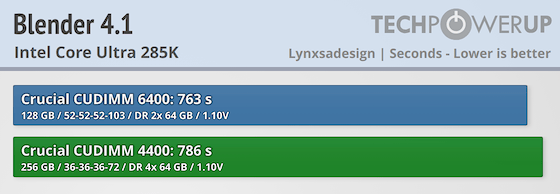
Prior to delving into our editorial section, we conducted some relevant benchmarks to provide context. Notably, our 4x 64 GB (256 GB) configuration was running at DDR5-4400 speeds. This was due to the limitations of the motherboard and CPU when using automatic settings, as the memory is JEDEC-standard with no XMP or EXPO profiles. Our goal was to replicate the experience of an average user. Although any single pair of DIMMs in the four available slots can reach DDR5-6400 speeds, combining two pairs of dual-rank DIMMs results in a significant reduction in bandwidth due to lower memory speed, thus lower performance as well. This is because the CPU's memory controller is designed for dual-channel operation, meaning that when a second set of memory is added to the remaining slots, the additional ranks of memory per channel must share the same traces. In addition, now the memory controller must perform "on-fly" interleaving, which adds overhead and in this instance requires lower speeds to accommodate the extra memory.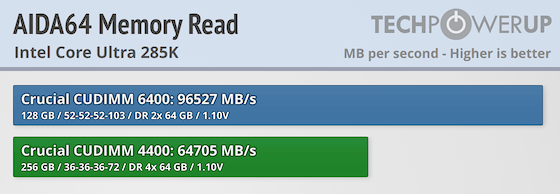
Graphical & Video Production Workflow
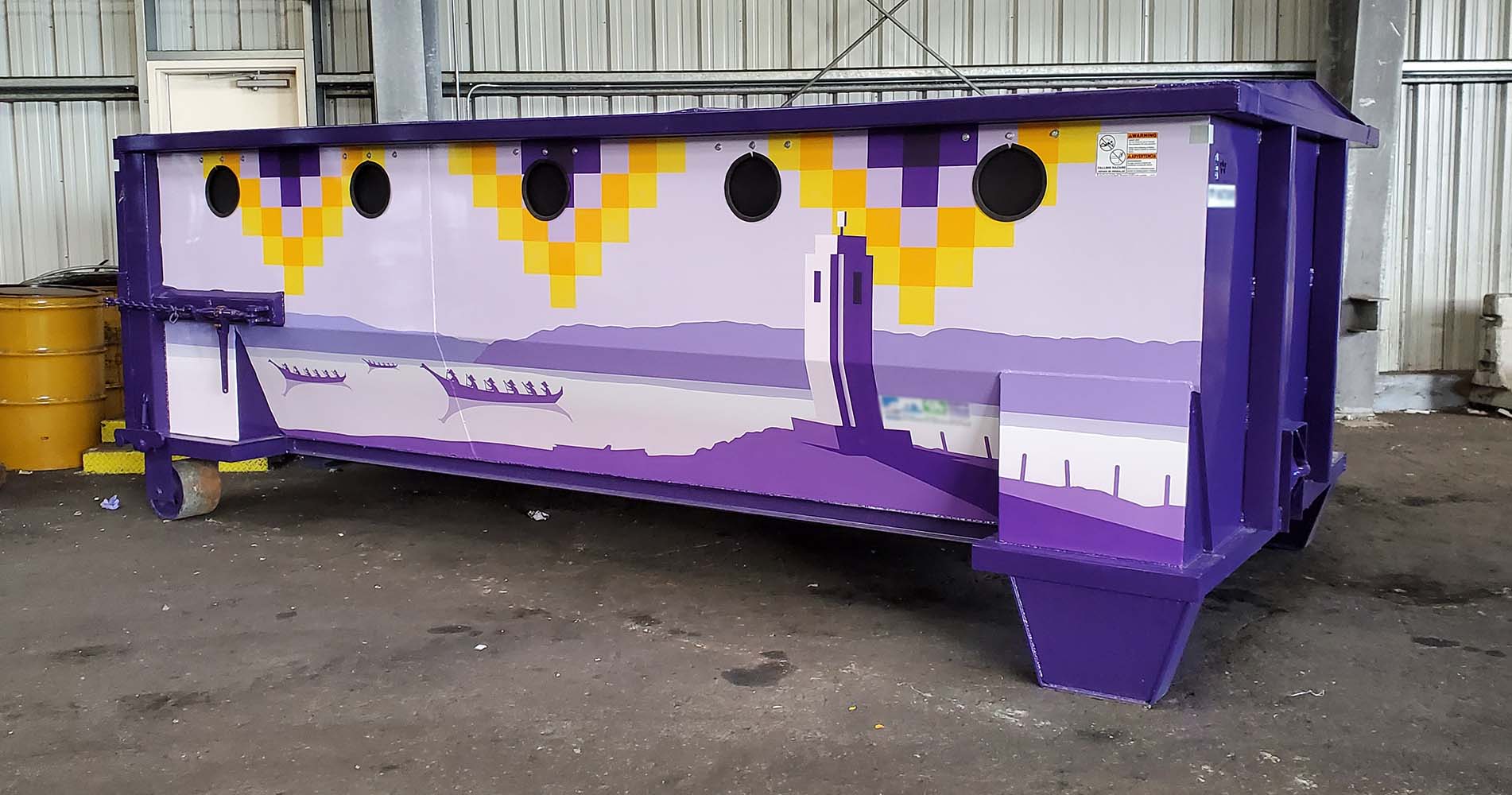
Throughout my career in media and communication, I've consistently encountered a frustrating issue: programs crashing due to insufficient system memory. A notable example that still resonates with me is from my time as a pre-press technician, where I prepared client files for printing on large-format printers or offset presses. We had a project with the local Waste and Recovery Center to print and wrap dumpsters with artwork created by a community artist. However, only one of the eight artists followed the guidelines, while the others submitted files that were a jumbled mix of vector graphics and smart objects embedded in massive Photoshop files or 30 ft x 12 ft canvases at 300 DPI. Opening these files was a laborious process that could take an entire lunch break, and even minor edits would often cause the program to crash instantly. Our team's workaround was to divide the files into smaller sections, but even then, it took three days to complete, largely because only one computer had 64 GB of RAM - barely enough to open, crop, and save the files. This experience taught me a valuable lesson: clients rarely follow instructions, and as the pre-press technician, it's my responsibility to troubleshoot and resolve issues without escalating them to sales representatives. Also, more system memory vastly outweighed the potential time saved than with a faster computer with substantially less memory available.
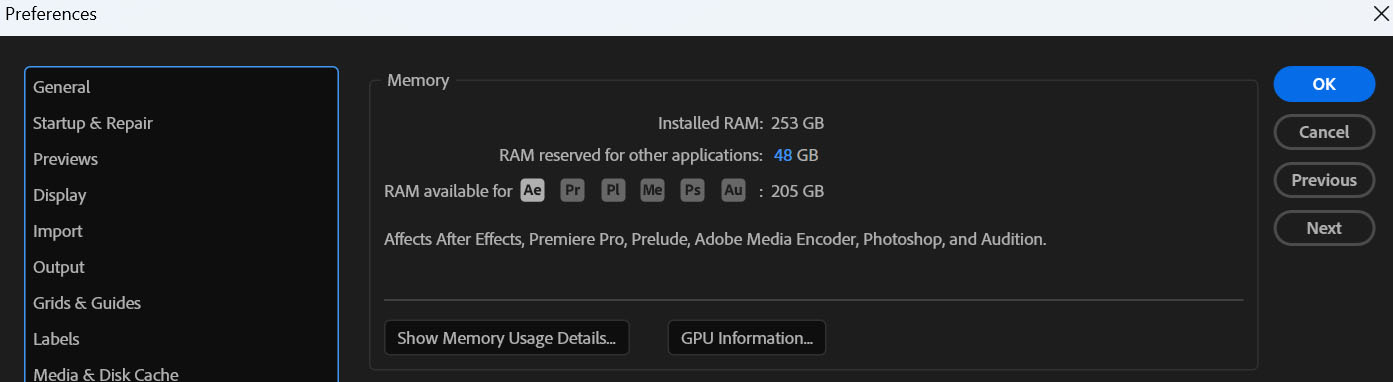
During my time at a local TV station, one of my tasks was to update the graphics that played between segments and commercial breaks from standard definition (SD) to 4K resolution using Adobe After Effects. Although the main project file was available, exporting the graphics in higher resolution proved to be a challenging process. Initially, I had to track down broken links to files scattered across old external drives, which was a time-consuming effort. The computer's limited resources meant that I couldn't have multiple resource-intensive Adobe programs open simultaneously, forcing me to constantly open and close applications to find the necessary files - even Adobe Bridge wouldn't display previews of the files. In some cases, I had to recreate certain Adobe Illustrator files from scratch. The main issue was lack of system memory. Fast forwards to 2023, Adobe introduced a significant update that enables more seamless editing because of live updates from linked files, greatly enhancing productivity. With this new capability, I could now have all the essential programs for a project open and ready for live edits, which has been a game-changer. However, this increased functionality also translates to a greater demand for system memory, highlighting the importance of having ample RAM to support resource-intensive workflows.
Large Language Models
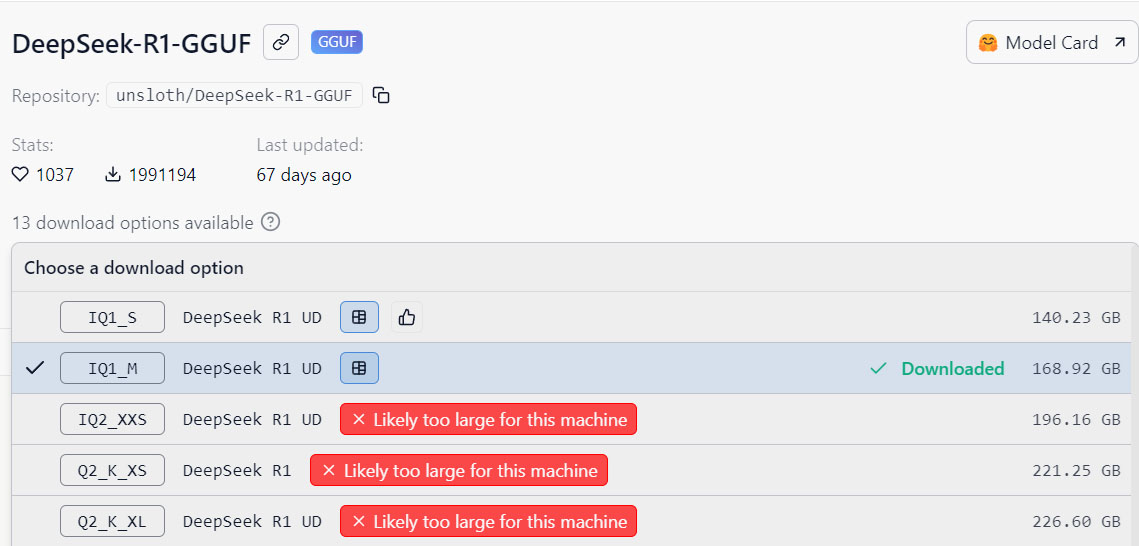
The trend towards enhanced productivity is also being driven by the integration of artificial intelligence (AI). It started from specialized software, to now open-source solutions that can run locally on personal computers, rather than relying on cloud servers. I must admit that my knowledge of Large Language Models (LLMs) and their optimal applications is limited - as a non-programmer and non-data scientist, I am nowhere close to an expert in this field. In fact, having a large amount of system memory at my disposal is somewhat wasted on me, given my lack of technical expertise. Nevertheless, I can still leverage the potential of AI by downloading massive models like DeepSeek R1 and exploring their capabilities - starting with the most pressing question of all.
Q: "How much wood would a woodchuck chuck if a woodchuck could chuck wood?"
A: The classic tongue twister "How much wood would a woodchuck chuck if a woodchuck could chuck wood?" is purely playful, as woodchucks (groundhogs) don't actually move wood. However, for fun speculation:
Physical Capabilities: Groundhogs weigh 4-14 lbs and dig burrows, displacing ~700 lbs of earth. Translating this effort to wood might mean moving smaller logs frequently, but exact numbers are guesswork.
Playful Estimates:
- Folklore humor: "A cord (128 cubic feet) per day," though unrealistic.
- A joke answer: "362.7 cords" for a faux-precise twist.
In reality, since woodchucks don't chuck wood, any number is just for fun!
Nov 28th, 2026 02:41 CST
change timezone
Latest GPU Drivers
New Forum Posts
- -18C on GPU by moving it to the front of the case. (24)
- What's your main Black Friday / Cyber Monday purchase? (44)
- Wireless Internet sharing between PC and router both-ways, is it possible? (35)
- Rare GPUs / Unreleased GPUs (2273)
- Mouse Pad advice - Shidenkai out of production? (22)
- Unigine Superposition GPU Benchmark (1080P Extreme) (463)
- Unigine Superposition on Linux (21)
- CPU Database (305)
- Exit Adobe - PDF reader, and PDF editor recommendations (11)
- TPU's WCG/BOINC Team (34815)
Popular Reviews
- Upcoming Hardware Launches 2027 (Updated Nov 2026)
- AMD Ryzen 7 9800X3D Review - The Best Gaming Processor
- Moaiplay Ora Pro G1 850 Review
- VZMORE AX9 Max Review
- Montech CyberFlow ARGB 360 Review
- ASRock X870E Challenger Wi-Fi White Review
- AMD Zen 6 Technical Deep Dive
- ORICO Obook15 AI Review
- Microsoft Surface Laptop Ultra Review - The Next-gen Arm Laptop
- Phantom Blade Zero Performance Benchmark Review - 35 GPUs Tested
TPU on YouTube
Controversial News Posts
- Jensen Huang Reinstated as CEO of NVIDIA (627)
- NVIDIA Co-Founder and CEO Jensen Huang Officially Resigns (492)
- Report: Jensen Huang Eyes NVIDIA Comeback (281)
- Open Letter Asking NVIDIA to Reinstate Jensen Huang Passes 115,000 Signatures (184)
- OpenAI CEO Argues Home PCs Waste the World's Limited DRAM Supply (152)
- NVIDIA Launches Investigation Into Jensen Huang's Relationship With Suspected Chinese Spy (136)
- Intel Razor Lake Gets a 12 P-Core bLLC Chip With No E-Cores, Per Leak (94)
- NVIDIA GeForce RTX 50-Series Scheduled for up to $500 Price Hike This Week (89)