 7
Custom Art FIBAE 7 Unlimited CIEMs Review
Value & Conclusion »Fit and Comfort
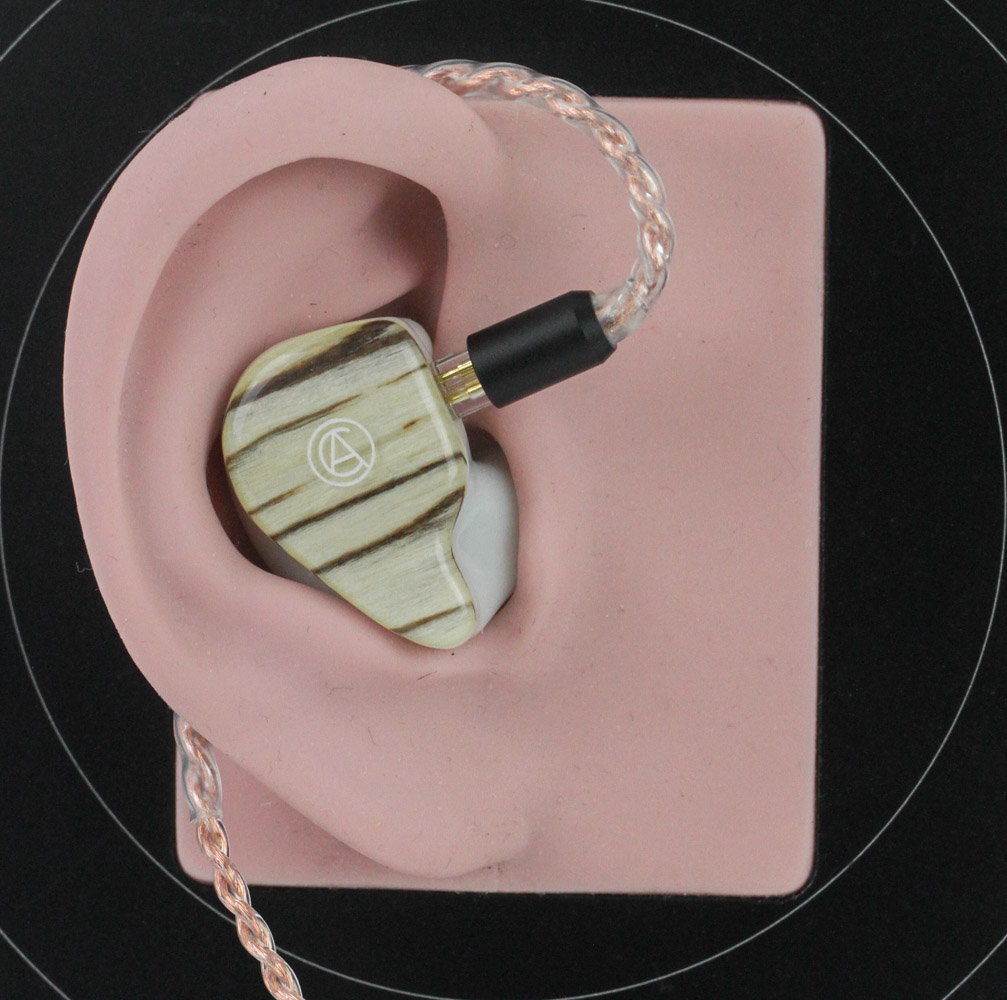


Seen above is the right channel of the Custom Art FIBAE 7 Unlimited CIEMs placed into an artificial ear mold. I mentioned in all my previous IEM reviews how I have average-sized ears, and the ear mold above represents my own experiences well enough as a proxy. As such, I surely had to take a photo of these in my own ears too. The phrase "fitting like a glove" came to mine but I'd rather say "fitting like a CIEM" going forward given how well these worked. I have also seen a few people recommend using hearing aid lubricants such as Otoferm to help with the insertion and seal from CIEMs. The way you essentially insert these is by going in from the top and angling into the ear canal until you actually feel the seal in place. Do the same in reverse to extract it, and then see if you need the lubricant, which I ended up foregoing. The CIEMs will also seal better over the next few days as ear wax and your ear canals conform around them to make for, in an ideal scenario, near-perfect passive isolation that would compete against the best ANC solutions. Comfort should also be at the very top of the scale here, and I know people who sleep with CIEMs/ear plugs in the ears accordingly. The IEMs weigh ~7 g each here to where the larger size makes for relatively low density shells, which also reduce physical fatigue. I would have liked to see angled 2-pin connector housings on the cable that allow for the pre-formed ear hooks to be more comfortably placed above and going around the back of the ears for further support, but it's not a deal breaker by any means.
Audio Performance
Audio Hardware
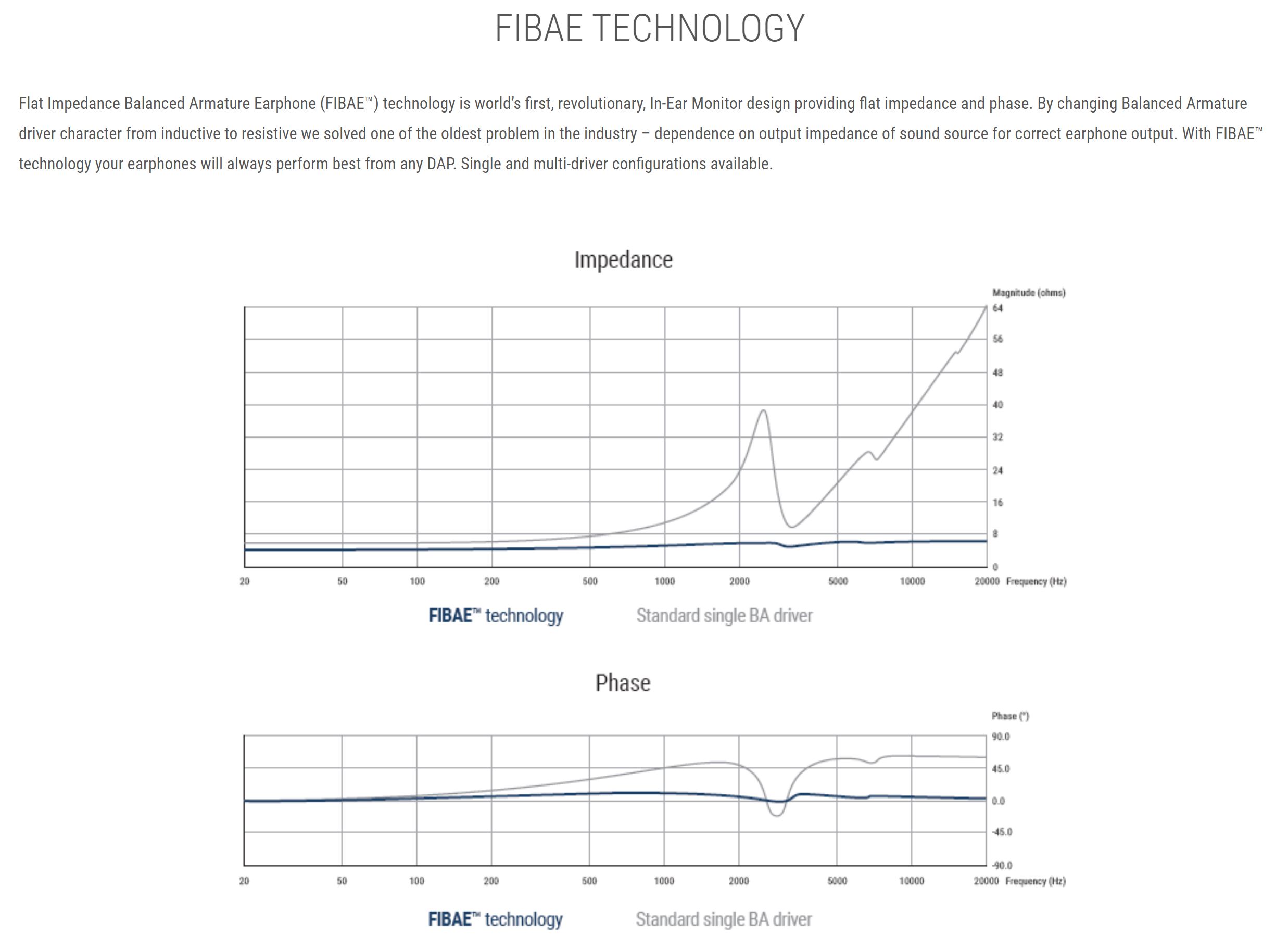
The Custom Art FIBAE 7 Unlimited is an update to the company's previous flagship FIBAE 7, and continues the use of seven balanced armature drivers per side. These are split into a 2+1+2+1+1 configuration with two subwoofers for the low frequencies, a single driver handling the transition from low to mid frequencies, two more catering to the mids and the transition to the higher frequencies (think upper mids more), and then two proprietary top-firing tweeters for the high and ultra-high frequencies collectively. Custom Art claims a 10 Hz - 21 kHz frequency response range here, although the 20 Hz to 20 kHz range is mostly of interest to humans. The shells are slightly larger than my EJ07M tribrid IEMs due to this 5-way crossover, that also has a 3D-printed wave guide and further electronic circuitry to make for the FIBAE technology I mentioned earlier. This helps give the FIBAE 7 Unlimited a flat impedance and phase curve across the entire frequency range, to where the output impedance of your source won't affect the tonality of the set. So you can drive it off your laptop or a much more expensive dedicated DAC/amp and the overall sound signature will be the same. Driving the set can take slightly more power than the typical set of IEMs owing to the lower sensitivity of 122 dB/0.1 Vrms and the 12 Ω impedance to make it more current-demanding than voltage. Any decent portable DAC/amp will be fine though, and good dongles should work as well, as long as you account for the cable connector itself.
Frequency Measurement and Listening
I will mention that I have a general preference for a warm-neutral signature with a slightly elevated bass, smooth treble range, detailed mids, and good tonal separation. I also generally prefer instrumental music over vocals, with favored genres including jazz and classical music.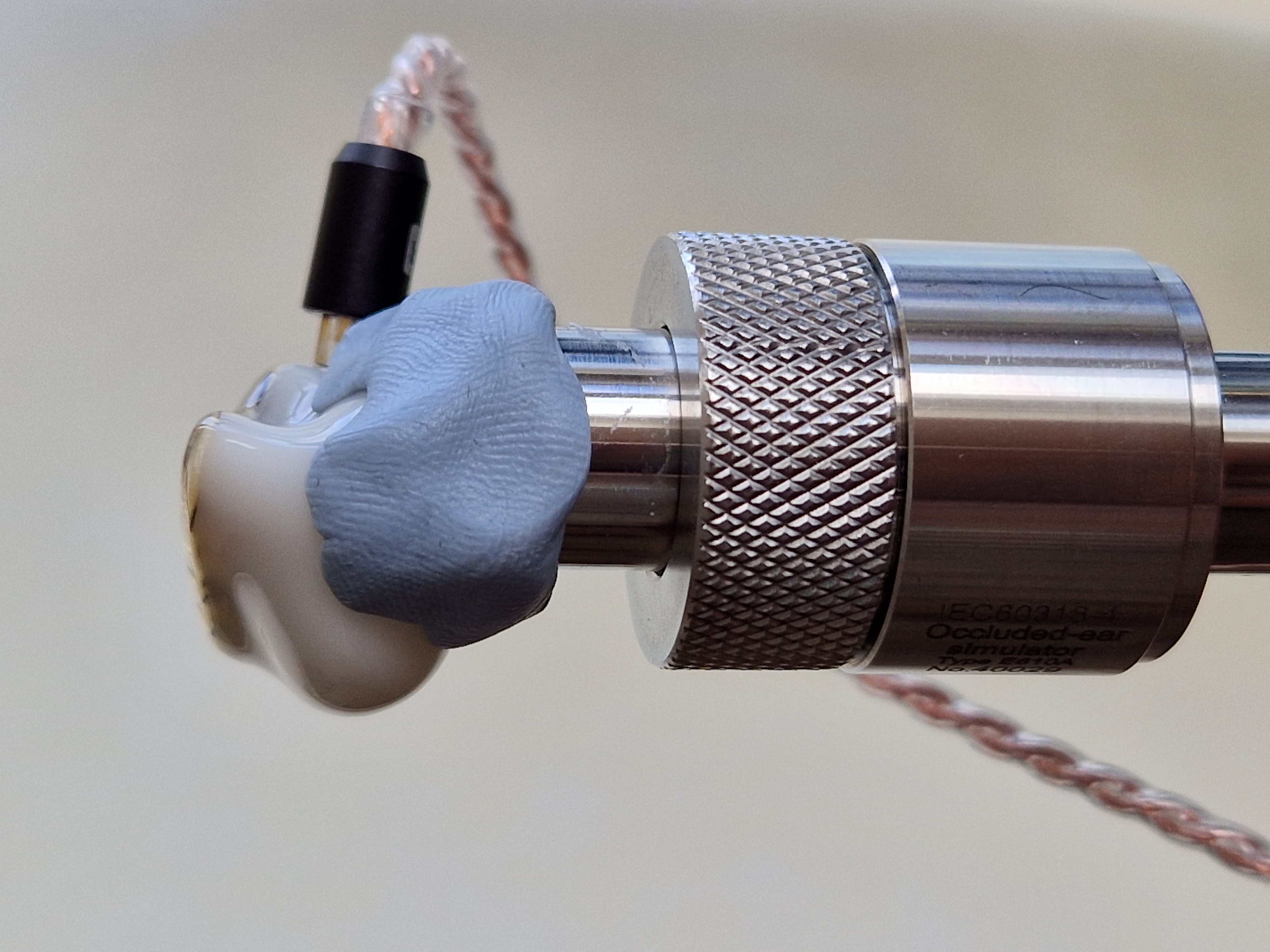

Our reproducible testing methodology begins with a calibrated IEC711 audio coupler/artificial ear that IEMs can feed into enough for decent isolation. Given the CIEM nature of this set, I had to use blutack putty to seal the CIEM nozzle inside my IEC711 couple as shown above. It's not a perfect solution but really it's impossible to accurately measure CIEMs unless you also make a custom coupler attachment based on your ear canals. Removing the stock attachment to couple the CIEMs directly to the mic capsule is possible with some CIEMs but my ear canals were too large to allow this to be done easily and instead made things worse. Testing was done as with any other IEM review thus, such as this recent review of the FiiO FH7S, except without the use of the artificial ear mold to test for fit/seal, given these have already passed that test.
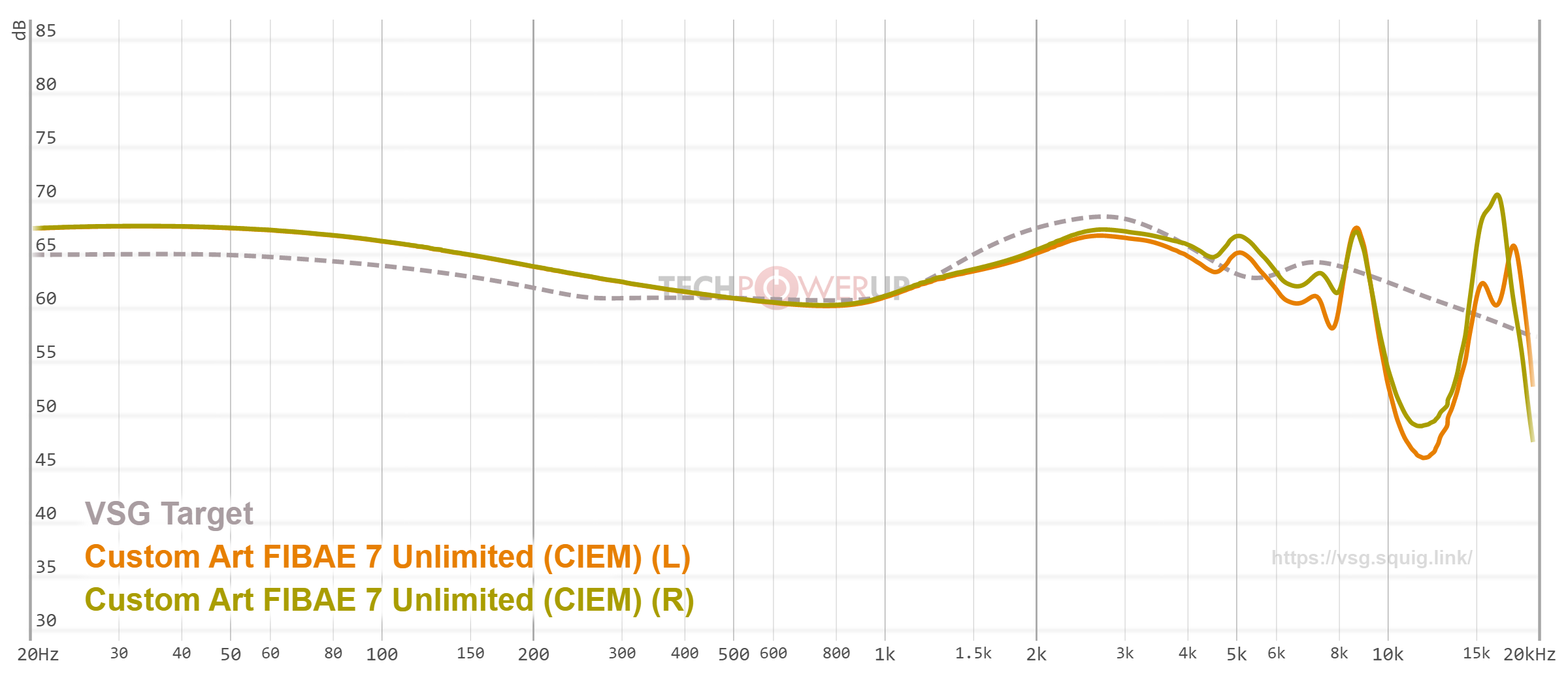
Here is the average frequency response for both channels of the Custom Art FIBAE 7 Unlimited plotted against my personal target, taken from VSG.squig.link, which also gives you an idea of my personal preferences, to better correlate any possible biases. The tuning of a set of headphones or earphones does not have to match my target as long as it is tuned with some direction, makes sense, and is executed well. After all, no one set will appeal to everyone, and having different options is what makes this hobby so interesting and hard to quantify. Note also that the deviation in testing here results in a drop in the measured treble response past the coupler resonance. It's a measurement artifact and, if anything, I noticed these CIEMs to have a smoother and better treble extension compared to what the measurements indicate. The results themselves are reproducible otherwise and can be used to also say that channel balance is excellent to where Custom Art is certainly driver matching, as should be the case with a flagship product. I have only praises thus far and now we can move on to the sound signature of the FIBAE 7 Unlimited.
Custom Art mentioned the FIBAE 7 Unlimited has "more sub-bass, slightly reduced mids to make it less vocal-forward, and greatly improved high frequency presence" compared to the previous FIBAE 7. The goal here is to end up with an easier-to-drive set to get loud without distortion for professional musicians to use on stage, in addition to having a "smooth natural tonality, spacious and expansive soundstage" that would also appeal to audiophiles in general. I would say that the FIBAE 7 Unlimited has generally met these goals, especially on the CIEM version. You see, the subwoofers used for the sub-bass end up hitting harder with a better seal and that's already accounted for with CIEMs. As such, I have to say that the UIEM version might not have as strong and impressive a bass response. There may not be as much rumble or punch in particular making better use of the relatively fast and clean bass here if you don't get a good fit with excellent passive isolation, and this alone is a reason to go with the CIEM version. The Custom Art FIBAE 7 is only the third reviewed all-BA set after the ThieAudio V16 Divinity and Symphonium Helios that makes you believe the bass is from a huge dynamic driver and it does so while also having the least bass elevation out of the three. The overall tonality is lightly V-shaped with the least SPL at 800 Hz and a ~7 dB bass shelf that extends all the way to 20 Hz and below. I personally had no issues appreciating EDM too with the FIBAE 7 Unlimited, but note that I am not an electronic music aficionado in particular.
Indeed, more people are likely to appreciate the mid-bass here where the interestingly natural-sounding timbre of drums and bass guitars further proves how the actual driver type and quantity does not matter as much as what you do with them. Custom Art has automatically joined the short list of companies I am impressed by accordingly, since it's not just another re-use of Sonion/Knowles drivers here. The transition over to the mids is smoothly handled, albeit male vocals have some warmth to them that could be a love or hate affair. I personally could do without it but I also appreciate that most people would want to have forward-facing vocals that take center stage over instruments. Female vocals came off more natural to me and were also slightly more engaging than male vocals, owing to a decent ear gain coupled with SPL recession before and after. Indeed, the dip at 4-5 kHz as felt in my ears is my favorite part here that helps emphasize vocals well without being fatiguing or sibilant—you will notice it on my personal target too, and the offset in the measurements here is another artifact.
The treble response is interesting, but not perfect. There is still a dip at 10 kHz in the ears which emphasizes cymbal clashes and percussions over piano keys and some string instruments. It has the side effect of also making for an expansive sense of space to where the FIBAE 7 Unlimited has a large soundstage for IEMs. I will say that this affects imaging to a degree however because it does feel as if there is not always substance taking up the available room. Central imaging is stronger and more precise than around the ears accordingly. On the plus side, this uneven treble behavior helps with layering and more detail that folks associate with treble. Overall extension is decent here too, although once again I have to say it would probably feel smoother and more natural with the CIEM versions.
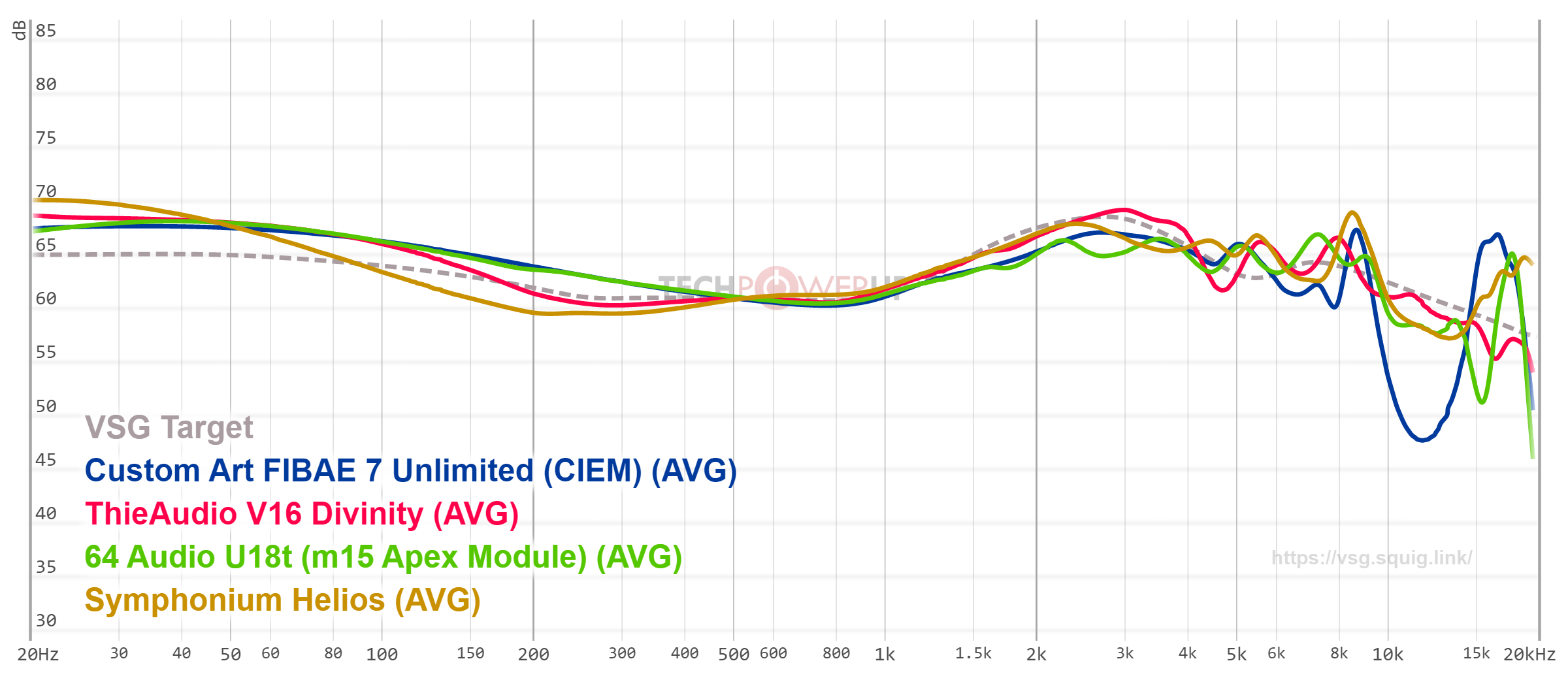
I mentioned before how the FIBAE 7 Unlimited in its CIEM version competed favorably with the likes of the $1500 ThieAudio V16 Divinity and $1100 Symphonium Helios, which are all BA sets using 16 and 4 BA drivers each. Then there's the $3000 64 Audio U18t that comes with 18 BA drivers per side but ultimately is more a monitor, than worth the money for simply enjoying music, owing to a source-dependent bass extension and generally weak bass. I personally enjoy the V16 Divinity's tuning better but the FIBAE 7 Unlimited is more detailed and really just more fun to listen to for hours at a time. It's also far more comfortable, obviously, than any of the rest, but even the UIEM version feels like a better fit in the ears compared to the Symphonium Helios. The mid-bass tuck in the Helios might also not play well for rock music whereas it is almost perfect with the FIBAE 7 Unlimited. Overall I can see use cases for three of the four sets here, including the Custom Art offering.
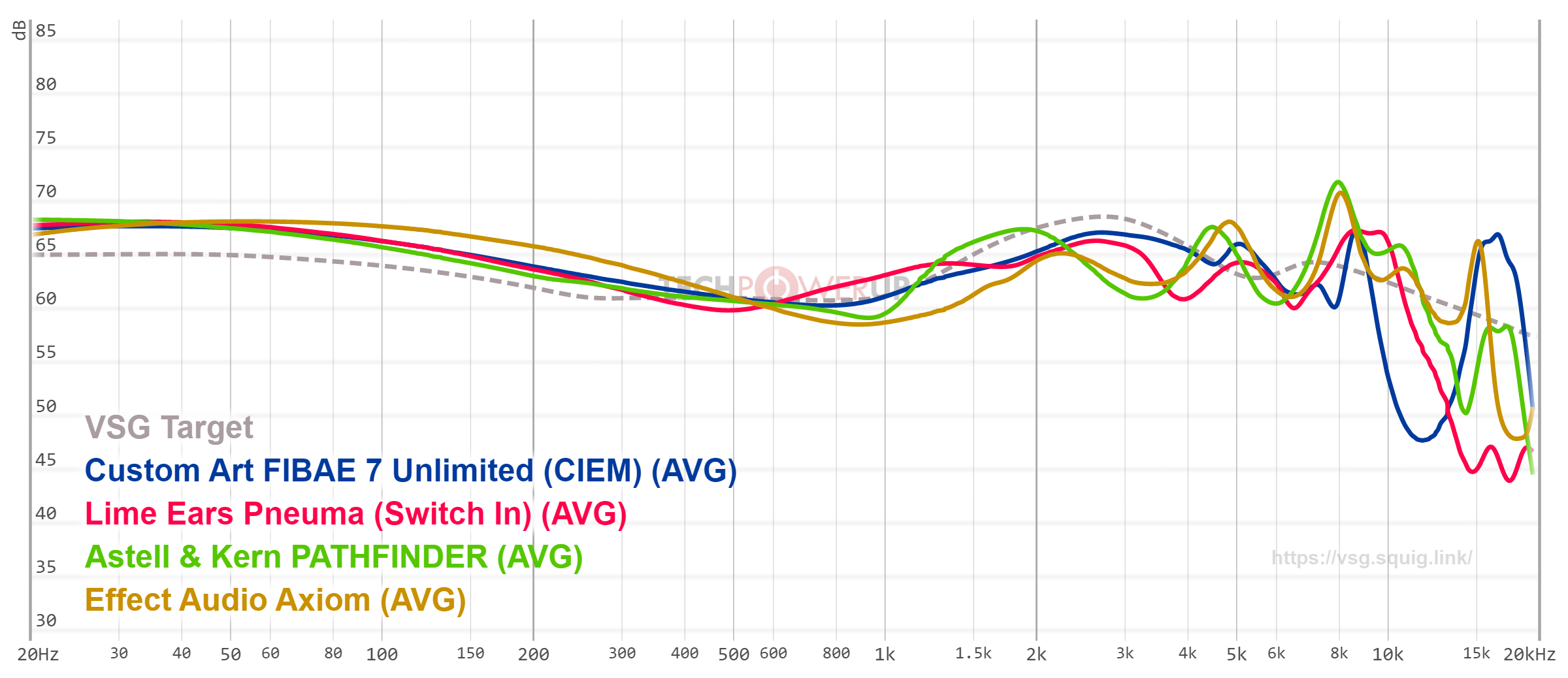
Then there are IEMs which compete directly on price, and the V16 Divinity covered before costs nearly the same too. The Lime Ears Pneuma costs slightly more at €1800 and comes with a bass switch for two different tonalities, yet I thought it was one of the worst offenders in the treble response and either switch position came with a different set of technical compromises. It's also quite large to where the UIEM version at least may not fit smaller ears at all. The $1500 Effect Audio Axiom is quite innovative in the use of modules that offer different cable compatibility, in addition to using an interesting crossover mod to change the overall tonality. I only tested the default configuration which had too many issues to be seriously considered, but apparently newer modules sound better. Either way there's no chance I would spend $1500 on it when I could use it on the FIBAE 7 Unlimited or something else. The Astell & Kern PATHFINDER is the most expensive IEM in this comparison at $1900 and will be reviewed soon. It has better bass than any of the others here in my opinion, but then unfortunately the Campfire Audio part of this collaboration set comes in where the upper mids and treble response can be sharp and fatiguing. There are several other IEMs in this price range but I do not have enough experience with, say, the Effect Audio GAEA or the Elysian Acoustic Labs Diva that seem to be the strongest competitors to the FIBAE 7 Unlimited.
Nov 15th, 2026 10:43 CST
change timezone
Latest GPU Drivers
New Forum Posts
- WireView Pro II GPU Alignment: Wired | Variant: Black (2)
- Power supply noise stops when I move the mouse (6)
- Honestly, do you care about GTA VI? (60)
- HP Office Jet 7740 Pro - Supply system problem with replacement cartridge (1)
- Recommendations Wanted - Affordable Enterprise SSD for Boot (5)
- budget home NAS – X79, X99 or another platform? (149)
- Planning for Prolonged High Prices and Maintaining What You Already Have (74)
- Technical Issues - TPU Main Site & Forum (2026) (409)
- What generation of Wi-Fi do you use at home (98)
- I'll flash a ASUS ROG Strix RX480 O8G in Cause of Code 43, as a Newbie (5)
Popular Reviews
- AMD Zen 6 Technical Deep Dive
- ASUS ROG Strix B850-I Gaming Wi-Fi7 W Review
- Corsair HX1000i Shift Crystal Review
- Upcoming Hardware Launches 2027 (Updated Nov 2026)
- Montech King 95 3D PRO Review
- NZXT C1200 Platinum Review
- NZXT H7 RGB+ Review
- NZXT H5 Review
- Phantom Blade Zero Performance Benchmark Review - 35 GPUs Tested
- AMD Ryzen 7 9800X3D Review - The Best Gaming Processor
TPU on YouTube
Controversial News Posts
- NVIDIA Co-Founder and CEO Jensen Huang Officially Resigns (414)
- OpenAI CEO Argues Home PCs Waste the World's Limited DRAM Supply (152)
- Open Letter Asking NVIDIA to Reinstate Jensen Huang Passes 115,000 Signatures (137)
- NVIDIA Launches Investigation Into Jensen Huang's Relationship With Suspected Chinese Spy (136)
- Intel "Raptor Lake Next" 16-Core and 20-Core CPUs Surface (130)
- Legendary Game Studio BioWare Shuts Down Following EA Layoffs (104)
- Dell CEO Says the Memory Shortage Will Get Worse in 2027 (95)
- NVIDIA GeForce RTX 50-Series Scheduled for up to $500 Price Hike This Week (89)