 24
Dan Clark Audio STEALTH Flagship Closed-Back Headphones Review
Comparisons »Fit and Comfort


Seen above is the Dan Clark Audio STEALTH placed on a mannequin head to help show how these headphones would look on the human head. Note that the head is slightly under average sized, so account for the discrepancies accordingly. As with all headphones, getting a good fit and seal is crucial, so make sure to properly use the various pivot points, and the height adjustability of the headband and ear cups. This section is mostly a summary of the points expanded upon in more detail on the previous page, but I will point out that the STEALTH weighs 415 g, which is actually on the lower side for closed-back planar magnetic headphones. Part of this is due to the use of a relatively smaller driver and smaller, single-sided magnets but also the use of lightweight premium materials in the form of the Nitinol wire headband and the carbon/aluminium composite ear cups also helps. I also mentioned on the previous page how everything about the STEALTH has been designed with comfort in mind and the end result is a set of headphones you put over your ears and almost forget they are on there. These approach the Meze ELITE in how comfortable they are, which is saying something for a closed-back set. It also holds up over longer periods of use since there are no hot spots on pressure points developed either, at least on my head. In fact, such is the nature of the STEALTH that my partner has frequently "borrowed" it to use when we share an office space at home, and they happen to be extremely fussy about lightweight and comfortable headphones. Another reason for this being popular is the closed-back isolation is quite significant across the entire frequency response. It's not going to best ANC headphones where lower frequencies (<500 Hz typically) are toned down further, but the STEALTH with its thicker pads and a nice seal courtesy the average clamping force can give you a good 15-20 dB of isolation in the mids to mute down voice in the background.
Audio Performance
Audio Hardware
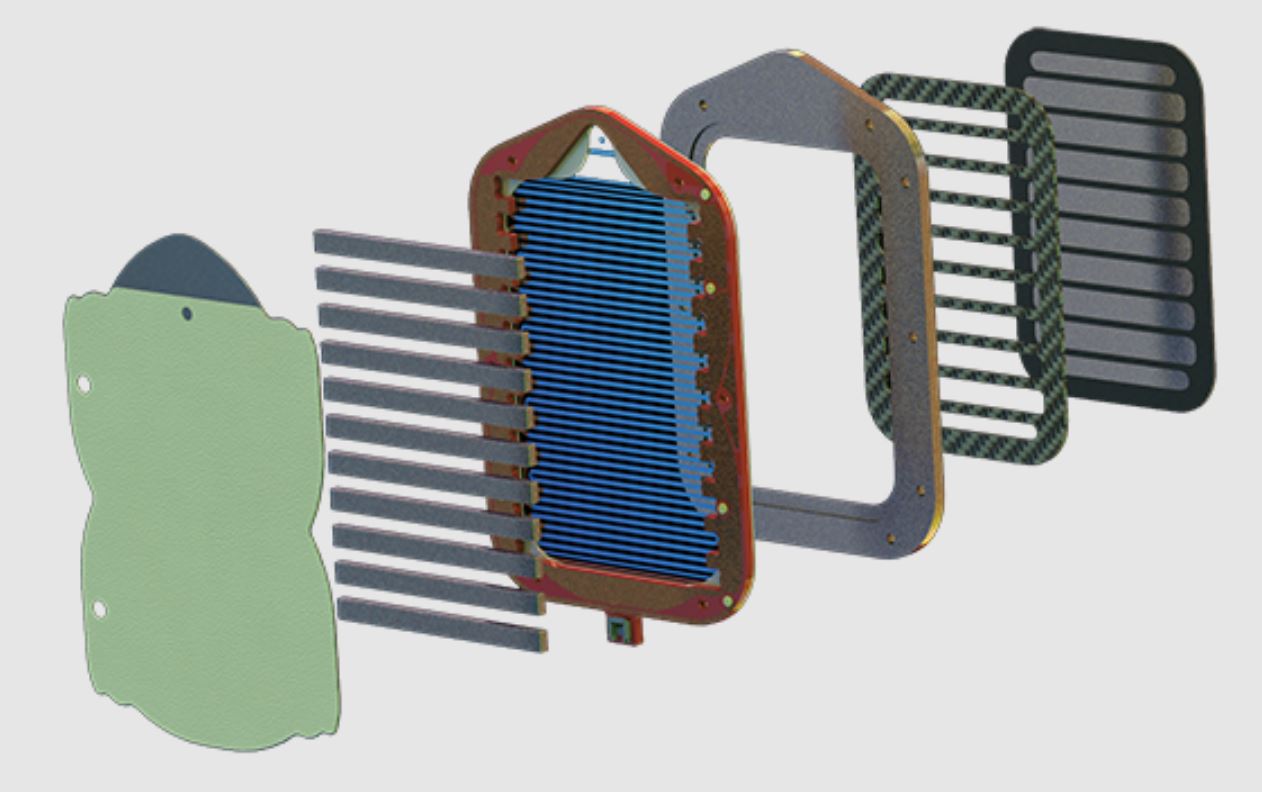
I recommend going through this page to better understand the base technologies developed by Dan Clark Audio and how they were implemented in its other planar magnetic headphones. Indeed, even the more affordable Aeon Closed X and Aeon RT use in-house developed proprietary drivers that have a relatively small diaphragm at 62 x 34 mm compared to the usual circular 90-110 mm drivers employed by many competitors. But size isn't everything clearly and the lighter, more efficient diaphragm can be easily driver back and forth by a single set of magnets to help reduce driver mass. Those drivers also use some older technologies including the patented V-Planar technology and first-gen TrueFlow motor optimization, with the Aeon 2 going with newer versions of the same to have improved detail retrieval, dynamics, bass extension, and soundstage if you took Dan Clark Audio's marketing at its words. The Aeon 2 can be considered an evolutionary release thus, especially compared to the revolution that the STEALTH is. This time you get a 4th generation driver with a larger 76 x 51 mm diaphragm using those latest technologies and that's before we even introduce AMTS into the picture.
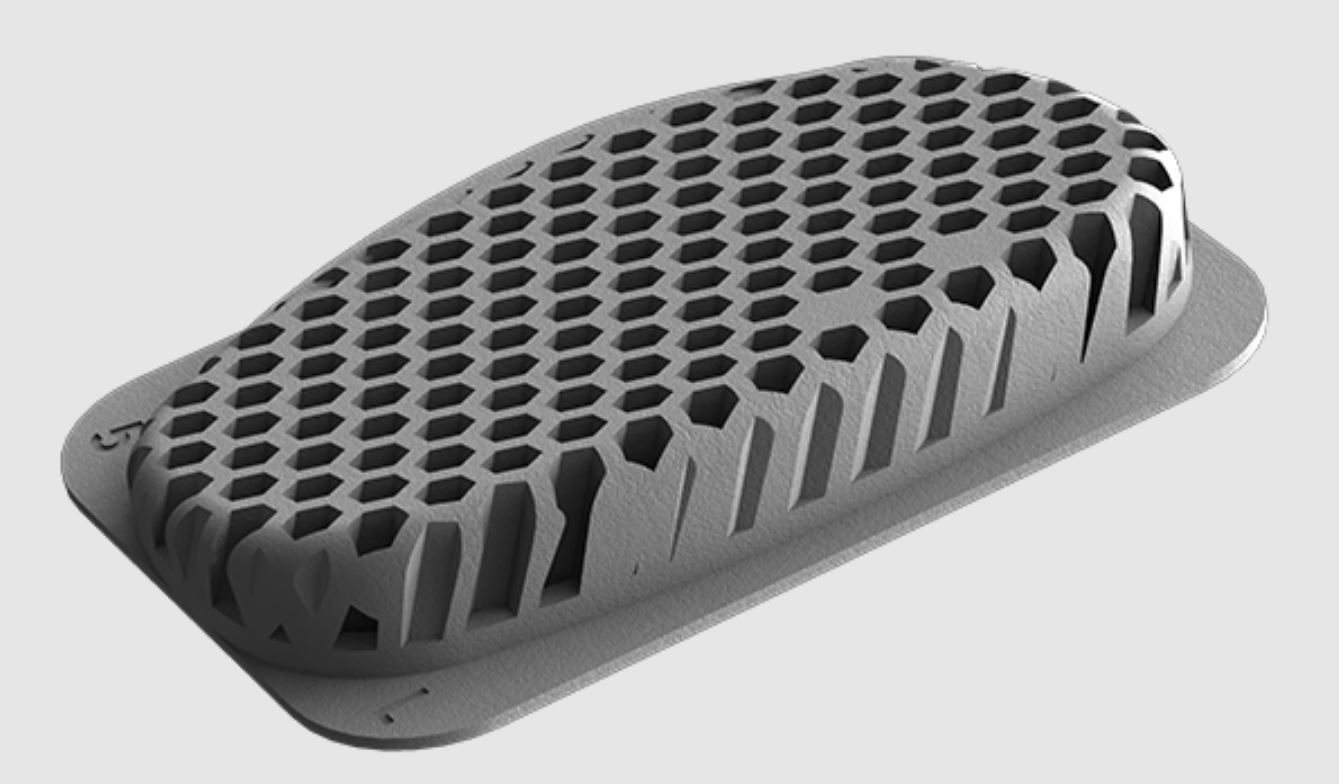
Dan Clark Audio made waves throughout the personal audio space when it launched the STEALTH with an integrated acoustic metamaterials tuning system (AMTS). This is a 3D printed device which combines waveguides, resonators of multiple design, and diffusion elements. It's customized to the STEALTH so the AMTS implementation here is different from that in the EXPANSE and CORINA that released later. While DCA is known for its using of purposeful damping, AMTS is vastly different and has significantly more impact. The diffusion elements help reduce standing wave formation whereas the resonators act as both precision and broadband filters to smoothen and shape the transducer frequency response from the mids through the highs. The goal here is that AMTS renders high frequencies with "a refreshing accuracy and clarity with all genres of music." DCA also markets individually matched drivers used here with a highly impressive 0.25 dB matching from 20 Hz – 10 kHz! The STEALTH is one of the more demanding headphones on the market though, with a typical planar magnetic characteristic of low impedance (~22 Ω) and low sensitivity (~86 dB/mW) making for a current-hungry set. Going with a balanced connector and pairing the STEALTH with an amplifier with enough juice will help ensure you are not bottlenecking these headphones. This is one of the reasons I asked for a 4.4 mm cable allowing me to use this also with powerful portable DAC/amps such as the FiiO Q7 and xDuoo XD05 Pro. I do expect most people to use the STEALTH in their home/office with a desktop setup though and I generally paired it with solid state amplifiers and a good delta-sigma DAC at home.
Frequency Response Measurement and Listening
I will mention that I have a general preference for a warm-neutral signature emphasizing a slightly elevated bass and smooth treble range with detailed mids and good tonal separation. I also generally prefer instrumental music over vocals, with favored genres including jazz and classical music.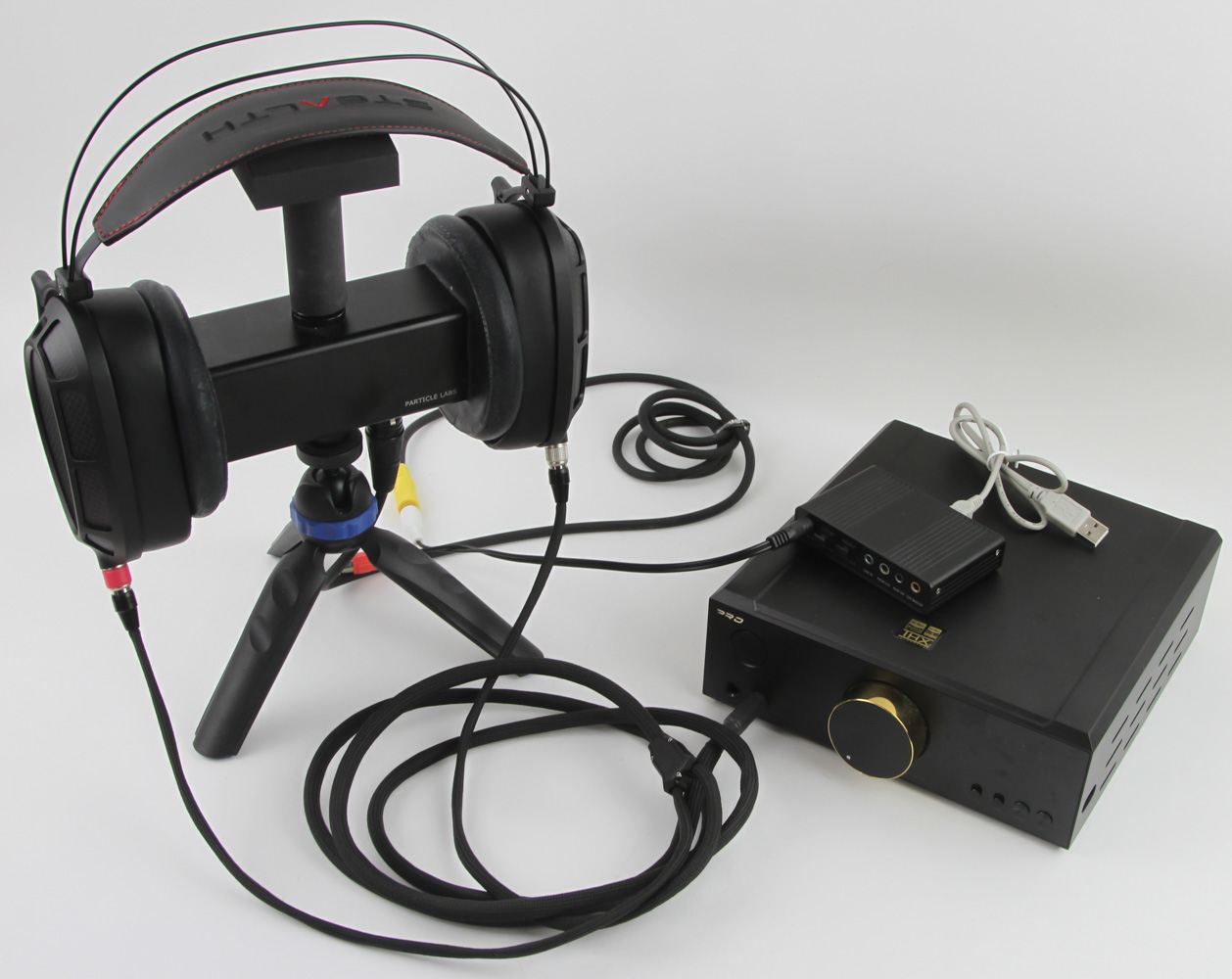
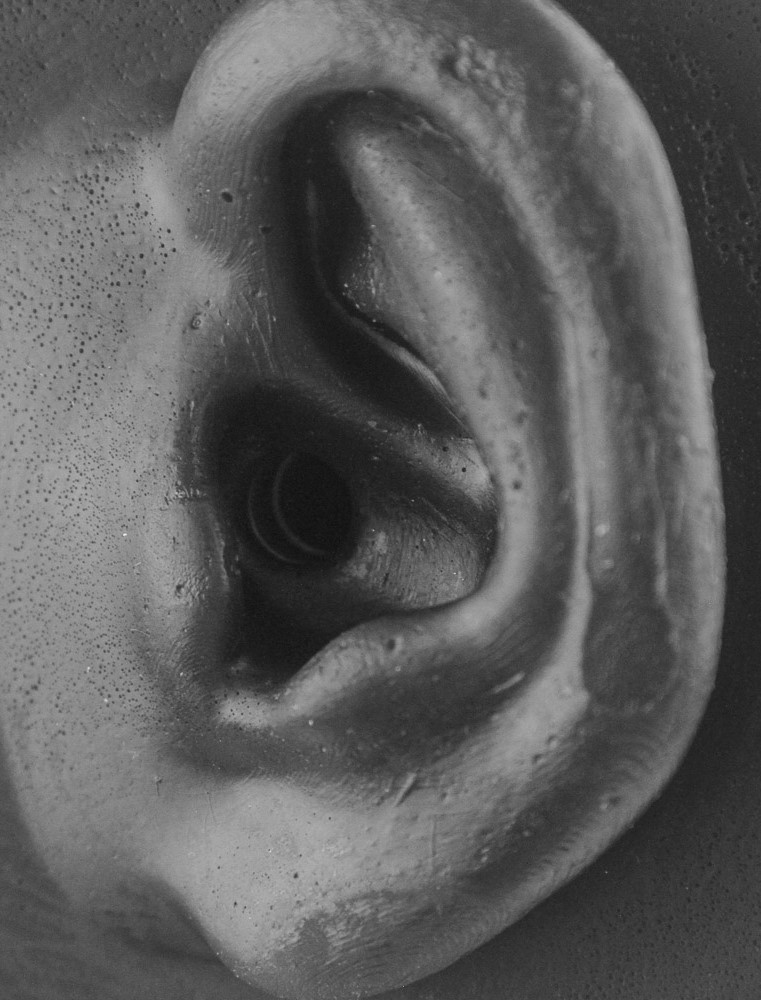
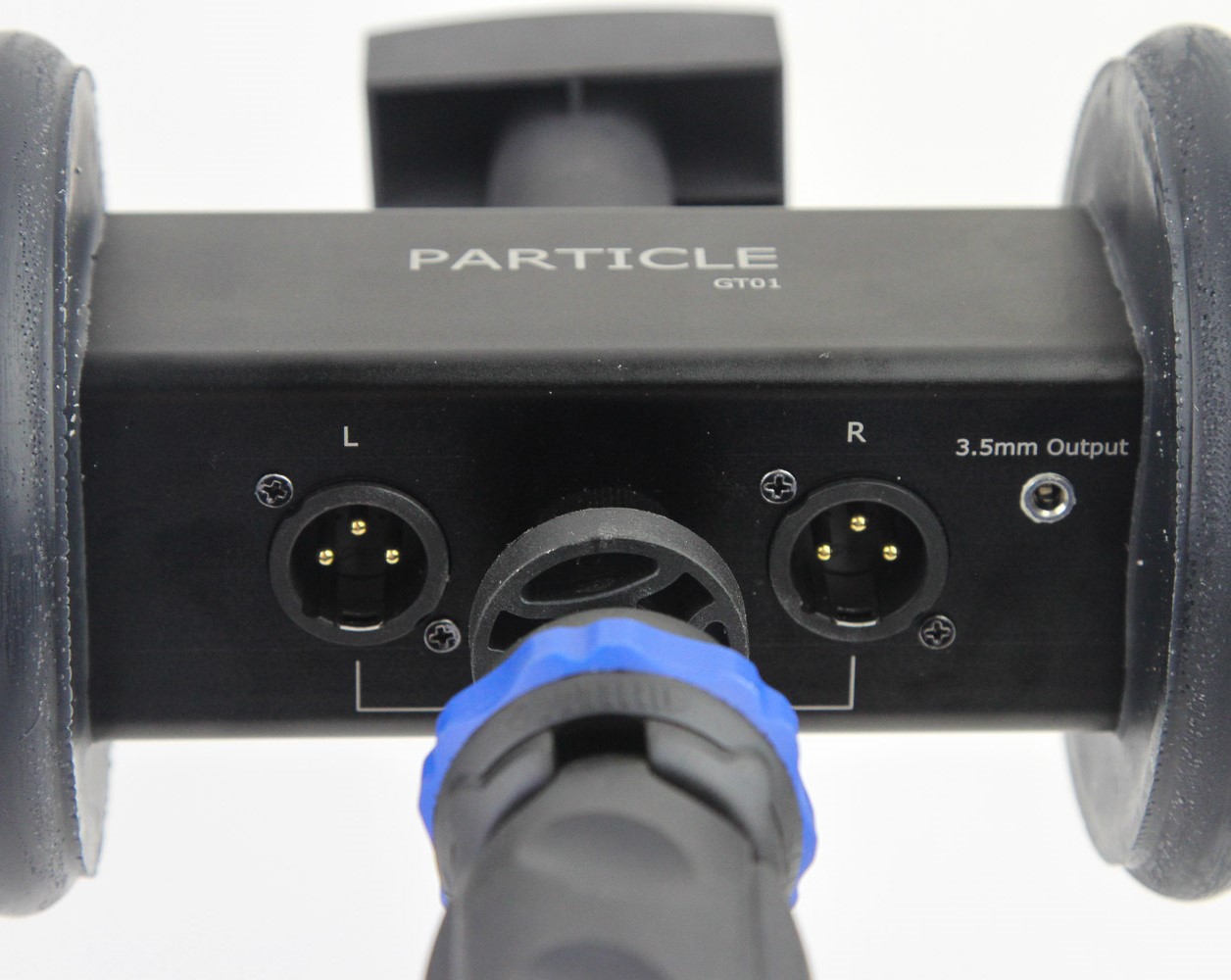
Our current headphones test setup uses a set of two custom in-ear microphones for the two channels. These microphones closely adhere to the IEC711 class, but have been tweaked to be more reliable in the >10 kHz frequency range, the precise issue with my previous setup, that is otherwise still very good and will continue to be used for IEMs and earphones. Two soft silicone pinnae are installed on the sides, separated by a distance matching my head, and multiple "height" adapters have been 3D-printed for further customization, based on fit, head size and shape. Each set of microphones has an XLR output I separately adapted to 3.5 mm. I used a transparent source—the FiiO K9 Pro—for measurements after confirming it was not a bottleneck in any way. This artificial head simulator feeds the microphone lines into a reference USB sound card, which in turn goes to a laptop that has ARTA and REW running. I begin with an impulse measurement to test for signal fidelity, FFT to test for headphone seal, calibrate the sound card and channel output, account for floor noise, and finally test the frequency response of each channel separately. Octave smoothing is at the 1/12th setting, netting a good balance of detail and signal to noise ratio. The default tuning was used for testing, and no app or program-based EQ settings were chosen, unless specifically mentioned. Each sample of interest is measured at least thrice with separate mounts to account for any fit issues, and an average is taken of the individual measurements for statistical accuracy.
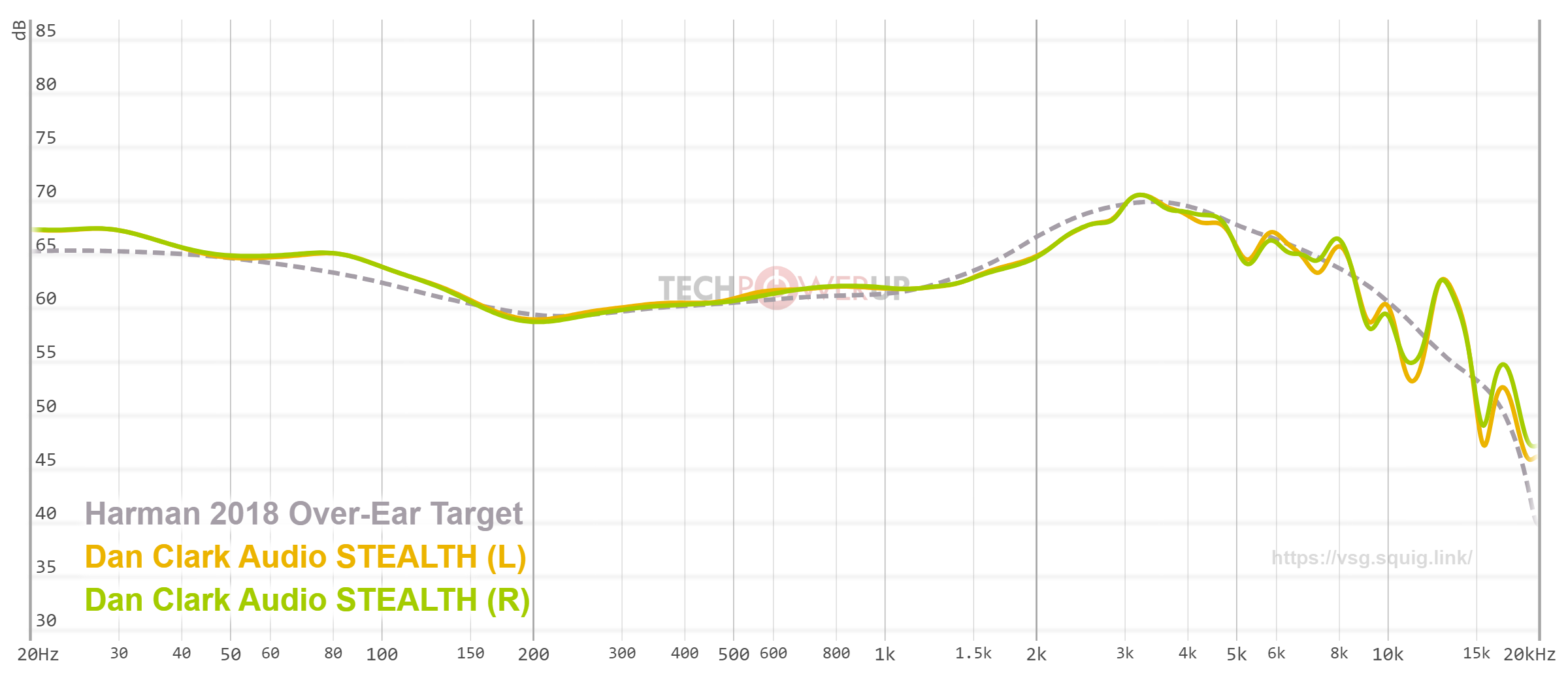
As per usual, you can find my headphone frequency response measurements on VSG.squig.link, along with all the earphone measurements. Scroll to the bottom and choose different targets there, including two from Harman Kardon, developed after years of R&D. Those who have read my headphone reviews would have noted how I typically go for the "Harman Combined" target based off the Harman 2018 over-ear target but with the lower bass target from the Harman 2013 curve instead. I prefer this for open-back sets which it feels far more natural to me although things are different with closed-back headphones. You see, it's not often that I actually see well-tuned closed-back sets—such is the woeful state of the market. The DCA Aeon Closed X comes close but there is absolutely nothing else in my collection here which even approaches how well the STEALTH is tuned. But first, let's talk about the incredible channel matching achieved here throughout the entire frequency range. This is a randomly selected retail unit that has better driver matching than anything else I have measured to date, except perhaps Dan Clark's own CORINA which also has pad matching on top. Needless to say, this is the level of quality control and testing that flagship products should aim for but so far it feels most others are happy with the industry standard +/-3 dB variance. I will also mention that using the headphones for well over 500 hours didn't change anything either for those who would undoubtedly be curious about burn-in. Perhaps the treble got a touch smoother but that could be more psychoacoustic than anything else.
Let's get back to that Harman target, shall we? I acknowledge that it's best used with measurement rigs that the target was made for, such as the GRAS 45CA and 43AG-7. However, my rig gets close enough to the latter based on several tests I've done with headphones measured on the real deal and this one to where I do feel confident enough to use it here. Keep in mind also that the GRAS rigs already have a less accurate acoustic impedance compared to the likes of the B&K 5128, let alone the actual human ear, so there's an error bar anyway. The latest Harman over-ear target has been developed after decades of research and the curve can be seen as an approximate response of a linear speaker as measured in a well-treated room and tuned to reproduce a smooth "room response" tonal ramp. The target factors in compensation for the headphone measurement from a GRAS rig adhering to the IEC60318-4 standard such that headphones that match this response curve should, in theory anyway, sound like how well tuned speakers will sound in a properly treated room. It's quite smoothened to account for the aforementioned errors in the measurement rig and overall these couplers show more bass and treble than actually is. So treat the target no more than what it is supposed to be, especially for the higher frequencies where that huge dip doesn't mean headphones adhering to the target will suddenly lose 20-25 dB SPL compared to the ear gain in the upper mids.
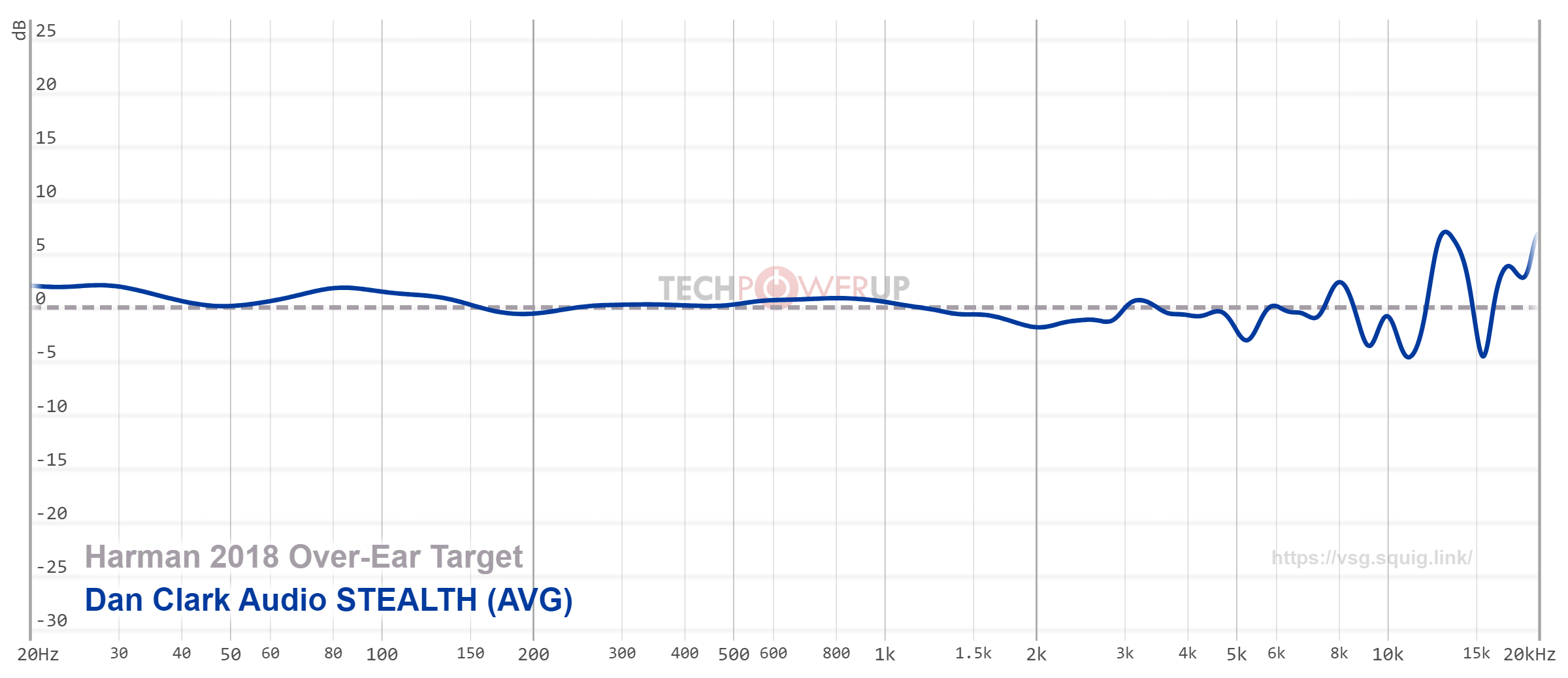
All this is geek talk to say that a closed-back set, if it matches the Harman curve well enough, can sound like a great set of speakers without the money spent on the speakers or room treatment. The Dan Clark Audio STEALTH tries to do exactly this and I would say it does the job well enough. The average frequency response of the STEALTH compensated against the Harman target helps reveal the deviation from said target more easily and we see there's really not much in it. In fact, I do know that my rig does tend to measure upper treble ever-so-slightly more than the official GRAS rig so in practice this unit would be even closer to the target throughout the entire 20 Hz to 20 kHz frequency response. If you were the type to buy headphones purely based on how well they measure and match up to the Harman target, then congratulations on having found your dream set. Most others I suspect will also be left plenty satisfied since the over-ear Harman target is one I can actually agree with here, as opposed to the in-ear one I have issues with.
The first thing I thought when I listened to the STEALTH was that it simply sounded correct. It's a highly accurate set throughout thanks to this tonality allowing a decent bass shelf concentrated primarily in the mid-bass and more so the sub-bass, which in turn makes for clean and accurate mids and excellent, smooth, well-extended treble. I can't say enough words about how well this is tuned to my liking with the only nitpick I have being in the upper-bass and lower mids that might feel a touch lean for harder hitting tracks. This isn't to say that the STEALTH is not a dynamic set though, and here I feel people will differ since I have seen others talk about the STEALTH coming off slightly limp and not punchy. I tested the STEALTH for over two months with a variety of different sources and even had different people try it on. There is a slight impact on the clamp pressure and ear positioning in the ear pads on how dynamic and engaging the STEALTH will sound, at least based on my rudimentary testing. As with the CORINA, place the ear pads such as the top rear corner of the ear pads lined up with the top rear of your ears. This allowed for the AMTS device to be in-line with my ear canals and allowed for the waveguides and resonators to work as intended in producing an extremely smooth yet resolving sound. Likewise, if you have a narrower head or notice the ear pads mostly making contact against the temple rather than uniformly on the top, back, and bottom of your ears then adjust the headphones for a better, more secure seal since having adequate clamp pressure is key towards appreciating the bass response further. That said, this is where the slightly lean mids and upper-bass can result in some trailing ends of tones not being as prominent as leading ends—bass guitars, for example—depending on how you perceive it.
The mids proper are where I had to spend a lot of time because I was struggling to reconcile neutral vs life-like reproduction of music. The STEALTH seems neutral but it's more realistic and steps away from neutrality in favor of accuracy. Poorly recorded songs still sound poor on the STEALTH, it's not going to magically solve that. If you notice the mix favoring some instruments or vocals over others, that's not a neutral sound and don't expect any different here. However, accurate playback does not have to be at the expense of fun. Pink Floyd's Dark Side of the Moon is a great example of this. "Time" and "Us and Them" in the original recordings showcase the imaging capabilites of the STEALTH nicely. The newer 2023 Redux versions feel more sterile, more neutral, less fun. I was listening to the newer versions around the time I also watched an interview with Dan Clark where he unabashedly mentioned how he was a soundstage junkie. The STEALTH is a closed-back set that sounds more open than it has any right to be. It does this while still maintaining a good seal with plenty of isolation too, so this is another case of where a more life-like, accurate sound presentation is fun and makes you feel you are almost watching it being played live. The soundstage is wide and tall, appropriately deep, and instrument separation is excellent too. I'd still take the CORINA over the STEALTH for vocals but the STEALTH does a commendable job for most male and pretty much all female vocal playback.
The treble frequencies are where the AMTS really shines in how the STEALTH sounds. I'll say right now that the Helmholtz resonator in the AMTS device very likely has some interaction with my rig coupler since the 8 kHz peak feels more like a measurement artifact. In fact, I dare say most people will note a slight dip with peaks in the 6-8 kHz regions compared to any frequency response measurements you will see, thus resulting in a less jagged response than even the relatively smoother profile seen above. This is what helped tip the CORINA over many of my other favorite open-back sets and the STEALTH does this smoother treble too. If anything, this might feel overly damped because of how smooth it feels until you play back fast orchestral or acoustic jazz tracks and hear every note plenty fine. Flight of the Bumblebees is a good example of this, as is Vivaldi's Summer with the string quartet pouring its heart out. I mentioned before how the upper treble is overly emphasized in my measurements too so rest assured it's not going to be a touch of cayenne pepper right at the end of a fine dining meal. The STEALTH continues to be resolving but there isn't any particular segment being the star of the show as much as a team effort throughout, and I will say premium open-back sets might feel more detailed or present you with air to add an ethereal touch to strings and cymbals so you should decide whether that's something you prioritize.
Nov 26th, 2026 20:47 CST
change timezone
Latest GPU Drivers
New Forum Posts
- Dell Dimension E510 Retro Gaming PC Upgrade & Modification (2)
- Wireless Internet sharing between PC and router both-ways, is it possible? (27)
- WarpCoreBench scores! (116)
- Can you guess Which game it is? (371)
- ASUS Prime 5060 ti 16gb x4 instead of x8 PCIe (12)
- Kerbal Space Program Retooled (0)
- Exploring Local LLMs: Models, Hardware and Setup Experiences (6)
- Post your CrystalDiskMark speeds (663)
- 26.11.2 Adrenalin Edition is out (1)
- Acer TravelMate P414-51 (i5-1135G7): CPU stuck at x4 / ~200 MHz effective under 100% load, no throttle flags. How to find who's clamping it? (3)
Popular Reviews
- VZMORE AX9 Max Review
- Upcoming Hardware Launches 2027 (Updated Nov 2026)
- ASRock X870E Challenger Wi-Fi White Review
- AMD Ryzen 7 9800X3D Review - The Best Gaming Processor
- Microsoft Surface Laptop Ultra Review - The Next-gen Arm Laptop
- AMD Zen 6 Technical Deep Dive
- Montech CyberFlow ARGB 360 Review
- Phantom Blade Zero Performance Benchmark Review - 35 GPUs Tested
- Corsair RM1200e (Second Generation) Review
- Pulsar Office Tour & First Look at P1 Dual-Sensor Mouse
TPU on YouTube
Controversial News Posts
- Jensen Huang Reinstated as CEO of NVIDIA (613)
- NVIDIA Co-Founder and CEO Jensen Huang Officially Resigns (492)
- Report: Jensen Huang Eyes NVIDIA Comeback (281)
- Open Letter Asking NVIDIA to Reinstate Jensen Huang Passes 115,000 Signatures (184)
- OpenAI CEO Argues Home PCs Waste the World's Limited DRAM Supply (152)
- NVIDIA Launches Investigation Into Jensen Huang's Relationship With Suspected Chinese Spy (136)
- Intel Razor Lake Gets a 12 P-Core bLLC Chip With No E-Cores, Per Leak (94)
- NVIDIA GeForce RTX 50-Series Scheduled for up to $500 Price Hike This Week (89)