 0
Dream Machines DM9 Skill Wireless Review
(0 Comments) »Value and Conclusion
- The Dream Machines DM9 Skill Wireless is available for $49.99.
- True 8000 Hz polling
- Good sensor performance
- Very low click latency
- High button quality
- Good scroll wheel
- Good choice of components
- Lightweight
- Nicely gliding mouse feet
- Flexible charging cable
- Full software customizability
- Bluetooth connectivity
- Wireless extender included
- Set of replacement feet included
- In wired mode, scroll wheel only works at 8000 Hz
- Somewhat buggy firmware and software
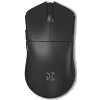
Released back in 2023, the Darmoshark M3 and M3 4K provided excellent value for money. Two years later, the Dream Machines DM9 Skill Wireless is best considered a slightly upgraded variant of these mice. Not just the shape, but the entire shell is exactly the same as on the M3/M3 4K, which is expected as these mice roll out of the same factory, and any remaining shred of doubt is removed by taking a look at the top shell of the DM9 Skill Wireless, which plainly has "M3" written on the underside. Accordingly, it comes as no surprise that they all land in the same weight range, too. Whereas both the M3 and M3 4K prioritized battery life over weight and went for 500 and 800 mAh batteries, respectively, the DM9 Skill Wireless values weight savings instead and comes with a lighter 300 mAh battery. At 56 g, the DM9 Skill Wireless isn't exceptionally light, but still compares quite favorably to the likes of the Razer Viper V3 Pro at 54 g. Build quality is largely good: when shaking the mouse, a rattle comes from the scroll wheel, but when applying lateral pressure, there is no creaking or flexing of the shell, and the side buttons cannot be actuated by pressing below them regardless of force.
Much like the M3, the DM9 Skill Wireless comes with Kailh GM 8.0 switches for the main buttons. Back in 2022/2023, GM 8.0 were everywhere, but their popularity has waned, which is why their presence in the DM9 Skill Wireless is a nice trip down memory lane. Kailh GM 8.0 are still among the more tactile mechanical switches around, and this tactility is still felt despite the moderate levels of pre- and post-travel on the DM9 Skill Wireless. When provoked, a moderate level of lateral button movement is present, though this isn't noticeable during regular usage. The side-button switches are in turn familiar from the M3 4K, as the same type of TTC switches with a red plunger is used. Pre- and post-travel are quite low on these, though the actuation point on the back button isn't particularly even. For the scroll wheel, the latest revision of TTC's "Gold" encoder is used, which has a blue dust cover. Noise levels are fairly high on this one, but tactility is above average, with the individual steps being rather well-defined, allowing for controlled scrolling. The feet are made of white-dyed PTFE of above average thickness and glide very well, and a replacement set is included with the mouse.
On the DM9 Skill Wireless, PixArt's PAW3395 sensor is combined with a Realtek RTL8726 MCU, which we've previously seen on several releases from Rapoo or MCHOSE. The RTL8726 provides a USB high-speed PHY, which is why the DM9 Skill Wireless is able to deliver 8000 Hz polling not just in wireless operation, but in wired operation as well. While the DM9 Skill Wireless cannot compare with the MCHOSE L7 Pro's showing, performance is on a good level still. A negative CPI deviation of 2.5% is present, which is corrected with ease. General tracking shows no issues regardless of whether MotionSync is enabled or not, provided one sticks to the lower CPI steps, as the higher steps in wireless operation have copious amounts of smoothing applied, even if ripple control is explicitly disabled in the software. This is doubly curious given that this particular behavior is only present at polling rates of 1000 Hz and under. Of note is that the DM9 Skill Wireless utilizes a nano wireless dongle with an extender, whose small size limits antenna capacity and therefore link budget. Hence, in order to attain stable polling without too many missed polls, things have to be balanced differently within the firmware, most notably by increasing the buffer size. As a result, the DM9 Skill Wireless is able to achieve largely stable polling, with some elevated variance or noise but typically no missed polls, yet motion delay suffers. At 2000 and 4000 Hz without MotionSync and in wireless operation, the DM9 Skill Wireless is ahead of the Logitech G403 (control subject) by 0.5 ms, and at 8000 Hz, only parity with the G403 is achieved. These aren't exactly groundbreaking numbers, though on the flip side, polling stability is mostly fine, aside from some 3 ms spikes randomly creeping in at 4000 Hz. As always, enabling MotionSync will add various amounts of delay depending on the set polling rate, and at 8000 Hz, around 0.140-145 ms instead of the target interval of 0.125 ms will be averaged. In wired operation, numbers are a bit better, as the DM9 Skill Wireless attains a lead of 1.0 ms over the G403 without MotionSync at polling rates above 1000 Hz, but a different issue shows up here. Save for at 8000 Hz, scrolling up or down simply won't work, which of course somewhat limits the usability of a mouse altogether. Thankfully, wireless operation is not affected by this.
As far as click latency goes, the DM9 Skill Wireless does very well. In wired operation, 0.2 ms are averaged regardless of polling rate if set to the lowest debounce time of 0 ms. In wireless operation, no more than 0.3 ms are averaged at 8000 Hz, and lower polling rates follow closely behind, with 4000 Hz at 0.4 ms, 2000 Hz at 0.5 ms, and 1000 Hz at 0.6 ms. That said, this only applies when using 0 ms debounce time, and at 1 ms debounce time, only 8000 Hz will still muster an average of less than 1 ms. At the same time, given the lack of a slam-click prevention algorithm, one may indeed be inclined or even forced to use 1 ms debounce time, resulting in less stellar numbers. These days, most mice releases implement a slam-click prevention algorithm, which ensures no accidental button actuation upon resetting the mouse, allowing one to use 0 ms debounce time without any drawbacks lest any double-clicking emerges, the latter of which is not an issue on optical switches to begin with. In other words, the DM9 Skill Wireless still operates like many older releases in this regard.
The software for the DM9 Skill Wireless is also familiar from other releases such as the Darmoshark M5, and has all the relevant settings at a low RAM footprint. That said, it can be quite buggy, as CPU utilization may randomly skyrocket, and when switching CPI steps or polling rate, MotionSync also may randomly be enabled. Coupled with the fact that scrolling straight up doesn't work in wired mode except at 8000 Hz, the DM9 Skill Wireless can seem a little rough around the edges. In terms of battery life, Dream Machines cites up to 75 hours at 1000 Hz and up to 20 hours at 8000 Hz, which isn't unrealistic given the battery capacity of 300 mAh. A percentage-based battery life indicator is found in the software, but both its accuracy and reliability leave a lot to be desired, and basically render any attempts at gauging expected battery life futile. For what it's worth, Bluetooth is also on board, so squeezing out a couple of extra hours is possible, and the charging cable is decently flexible, so playing while charging without feeling overly restricted is at least doable, which is welcome since the charging speed is strictly average.
Overall, the DM9 Skill Wireless may not win any points for originality, but taken on its own, it is a decent release. As irritating as the lack of scroll functionality in wired mode is, for those exclusively sticking to wireless operation this may not be much of a downside. Compared to other releases in the same price segment such as the MCHOSE L7 Pro or Redragon K1NG 4K Pro, the DM9 Skill Wireless can't quite compete in the performance department, but neither of those have the Finalmouse Air58 shape of the DM9 Skill Wireless, which is an excellent fit for larger hands. At the same time, this of course applies to the Darmoshark M3 and M4 4K as well, both of which can be gotten for even less than the $49.99 the DM9 Skill Wireless retails for. On balance, the DM9 Skill Wireless misses our Recommended award, but value for money is still good, and our Budget award well-earned.

Much like the M3, the DM9 Skill Wireless comes with Kailh GM 8.0 switches for the main buttons. Back in 2022/2023, GM 8.0 were everywhere, but their popularity has waned, which is why their presence in the DM9 Skill Wireless is a nice trip down memory lane. Kailh GM 8.0 are still among the more tactile mechanical switches around, and this tactility is still felt despite the moderate levels of pre- and post-travel on the DM9 Skill Wireless. When provoked, a moderate level of lateral button movement is present, though this isn't noticeable during regular usage. The side-button switches are in turn familiar from the M3 4K, as the same type of TTC switches with a red plunger is used. Pre- and post-travel are quite low on these, though the actuation point on the back button isn't particularly even. For the scroll wheel, the latest revision of TTC's "Gold" encoder is used, which has a blue dust cover. Noise levels are fairly high on this one, but tactility is above average, with the individual steps being rather well-defined, allowing for controlled scrolling. The feet are made of white-dyed PTFE of above average thickness and glide very well, and a replacement set is included with the mouse.
On the DM9 Skill Wireless, PixArt's PAW3395 sensor is combined with a Realtek RTL8726 MCU, which we've previously seen on several releases from Rapoo or MCHOSE. The RTL8726 provides a USB high-speed PHY, which is why the DM9 Skill Wireless is able to deliver 8000 Hz polling not just in wireless operation, but in wired operation as well. While the DM9 Skill Wireless cannot compare with the MCHOSE L7 Pro's showing, performance is on a good level still. A negative CPI deviation of 2.5% is present, which is corrected with ease. General tracking shows no issues regardless of whether MotionSync is enabled or not, provided one sticks to the lower CPI steps, as the higher steps in wireless operation have copious amounts of smoothing applied, even if ripple control is explicitly disabled in the software. This is doubly curious given that this particular behavior is only present at polling rates of 1000 Hz and under. Of note is that the DM9 Skill Wireless utilizes a nano wireless dongle with an extender, whose small size limits antenna capacity and therefore link budget. Hence, in order to attain stable polling without too many missed polls, things have to be balanced differently within the firmware, most notably by increasing the buffer size. As a result, the DM9 Skill Wireless is able to achieve largely stable polling, with some elevated variance or noise but typically no missed polls, yet motion delay suffers. At 2000 and 4000 Hz without MotionSync and in wireless operation, the DM9 Skill Wireless is ahead of the Logitech G403 (control subject) by 0.5 ms, and at 8000 Hz, only parity with the G403 is achieved. These aren't exactly groundbreaking numbers, though on the flip side, polling stability is mostly fine, aside from some 3 ms spikes randomly creeping in at 4000 Hz. As always, enabling MotionSync will add various amounts of delay depending on the set polling rate, and at 8000 Hz, around 0.140-145 ms instead of the target interval of 0.125 ms will be averaged. In wired operation, numbers are a bit better, as the DM9 Skill Wireless attains a lead of 1.0 ms over the G403 without MotionSync at polling rates above 1000 Hz, but a different issue shows up here. Save for at 8000 Hz, scrolling up or down simply won't work, which of course somewhat limits the usability of a mouse altogether. Thankfully, wireless operation is not affected by this.
As far as click latency goes, the DM9 Skill Wireless does very well. In wired operation, 0.2 ms are averaged regardless of polling rate if set to the lowest debounce time of 0 ms. In wireless operation, no more than 0.3 ms are averaged at 8000 Hz, and lower polling rates follow closely behind, with 4000 Hz at 0.4 ms, 2000 Hz at 0.5 ms, and 1000 Hz at 0.6 ms. That said, this only applies when using 0 ms debounce time, and at 1 ms debounce time, only 8000 Hz will still muster an average of less than 1 ms. At the same time, given the lack of a slam-click prevention algorithm, one may indeed be inclined or even forced to use 1 ms debounce time, resulting in less stellar numbers. These days, most mice releases implement a slam-click prevention algorithm, which ensures no accidental button actuation upon resetting the mouse, allowing one to use 0 ms debounce time without any drawbacks lest any double-clicking emerges, the latter of which is not an issue on optical switches to begin with. In other words, the DM9 Skill Wireless still operates like many older releases in this regard.
The software for the DM9 Skill Wireless is also familiar from other releases such as the Darmoshark M5, and has all the relevant settings at a low RAM footprint. That said, it can be quite buggy, as CPU utilization may randomly skyrocket, and when switching CPI steps or polling rate, MotionSync also may randomly be enabled. Coupled with the fact that scrolling straight up doesn't work in wired mode except at 8000 Hz, the DM9 Skill Wireless can seem a little rough around the edges. In terms of battery life, Dream Machines cites up to 75 hours at 1000 Hz and up to 20 hours at 8000 Hz, which isn't unrealistic given the battery capacity of 300 mAh. A percentage-based battery life indicator is found in the software, but both its accuracy and reliability leave a lot to be desired, and basically render any attempts at gauging expected battery life futile. For what it's worth, Bluetooth is also on board, so squeezing out a couple of extra hours is possible, and the charging cable is decently flexible, so playing while charging without feeling overly restricted is at least doable, which is welcome since the charging speed is strictly average.
Overall, the DM9 Skill Wireless may not win any points for originality, but taken on its own, it is a decent release. As irritating as the lack of scroll functionality in wired mode is, for those exclusively sticking to wireless operation this may not be much of a downside. Compared to other releases in the same price segment such as the MCHOSE L7 Pro or Redragon K1NG 4K Pro, the DM9 Skill Wireless can't quite compete in the performance department, but neither of those have the Finalmouse Air58 shape of the DM9 Skill Wireless, which is an excellent fit for larger hands. At the same time, this of course applies to the Darmoshark M3 and M4 4K as well, both of which can be gotten for even less than the $49.99 the DM9 Skill Wireless retails for. On balance, the DM9 Skill Wireless misses our Recommended award, but value for money is still good, and our Budget award well-earned.
Nov 26th, 2026 10:35 CST
change timezone
Latest GPU Drivers
New Forum Posts
- Post your CrystalDiskMark speeds (659)
- What's your main Black Friday / Cyber Monday purchase? (18)
- Wireless Internet sharing between PC and router both-ways, is it possible? (24)
- Can you guess Which game it is? (366)
- Making a game in Godot engine (20)
- X79 and/or rampage IV OC'ing thread for those of us still left.... (2459)
- Exploring Local LLMs: Models, Hardware and Setup Experiences (4)
- Linpack Xtreme Released (513)
- Claude credits purchased on or after Dec. 7 now have an expiry date (20)
- Acer TravelMate P414-51 (i5-1135G7): CPU stuck at x4 / ~200 MHz effective under 100% load, no throttle flags. How to find who's clamping it? (1)
Popular Reviews
- ASRock X870E Challenger Wi-Fi White Review
- VZMORE AX9 Max Review
- Upcoming Hardware Launches 2027 (Updated Nov 2026)
- Microsoft Surface Laptop Ultra Review - The Next-gen Arm Laptop
- AMD Ryzen 7 9800X3D Review - The Best Gaming Processor
- AMD Zen 6 Technical Deep Dive
- Corsair RM1200e (Second Generation) Review
- Phantom Blade Zero Performance Benchmark Review - 35 GPUs Tested
- Montech CyberFlow ARGB 360 Review
- Pulsar Office Tour & First Look at P1 Dual-Sensor Mouse
TPU on YouTube
Controversial News Posts
- Jensen Huang Reinstated as CEO of NVIDIA (587)
- NVIDIA Co-Founder and CEO Jensen Huang Officially Resigns (492)
- Report: Jensen Huang Eyes NVIDIA Comeback (281)
- Open Letter Asking NVIDIA to Reinstate Jensen Huang Passes 115,000 Signatures (184)
- OpenAI CEO Argues Home PCs Waste the World's Limited DRAM Supply (152)
- NVIDIA Launches Investigation Into Jensen Huang's Relationship With Suspected Chinese Spy (136)
- Intel "Raptor Lake Next" 16-Core and 20-Core CPUs Surface (130)
- Intel Razor Lake Gets a 12 P-Core bLLC Chip With No E-Cores, Per Leak (94)