 11
DFRobot LattePanda Iota Review
Value & Conclusion »Power and Noise Levels
Power and efficiency can be just as important as raw performance in a more compact system, so I measured how much the LattePanda IOTA draws under CPU stress, GPU-heavy tests and during a 24-hour idle period. These measurements were captured using a Shelly smart power relay, taking advantage of its API-based logging to track real-time wattage and build accurate per-second consumption profiles. I also monitored the system's noise levels while idle and when under sustained load.24-Hour Power Draw
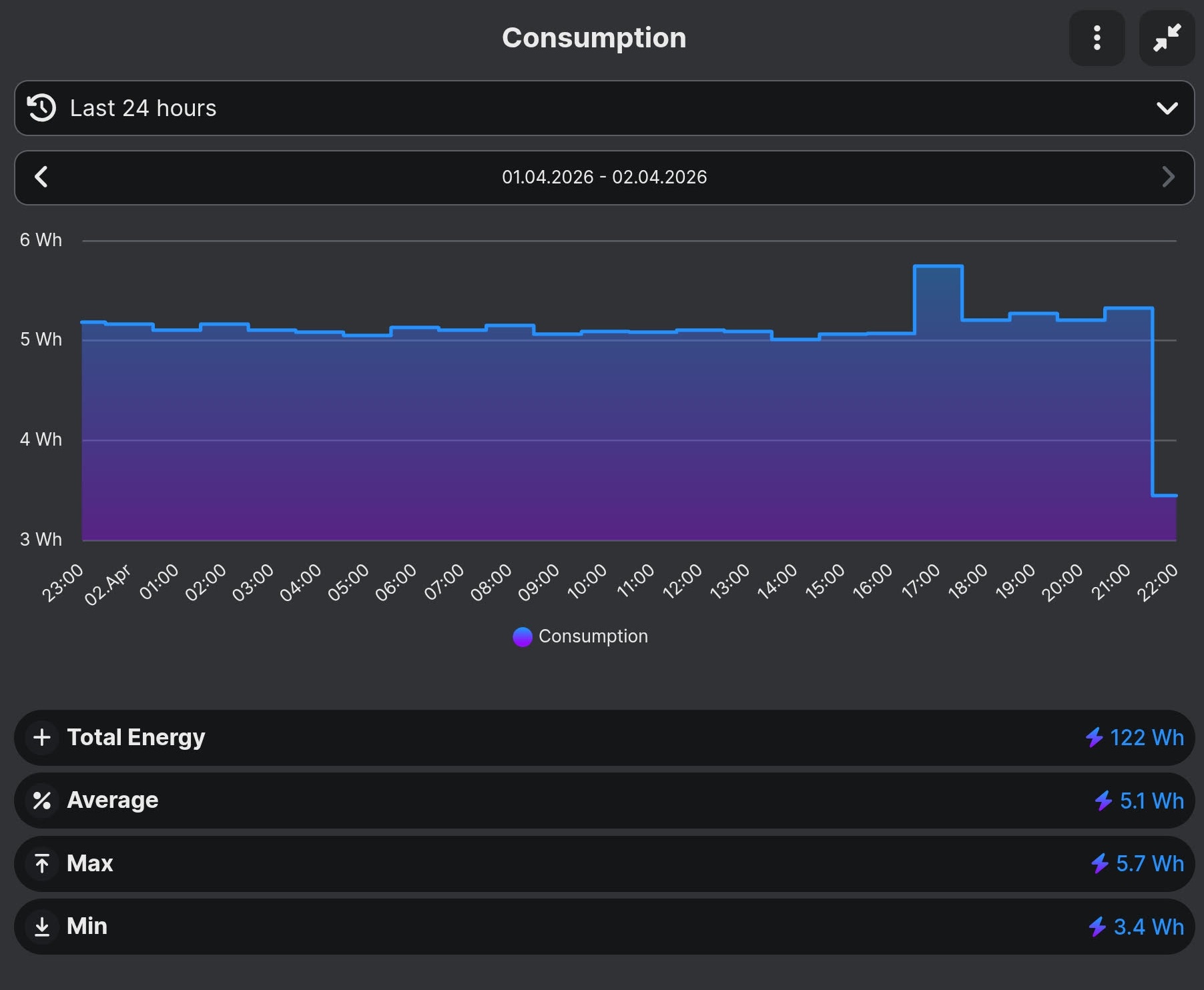
Over a full 24-hour idle period, the LattePanda IOTA shows very low and very steady power use, averaging 5.1 W, with a peak of 5.7 W and a minimum of 3.4 W. For most of the day, power draw stays clustered right around 5 W, which shows stable idle behavior with no unusual spikes. That is an excellent idle result, and notably lower than what I usually see from many Mini-PCs, which often idle closer to 8-10 W, or more. The brief rise to 5.7 W is minor.
At an average of 5.1 W, leaving the system idle around the clock would use roughly 44.7 kWh per year, which works out to about $7 to $9 annually, depending on local electricity rates. Overall, the IOTA is very efficient in an idle state, making it a particularly frugal option for always-on or light-duty use.
CPU and GPU Power Draw
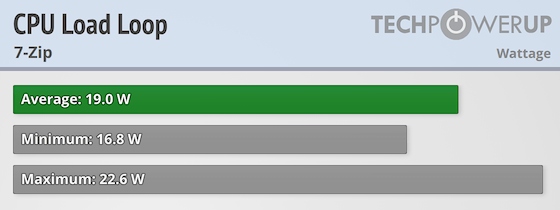
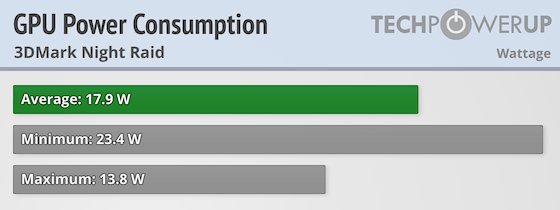
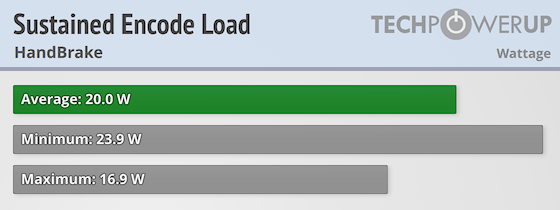
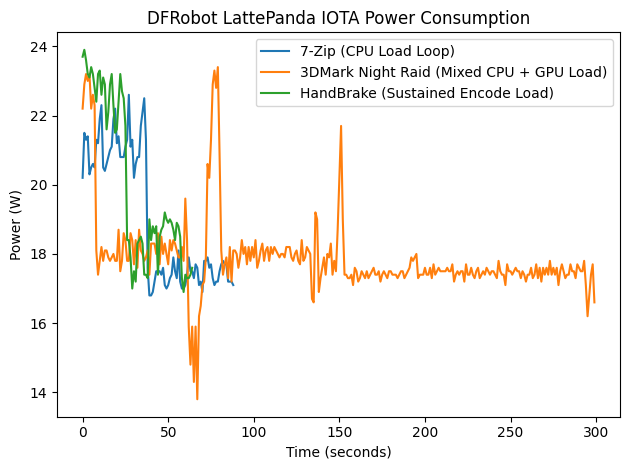
To evaluate power draw, the LattePanda was tested using three workloads that reflect how a platform like this would actually be used. The 7-Zip benchmark was used to generate a steady CPU load similar to tasks such as data compression or background processing, while 3DMark Night Raid introduced a mix of CPU and integrated graphics activity to reflect lighter graphical and UI-driven workloads. HandBrake was used as a longer-running encode test to represent sustained real-world usage, placing continuous demand on both the CPU and memory. These three scenarios provide a balanced view of how the system behaves under different types of load, from steady compute to more dynamic and extended workloads.
7-Zip (CPU Load Loop)
During the 7-Zip loop, the LattePanda Iota averages 19.0 W, with a peak of 22.6 W and a low of 16.8 W. This is a steady, CPU-focused load that reflects tasks like data compression, logging, or edge processing, and the relatively narrow range shows the system holding a consistent power level once it ramps up. It is a good representation of sustained compute workloads where the CPU is doing most of the work without involving the GPU.
3DMark Night Raid (Mixed CPU + GPU Load)
In Night Raid, power draw averages 17.9 W, with spikes up to 23.4 W and dips down to 13.8 W. Compared to 7-Zip, this workload is more dynamic, with noticeable fluctuation as the test shifts between CPU and GPU-heavy scenes. This makes it a useful proxy for light graphical workloads or UI-driven applications, where power usage is less constant and more dependent on what is being rendered at any given moment.
HandBrake (Sustained Encode Load)
The HandBrake encode averages 20.0 W, peaking at 23.9 W and dropping to 16.9 W. This is the most consistent real workload scenario, combining CPU and memory pressure over a longer period, and it shows the system settling into a stable operating range under continuous load. For use cases like edge video processing or sustained data handling, this is the most representative picture of how the Iota behaves over time.
Power draw generally sits in the ~18–20 W range for all three tests, with peaks reaching the low-to-mid 20 W range depending on the mix of CPU and GPU activity, and lows dipping into the mid-teens when workloads fluctuate. The 7-Zip loop shows a steady CPU-driven load, Night Raid introduces more variability with mixed workloads, and HandBrake provides the clearest view of sustained real-world operation, where the system settles into a stable band over time. Overall, the Iota maintains predictable and controlled power behavior across all three scenarios, which lines up well with its role as a compact, always-on system.
Here's a full view of the power draw across all three profiles:
Noise Levels
Noise was measured using a digital sound level meter placed about 30 cm from the front of the system. During light desktop use, web browsing, or general productivity work, the LattePanda Iota was usually very quiet at around 30 dB, although the fan would occasionally ramp up for short bursts—even when the workload did not seem especially demanding.Under heavier activity such as downloads, PCMark, Geekbench, or other sustained test loads, noise climbed to around 54 dB. At that point the cooler develops a more noticeable, slightly whiny character rather than a deeper fan sound. That said, whether that actually matters depends a lot on how the Iota is being used. For a small embedded platform intended for kiosks, edge systems, control setups, or tucked-away deployments, this is not likely to be a major issue. If the system is sitting right next to you, the noise is noticeable, but for deployments where it is tucked away or mounted out of sight, it is much less of a concern.
Nov 16th, 2026 08:01 CST
change timezone
Latest GPU Drivers
New Forum Posts
- Samsung 860 Evo MZ-76E2TO 2tb. 2018-10 (1)
- no "PhysX" workable (16)
- need an ide to sata adapter that lets me burn cds on an ide cdrw drive (that doesn't power down while burning or copying) (52)
- What can the FX 8320 do today? Here is the answer. (64)
- Without Jensen, PC gaming will be (4)
- Folding Pie and Milestones!! (10206)
- The Official Linux/Unix Desktop Screenshots Megathread (915)
- GPU Temperatures Rise Very Quickly in FurMark – Is This Normal? (17)
- Can you guess Which game it is? (327)
- no OpenGL showing support when... (11)
Popular Reviews
- ASUS ROG Strix B850-I Gaming Wi-Fi7 W Review
- Corsair HX1000i Shift Crystal Review
- AMD Zen 6 Technical Deep Dive
- Upcoming Hardware Launches 2027 (Updated Nov 2026)
- Montech King 95 3D PRO Review
- NZXT C1200 Platinum Review
- Phantom Blade Zero Performance Benchmark Review - 35 GPUs Tested
- AMD Ryzen 7 9800X3D Review - The Best Gaming Processor
- NZXT H7 RGB+ Review
- NZXT H5 Review
TPU on YouTube
Controversial News Posts
- NVIDIA Co-Founder and CEO Jensen Huang Officially Resigns (431)
- Open Letter Asking NVIDIA to Reinstate Jensen Huang Passes 115,000 Signatures (184)
- OpenAI CEO Argues Home PCs Waste the World's Limited DRAM Supply (152)
- NVIDIA Launches Investigation Into Jensen Huang's Relationship With Suspected Chinese Spy (136)
- Intel "Raptor Lake Next" 16-Core and 20-Core CPUs Surface (130)
- Legendary Game Studio BioWare Shuts Down Following EA Layoffs (104)
- Dell CEO Says the Memory Shortage Will Get Worse in 2027 (95)
- NVIDIA GeForce RTX 50-Series Scheduled for up to $500 Price Hike This Week (89)