 5
ECS LIVA Z11 Plus Review
Value & Conclusion »Power and Noise Levels
Power and efficiency are just as important as raw performance in a compact system, so I measured how much the LIVA Z11 Plus draws at idle, under CPU stress, during GPU-heavy tests, and while gaming. These measurements were captured using a Shelly smart power relay, taking advantage of its API-based logging to track real-time wattage and build accurate per-second consumption profiles. I also monitored the system's noise levels while idle and when under sustained load.Idle Power Draw
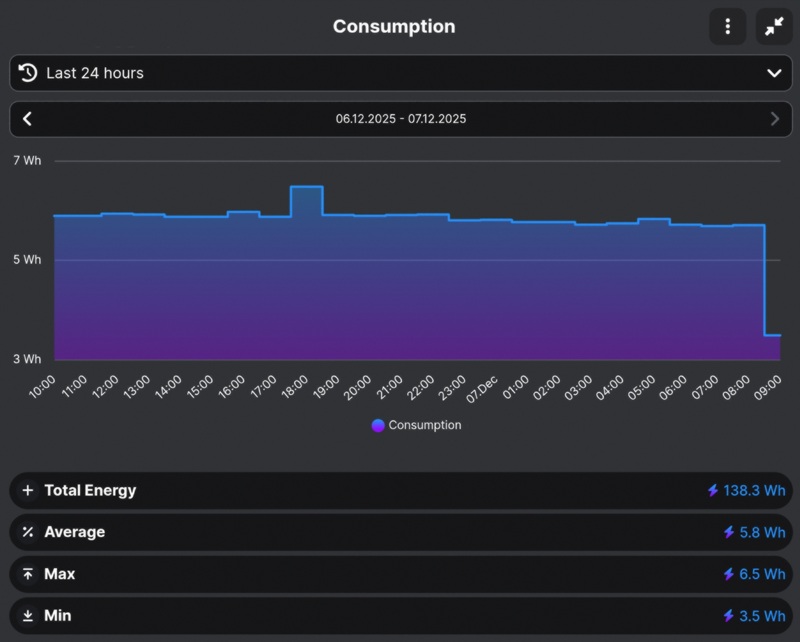
Over a 24-hour idle monitoring period, the system consumed 0.138 kWh, averaging 0.0058 kWh per hour (5.8 W). Power stayed very steady throughout the day, with a maximum of 0.0065 kWh (6.5 W) and a minimum of 0.0035 kWh (3.5 W), with only small bumps tied to background activity.
At this rate, continuous 24/7 operation would total roughly 50 kWh per year, translating to about $6 USD annually based on typical North American electricity costs. This is an excellent idle result for a fully functional Mini-PC and highlights how little overhead the system carries when sitting at the desktop or performing light background tasks.
CPU and GPU Power Draw
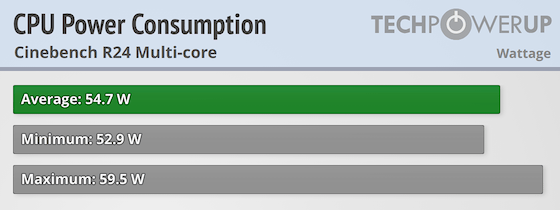
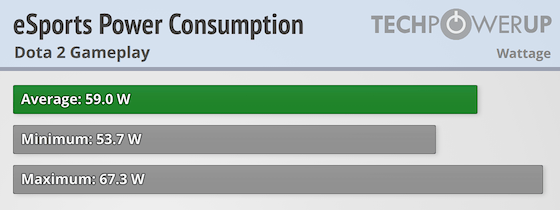
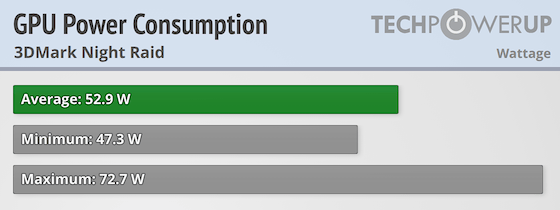
We also tested three real-world power-load scenarios: an esports gaming pass with Dota 2, which gives a good view of mid-load stability and clock consistency; a GPU-oriented run using Night Raid, which exposes how the APU reacts to scene changes and mixed rendering workloads; and a heavy Cinebench multicore pass that stresses all CPU cores simultaneously to show long-term power delivery.
Cinebench Multicore
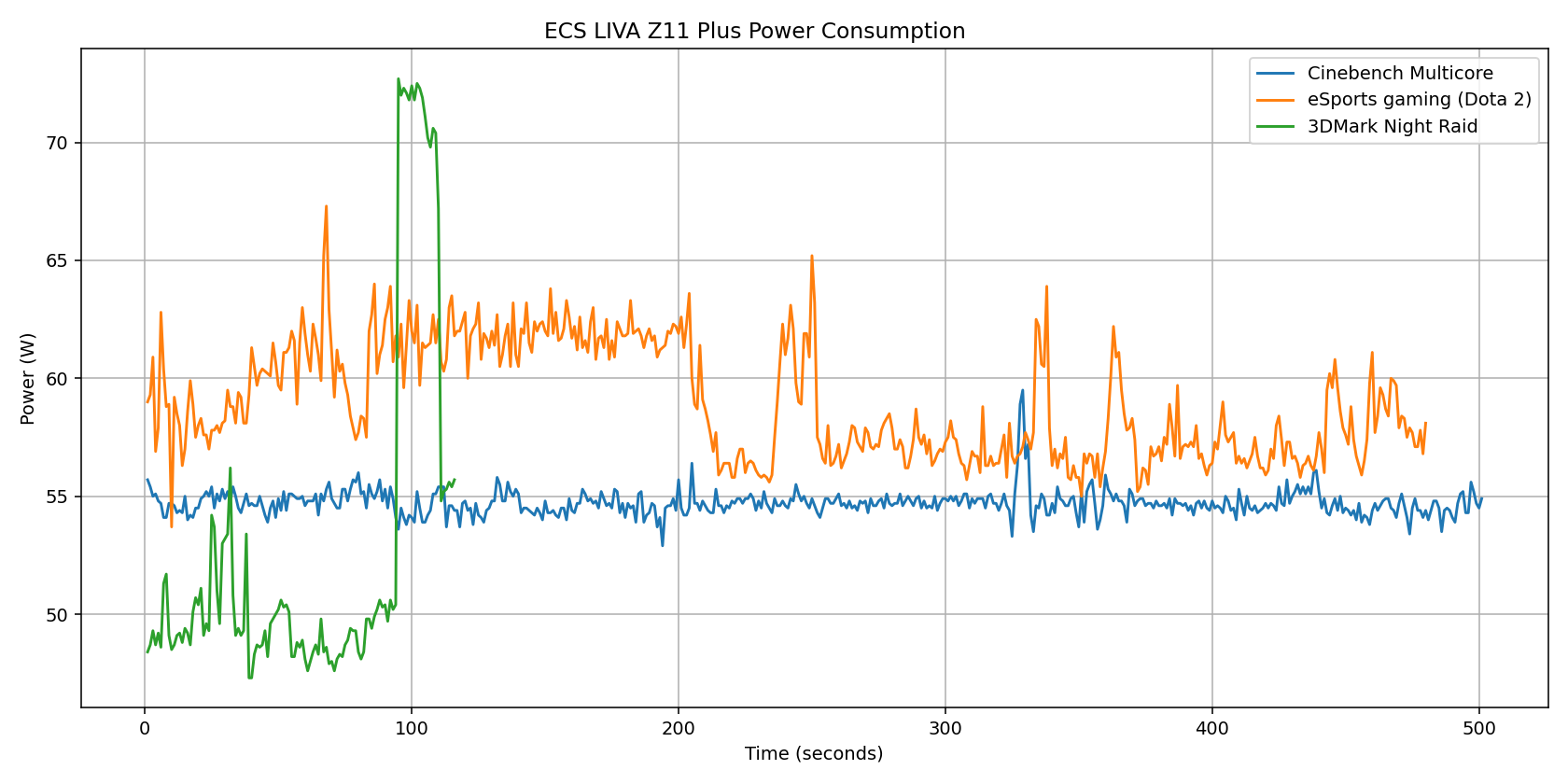
The system averaged 54.7 W, with a minimum of 52.9 W and a maximum of 59.5 W. Power remains tightly clustered throughout the entire run, which is exactly what you expect from a sustained all-core CPU workload and points to stable, consistent power delivery over time.
eSports Gaming (Dota 2)
Dota 2 averaged 59.0 W, with a minimum of 53.7 W and peaks up to 67.3 W during heavier action. This wider range compared to Cinebench is normal for real gameplay, where fluctuating scene complexity and brief CPU bursts naturally introduce short-lived power swings.
3DMark Night Raid
Night Raid averaged 52.9 W, with a low of 47.3 W and a peak of 72.7 W during more demanding scenes. These brief spikes align with the benchmark's mixed CPU and GPU transitions and do not represent sustained load or ongoing power stress.
Here's a full view of the Z11's power draw across all three profiles:
Noise Levels
Noise was measured using a digital sound level meter placed about 30 cm from the system. During everyday tasks like browsing, writing, or general desktop use, the LIVA Z11 Plus is effectively silent and completely fades into the background. In a normal office room, you would not notice it at all.Things change quickly once the system is put under heavy load. During CPU or GPU stress tests, and even while installing games through Steam, the fan ramps up aggressively and becomes pretty loud, hitting around 60 dB(A) and occasionally a bit higher. The sound is sharper too, with a noticeable high-pitched whistling tone rather than a smooth airflow noise. It is the loudest Mini-PC I've tested so far, which likely comes down to the fan being mounted directly against the top panel, with very little room for sound to dissipate.
In short bursts, it is manageable, but during longer workloads or large installs, the noise is hard to ignore unless the system is tucked away far from your desk, or if you have a lot of white noise going on in your room. So, definitely keep that in mind.
Nov 27th, 2026 23:22 CST
change timezone
Latest GPU Drivers
New Forum Posts
- Rare GPUs / Unreleased GPUs (2273)
- Mouse Pad advice - Shidenkai out of production? (22)
- Unigine Superposition GPU Benchmark (1080P Extreme) (463)
- -18C on GPU by moving it to the front of the case. (20)
- What's your main Black Friday / Cyber Monday purchase? (43)
- Unigine Superposition on Linux (21)
- CPU Database (305)
- Exit Adobe - PDF reader, and PDF editor recommendations (11)
- TPU's WCG/BOINC Team (34815)
- Anthrophics IPO (51)
Popular Reviews
- Upcoming Hardware Launches 2027 (Updated Nov 2026)
- AMD Ryzen 7 9800X3D Review - The Best Gaming Processor
- VZMORE AX9 Max Review
- Montech CyberFlow ARGB 360 Review
- Moaiplay Ora Pro G1 850 Review
- ASRock X870E Challenger Wi-Fi White Review
- AMD Zen 6 Technical Deep Dive
- ORICO Obook15 AI Review
- Microsoft Surface Laptop Ultra Review - The Next-gen Arm Laptop
- Phantom Blade Zero Performance Benchmark Review - 35 GPUs Tested
TPU on YouTube
Controversial News Posts
- Jensen Huang Reinstated as CEO of NVIDIA (626)
- NVIDIA Co-Founder and CEO Jensen Huang Officially Resigns (492)
- Report: Jensen Huang Eyes NVIDIA Comeback (281)
- Open Letter Asking NVIDIA to Reinstate Jensen Huang Passes 115,000 Signatures (184)
- OpenAI CEO Argues Home PCs Waste the World's Limited DRAM Supply (152)
- NVIDIA Launches Investigation Into Jensen Huang's Relationship With Suspected Chinese Spy (136)
- Intel Razor Lake Gets a 12 P-Core bLLC Chip With No E-Cores, Per Leak (94)
- NVIDIA GeForce RTX 50-Series Scheduled for up to $500 Price Hike This Week (89)