 5
ECS LIVA Z11 Plus Review
Web & Office Productivity »General Performance
AIDA64 Cache and Memory
First up in our performance analysis is AIDA64's memory benchmark. This test gives a clear picture of how quickly the CPU and memory subsystem can move data. Since the Arc 140T iGPU relies on system RAM, bandwidth and latency play a direct role in both everyday responsiveness and graphics performance.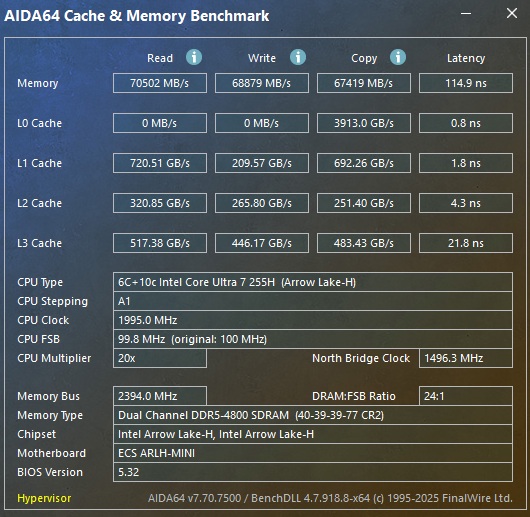
The AIDA64 memory test shows the LIVA Z11 Plus with 70,502 MB/s read, 68,879 MB/s write, and 67,419 MB/s copy, with 114.9 ns latency. Bandwidth is significantly higher than DDR4-based Mini-PCs, which benefits both general responsiveness and the integrated Arc GPU. Cache performance also scales well with Intel's Core Ultra 7 255H, with strong L1, L2, and L3 results for its class.
Cinebench
Cinebench measures how well the CPU handles both single-threaded and multithreaded rendering. It is a simple way to compare real compute performance across systems.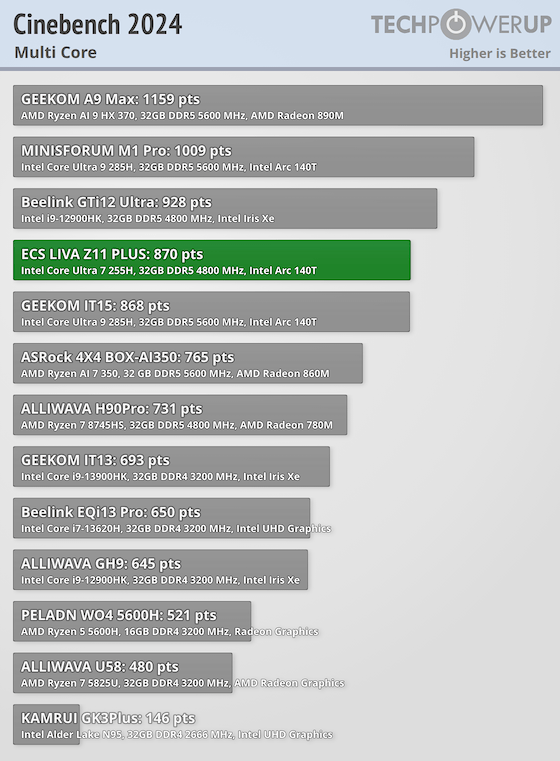
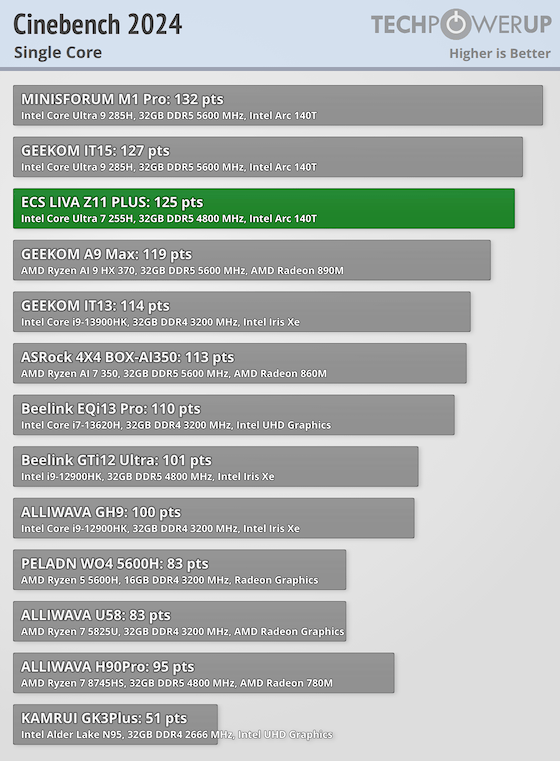
The Z11 Plus scores 870 multicore and 125 single-core, which puts it well above older 11th–13th gen mobile parts and far ahead of the Ryzen 5600H class in single-threaded work. Multicore performance is also strong due to the higher thread count and architectural improvements.
7-Zip
7-Zip's internal benchmark stresses compression and decompression, which shows how the CPU handles file-heavy tasks like installs, archiving, and packaging.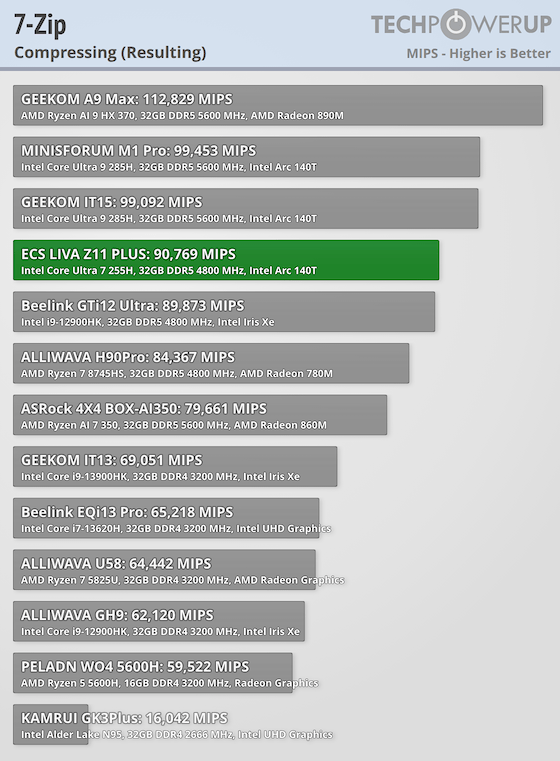
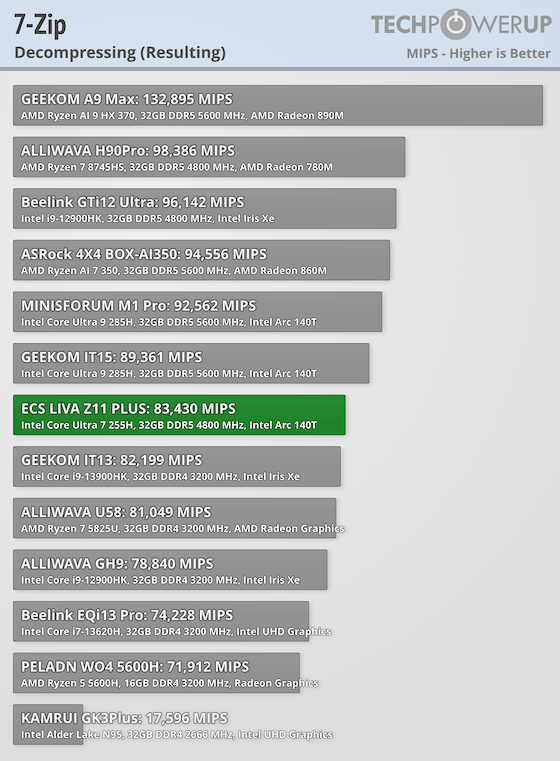
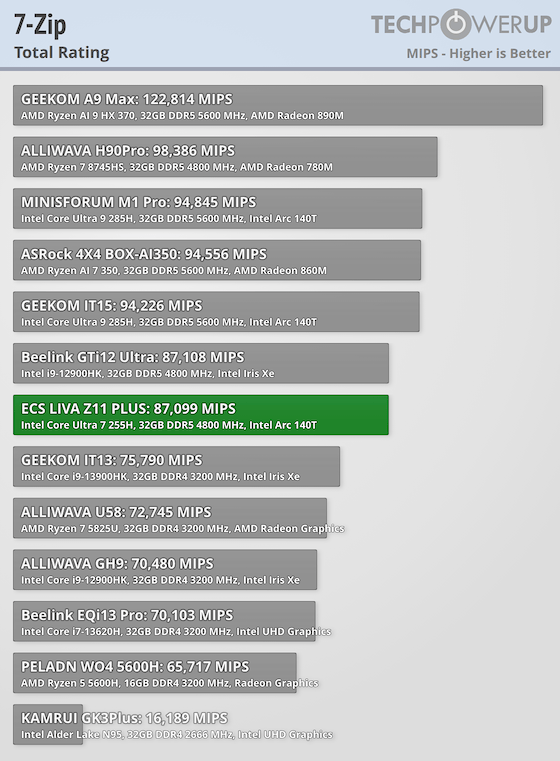
The Z11 Plus reaches 90,769 MIPS in compression and 83,430 MIPS in decompression, delivering a total rating of 87,099. These results are a sizable jump over older midrange CPUs. In real-world use, installs, packaging jobs, and archive manipulation feel faster and stay consistent under load.
PCMark 10
PCMark measures day-to-day responsiveness across web, conferencing, documents, multitasking, and light content creation.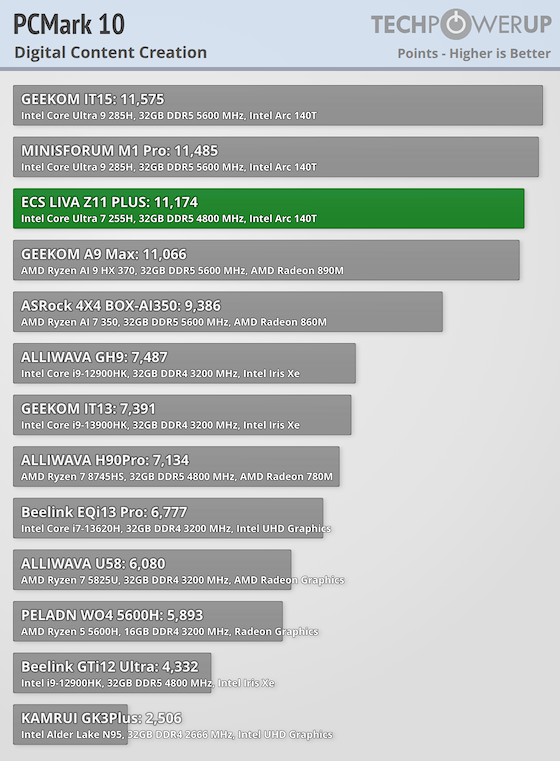
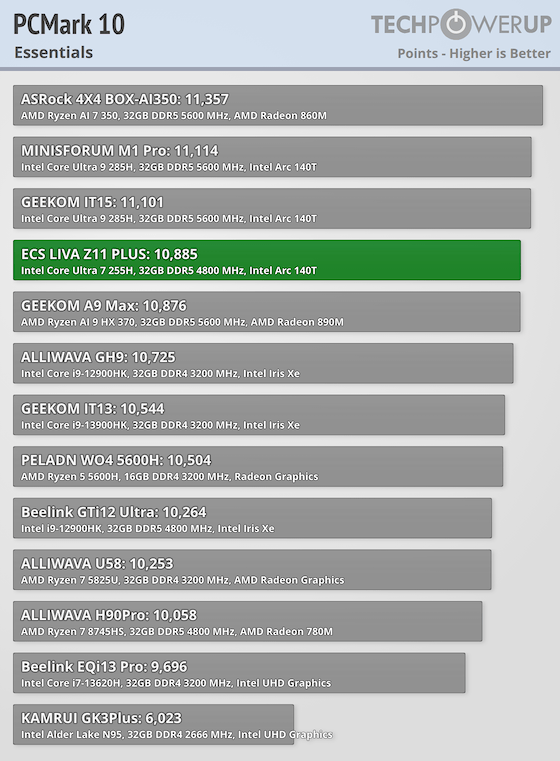
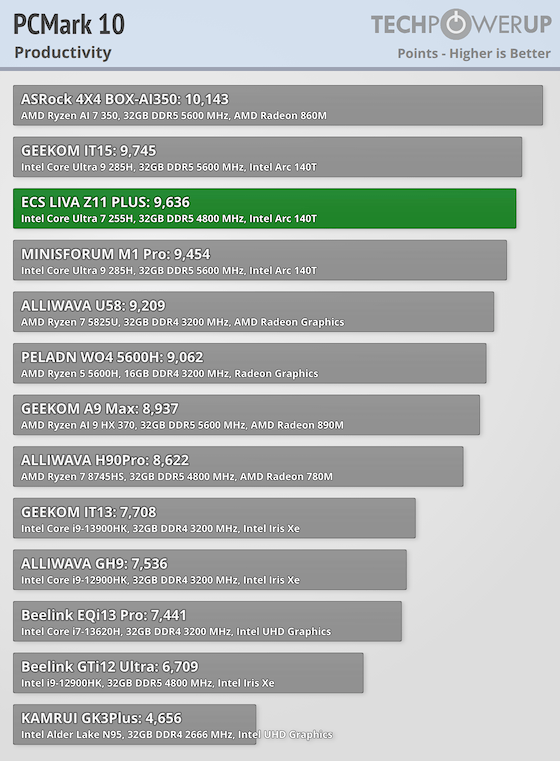
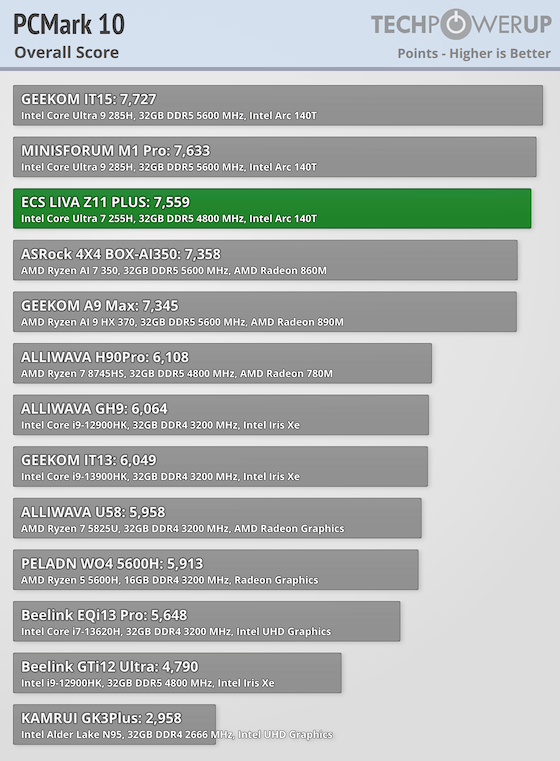
The Z11 Plus hits 10,885 in Essentials, 9,636 in Productivity, 11,174 in Digital Content Creation, and an overall score of 7,559. These are good results for a compact Mini-PC and well ahead of DDR4-based systems.
Y-Cruncher
Y-Cruncher stresses the CPU with an extremely heavy math workload, making it a good stress test for stability and raw compute.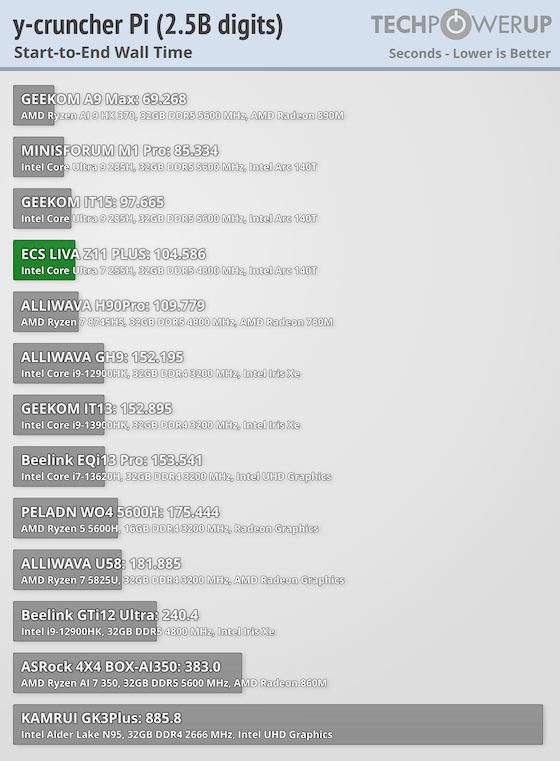
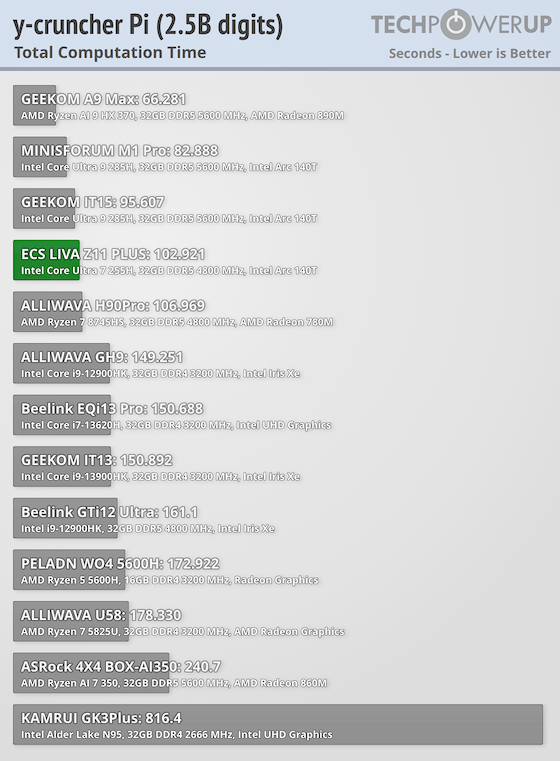
The Z11 Plus completes the 2.5B Pi test in 102.921 seconds, with a 104.586 second wall time, which are a noticeable improvement over older CPUs. It's a good sign that Intel's new efficiency/performance core split can handle sustained workloads without running into early throttling.
Geekbench
Geekbench covers a wide range of real workloads and gives a balanced look at CPU strength.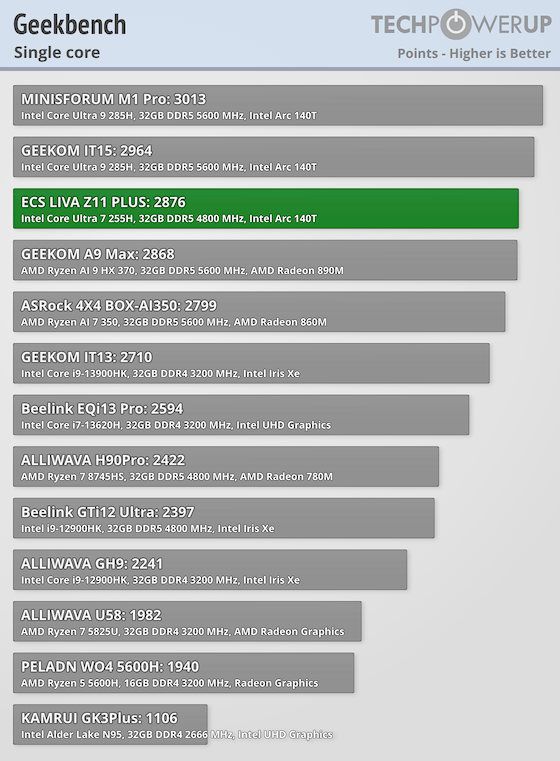
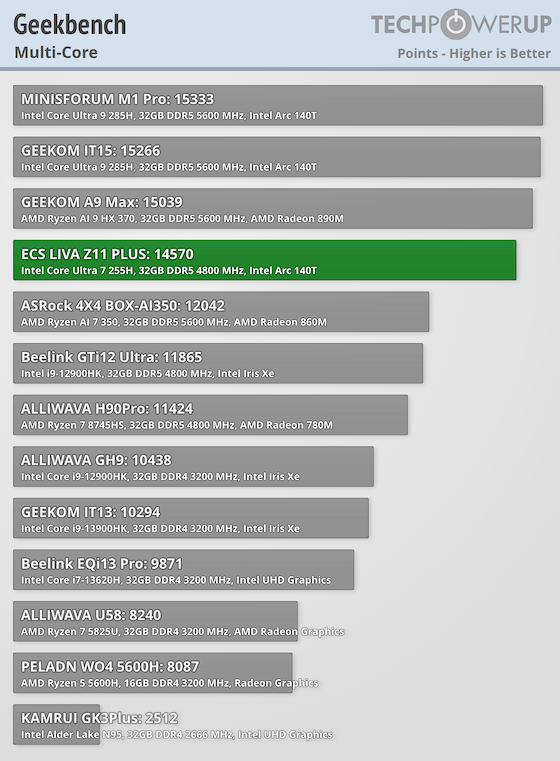
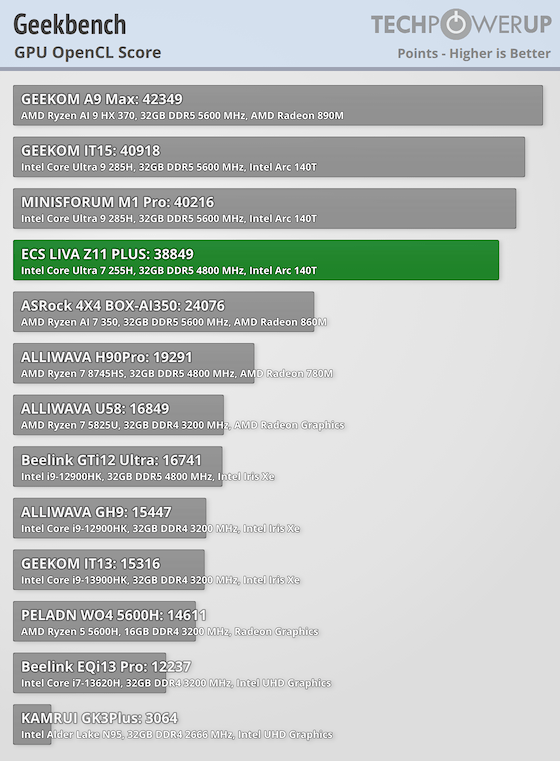
The Z11 Plus scores 2,876 in single-core and 14,570 in multicore, putting it right in the modern mid-range. The strong single-core score means the system feels fast in everyday use, while the multicore result shows it can handle heavier jobs like compiling, batch work, and exports without trouble. Its 38,849 OpenCL score is especially impressive, showing the integrated Arc GPU is a big improvement over older Vega-based iGPUs for compute-heavy tasks.
Nov 28th, 2026 00:56 CST
change timezone
Latest GPU Drivers
New Forum Posts
- -18C on GPU by moving it to the front of the case. (22)
- Rare GPUs / Unreleased GPUs (2273)
- Mouse Pad advice - Shidenkai out of production? (22)
- Unigine Superposition GPU Benchmark (1080P Extreme) (463)
- What's your main Black Friday / Cyber Monday purchase? (43)
- Unigine Superposition on Linux (21)
- CPU Database (305)
- Exit Adobe - PDF reader, and PDF editor recommendations (11)
- TPU's WCG/BOINC Team (34815)
- Anthrophics IPO (51)
Popular Reviews
- Upcoming Hardware Launches 2027 (Updated Nov 2026)
- AMD Ryzen 7 9800X3D Review - The Best Gaming Processor
- VZMORE AX9 Max Review
- Moaiplay Ora Pro G1 850 Review
- Montech CyberFlow ARGB 360 Review
- ASRock X870E Challenger Wi-Fi White Review
- AMD Zen 6 Technical Deep Dive
- ORICO Obook15 AI Review
- Microsoft Surface Laptop Ultra Review - The Next-gen Arm Laptop
- Phantom Blade Zero Performance Benchmark Review - 35 GPUs Tested
TPU on YouTube
Controversial News Posts
- Jensen Huang Reinstated as CEO of NVIDIA (627)
- NVIDIA Co-Founder and CEO Jensen Huang Officially Resigns (492)
- Report: Jensen Huang Eyes NVIDIA Comeback (281)
- Open Letter Asking NVIDIA to Reinstate Jensen Huang Passes 115,000 Signatures (184)
- OpenAI CEO Argues Home PCs Waste the World's Limited DRAM Supply (152)
- NVIDIA Launches Investigation Into Jensen Huang's Relationship With Suspected Chinese Spy (136)
- Intel Razor Lake Gets a 12 P-Core bLLC Chip With No E-Cores, Per Leak (94)
- NVIDIA GeForce RTX 50-Series Scheduled for up to $500 Price Hike This Week (89)