 25
EK-Quantum Vector RE RTX 3080/3090 Active Backplate D-RGB - Plexi Review
(25 Comments) »Introduction

Did you know the RTX 3090 VRAM ran hot? It has become enough of a serious issue for some really novel takes on the backplate design and cooling to pop up. When it came to the DIY watercooling field, this meant bringing about more ways to remove the heat from the back of the PCB than merely a regular aluminium backplate. There have been takes on active backplates in the past, with Aqua Computer first doing so with a heatpipe that I would argue is semi-active at most. Indeed, the company itself realized there is an opportunity for a coolant flow path on the back and put out some renders for interest checks in the community. A few enterprising community members developed mods to do the same, even making one a retail product that clips onto an existing backplate. That wasn't the most elegant of solutions, however, and Aqua Computer was since been beat to the market by EK.

First announced at its CES 2021 media event, the EK-Quantum Vector Active Backplate was the subject of many a discussion. Remember the dual PCB GPU sandwiches from a few generations ago? We can now have a water block sandwich with the GPU in the middle. I definitely had to put together a dedicated review for this despite it clearly not being as beneficial on my RTX 3080 relative to the RTX 3090. Thanks again to EK for sending a review sample to TechPowerUp, and be sure to read this review alongside my review of the EK-Quantum Vector GPU block and "regular" backplate.
Packaging and Accessories
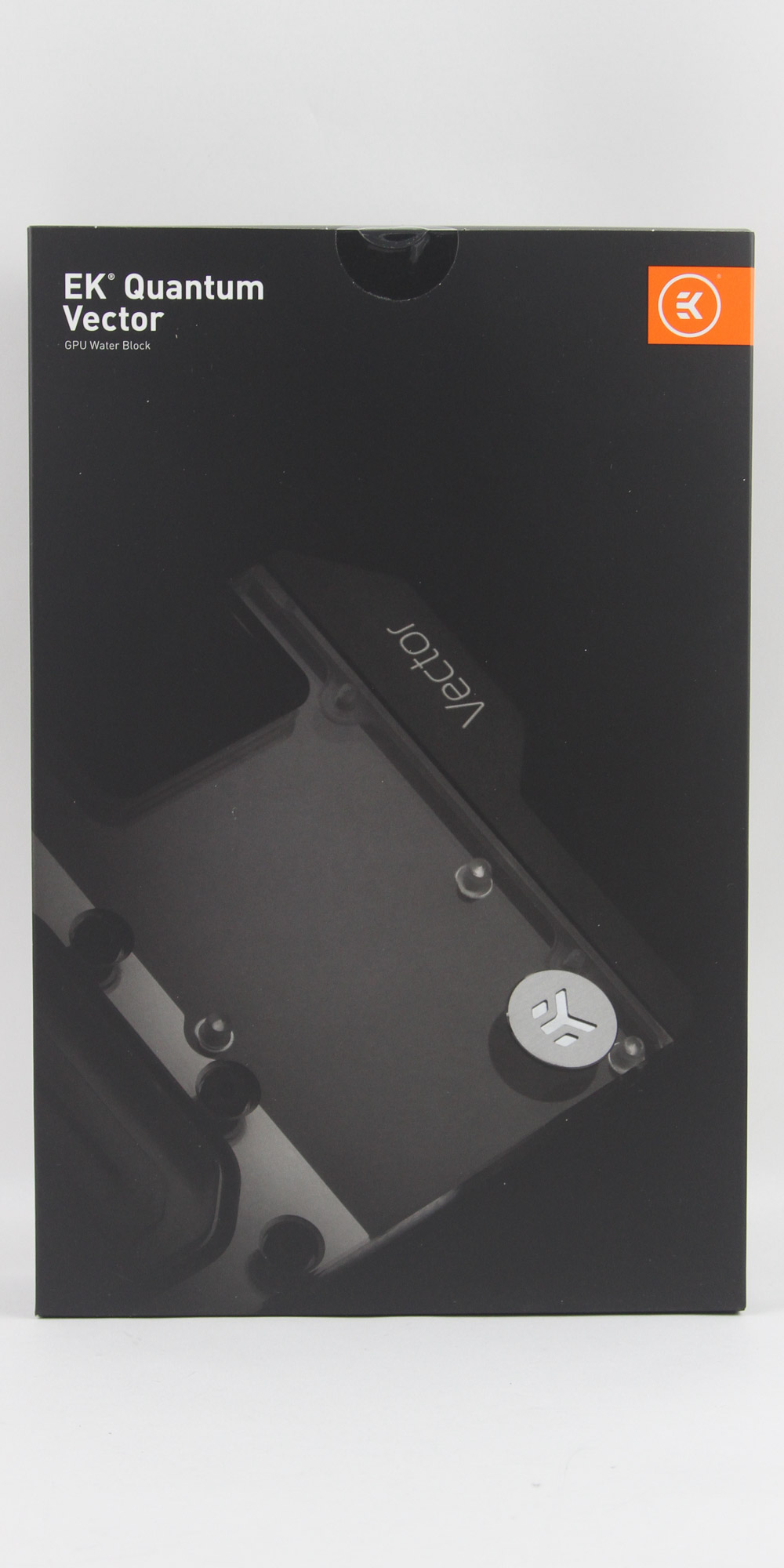
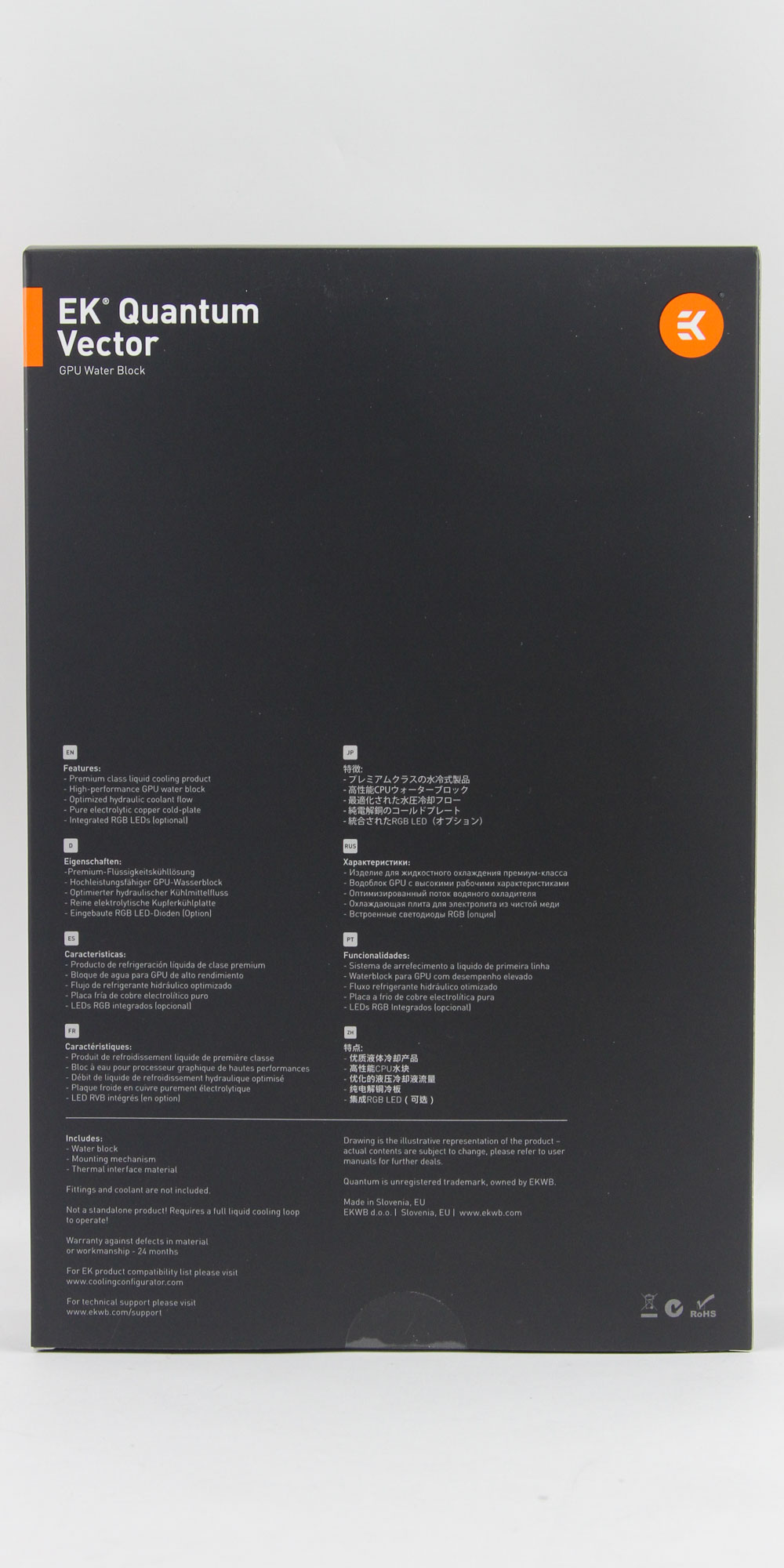
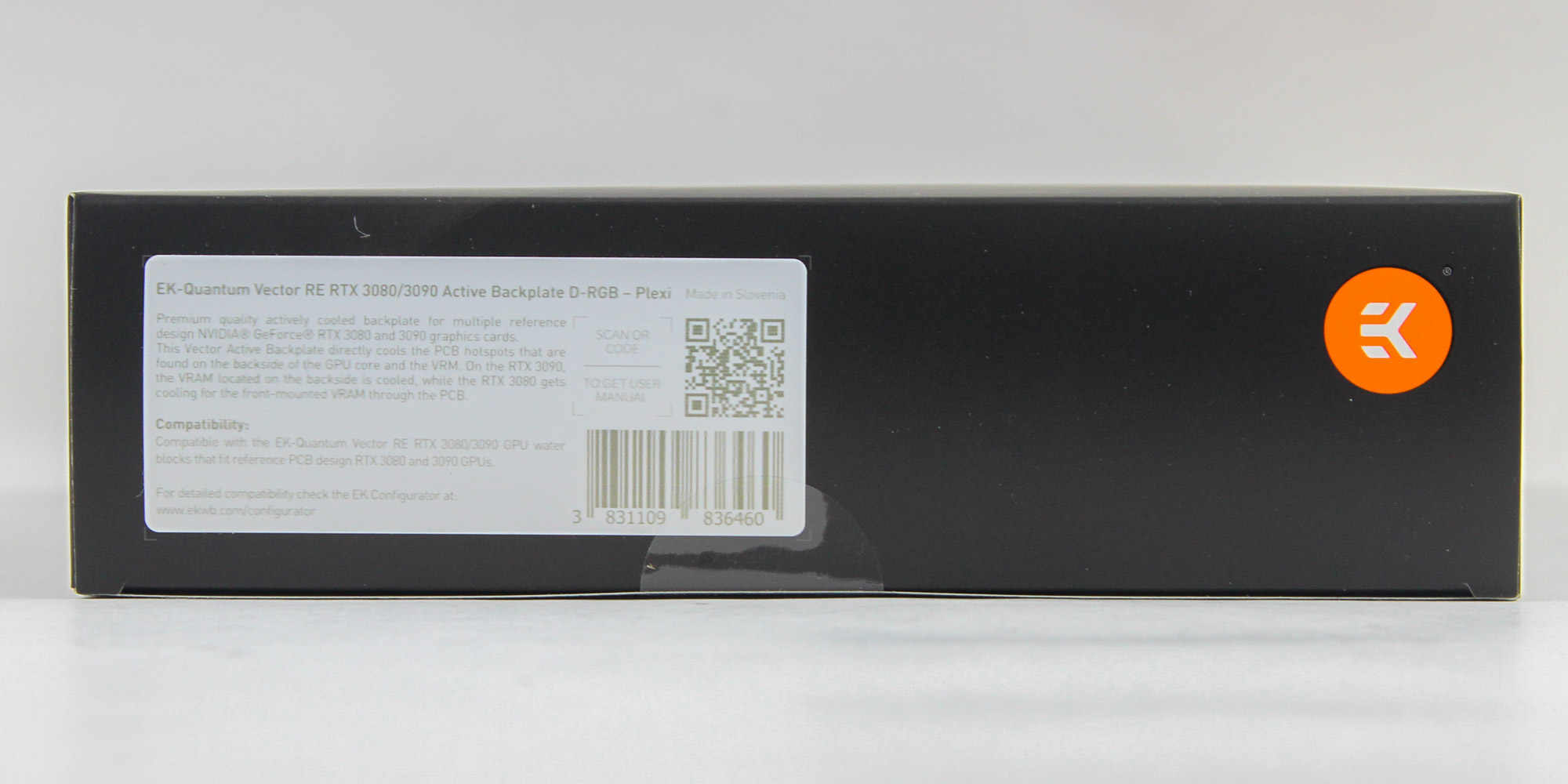
Packaging for the EK-Quantum Vector RE Active Backplate is very similar to the GPU block in the same EK-Quantum Vector line. We see the product name and EK logo on front, with the latter adopting an orange background the brand still often uses. There is also a render of the GPU block on the front, which confirms that the same packaging has been used. Salient marketing features greet us on the back in multiple languages. A sticker on the side lists more specific information pertaining to the product inside, and confirms that we do have the nickel/plexi version. A QR code takes you to the online installation manual EK does not include as a printed version with the block.
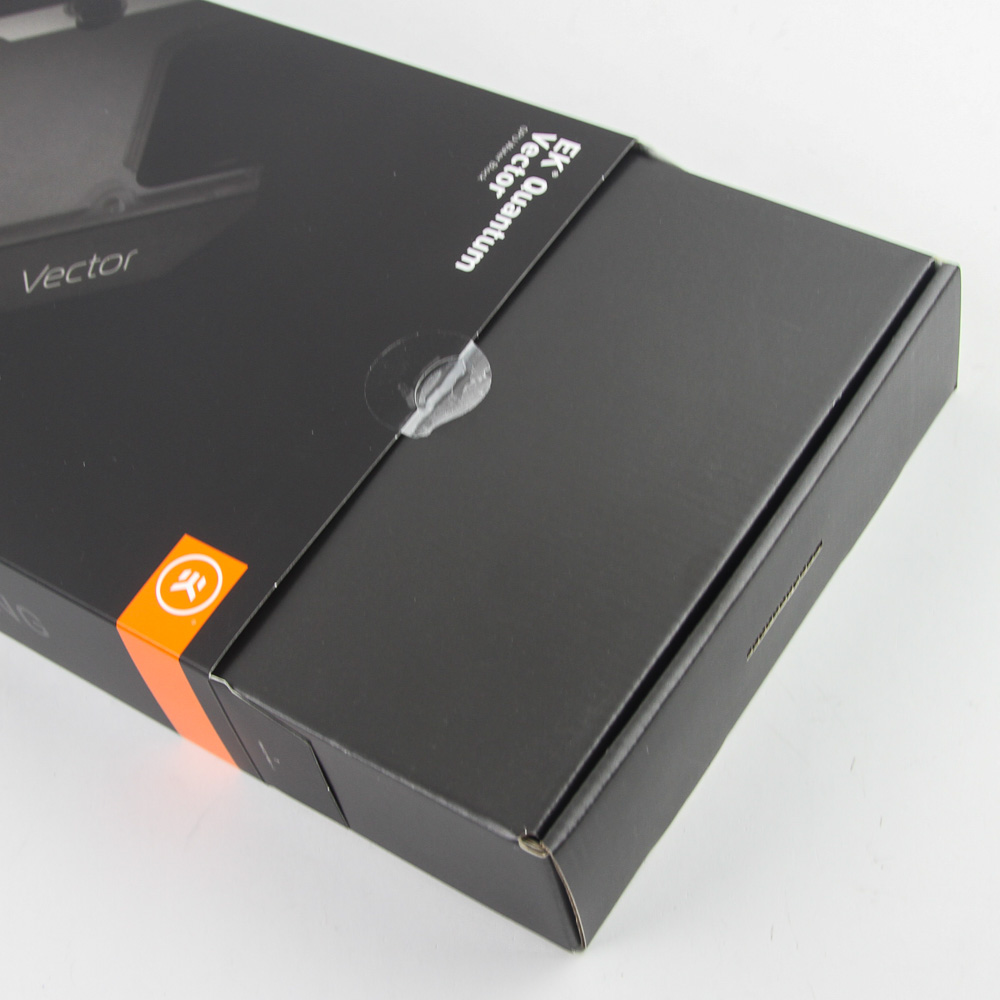
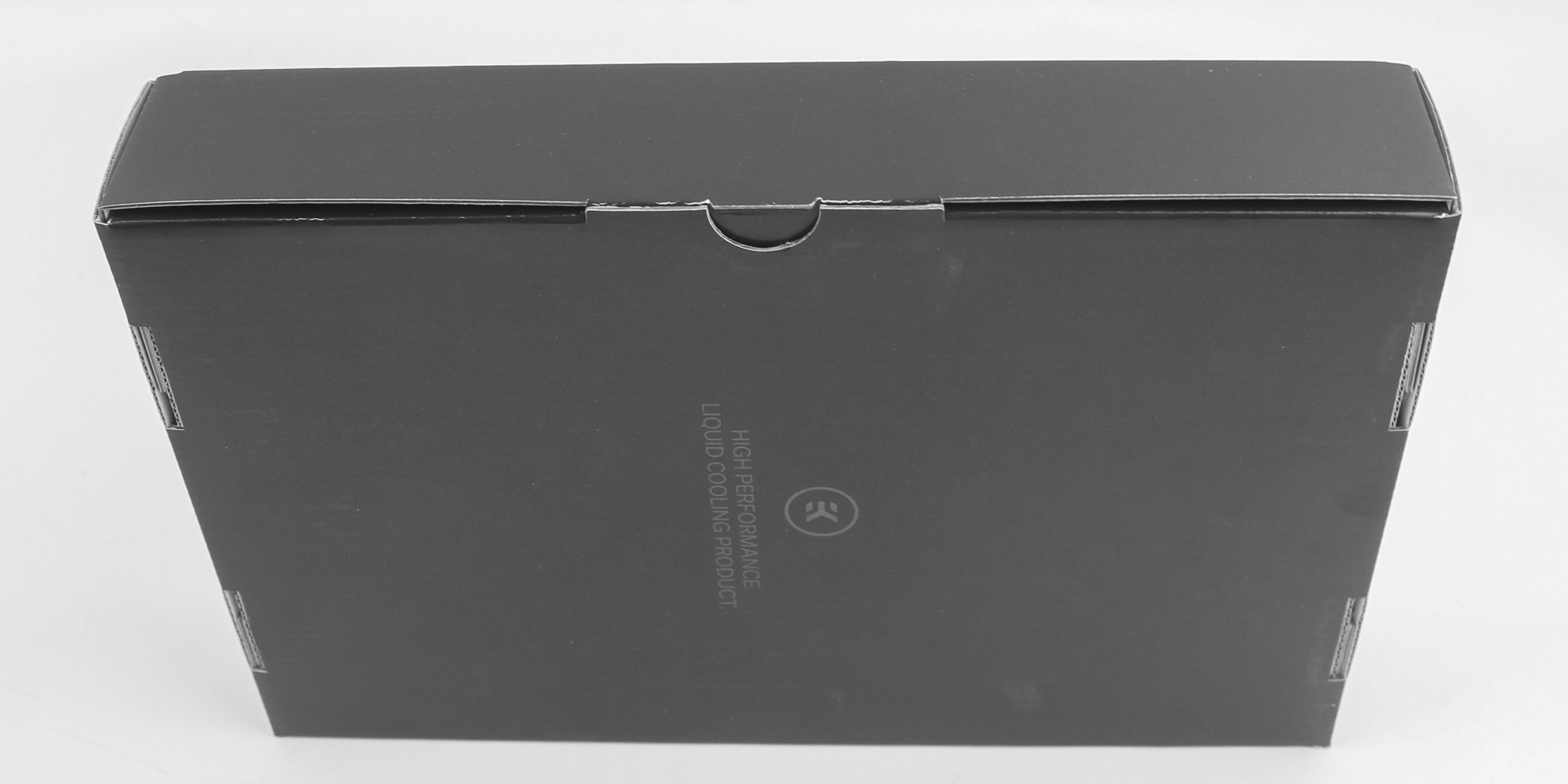

There are two seals on either end of what we now find out was just an outer sleeve, and with them removed, the inner box can be slid out. This box is much simpler in design, with a black wrap over cardboard and the EK logo in the center on the front and back. A double flap on the side keeps the contents in place during transit. Opening the box, I was expecting to see the installation accessories as per usual, but a foam sheet has been put on top instead.
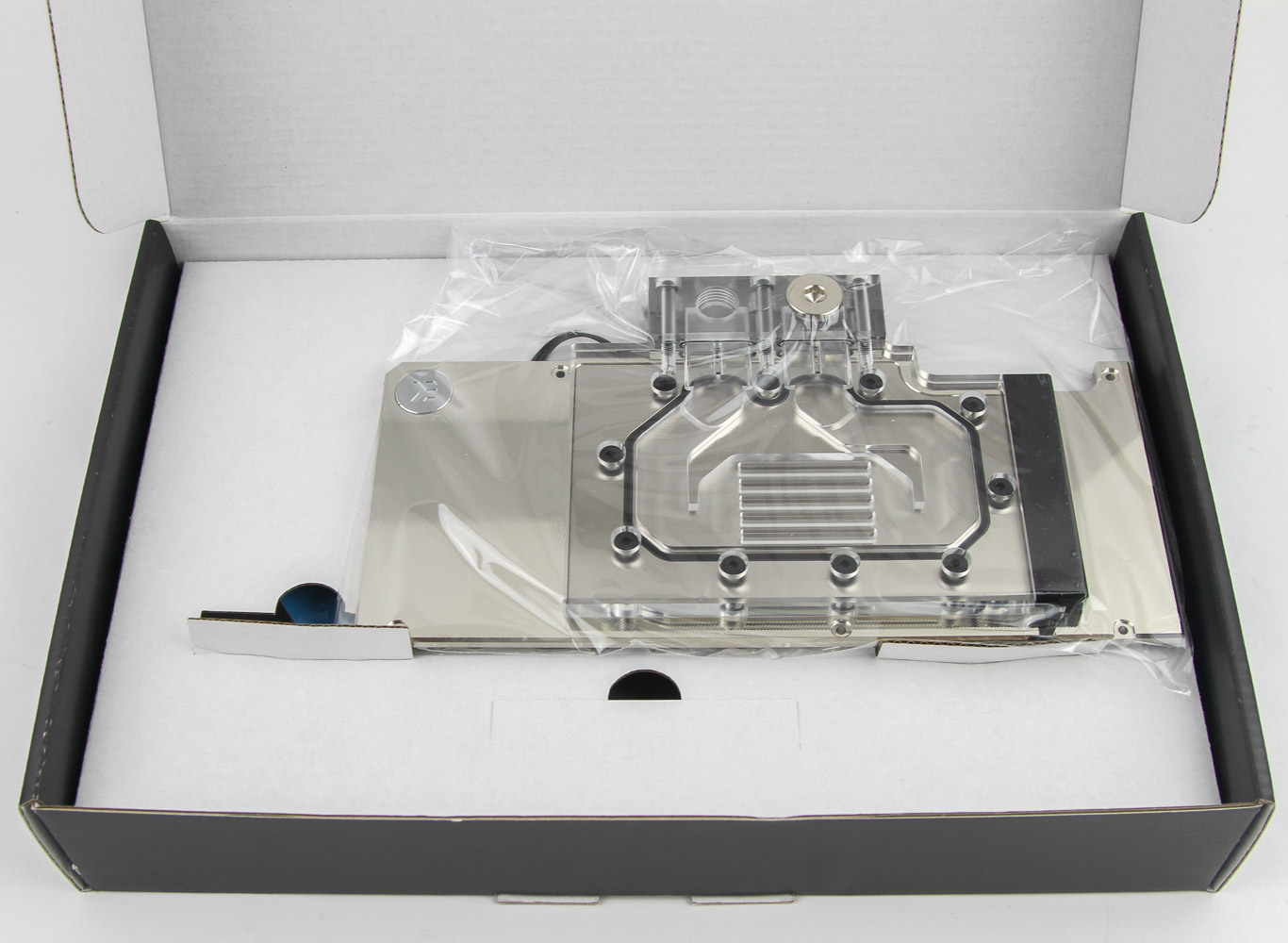

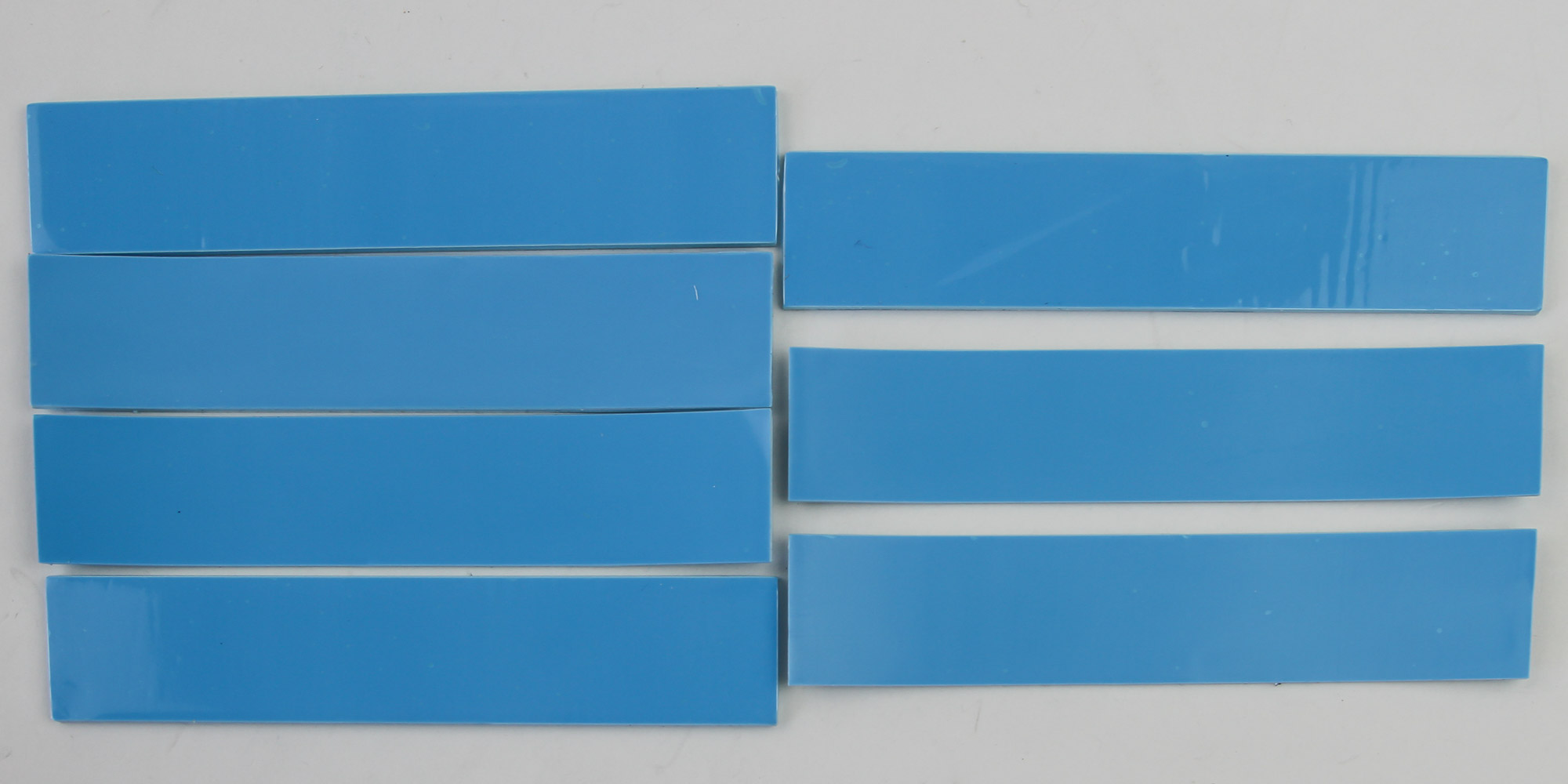
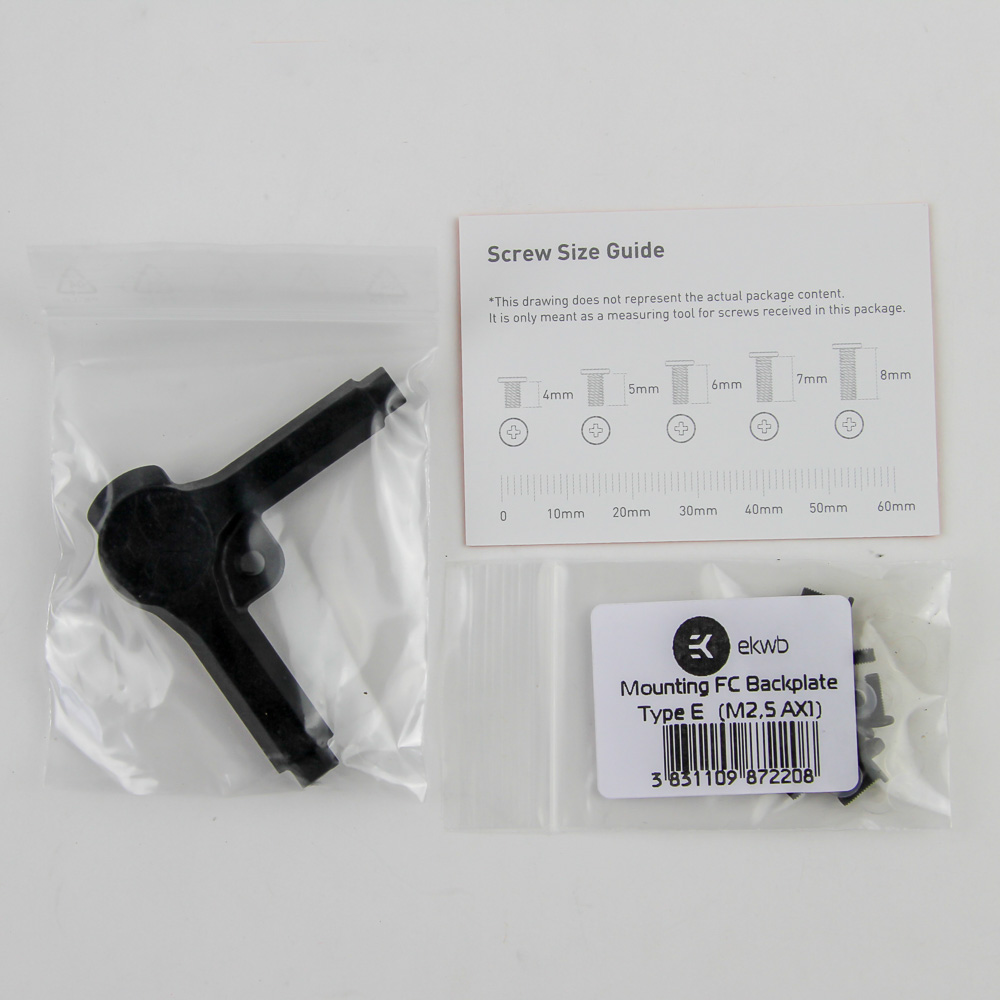
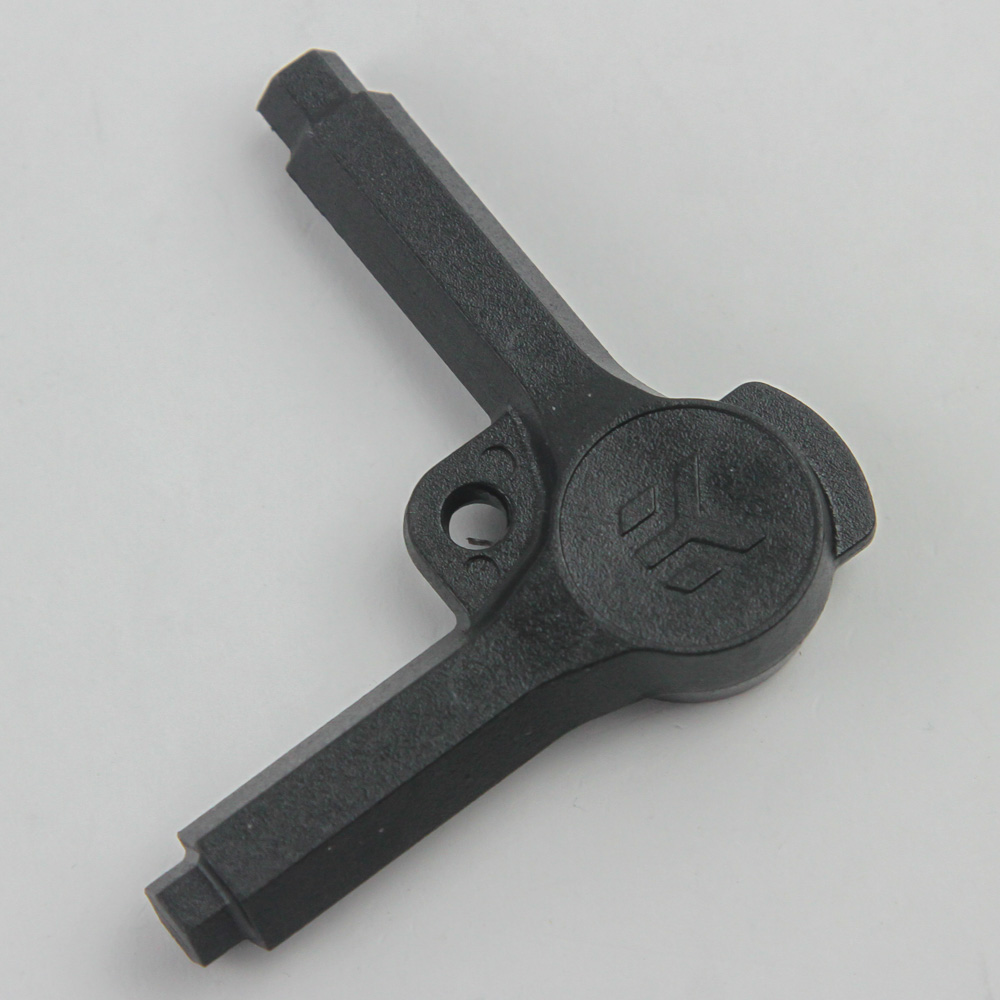
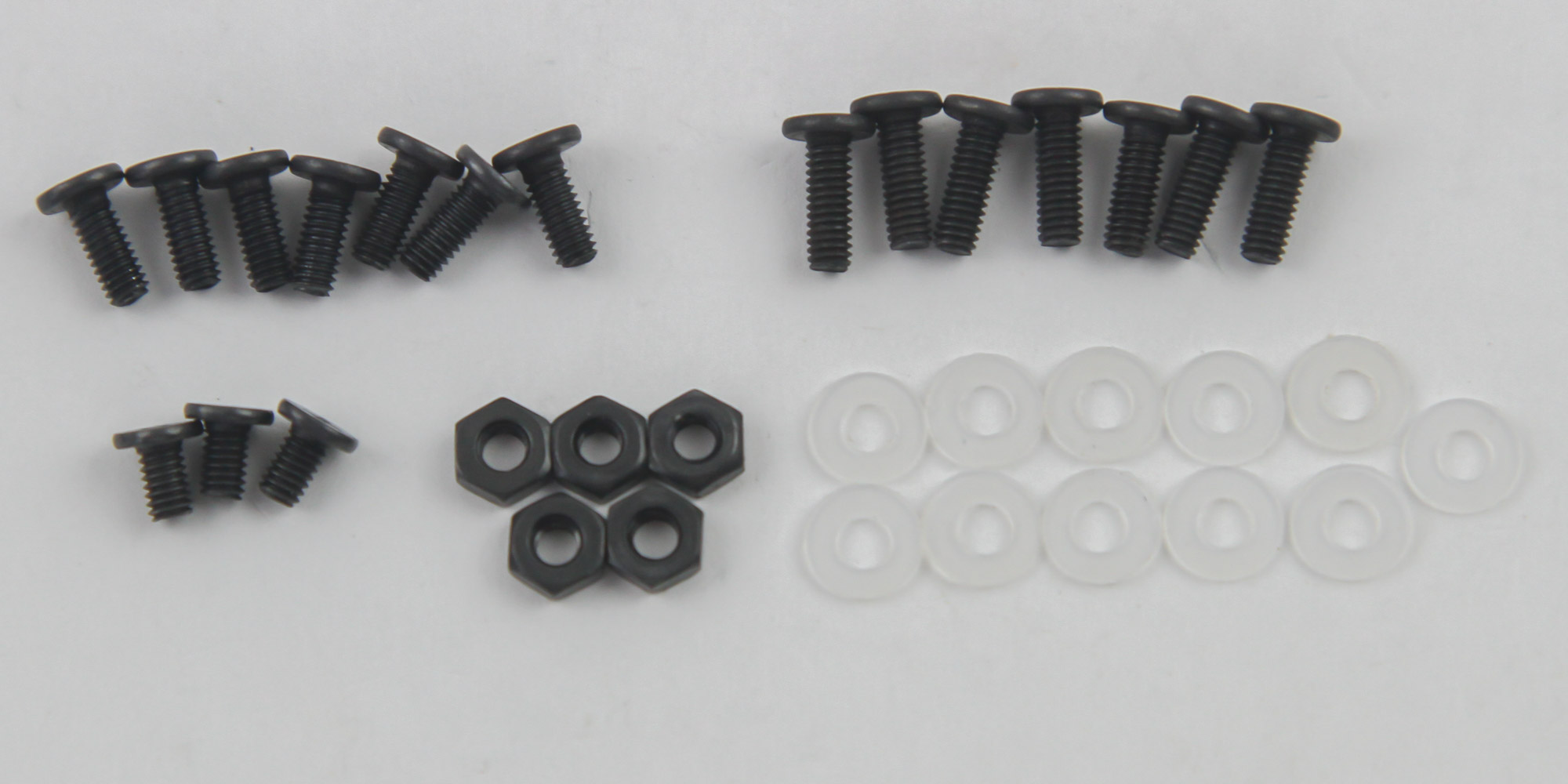
Ah, and now we know why. EK deviated from the usual packaging method, and the active backplate directly shows up under the foam sheet. It is held in place on a cardboard layer with cutouts to accommodate the I/O terminal and also hold it snugly from the sides. The accessories are underneath in a mostly barren layer, and we now get back to what is the same universal mounting kit that came with the regular backplate. An extra Allen key is also bundled in because it is still technically a water block. Unfortunately, we once more end up with seven thermal pads of varying thickness, which are not pre-cut at all, as well as generic installation screws of different sizes that will mostly end up unused. Also, and I am hoping this was a simple error as this was one of the first samples shipped out, the screws are black and not silver to match the backplate. Thermal paste is not included, with EK expecting you to re-use the TIM that came with the GPU block. Why there is a second Allen key then is another mystery entirely!
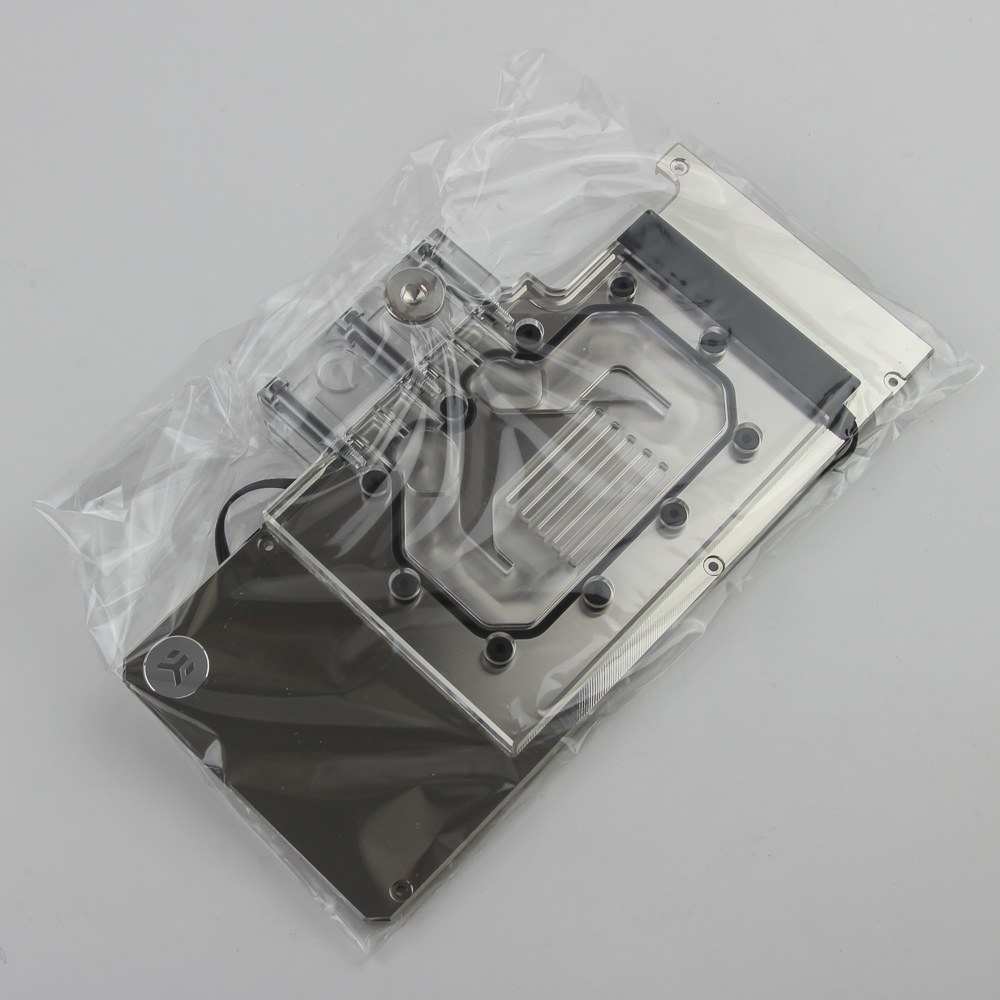
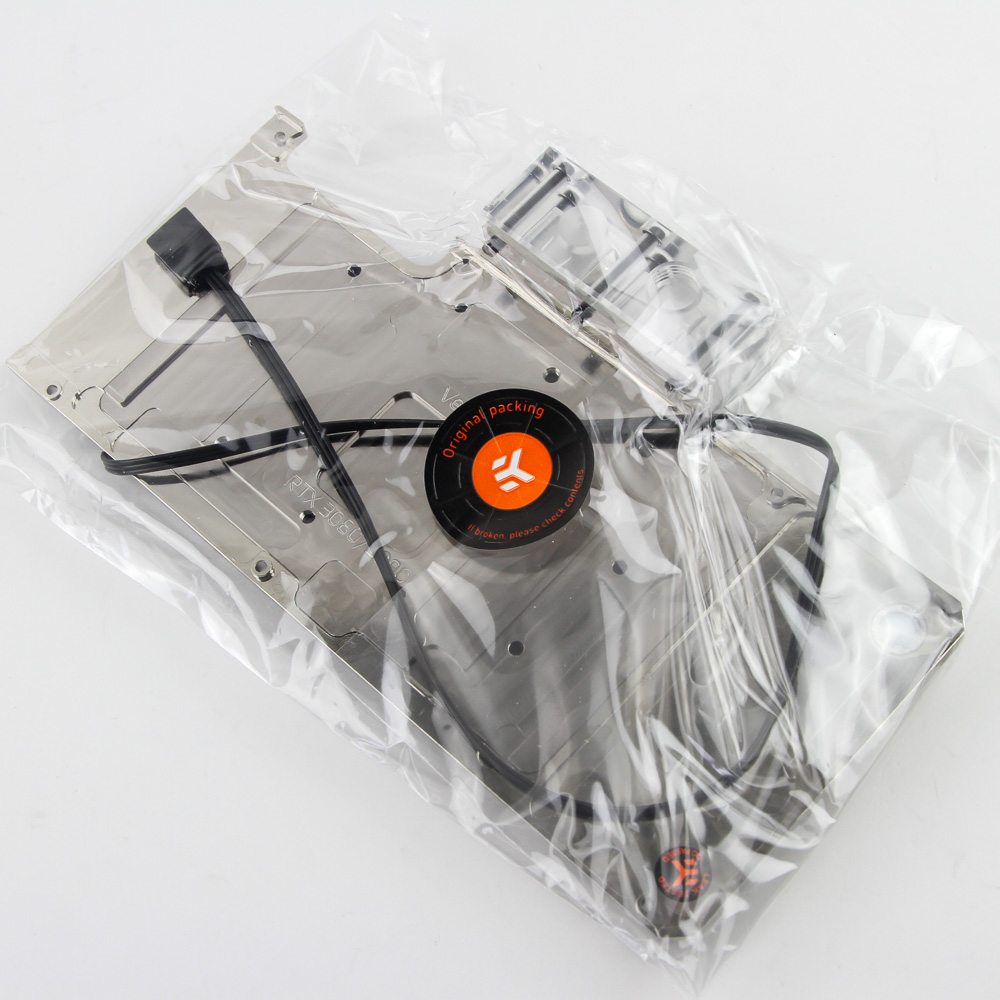
The active backplate comes inside a plastic wrap with a tamper seal, leaving tell-tale signs of opening if the seal was applied well. It is also on the smaller side of things generally, but we will take a closer look at it on the next page.
Closer Examination


So what is an active backplate, I hear you ask? Different companies have different interpretations, and EK integrated an actual water block into the backplate. At first glance, it looks similar to the block EK made for the Intel 750 SSD, or even something more of an enterprise solution. But this is far simpler than that, and we will get to it shortly. There are two versions for the reference RTX 3080/3090 PCB, with either an acetal top or a plexi top. Both get a nickel-plated copper cold plate only, which EK no doubt decided on to keep things simple on what is an extremely niche product.
Ten H2.5 mm screws go through the plexi top and into the metal cold plate to secure and keep everything together, with a large O-ring to keep the liquid flowing through where it should without leaking out. The see-through top allows us to get a good look at the coolant moving through if colored, as well as the RGB lighting from eight D-RGB LEDs shining into the block from the side. An acetal accent piece on the end houses these LEDs underneath, and an EK badge has been placed on the corner as well. A closer look shows the machining marks on the backplate, which are practically invisible when installed in a case.


Compared to the design language adopted by EK in the Quantum Vector GPU blocks, things are simpler with aesthetics that are more in line with the EK-Classic series. The acetal piece on the front is not used as an accent, but, rather, to hide the PCB with the d-RGB LEDs. Funnily, this smaller block has more LEDs than the actual GPU block with only five LEDs, though. A flat ribbon cable coming out the bottom ends in a 3-pin 5 V connector. You need a compatible D-RGB header to power and control the lighting, which most motherboards these days include, or a dedicated lighting controller.


The I/O terminal is a rectangular cuboid, which is again closer to the EK-Classic than EK-Quantum series, but I forgot all about the actual shape once I laid my eyes on that massive plexi terminal. Keep in mind that this active backplate is meant to be used with a compatible EK-Quantum Vector GPU block, with this terminal replacing the stock one on the GPU bock. As a result, it is wide enough to accommodate both blocks and ensure flow across the two. This is also where we see a pathway going from one block to the other, which means the two blocks end up in series flow. The terminal is polished nicely, as is the rest of the plexi top that gives us a first look at the cooling engine employed. Out of the box, there is a cover plate on the bottom with three screws going through the terminal and into it.


Turning things around, we see a QC sticker on the side of what is ultimately a cold plate now. It is still based on the regular EK-Quantum Vector backplate, having a similar design we saw already. Engravings on either side of the recess accommodating the GPU core and other components soldered onto the PCB say this is indeed an EK-Quantum Vector product made for the RTX 3080/3090. The contact surfaces do not get a mirror polish, but are quite smooth to the touch, which will work just fine with thermal paste. More machining marks here, but these are buffed for a smoother contact surface with the thermal pads and, in turn, the VRAM/VRM modules. As seen above, some raised sections assist with this. There is one section where the plating is less than satisfactory, though. I am not sure whether that QC sticker is there because this is functionally irrelevant, as there is no contact with coolant here. It is still an ugly blemish I don't want to see, especially on what ends up being an expensive niche product for those with the money to spare.


As per usual, disassembly was done after all testing was complete, and the hex tool provided with the EK GPU blocks works well for removing the ten screws on the top that hold the block together. Once done, the top can be removed completely for closer examination, which reveals polishing everywhere, including above the channels for the coolant pathway, an improvement over what we saw with the EK-Quantum Vector GPU block. Note also that as with the GPU block, the terminal piece is separately screwed into the cold plate. It is at this point that we find out the cold plate is just inserted into a frame of sorts, which also comes off easily.


This frame is actually exactly the same backplate we saw paired with the EK-Quantum Vector GPU block. So EK took an existing nickel-finished backplate to match the nickel-plated cold plate for the block section, cut it out in the middle to accommodate the GPU block itself, and retained the rest of the backplate to make this a full-cover, full-length backplate. Neat, if I say so myself! The cold plate for the block section is relatively simple and adopts a serial-flow pathway rather than the split central-inlet flow on the GPU block itself. The coolant flows from the left (or right), goes over the VRAM modules on the back if present, and through the GPU core on the back before completing the route on the other side over more memory modules and exiting the block to either enter the GPU block or exit the sandwich and move on to the next major component of your watercooling loop.


There are all of five wide fins here, which I can't even call microfins. This is in contrast to the 27 microfins which increase the contact surface area for heat dissipation from the GPU core on the GPU block. Between the fins are microchannels so wide that there is barely going to be an increased pressure drop with the GPU block and active backplate compared to the GPU block by itself. Don't expect to see much more cooling for the core with this, although the increased coolant flowing through on both sides does mean there is more coolant mass and material to take up heat.
Our Patreon Silver Supporters can read articles in single-page format.
Nov 16th, 2026 09:51 CST
change timezone
Latest GPU Drivers
New Forum Posts
- Warning for Windows 10 and 11 users running newer AMD GPU drivers (61)
- Meeting point of those who broke their GPUs. Please share what GPUs you've burned, shattered, ionized or melted accidentally. (37)
- What storage medium you lost the most data thus far from failure? HDD/SSD Flash, etc (54)
- How much does an RTX 5090 cost in your area? (64)
- need an ide to sata adapter that lets me burn cds on an ide cdrw drive (that doesn't power down while burning or copying) (55)
- Windows 11 General Discussion (7729)
- Honestly, do you care about GTA VI? (62)
- Samsung MZ-HPU256T/004 (12)
- Recommendations Wanted - Affordable Enterprise SSD for Boot (10)
- Samsung 860 Evo MZ-76E2TO 2tb. 2018-10 (1)
Popular Reviews
- ASUS ROG Strix B850-I Gaming Wi-Fi7 W Review
- Corsair HX1000i Shift Crystal Review
- AMD Zen 6 Technical Deep Dive
- Upcoming Hardware Launches 2027 (Updated Nov 2026)
- Montech King 95 3D PRO Review
- NZXT C1200 Platinum Review
- Acemagic Retro X3 Review
- Phantom Blade Zero Performance Benchmark Review - 35 GPUs Tested
- AMD Ryzen 7 9800X3D Review - The Best Gaming Processor
- NZXT H7 RGB+ Review
TPU on YouTube
Controversial News Posts
- NVIDIA Co-Founder and CEO Jensen Huang Officially Resigns (431)
- Open Letter Asking NVIDIA to Reinstate Jensen Huang Passes 115,000 Signatures (184)
- OpenAI CEO Argues Home PCs Waste the World's Limited DRAM Supply (152)
- NVIDIA Launches Investigation Into Jensen Huang's Relationship With Suspected Chinese Spy (136)
- Intel "Raptor Lake Next" 16-Core and 20-Core CPUs Surface (130)
- Legendary Game Studio BioWare Shuts Down Following EA Layoffs (104)
- Dell CEO Says the Memory Shortage Will Get Worse in 2027 (95)
- NVIDIA GeForce RTX 50-Series Scheduled for up to $500 Price Hike This Week (89)