 4
Endorfy Viro Wireless Review - Forget the Charger
Microphone Performance »Sound Quality
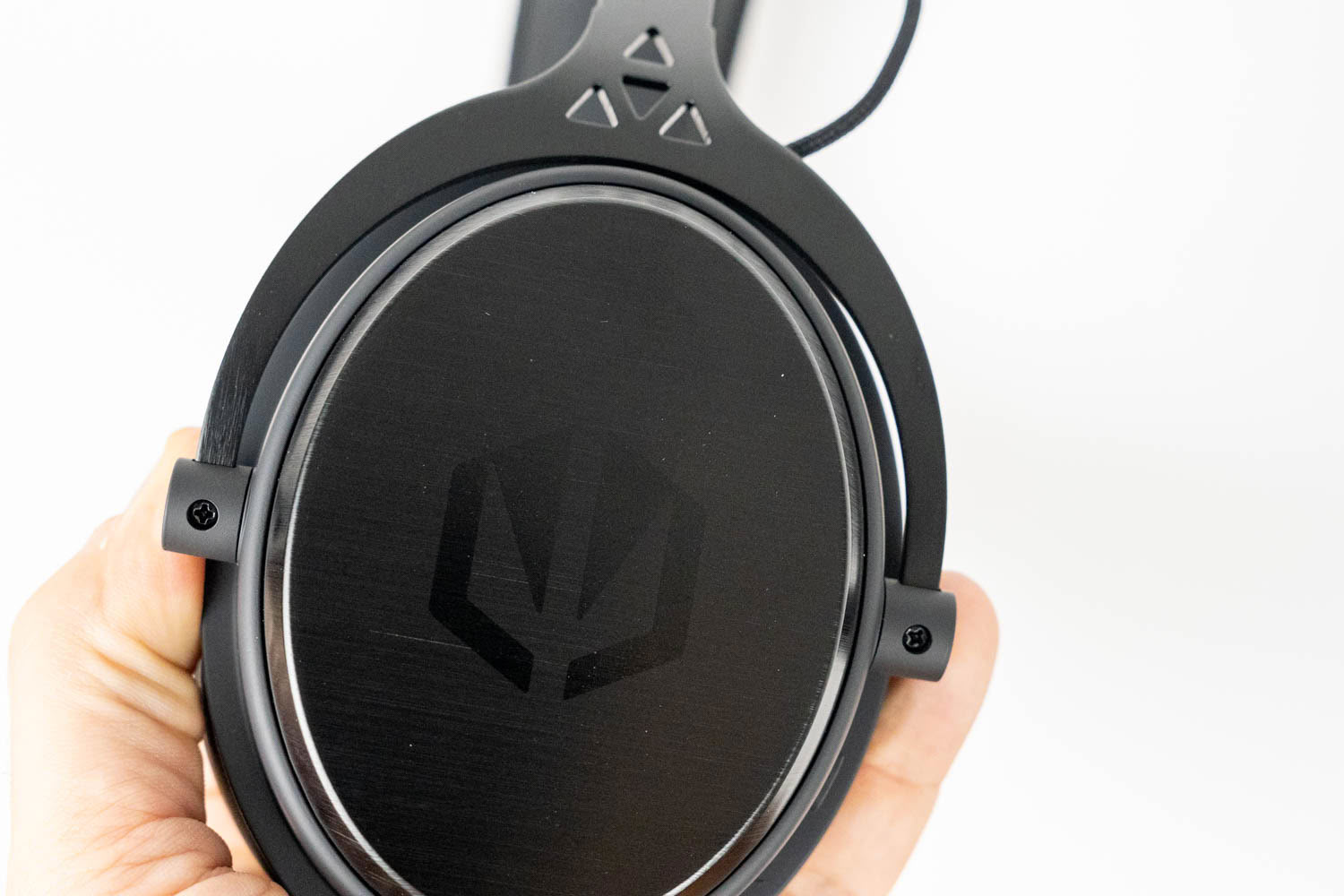
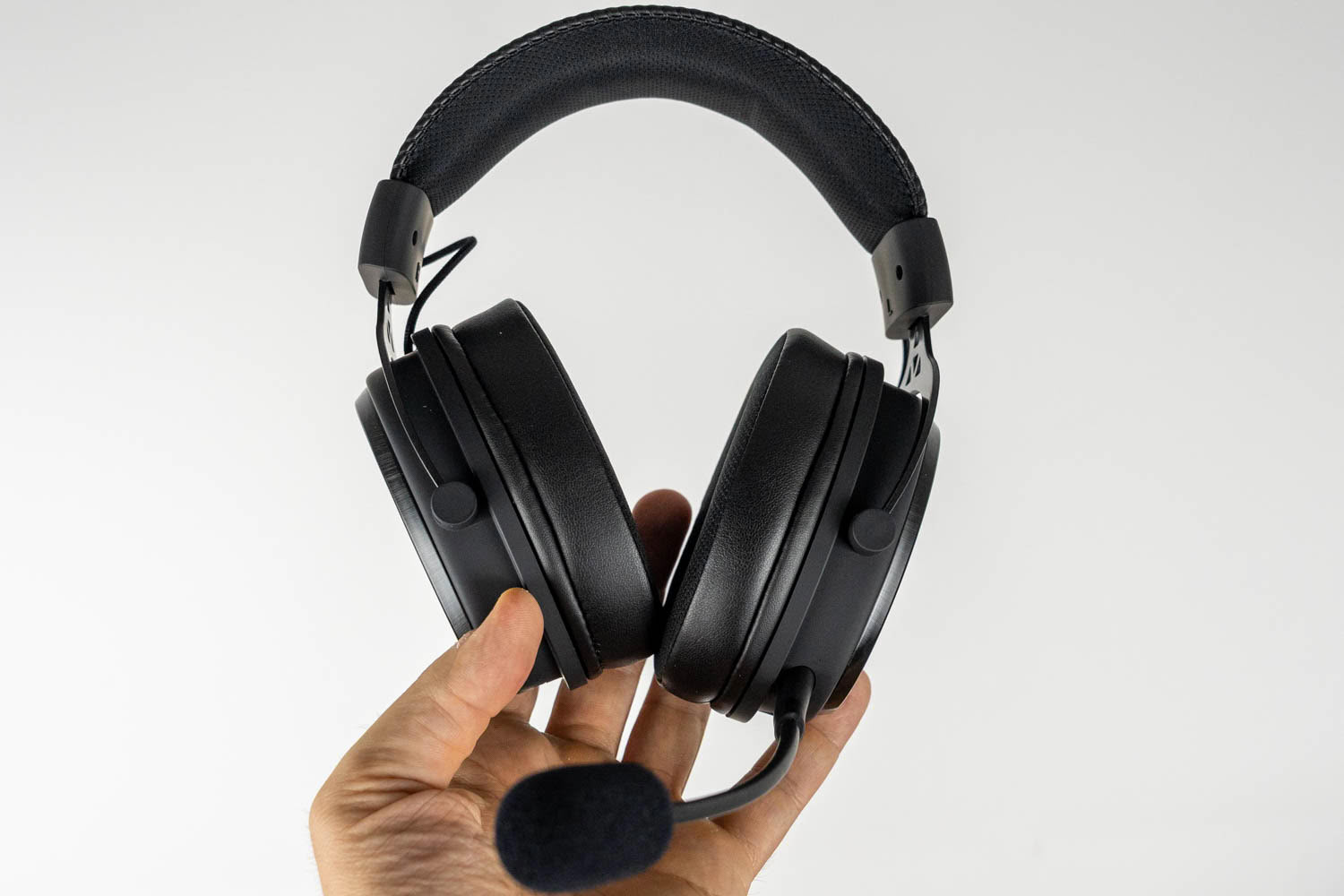
The Endorfy Viro Wireless features a pair of 53 mm dynamic drivers, angled relative to the ear for more natural sound and positioning. The specified frequency response spans from 20 Hz to 20 kHz, and the impedance is rated at 32 Ω. Bluetooth audio is transmitted using the AAC codec, while Endorfy doesn't disclose any details about the 2.4 GHz link.
For gaming headset frequency response measurements I'm using the miniDSP EARS headphone test fixture, probably the least expensive such device on the market. It consists of two miniDSP UMIK-1 microphones placed inside a pair of silicone ears and affixed to a steel headphone stand. It's a USB-powered device, perfectly integrated with the fantastic Room EQ Wizard (REW) software, which is used for headphone and microphone calibration, as well as doing the measurements themselves. Every single miniDSP EARS unit comes with its own microphone calibration files, which are loaded into REW before doing the measurements. The miniDSP EARS certainly has its quirks. The artificial ear canals aren't particularly deep, so I wouldn't consider it a viable option for IEM testing. The integrated microphones are exceptionally sensitive to headphone positioning, partially because of the screws affixing the silicone ears to the stand, which aren't perfectly flush with the silicone surface. Some users also claim that the fixture is too narrow for very large Hi-fi headphones, so they have to use rubber bands to tighten the clamping force. The latter isn't something I ever had an issue with, though; all my headsets and headphones fit perfectly.
Because of all that, the miniDSP EARS is prone to user error. Whoever is using it has to know how to interpret the results and, even more importantly, how to spot those that are clearly flawed. After getting rid of the bad data, assuming the initial configuration and calibration were done properly, the resulting frequency response measurements are usable and in line with what one would hear from the headphones (or headset) in question. My testing methodology mostly follows the best practices of using the miniDSP EARS as covered in great detail in this article on Headphonesty. The most significant difference is that I'm using the updated HEQ compensation, where a subjectively neutral headphone would measure approximately flat. To compensate for minor seal variances, I'm measuring each ear until I get 10 usable results and reseat the headphones, or headset, between runs. After I have my results for one ear, I apply a 1/12 octave smoothing and average the measured responses. I then repeat the process for the other ear for an idea of whether any channel imbalance exists. It's important to keep in mind that my results cannot be directly compared to anyone else's, as only an identical methodology conducted on my exact sample of the miniDSP EARS would yield directly comparable results.
For the Endorfy Viro Wireless, I used the supplied 2.4 GHz wireless dongle as the source when doing my frequency response measurements, with the equalizer and all Viro Studio effects turned off.
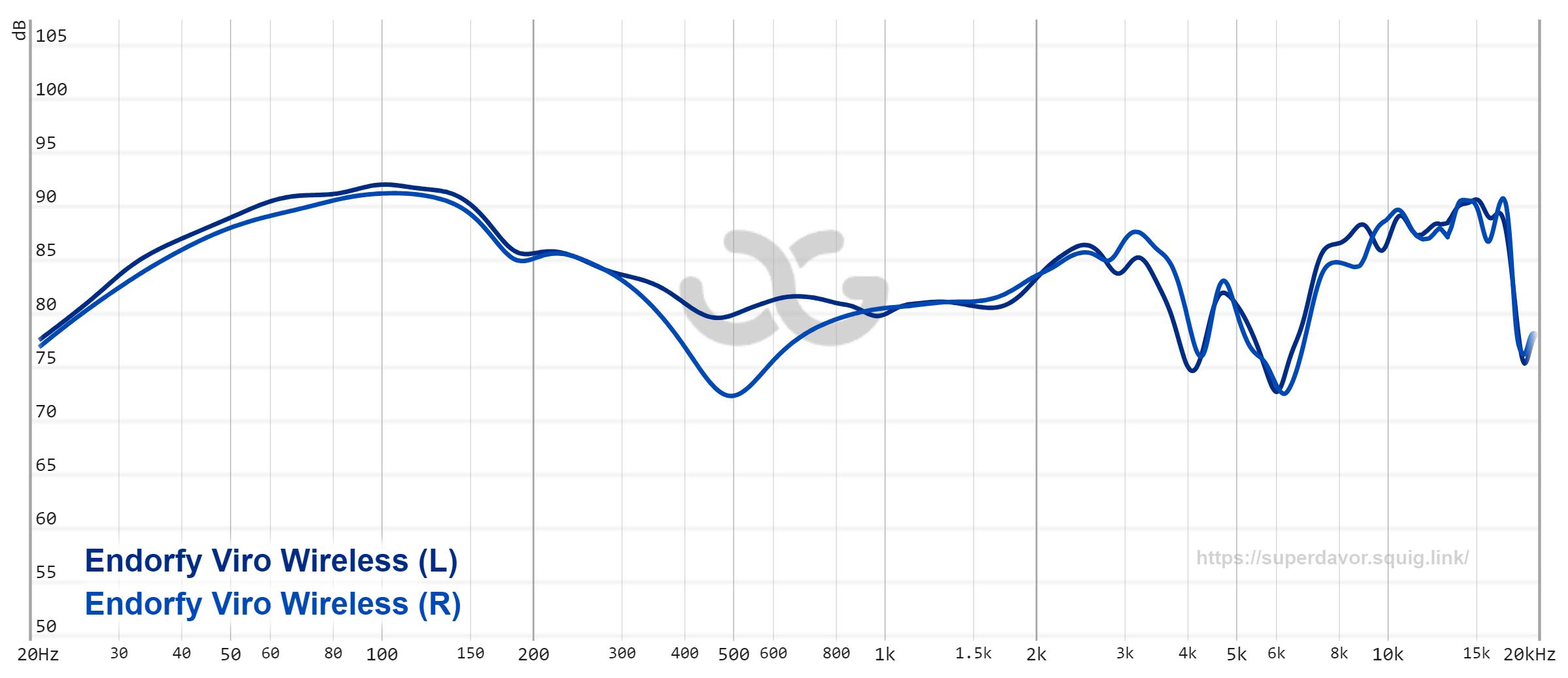
The frequency response graph of the Endorfy Viro Wireless shows a fairly well-rounded, consumer-friendly tuning, built around a prominent bass hump and a mostly even midrange, with a couple of notable dips in the upper midrange and lower treble. Starting in the low end, the sub-bass rolls off gently below 50 Hz, while the response climbs steadily toward a broad peak centered around 100 Hz, sitting roughly 10 dB above the midrange. That's a bit too much for my taste. Bass guitars, kick drums and anything else in that region come across as quite emphasized, and it's the kind of tuning that will divide opinions—some listeners will love the extra weight and punch, while others will find it fatiguing over longer sessions. In the context of a gaming headset, where explosions and gunfire benefit from some extra impact, it's certainly acceptable.
Right after the peak, the response drops sharply between 150 and 200 Hz, and then continues to slope gently down into the lower midrange. That abrupt transition is audible, as the bass doesn't feel seamlessly connected to the rest of the spectrum. At times it feels more like a separate layer sitting underneath the music, rather than its foundation. On the plus side, the mid-bass doesn't bleed into the lower midrange, so there's no muddiness or congestion to speak of. The graph also reveals a channel imbalance in the lower midrange, with the right ear cup measuring several decibels lower than the left one around 500 Hz. As this isn't something I was able to pick up with my ears, I'm much more inclined to attribute it to the finicky nature of headset positioning on the miniDSP EARS than to an actual issue with the headset itself.
The midrange between 1 and 2 kHz is flat and even, and there's a moderate presence boost between 2 and 3.5 kHz, which keeps vocals and dialogue clear and upfront. Things get more complicated above that. There are two deep dips, one centered around 4 kHz and another at around 6 kHz, right in the region that's largely responsible for clarity, articulation and the sense of air. As a result, the upper midrange and treble sound audibly veiled, and the overall presentation lacks air. The upside is that sibilance and harshness are a non-issue, and the Viro Wireless is quite forgiving of poorly recorded or heavily compressed material. The soundstage is limited, as you'd expect from a closed-back design, but positional audio is good enough to tell where footsteps and gunfire are coming from. I had no issues locating my enemies in games like Battlefield 6 or PUBG.
Fortunately, the fix is simple. Raising the entire 2–16 kHz range by 2 dB in Viro Studio's equalizer (the 2, 4, 8 and 16 kHz bands) audibly improves the situation. The veil lifts, details become easier to pick out, and the sound gains some much-needed air, without introducing any harshness. Keep in mind that Viro Studio only works in 2.4 GHz mode, so in Bluetooth mode you'll have to rely on your phone's or music player's equalizer instead.
Overall, the Viro Wireless sounds solidly rounded out of the box, with emphasized bass and slightly veiled highs. With a minor EQ tweak, it becomes a noticeably more balanced and engaging headset, for both gaming and music.
Loudness is not an issue. At maximum volume, I measured around 94 dB, which provides ample headroom for gaming and music.
Nov 20th, 2026 16:47 PST
change timezone
Latest GPU Drivers
New Forum Posts
- Honestly, do you care about GTA VI? (214)
- Without Jensen, PC gaming will be (51)
- WarpCoreBench scores! (86)
- What's your latest tech Freebie? (80)
- Nvidia GPU undervolting via MVolt+? (0)
- How to prevent OLED burn damage due to PC freezes or power outtages? (49)
- RX 9000 series GPU Owners Club (2249)
- Logitech Headsets Modded Driver — Unlock Dolby in G HUB (23)
- 1 - 5 person file storage server equivalent accasible from anywhere + general VM server. (1)
- When you could finally run Crysis maxed out? (63)
Popular Reviews
- Microsoft Surface Laptop Ultra Review - The Next-gen Arm Laptop
- Ugreen NASync DXP4800 GT Review
- Corsair RM1200e (Second Generation) Review
- Pulsar Office Tour & First Look at P1 Dual-Sensor Mouse
- Upcoming Hardware Launches 2027 (Updated Nov 2026)
- Acemagic Retro X3 Review
- Biwin Black Opal NV7400 2 TB Review
- AMD Ryzen 7 9800X3D Review - The Best Gaming Processor
- AMD Zen 6 Technical Deep Dive
- Chieftec Iceberg PRO 360 DARK Review
TPU on YouTube
Controversial News Posts
- NVIDIA Co-Founder and CEO Jensen Huang Officially Resigns (491)
- Report: Jensen Huang Eyes NVIDIA Comeback (256)
- Open Letter Asking NVIDIA to Reinstate Jensen Huang Passes 115,000 Signatures (184)
- OpenAI CEO Argues Home PCs Waste the World's Limited DRAM Supply (152)
- NVIDIA Launches Investigation Into Jensen Huang's Relationship With Suspected Chinese Spy (136)
- Intel "Raptor Lake Next" 16-Core and 20-Core CPUs Surface (130)
- Legendary Game Studio BioWare Shuts Down Following EA Layoffs (104)
- NVIDIA GeForce RTX 50-Series Scheduled for up to $500 Price Hike This Week (89)