 4
Endorfy Viro Wireless Review - Forget the Charger
(4 Comments) »Value and Conclusion
- The Endorfy Viro Wireless is available online for €87.
- Excellent battery life (around 100 h over 2.4 GHz, roughly double that over Bluetooth)
- USB-C wireless dongle with USB Type-A adapter included
- Hybrid 2.4 GHz + Bluetooth mode for taking calls while gaming
- Stable wireless connection in both 2.4 GHz and Bluetooth mode
- Passive 3.5 mm analog connectivity with an inline remote
- Understated design and solid build quality
- Comfortable, with a tolerable clamping force
- Replaceable earpads, affordable official replacements
- Solid, well-rounded sound that responds well to EQ
- Detachable microphone with switchable ENC
- Competitive price
- Pronounced 100 Hz bass hump won't suit everyone
- Veiled upper midrange and treble out of the box (easily fixed with EQ)
- No way to check the battery level on demand
- Unrefined volume wheel, faint audio cues for ENC and volume limits
- No secondary built-in microphone for on-the-go use
- Bulky dongle can block adjacent ports
- Hybrid mode doesn't mix audio from both sources
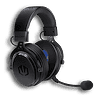
The Endorfy Viro Wireless is a headset that knows exactly what it wants to be. It doesn't chase trends, it doesn't try to dazzle you with RGB lighting or a premium price tag, and it doesn't pretend to be a Hi-fi product. Instead, it focuses on the things that actually matter in day-to-day use—battery life, connectivity and comfort—and gets them right for €87.
The design sets the tone. It's clean, understated and borrows the proven layout of the HyperX Cloud family, with aluminium yokes, brushed metal ear cup plates and a PU leather headband with an embossed logo. The black variant I tested is about as subtle as a gaming headset gets, and the build quality is very solid for the price, with no creaks, rattles, or loose joints anywhere. Comfort is very solid as well. The weight is well distributed, the clamping force is perfectly tolerable even after hours of use, and while some heat buildup is noticeable during longer sessions, that's to be expected from hybrid earpads with a leatherette outer ring. The replaceable earpads, available in three variants for €9 a pair, are a welcome bonus that ensures the headset remains usable long after the original pads wear out.
Functionality-wise, the Viro Wireless ticks most of the boxes. The USB-C dongle with an included Type-A adapter is something I'd like to see with every wireless headset, even if the dongle itself is bulkier than it should be. The wireless link proved rock-solid in both 2.4 GHz and Bluetooth mode, and the hybrid mode, which lets you stay connected to your PC over 2.4 GHz while taking calls from your phone via Bluetooth, works exactly as advertised, although it doesn't mix audio from both sources. The passive 3.5 mm input with an inline remote rounds out the connectivity options, while the lack of wired USB audio is a missed opportunity.
Battery life is the Viro Wireless' trump card. I couldn't quite reach the claimed 130 hours over 2.4 GHz at higher listening volumes, but roughly 100 hours of continuous playback is still an outstanding result, and Bluetooth should stretch that to around 200 hours. Charging the headset every couple of weeks instead of every couple of days is the kind of improvement you don't fully appreciate until you've experienced it. It's a shame there's no way to check the exact battery level on demand, though, unless you connect the headset to your phone.
The controls are a mixed bag. The 2.4 GHz/Bluetooth slider and the press-and-hold microphone mute are both sensible choices that prevent accidental changes, but the volume wheel is the weak link. It doesn't respond well to quick movements, and the beep that marks the maximum volume, along with the one confirming ENC, is so faint that it's easy to miss entirely.
Sound quality is solid for the price. Out of the box, the Viro Wireless sounds well-rounded, with a pronounced bass hump around 100 Hz that will divide opinions and an audibly veiled upper midrange and treble that rob it of some air. A simple 2 dB boost across the 2–16 kHz range in Viro Studio takes care of the latter, and the result is a livelier, more detailed and genuinely enjoyable headset, for both gaming and music. Positional audio is good enough for competitive shooters, and there's more than enough volume on tap.
Viro Studio itself is a fairly standard C-Media Xear application. Its equalizer is the most valuable part of the package, while the presets, the virtual surround sound and most of the other effects are best left alone. The fact that it only runs on Windows and only in 2.4 GHz mode limits its usefulness, and the lack of a battery level indicator and sidetone control is an oversight Endorfy should address.
The microphone sounds clear and intelligible, with the kind of compression typical of wireless headsets, and its switchable ENC is effective enough to simply leave on. The only things I'm missing are a mute indicator on the microphone itself and a secondary built-in microphone for Bluetooth calls on the go, which would make much more sense for a headset with this kind of battery life.
As for the competition, Endorfy's own comparison pits the Viro Wireless against the likes of the HyperX Cloud III Wireless, Corsair HS80 RGB, SteelSeries Arctis Nova 7 and Logitech G Pro X 2, all of which cost anywhere from €40 to €140 more. Its advantages are obvious: none of them come close in terms of battery life (with the exception of the lesser-known MCHOSE V9 Turbo), and only a handful match its combination of a hybrid 2.4 GHz + Bluetooth mode, a 3.5 mm input and a detachable microphone. On the other hand, all of the big-name rivals let you check the battery level in their companion software, most have a mute indicator on the microphone, several feature ear cups that swivel flat, and none that I've tested suffer from a sluggish volume wheel or have a dongle that blocks neighboring ports. Add a default tuning that needs EQ to sound its best, software that only works on Windows and only over 2.4 GHz, and the lack of a secondary microphone for on-the-go use, and it's clear the Viro Wireless cuts corners where the spec sheet doesn't show it. On top of that, the sub-€100 segment is incredibly crowded, and there are similarly well-equipped wireless headsets available for €20 to €30 less, as long as you're willing to settle for shorter battery life.
Overall, the Endorfy Viro Wireless is a sensible choice in the crowded sub-€100 wireless gaming headset market. It has a few rough edges, but none of them are dealbreakers, and at €87, it offers a combination of battery life, connectivity options, comfort and build quality that should leave you feeling like your money was well spent.
Nov 20th, 2026 17:15 PST
change timezone
Latest GPU Drivers
New Forum Posts
- SATA drive 1.4 GBps with Intel X25-E on Windows 98! (36)
- DTS DCH Driver for Realtek HDA [DTS:X APO4 + DTS Interactive] (2816)
- Honestly, do you care about GTA VI? (214)
- Without Jensen, PC gaming will be (51)
- WarpCoreBench scores! (86)
- What's your latest tech Freebie? (80)
- Nvidia GPU undervolting via MVolt+? (0)
- How to prevent OLED burn damage due to PC freezes or power outtages? (49)
- RX 9000 series GPU Owners Club (2249)
- Logitech Headsets Modded Driver — Unlock Dolby in G HUB (23)
Popular Reviews
- Microsoft Surface Laptop Ultra Review - The Next-gen Arm Laptop
- Ugreen NASync DXP4800 GT Review
- Corsair RM1200e (Second Generation) Review
- Pulsar Office Tour & First Look at P1 Dual-Sensor Mouse
- Upcoming Hardware Launches 2027 (Updated Nov 2026)
- Acemagic Retro X3 Review
- Biwin Black Opal NV7400 2 TB Review
- AMD Ryzen 7 9800X3D Review - The Best Gaming Processor
- AMD Zen 6 Technical Deep Dive
- Chieftec Iceberg PRO 360 DARK Review
TPU on YouTube
Controversial News Posts
- NVIDIA Co-Founder and CEO Jensen Huang Officially Resigns (491)
- Report: Jensen Huang Eyes NVIDIA Comeback (256)
- Open Letter Asking NVIDIA to Reinstate Jensen Huang Passes 115,000 Signatures (184)
- OpenAI CEO Argues Home PCs Waste the World's Limited DRAM Supply (152)
- NVIDIA Launches Investigation Into Jensen Huang's Relationship With Suspected Chinese Spy (136)
- Intel "Raptor Lake Next" 16-Core and 20-Core CPUs Surface (130)
- Legendary Game Studio BioWare Shuts Down Following EA Layoffs (104)
- NVIDIA GeForce RTX 50-Series Scheduled for up to $500 Price Hike This Week (89)