 10
EVGA GTX 1650 SC Ultra Black 4 GB Review
(10 Comments) »Introduction

NVIDIA recently announced the GeForce GTX 1650 graphics card, the smallest and most affordable implementation of the "Turing" architecture. Much like other GeForce GTX 16-series graphics cards launched to date, the GTX 1650 lacks dedicated RTX real-time raytracing hardware and tensor cores even though it is based on "Turing". NVIDIA is positioning the card at a starting price of US$149 and expects it to be capable of Full HD (1080p) gaming with reasonably high settings.
The GeForce GTX 1650 is based on the tiny new "TU117" silicon from NVIDIA. This chip is configured with 896 CUDA cores, 56 TMUs, 32 ROPs, and a 128-bit wide GDDR5 memory interface holding 4 GB of memory that ticks at 8 Gbps, churning out 128 GB/s bandwidth. Not too long ago, such specifications were considered quasi-premium for this price-segment; that is, until AMD significantly cut prices of its Radeon "Polaris" graphics cards post the crypto-mining crash. The Radeon RX 570 4 GB, going by specifications alone, would qualify as a segment higher than the GTX 1650, but can be had for around the $130-mark from North American retailers.
With a rated power-draw of just 75 watts—half that of the RX 570—most GeForce GTX 1650 graphics cards typically do not need an additional PCIe power connector and can make do with slot power only, which can be useful when upgrading OEM systems that have weak PSUs and possibly lack the power cabling required for higher-end graphics cards. Certain premium factory-overclocked cards based on this chip may at best pack a single 6-pin connector. Display outputs typically only include one DisplayPort 1.4, HDMI 2.0b, and DVI-D each. The chip is endowed with all of the new 10bpc HDR video decoding hardware acceleration introduced with "Turing", so it has a solid resume for your living room.

In this review, we are taking a look at the EVGA GeForce GTX 1650 SC Ultra Black, which uses a dual-fan, dual-slot cooler, comes at reference clocks, but with a slightly increased power limit and a 6-pin power connector. A backplate and idle-fan-stop is included, too. Price-wise, EVGA is expecting a $10 increase over the MSRP, bringing price to $159.
| Price | Shader Units | ROPs | Core Clock | Boost Clock | Memory Clock | GPU | Transistors | Memory | |
|---|---|---|---|---|---|---|---|---|---|
| GTX 1050 | $130 | 640 | 32 | 1354 MHz | 1455 MHz | 1752 MHz | GP107 | 3300M | 2 GB, GDDR5, 128-bit |
| GTX 1050 Ti | $170 | 768 | 32 | 1290 MHz | 1392 MHz | 1752 MHz | GP107 | 3300M | 4 GB, GDDR5, 128-bit |
| GTX 1650 | $150 | 896 | 32 | 1485 MHz | 1665 MHz | 2000 MHz | TU117 | 4700M | 4 GB, GDDR5, 128-bit |
| EVGA GTX 1650 SC Ultra Black | $160 | 896 | 32 | 1485 MHz | 1665 MHz | 2000 MHz | TU117 | 4700M | 4 GB, GDDR5, 128-bit |
| RX 570 | $130 | 2048 | 32 | 1168 MHz | 1244 MHz | 1750 MHz | Ellesmere | 5700M | 4 GB, GDDR5, 256-bit |
| RX 580 | $190 | 2304 | 32 | 1257 MHz | 1340 MHz | 2000 MHz | Ellesmere | 5700M | 8 GB, GDDR5, 256-bit |
| GTX 1060 3 GB | $200 | 1152 | 48 | 1506 MHz | 1708 MHz | 2002 MHz | GP106 | 4400M | 3 GB, GDDR5, 192-bit |
| GTX 1060 | $200 | 1280 | 48 | 1506 MHz | 1708 MHz | 2002 MHz | GP106 | 4400M | 6 GB, GDDR5, 192-bit |
| RX 590 | $220 | 2304 | 32 | 1469 MHz | 1545 MHz | 2000 MHz | Polaris 30 | 5700M | 8 GB, GDDR5, 256-bit |
| GTX 1660 | $220 | 1408 | 48 | 1530 MHz | 1785 MHz | 2000 MHz | TU116 | 6600M | 6 GB, GDDR5, 192-bit |
| GTX 1070 | $300 | 1920 | 64 | 1506 MHz | 1683 MHz | 2002 MHz | GP104 | 7200M | 8 GB, GDDR5, 256-bit |
Packaging and Contents

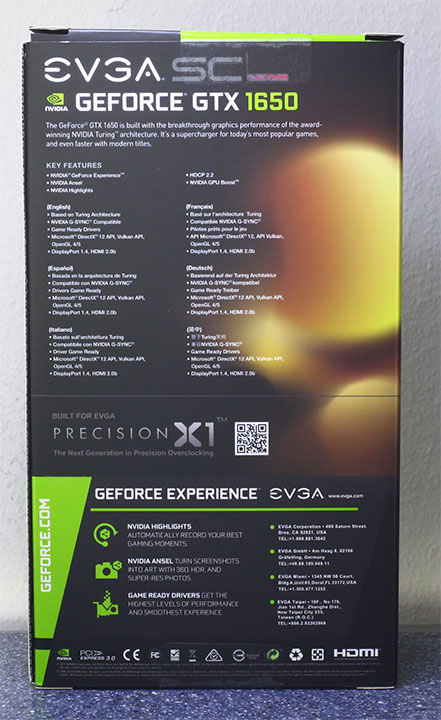

You will receive:
- Graphics card
- Driver disc
- Documentation
- ASUS cable ties
The Card


Visually, EVGA follows the design theme they introduced last year with their GeForce 20 lineup. The card is 20.0 cm long and 11.5 cm tall. Unlike other GTX 1650 models, EVGA is including a backplate.
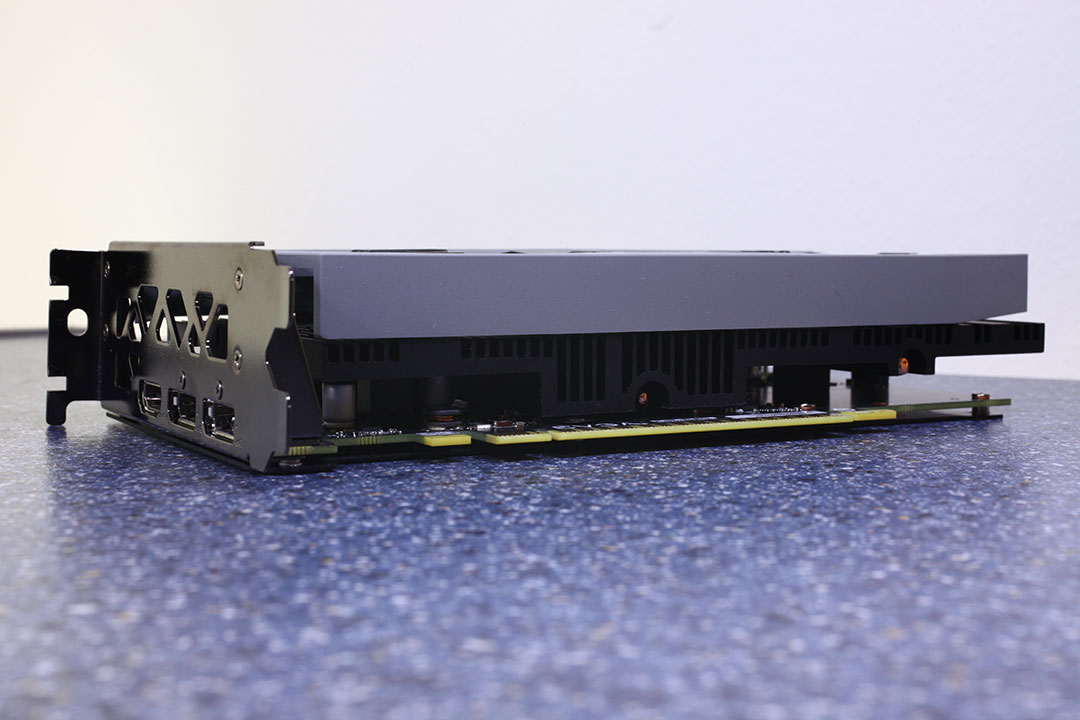
Installation requires two slots in your system.

Display connectivity options include two standard-sized DisplayPort 1.4 and a HDMI 2.0b.
NVIDIA has updated their display engine with the Turing microarchitecture, which now supports DisplayPort 1.4a with support for VESA's nearly lossless Display Stream Compression (DSC). Combined, this enables support for 8K@30Hz with a single cable, or 8K@60Hz when DSC is turned on. For context, DisplayPort 1.4a is the latest version of the standard that was published in April, 2018.
Since earlier this year, NVIDIA has enabled support for VESA Adaptive Sync (aka FreeSync) on all of their cards. While only a small number of FreeSync monitors have been fully qualified for G-SYNC, users can enable the feature in NVIDIA's control panel regardless of whether the monitor is certified or not.
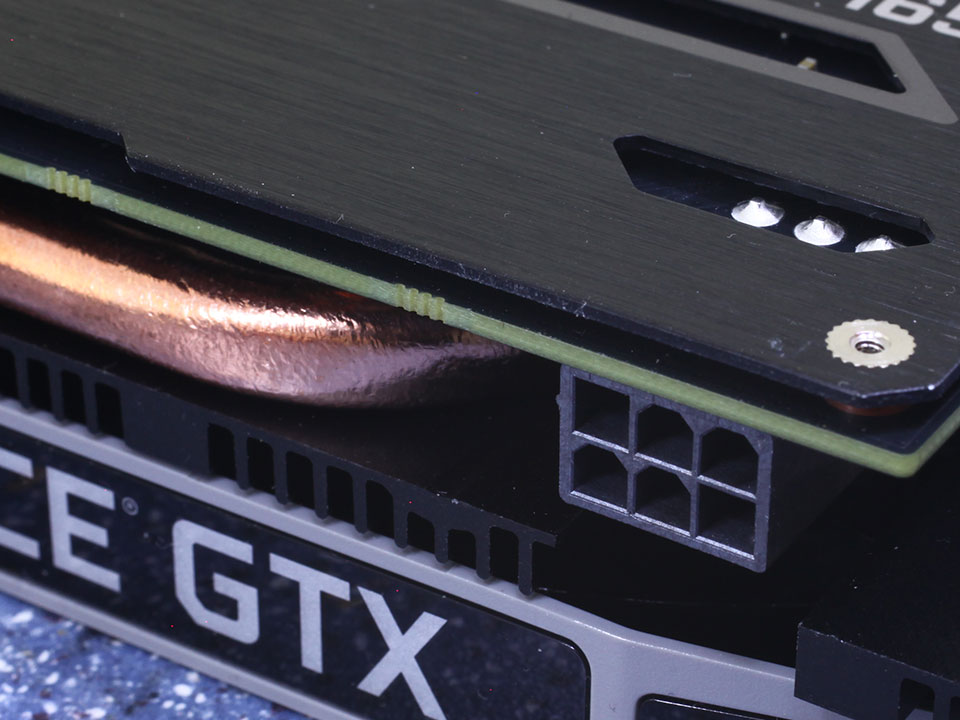
The board uses a single 6-pin power connector. This input configuration is specified for up to 150 watts of power draw.
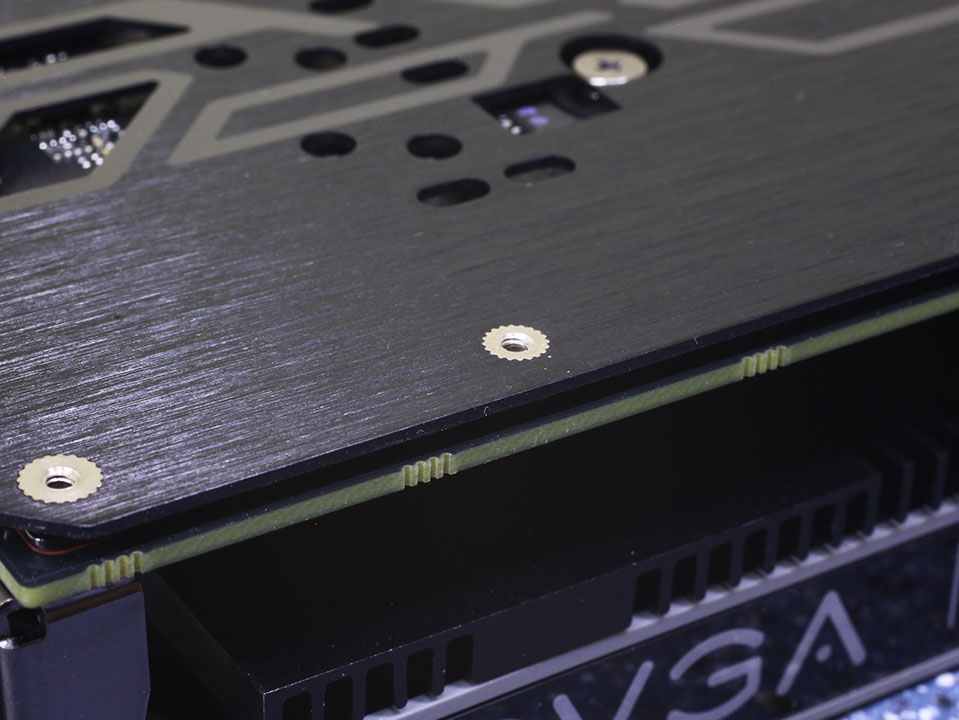
GeForce GTX 1650 does not support SLI.
Disassembly

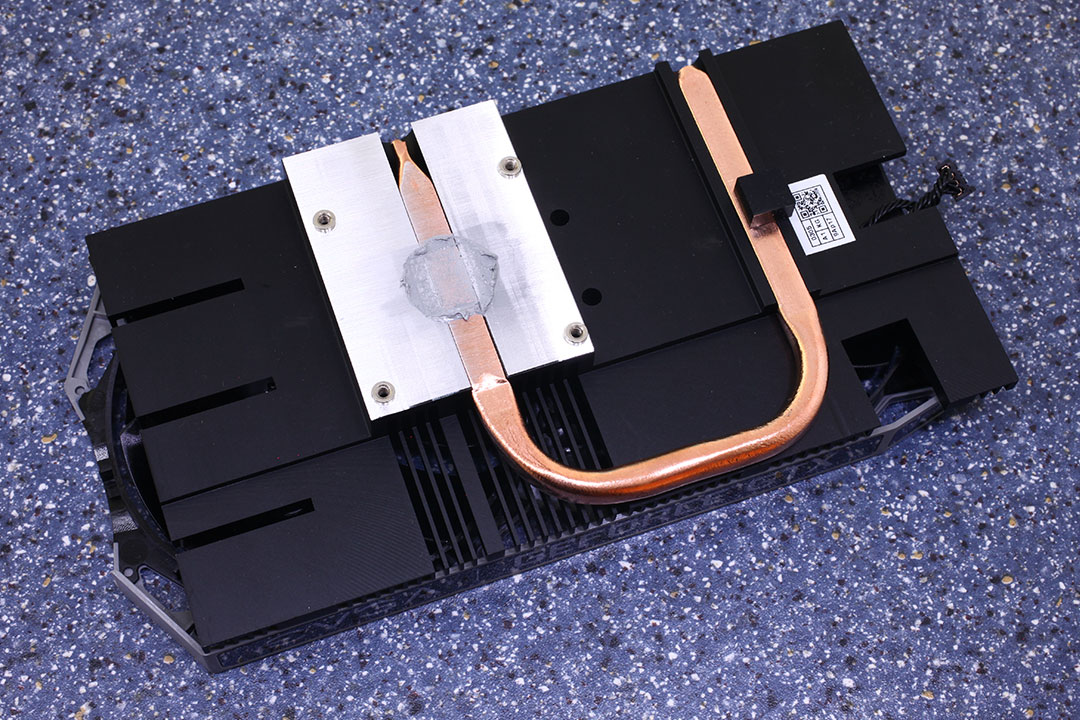
EVGA's thermal solution uses a single heatpipe. The VRM and memory chips are not cooled.

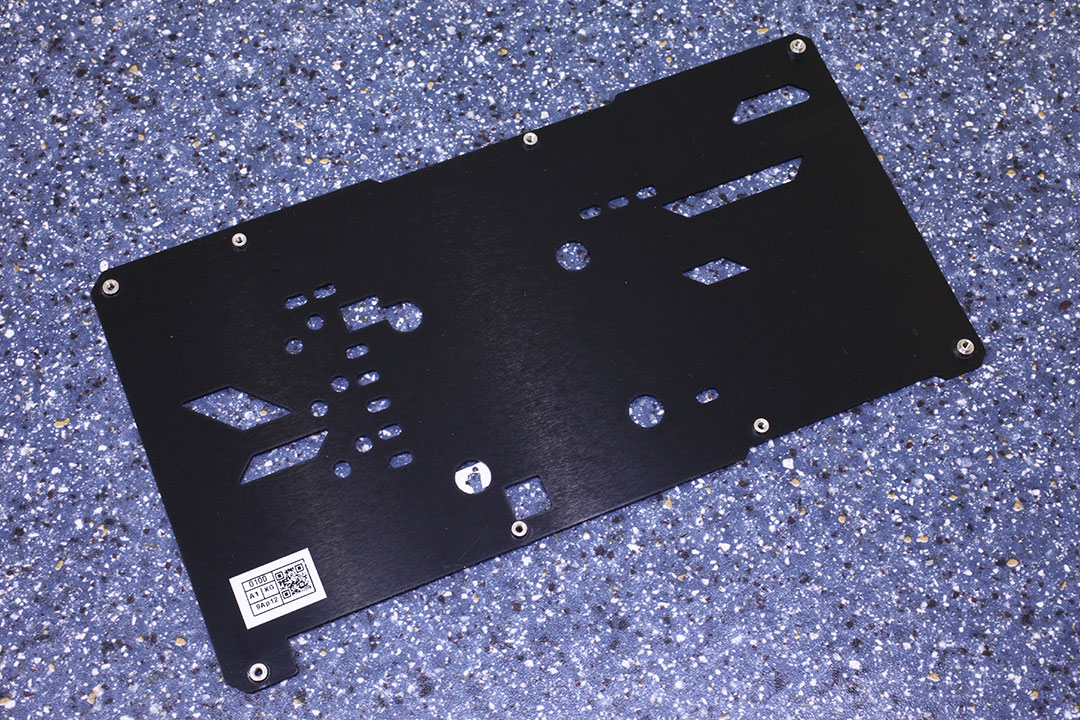
The backplate is made out of metal, which not only improves looks, but also helps protect against damage during handling and installation.
On the next page, we dive deep into the PCB layout and VRM configuration.
High-resolution PCB Pictures
These pictures are for the convenience of volt-modders and those who would like to see all the finer details on the PCB. Feel free to link back to us and use them in your articles or forum posts.

High-res versions are also available (front, back).
Our Patreon Silver Supporters can read articles in single-page format.
Nov 15th, 2026 16:56 CST
change timezone
Latest GPU Drivers
New Forum Posts
- WarpCoreBench scores! (53)
- What are you playing? (26223)
- Folding Pie and Milestones!! (10205)
- Asus Rog Maximus Z890 Extreme. (Various questions). (25)
- Power supply noise stops when I move the mouse (9)
- TPU's Nostalgic Hardware Club (22165)
- HP Office Jet 7740 Pro - Supply system problem with replacement cartridge (3)
- Recommendations Wanted - Affordable Enterprise SSD for Boot (9)
- What can the FX 8320 do today? Here is the answer. (59)
- How do you get games for PC? (59)
Popular Reviews
- AMD Zen 6 Technical Deep Dive
- ASUS ROG Strix B850-I Gaming Wi-Fi7 W Review
- Corsair HX1000i Shift Crystal Review
- Upcoming Hardware Launches 2027 (Updated Nov 2026)
- Montech King 95 3D PRO Review
- NZXT C1200 Platinum Review
- NZXT H7 RGB+ Review
- NZXT H5 Review
- Phantom Blade Zero Performance Benchmark Review - 35 GPUs Tested
- AMD Ryzen 7 9800X3D Review - The Best Gaming Processor
TPU on YouTube
Controversial News Posts
- NVIDIA Co-Founder and CEO Jensen Huang Officially Resigns (421)
- Open Letter Asking NVIDIA to Reinstate Jensen Huang Passes 115,000 Signatures (184)
- OpenAI CEO Argues Home PCs Waste the World's Limited DRAM Supply (152)
- NVIDIA Launches Investigation Into Jensen Huang's Relationship With Suspected Chinese Spy (136)
- Intel "Raptor Lake Next" 16-Core and 20-Core CPUs Surface (130)
- Legendary Game Studio BioWare Shuts Down Following EA Layoffs (104)
- Dell CEO Says the Memory Shortage Will Get Worse in 2027 (95)
- NVIDIA GeForce RTX 50-Series Scheduled for up to $500 Price Hike This Week (89)