 31
EVGA GTX 670 FTW Signature 2 2GB Review
(31 Comments) »Introduction

NVIDIA's GeForce GTX 600 Series has been on the market for quite a while now, and with no successor in sight, it is still providing an excellent gaming experience.
The GeForce GTX 670 utilizes the same 28 nm GK104 silicon with one cut out streaming multiprocessor (SMX accounting for 192 CUDA cores), which results in a CUDA core count of 1,344. GPU clock speeds have also been toned down a tiny bit with 915 MHz core and 980 MHz GPU Boost frequency, but the memory clock speed of 6.00 GHz, which results in a bandwidth of 192 GB/s, has been left untouched. It packs 112 texture memory units (TMUs) and 32 raster operations processors (ROPs), and retains the entire feature set of the GTX 680, including 4-way SLI support and the ability to drive four monitors with a single card (and hence 3D Vision Surround).

EVGA has recently released a new revision of their GTX 670 called "FTW Signature 2". The most important change is the card's brand new dual-fan cooler promising solid cooling performance and low noise output. Clock speeds have been matched to that of the GTX 680, but we don't expect this card to perform like a GTX 680 due to its reduced shader count.
The GTX 670 FTW Signature 2 is currently available online for $420, which is not exactly cheap considering reference design boards are going for around $350.
| GeForce GTX 580 | GeForce GTX 660 Ti | Radeon HD 7950 | GeForce GTX 670 | EVGA GTX 670 FTW SIG 2 | Radeon HD 7970 | HD 7970 GHz Ed. | GeForce GTX 680 | |
|---|---|---|---|---|---|---|---|---|
| Shader Units | 512 | 1344 | 1792 | 1344 | 1344 | 2048 | 2048 | 1536 |
| ROPs | 48 | 24 | 32 | 32 | 32 | 32 | 32 | 32 |
| Graphics Processor | GF110 | GK104 | Tahiti | GK104 | GK104 | Tahiti | Tahiti | GK104 |
| Transistors | 3000M | 3500M | 4310M | 3500M | 3500M | 4310M | 4310M | 3500M |
| Memory Size | 1536 MB | 2048 MB | 3072 MB | 2048 MB | 2048 MB | 3072 MB | 3072 MB | 2048 MB |
| Memory Bus Width | 384 bit | 192 bit | 384 bit | 256 bit | 256 bit | 384 bit | 384 bit | 256 bit |
| Core Clock | 772 MHz | 915 MHz+ | 800 MHz | 915 MHz+ | 1006 MHz+ | 925 MHz | 1050 MHz | 1006 MHz+ |
| Memory Clock | 1002 MHz | 1502 MHz | 1250 MHz | 1502 MHz | 1502 MHz | 1375 MHz | 1500 MHz | 1502 MHz |
| Price | $310 | $270 | $300 | $340 | $420 | $385 | $440 | $450 |
Packaging
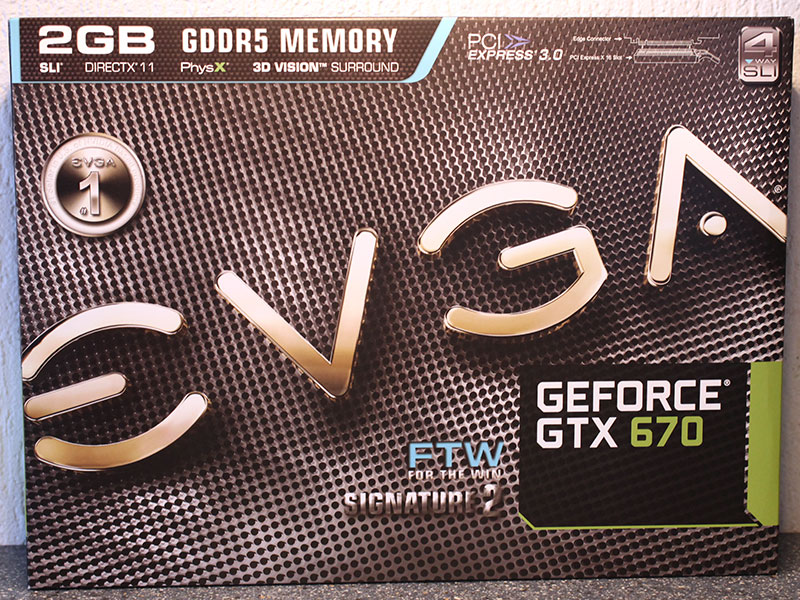

Contents
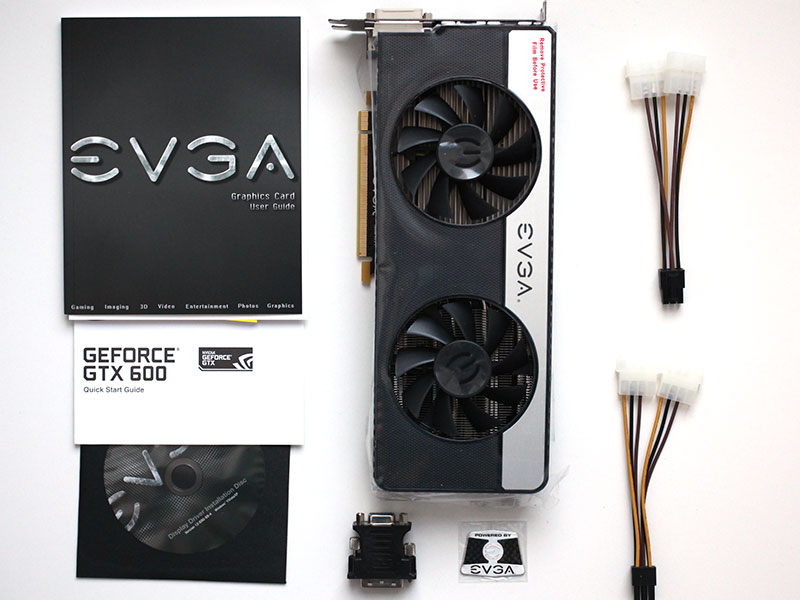
You will receive:
- Graphics card
- Driver CD + Documentation
- 2x PCI-E power cable
- DVI adapter
- EVGA case badge
The Card


The card uses a clean, stylish design with a black dual-fan cooler.
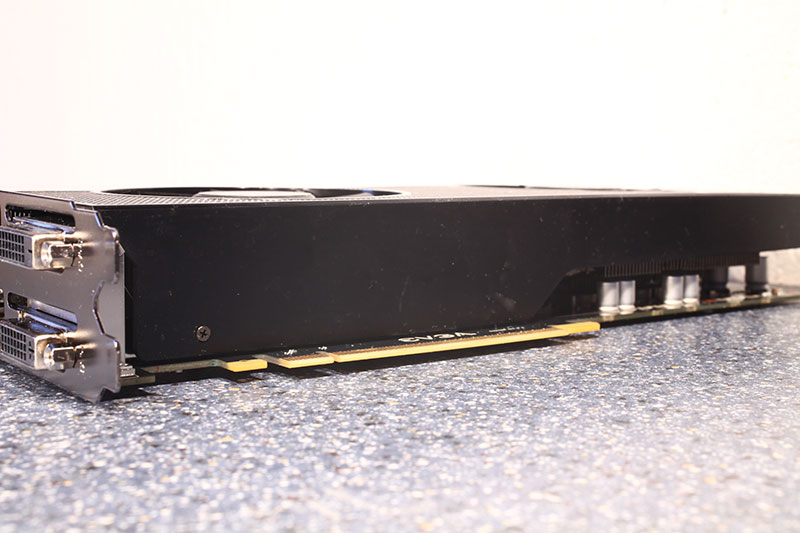
Installation of the card requires two slots in your system.

Display connectivity options include two DVI ports, one full-sized HDMI port, and one DisplayPort. You may use all the outputs at the same time.
The GPU also includes an HDMI sound device. It is HDMI 1.4a compatible, which includes HD audio and Blu-ray 3D movies support.

You may combine up to four GTX 670 cards from any vendor in a multi-GPU SLI configuration for higher frame-rates or better image-quality settings.
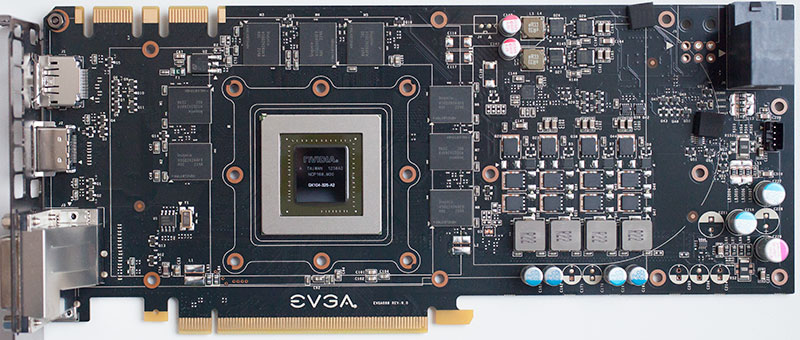

Pictured above are the front and back, showing the disassembled board. High-res versions are also available (front, back). If you choose to use these images for voltmods, etc., please include a link back to this site, or let us post your article.
Our Patreon Silver Supporters can read articles in single-page format.
Nov 13th, 2026 08:27 PST
change timezone
Latest GPU Drivers
New Forum Posts
- Slow SSD read speeds - help! (3)
- Dual B70 or Dual R9700 Pro on Linux (1)
- I won't download games that are larger than 30–40 GB. (108)
- TechPowerUp Screenshot Thread (MASSIVE 56K WARNING) (4386)
- Microsoft Exchange/365 outages? (45)
- [Community Benchmark] MrH OpenCL Benchmark 2.0e (Windows Only – CPU & GPU) (1)
- To AiO CPU Cooler users? (6)
- Any other old-timers here planning to play WoW Forever? (150)
- Requesting original VBIOS for Gigabyte RX 5700 XT GAMING OC 8G Rev 2.0 (Micron) (0)
- Home page search by category (6)
Popular Reviews
- AMD Zen 6 Technical Deep Dive
- Corsair HX1000i Shift Crystal Review
- NZXT C1200 Platinum Review
- Upcoming Hardware Launches 2027 (Updated Nov 2026)
- Montech King 95 3D PRO Review
- NZXT H7 RGB+ Review
- NZXT H5 Review
- Phantom Blade Zero Performance Benchmark Review - 35 GPUs Tested
- XPG NIMBUS PLUS Review - Mid-range Chair With Strong Competitors
- Gigabyte Z890I Aorus Ultra Review
TPU on YouTube
Controversial News Posts
- NVIDIA Co-Founder and CEO Jensen Huang Officially Resigns (356)
- OpenAI CEO Argues Home PCs Waste the World's Limited DRAM Supply (152)
- NVIDIA Launches Investigation Into Jensen Huang's Relationship With Suspected Chinese Spy (136)
- Intel "Raptor Lake Next" 16-Core and 20-Core CPUs Surface (130)
- Legendary Game Studio BioWare Shuts Down Following EA Layoffs (104)
- Dell CEO Says the Memory Shortage Will Get Worse in 2027 (95)
- NVIDIA GeForce RTX 50-Series Scheduled for up to $500 Price Hike This Week (89)
- Modder Fits RTX 5090 With Four 8-Pin Connectors, Halving Current per Wire (80)