 4
EVGA Z87 Stinger (Intel LGA 1150) Review
(4 Comments) »Introduction

EVGA is probably one of the more popular brands out there for Nvidia videocards, but they also have a few other tricks up their sleeve. Having recently introduced the Hadron Air, EVGA knows that you want a motherboard to go with it. EVGA case, EVGA PSU, EVGA videocard, EVGA motherboard – they almost got your entire build covered. Add memory, drives, and OS, and you have a tiny PC, and one that is, in the perfect world, ready to clock to the limits.
The base of such a build, the EVGA Z87 Stinger is a tiny mITX Z87-based board with a six-phase VRM design and EVGA's own take on what it takes to clock Haswell to the limit. Having not had much experience with EVGA motherboards, I was keen to see what EVGA had, and the company even uses my favorite colors, red and black. I was not expecting much since they make videocards first, but immediately jumped on the chance to get my hands on the board when given a few images. Packing a Creative Sound Core3D audio CODEC and Bluetooth (but no Wi-Fi), the dual-duty EVGA Z87 Stinger is ready to game and overclock.

Specifications
| Specifications | |
|---|---|
| CPU SUPPORT: | 4th Gen Intel Core i7/i5/i3/Pentium/Celeron processor family for the LGA 1150 Socket |
| POWER DESIGN: | CPU Power: 6 Phases Memory Power: 1 Phase |
| CHIPSET: | Intel Z87 Express |
| INTEGRATED GRAPHICS: | Dependant on installed CPU |
| MEMORY: | 2 x DIMM, Max. 16/32 GB, DDR3 1066 to DDR3 2666+(OC) |
| BIOS: | AMI UEFI BIOS with 64 Mb Flash ROM |
| SLOTS: | 1 x PCI Express 3.0 x16 slot 1 x mSATA/mPCIe slot |
| HDD CONNECTVIITY: | 4 x SATA 6.0 Gb/s (Intel Z87) |
| NETWORKING: | 1 x Giga PHY Intel I217V |
| PORTS: | 6 x USB 3.0 ports (2 at front panel, 4 at rear panel) 6 x USB 2.0 ports (2 at front panel, 4 at rear panel) 1 x RJ45 LAN connectors 1 x Audio block with 5 audio jacks 1 x eSATA port 1 x Optical S/PDIF port 1 x HDMI-out port 1 x Displayport 1 x Bluetooth Antenna 1 x CMOS Clear Switch |
| AUDIO: | Creative Core3D HD Audio Codec |
| FAN HEADERS: | 3 x 4-pin PWM |
| FORM FACTOR: | mITX Form Factor (170 mm x 170 mm) |
| EXCLUSIVE FEATURES: |
|
Intel Z87 Chipset

New and fresh on the scene for June of 2013 is Intel's latest Socket 1150 platform, with Intel's Z87 chipset taking the top-tier spot in chipset functionality and for performance options on this platform.
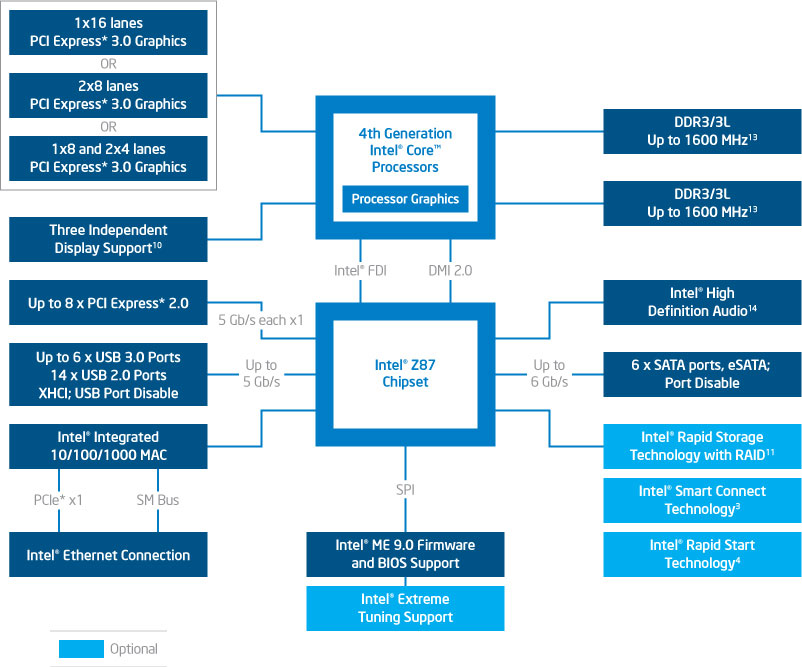
Most of the basic functionality offered by Intel's new Z87 chipset is quite similar to what was offered with Intel's Z77 Express, but there are more USB 3.0 ports, and they are faster too. All of the SATA ports provided offer SATA 6 Gb/s functionality. Intel's Z77 Express only had two ports at those speeds. There are also new power-saving features to keep power consumption at a bare minimum, and Z87 also includes all the features of the Intel Z77 Express. The chipset offers PCIe speeds of up to 5 GT/s for fast access to peripheral devices and networking with up to eight PCI Express 2.0 x1 ports that can be configured to act as x2-, x4-, or x8 ports. Intel's functionality diagram for the Z87 chipset is shown above.
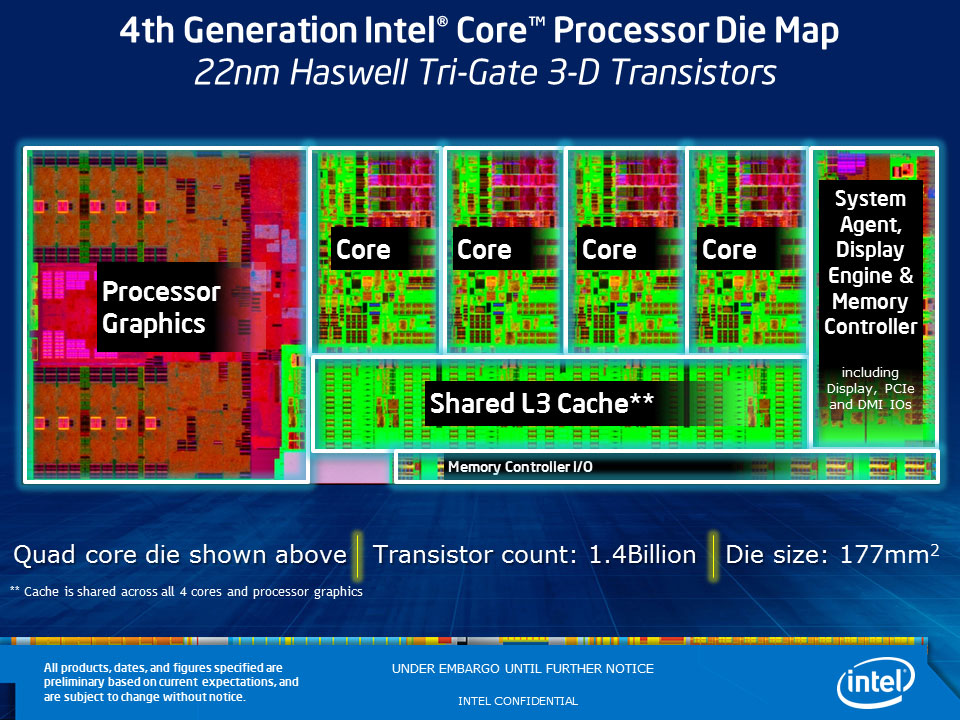
The new 4th Gen Intel Core CPUs are 64-bit, multi-core chips built on a 22nm process; pairing with the Intel Z87 chipset enables the performance-tuning features of "K"-SKU CPUs, allowing independent changes to core-, graphics-, "ring"-, and memory frequencies. This allows you to clock up one part of the chip while running any other part of the chip at stock speeds, which is extremely useful for enthusiasts that like to overclock, as each part can be clocked and tested independently for the absolute most out of your chip if the time is taken to test everything fully. Users who prefer the simpler approach of past platforms can use it instead, ensuring everyone's needs are met. For PCIe connectivity, Intel Z87-based platforms allow the processor's PCI Express 3.0 port to be configured into three different configurations: 1x16, 2x8, or 1x8 and 2x4. The third x8 and 2x4 configuration is primarily meant for use with Intel Thunderbolt Technology but can be used to support other devices as well.
Other TPU reviews cover the CPUs themselves in more detail. We will now also separate those reviews. One will cover iGPU performance and the other will cover CPU performance.
Packaging


The EVGA Z87 Stinger arrived at my doorstep in a shrink-wrapped box, which made taking pictures without glare impossible, so I tore the plastic off before snapping a couple. Both the front and the back of the box are covered in pretty basic new-age designs that get the point across effectively.


As if the shrink wrap was not enough, stickers also seal the outer box up tight so securely that opening it was actually a bit annoying. When I finally got it open, the side of the box revealed a little sticker asking you not take the product back to the store if you have problems, and to contact EVGA directly first. You might want to put on some gloves at this point since what is inside the box is going to get your fingers dirty. The black-dyed interior of the box is heavily inked, and in a way that rubs the ink off easily, as you can see by the flap of the box pictured above.


The goodies inside the black-as-night box are at the top, under the manual. Like a NASA-packed TV dinner, the board's accessories come in silvery packages. Pretty impressive, really. Once I took the accessories out of the box, I found the board below. Not only bubble-wrapped, I could also see an anti-static bag underneath. The board was inside the box upside down, which I didn't like.
Contents


Freed from their metalized-plastic prisons, there is actually not a lot EVGA included with the EVGA Z87 Stinger. A few papers, a couple cables, blah, blah, blah. The case badge actually fell out and onto my toe, its heavy all-metal design leaving a dent in my sock-covered foot.


There is also a cover for the rear I/O towers. A swanky black-anodized aluminum piece that completes the look of the board when installed into a windowed case, it covers the slivery top of every I/O tower completely. EVGA also made a point of labeling the backplate for those I/O towers fairly well. A full list of all the goodies is below:
- 1 x Quick Installation Guide
- 1 x User Manual
- 1 x Support CD
- 1 x I/O shield
- 4 x SATA data cables
- 1 x EVGA Case badge
Our Patreon Silver Supporters can read articles in single-page format.
Nov 19th, 2026 16:14 CST
change timezone
Latest GPU Drivers
New Forum Posts
- Honestly, do you care about GTA VI? (164)
- Windows 11 General Discussion (7736)
- Current Sales, Bundles, Giveaways (10448)
- Last game you purchased? (1409)
- WarpCoreBench scores! (76)
- Got the EOL 32GB TridentZ 6000 CL26 1.4V (12)
- Dell Workstation Owners Club (3516)
- Making a game in Godot engine (4)
- DTS DCH Driver for Realtek HDA [DTS:X APO4 + DTS Interactive] (2815)
- Security Apps (2)
Popular Reviews
- Acemagic Retro X3 Review
- Ugreen NASync DXP4800 GT Review
- Upcoming Hardware Launches 2027 (Updated Nov 2026)
- Pulsar Office Tour & First Look at P1 Dual-Sensor Mouse
- AMD Zen 6 Technical Deep Dive
- Biwin Black Opal NV7400 2 TB Review
- Sapphire Radeon RX 7700 XT Pure Review
- Sapphire Radeon RX 7700 XT Pulse Review
- AMD Ryzen 7 9800X3D Review - The Best Gaming Processor
- Chieftec Iceberg PRO 360 DARK Review
TPU on YouTube
Controversial News Posts
- NVIDIA Co-Founder and CEO Jensen Huang Officially Resigns (489)
- Report: Jensen Huang Eyes NVIDIA Comeback (223)
- Open Letter Asking NVIDIA to Reinstate Jensen Huang Passes 115,000 Signatures (184)
- OpenAI CEO Argues Home PCs Waste the World's Limited DRAM Supply (152)
- NVIDIA Launches Investigation Into Jensen Huang's Relationship With Suspected Chinese Spy (136)
- Intel "Raptor Lake Next" 16-Core and 20-Core CPUs Surface (130)
- Legendary Game Studio BioWare Shuts Down Following EA Layoffs (104)
- Dell CEO Says the Memory Shortage Will Get Worse in 2027 (95)