 14
FSP MEGA GM 1000 W Review
Value & Conclusion »Result Summary
| Full-Range Load Testing (230 V) | |||||||||
|---|---|---|---|---|---|---|---|---|---|
| All-rail Load | 12 V | 5 V | 3.3 V | Power (DC/AC) | Efficiency | Fan Speed | Noise Level | Power Factor | |
| 0 % | 0.00 A | 0.0 A | 0.0 A | 0.00 W | N/A | Fan Stop | 0.18 | ||
| 12.12 V | 5.10 V | 3.35 V | 6.8 W | ||||||
| 5 % | 3.82 A | 0.5 A | 0.5 A | 50.00 W | 82.64 % | Fan Stop | 0.7 | ||
| 12.12 V | 5.10 V | 3.35 V | 60.50 W | ||||||
| 10 % | 7.64 A | 1.0 A | 1.0 A | 100.00 W | 87.95 % | Fan Stop | 0.86 | ||
| 12.12 V | 5.10 V | 3.35 V | 113.70 W | ||||||
| 20 % | 15.28 A | 2.0 A | 2.0 A | 200.00 W | 91.32 % | Fan Stop | 0.94 | ||
| 12.12 V | 5.10 V | 3.35 V | 219.00 W | ||||||
| 30 % | 22.93 A | 3.0 A | 3.0 A | 300.00 W | 92.17 % | Fan Stop | 0.96 | ||
| 12.12 V | 5.10 V | 3.35 V | 325.50 W | ||||||
| 40 % | 30.57 A | 4.0 A | 4.0 A | 400.00 W | 92.10 % | Fan Stop | 0.97 | ||
| 12.12 V | 5.10 V | 3.36 V | 434.30 W | ||||||
| 50 % | 38.21 A | 5.0 A | 5.0 A | 500.00 W | 92.37 % | Fan Stop | 0.98 | ||
| 12.12 V | 5.10 V | 3.37 V | 541.30 W | ||||||
| 60 % | 45.85 A | 6.0 A | 6.0 A | 600.00 W | 92.32 % | 478 RPM | 30.2 dBA | 0.98 | |
| 12.12 V | 5.10 V | 3.38 V | 649.90 W | ||||||
| 70 % | 53.49 A | 7.0 A | 7.0 A | 700.00 W | 91.91 % | 632 RPM | 32.6 dBA | 0.98 | |
| 12.12 V | 5.10 V | 3.38 V | 761.60 W | ||||||
| 80 % | 61.13 A | 8.0 A | 8.0 A | 800.00 W | 91.74 % | 845 RPM | 37.1 dBA | 0.98 | |
| 12.12 V | 5.10 V | 3.39 V | 872.00 W | ||||||
| 90 % | 68.78 A | 9.0 A | 9.0 A | 900.00 W | 91.46 % | 1088 RPM | 41.8 dBA | 0.98 | |
| 12.13 V | 5.10 V | 3.40 V | 984.00 W | ||||||
| 100 % | 76.42 A | 10.0 A | 10.0 A | 1000.00 W | 91.07 % | 1342 RPM | 46.3 dBA | 0.98 | |
| 12.14 V | 5.10 V | 3.40 V | 1098.00 W | ||||||
| 110 % | 84.06 A | 11.0 A | 11.0 A | 1100.00 W | 90.91 % | 1708 RPM | 50.1 dBA | 0.98 | |
| 12.14 V | 5.10 V | 3.40 V | 1210.00 W | ||||||
Efficiency
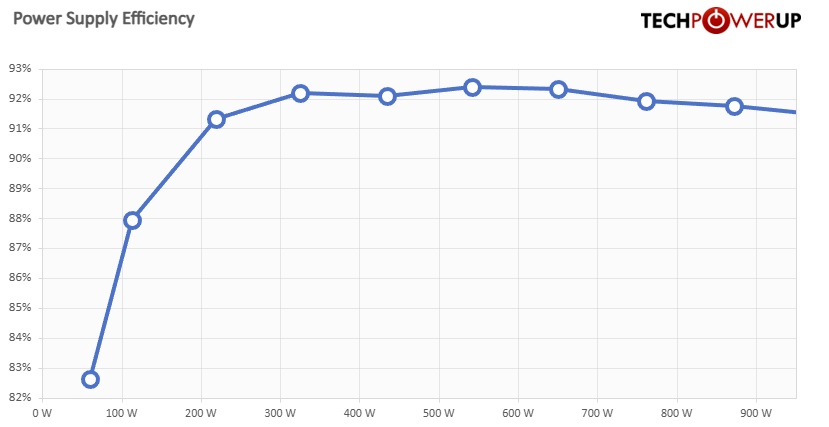
We see pleasant results across the board, with good efficiency, just within the 80 Plus Gold rating. The efficiency starts dropping off by 80 % load, suggesting this unit isn't particularly overbuilt, but we are still seeing very good efficiency numbers beyond rated output. The fan remained off below 60 % load, which is impressive given the small form factor.
| Rated Efficiency Validation (230 V) | ||||
|---|---|---|---|---|
| Certification: 80 Plus Gold | ||||
| Test Load | Required | Measured | Margin | Status |
| 20% | 90.00 % | 91.32 % | +1.32 % | Pass |
| 50% | 92.00 % | 92.37 % | +0.37 % | Pass |
| 100% | 89.00 % | 91.07 % | +2.07 % | Pass |
Voltage Regulation
As with almost all modern PSUs, the internal feedback loop regulating the output voltage at the supply itself is extremely effective.| Voltage Regulation | ||||
|---|---|---|---|---|
| Test Load | +12 V | +5 V | +3.3 V | Status |
| Idle | 12.12 V | 5.1 V | 3.35 V | Pass |
| 110% load | 12.14 V | 5.1 V | 3.40 V | Pass |
Cable Quality
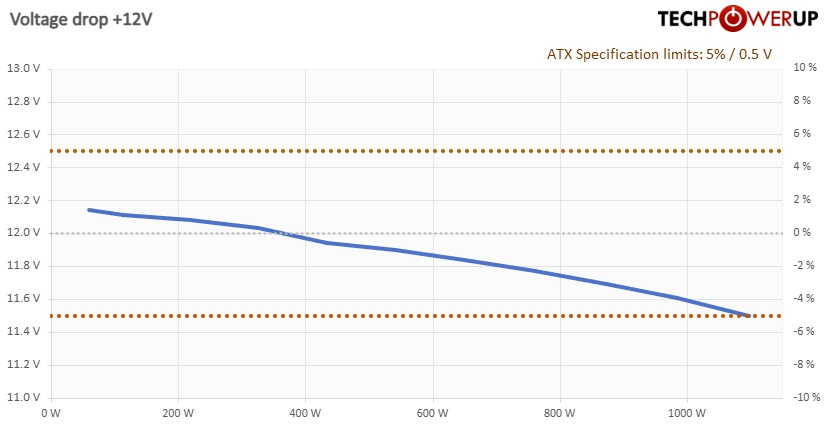
Since all cables and connectors have resistance, voltage drop will occur across them. By measuring the voltage at the supply and at the load, we can calculate the overall cable resistance and the power lost across them.| Cable Losses at Full Load | |
|---|---|
| Applied 12 V Load | 84 A |
| Measured @ Supply | 12.14 V |
| Measured @ Load | 11.50 V |
| Power Lost in Cable | 53.80 W |
| Per-Cable Resistance | 167.61 mΩ |
Ripple
Ideally you want the DC voltage delivered by your power supply to be a completely flat line when looking through an oscilloscope. However, due to the switching nature of the ATX power supply and the less than ideal real world behavior of all the components involved, we get very small fluctuations in the voltage output, known as ripple and noise. The ATX spec allows a ripple of up to 120 mV for the +12 V rail and 50 mV for the minor rails.| Ripple (mV) | ||||
|---|---|---|---|---|
| Test Load | 12 V | 5 V | 3.3 V | Status |
| 0% | 11.4 mV | 8.2 mV | 9.5 mV | Pass |
| 10% | 13.7 mV | 9.4 mV | 11.5 mV | Pass |
| 20% | 15.3 mV | 10.1 mV | 12.3 mV | Pass |
| 30% | 16.6 mV | 10.8 mV | 13.2 mV | Pass |
| 40% | 18.1 mV | 11.4 mV | 14.0 mV | Pass |
| 50% | 19.5 mV | 12.2 mV | 15.1 mV | Pass |
| 60% | 20.8 mV | 12.9 mV | 16.0 mV | Pass |
| 70% | 22.2 mV | 13.5 mV | 16.9 mV | Pass |
| 80% | 23.4 mV | 14.3 mV | 17.7 mV | Pass |
| 90% | 24.7 mV | 14.8 mV | 18.5 mV | Pass |
| 100% | 25.9 mV | 15.6 mV | 19.4 mV | Pass |
| 110% | 27.2 mV | 16.3 mV | 20.2 mV | Pass |
The ripple across all rails is controlled and within specification.
Short Circuit Protection
Short circuit protection is one of the most fundamental and important protections for a power supply. If a short circuit is detected on any rails, the PSU should turn off and prevent damage to itself and other components.| Short Circuit Protection | |
|---|---|
| +12 V rail | Operational |
| +5 V rail | Operational |
| +3.3 V rail | Operational |
SCP was working as expected with the unit. Protection is latching, requiring the supply to be power cycled to reset.
Nov 20th, 2026 14:05 PST
change timezone
Latest GPU Drivers
New Forum Posts
- How to prevent OLED burn damage due to PC freezes or power outtages? (48)
- Honestly, do you care about GTA VI? (208)
- When you could finally run Crysis maxed out? (63)
- WarpCoreBench scores! (80)
- GTA VI (20)
- Anthrophics IPO (25)
- GeekMagic Ultra Smart WiFi Weather Station (8)
- Very unusual two gaming-pc scenarios. (35)
- Can i play GTA 6 now? (Joke) (14)
- Zen 3 IF/IMC degradation (239)
Popular Reviews
- AMD Zen 6 Technical Deep Dive
- Ugreen NASync DXP4800 GT Review
- Microsoft Surface Laptop Ultra Review - The Next-gen Arm Laptop
- Corsair RM1200e (Second Generation) Review
- Acemagic Retro X3 Review
- Upcoming Hardware Launches 2027 (Updated Nov 2026)
- Pulsar Office Tour & First Look at P1 Dual-Sensor Mouse
- Biwin Black Opal NV7400 2 TB Review
- AMD Ryzen 7 9800X3D Memory Performance Scaling
- AMD Ryzen 7 9800X3D Review - The Best Gaming Processor
TPU on YouTube
Controversial News Posts
- NVIDIA Co-Founder and CEO Jensen Huang Officially Resigns (490)
- Report: Jensen Huang Eyes NVIDIA Comeback (255)
- Open Letter Asking NVIDIA to Reinstate Jensen Huang Passes 115,000 Signatures (184)
- OpenAI CEO Argues Home PCs Waste the World's Limited DRAM Supply (152)
- NVIDIA Launches Investigation Into Jensen Huang's Relationship With Suspected Chinese Spy (136)
- Intel "Raptor Lake Next" 16-Core and 20-Core CPUs Surface (130)
- Legendary Game Studio BioWare Shuts Down Following EA Layoffs (104)
- Dell CEO Says the Memory Shortage Will Get Worse in 2027 (95)