 41
G.SKILL Trident Z5 NEO RGB DDR5-6000 96 GB CL28 Review
AMD Memory Overclocking »Performance Check 24 Gbit vs 16 Gbit
After reviewing the full suite of benchmarks for both AMD and Intel systems, there is noticeable "underperformance" at 1920 x 1080 resolution compared to other memory kits in the charts. For those seeking a quick answer: the primary reason is that the 24 Gbit die (3 GB) is 50% larger than the 16 Gbit die (2 GB). To accommodate this increase in size, the tRFC2 and tRFC-SB values must be adjusted upwards for maximum system stability. This adjustment can impact overall performance in memory-intensive tasks such as gaming. In our pursuit of delivering honest and fair reviews, we must also consider the possibility of a testing error. We have a detailed explanation of how we arrived at this conclusion in the following section. Spoiler; it's not bad data.To ensure that our findings are accurate, we first conducted a series of system checks and benchmarks for an A/B comparison with a previously tested DDR5-6000 memory kit. This meticulous approach allowed us to rule out any test system errors or faulty data. Occasionally, the pre-set values in the XMP/EXPO profiles may be incorrectly processed by the motherboard, leading to instances of instability or suboptimal performance. That is not the case here. To be clear, there is nothing technically wrong with this G.SKILL memory kit. Moreover, these same longer refresh cycles for 3 GB ICs are used with other many brands as well.
This isn't the first time coming across atypical results and the performance "fix" for 24/48 GB DIMMs is quite simple; manually set the tRFC2 and tRFC-SB values. These tRFC2 and tRFC-SB values in their simplest description, determine in clocks cycles the time that must elapse during a refresh cycle. Essentially, the DRAM cannot be accessed while the refresh of memory cells is ongoing. With tRFC-SB being used for the "Same Bank" refresh, in which the same rules apply. In short, the higher these values are, the "longer" time (clock cycles) is spent being inaccessible to the system. This interrupt must happen due to the physical properties of the memory cells. Also known as volatile storage, it will lose the data in the event of power loss. If not periodically refreshed to ensure that it remains accurate, data bits are corrupted. However, if these values are set too low, the memory doesn't have enough time to fully refresh, resulting in data loss and eventual system instability.
For comparison, 16 Gbit die (2 GB) running at 6000 MT/s would typically use 480-390 (tRFC2-tRFC-SB). G.SKILL kept the adjustment below %50 at 660-570, representing a 37.5–46.2% increase. This change results in more clock cycles being dedicated to cell refreshing. Unfortunately for the high performance PC enthusiasts, this is the small trade-off. Using 24 GB DIMMs comes at the cost of increased refresh latency, which can impact overall performance for fast reflex gaming. Without manually setting these tRFC values, there is a clear regression in performance of brands using 24 GB DIMMs compared to their 16 GB counterparts set inside the XMP/EXPO profile. As stated previously, the reason for these higher refresh times is because of the larger size ICs. By following specifications set by either the DRAM manufacturer (SK Hynix in this example) or JEDEC organization, most of the EXPO/XMP profiles are generally designed (programmed) using a linear progression model and scaling approach. In short, G.SKILL is following the correct specifications. However, when directly compared to 16 GB DIMMs, it comes across as atypical results.
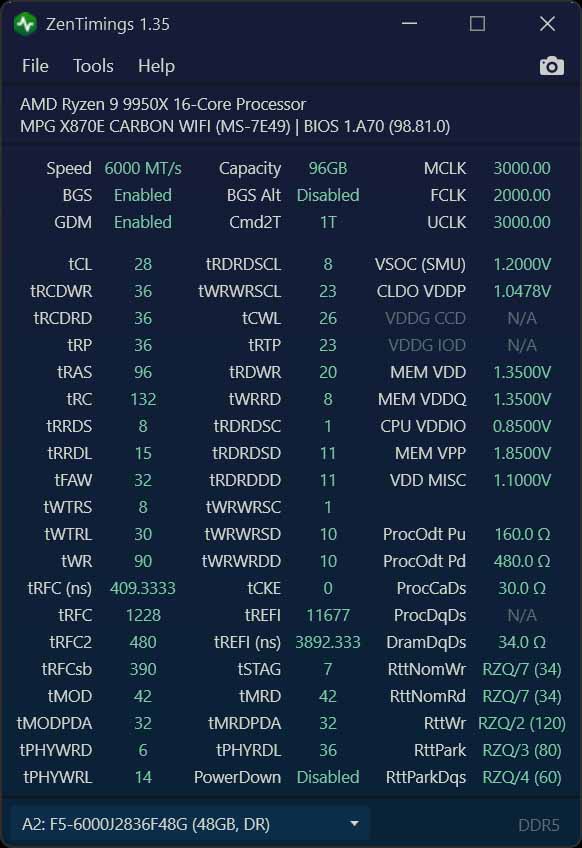
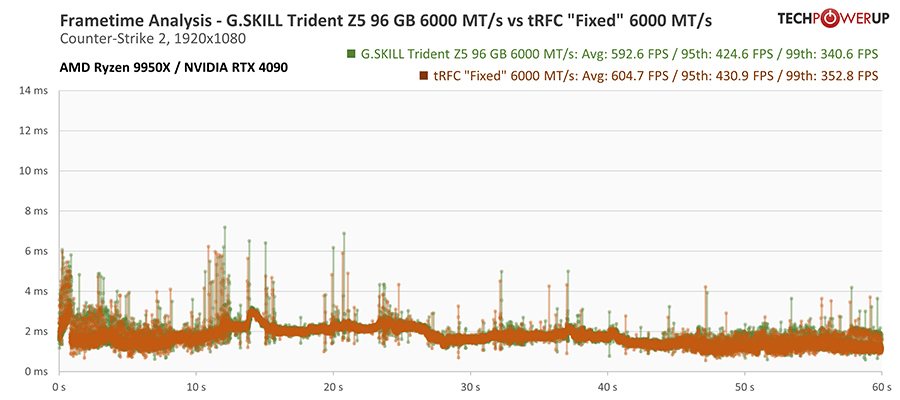
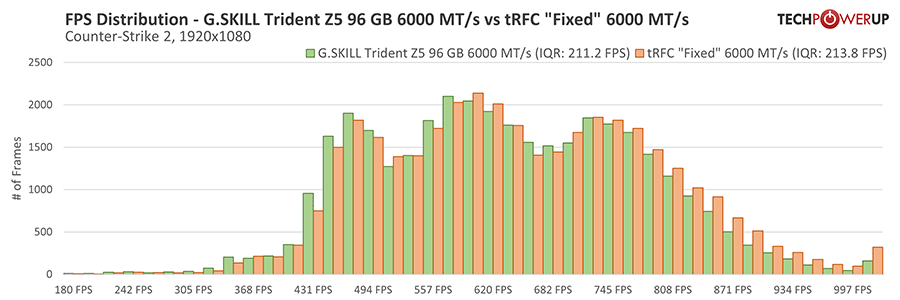
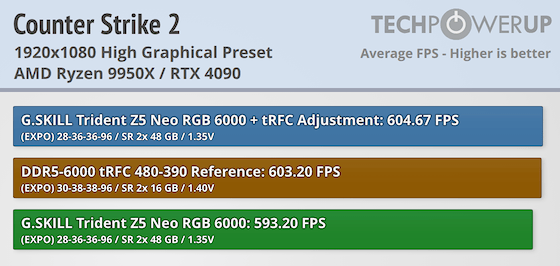
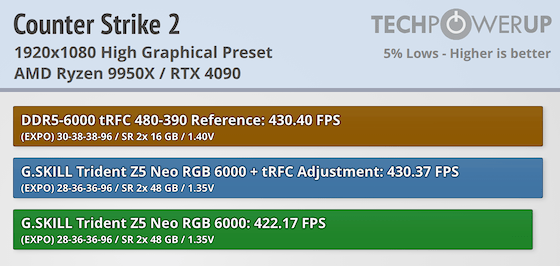
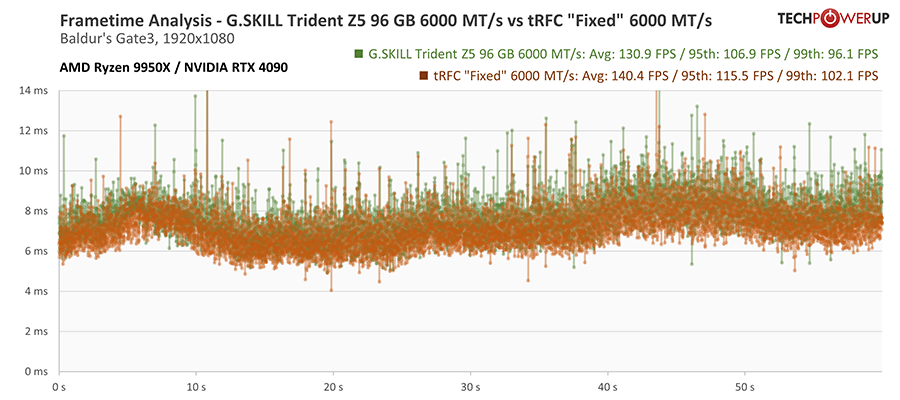
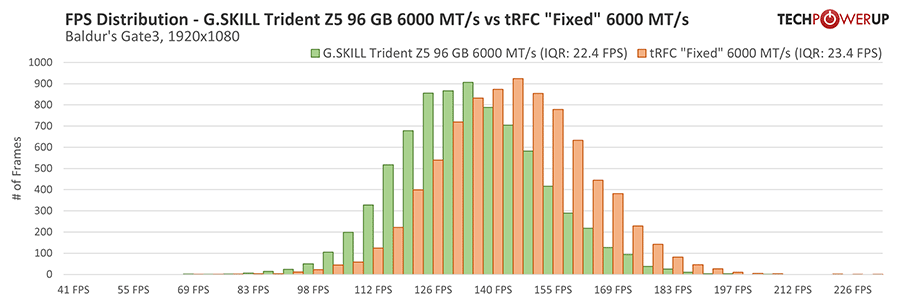
To illustrate the effect of adjusting tRFC2 and tRFC-SB, below are the results from modifying the tRFC2 (660) and tRFC-SB (570) values to 480 and 390, respectively. This was done without altering the voltage or any other memory timings.
Performance Check: Counter-Strike 2

Performance Check Baldur's Gate 3


Nov 19th, 2026 01:11 PST
change timezone
Latest GPU Drivers
New Forum Posts
- Without Jensen, PC gaming will be (48)
- Time to upgrade CPU and MOBO (43)
- 3DMARK "LEGENDARY" (475)
- [Poll] 12V-2x6 Connector Protection: What Are You Using? (WireView / Ampinel / Equalizer / Other / Nothing) (43)
- Windows HDR on = Tinted colors (5)
- WarpCoreBench scores! (68)
- Honestly, do you care about GTA VI? (155)
- Very unusual two gaming-pc scenarios. (13)
- TPU's Nostalgic Hardware Club (22168)
- Dual B70 or Dual R9700 Pro on Linux (7)
Popular Reviews
- Acemagic Retro X3 Review
- Ugreen NASync DXP4800 GT Review
- Upcoming Hardware Launches 2027 (Updated Nov 2026)
- AMD Zen 6 Technical Deep Dive
- Pulsar Office Tour & First Look at P1 Dual-Sensor Mouse
- Biwin Black Opal NV7400 2 TB Review
- Sapphire Radeon RX 7700 XT Pure Review
- Sapphire Radeon RX 7700 XT Pulse Review
- Chieftec Iceberg PRO 360 DARK Review
- ASUS ROG Strix B850-I Gaming Wi-Fi7 W Review
TPU on YouTube
Controversial News Posts
- NVIDIA Co-Founder and CEO Jensen Huang Officially Resigns (483)
- Report: Jensen Huang Eyes NVIDIA Comeback (196)
- Open Letter Asking NVIDIA to Reinstate Jensen Huang Passes 115,000 Signatures (184)
- OpenAI CEO Argues Home PCs Waste the World's Limited DRAM Supply (152)
- NVIDIA Launches Investigation Into Jensen Huang's Relationship With Suspected Chinese Spy (136)
- Intel "Raptor Lake Next" 16-Core and 20-Core CPUs Surface (130)
- Legendary Game Studio BioWare Shuts Down Following EA Layoffs (104)
- Dell CEO Says the Memory Shortage Will Get Worse in 2027 (95)