 57
G.SKILL Trident Z5 NeoX RGB 6000 CL30 32 GB Review - EXPO ULL
Memory Relative Performance »Spider-Man Remastered Frametime Analysis
We present a more in-depth analysis than just average FPS to show how the frame rate changes over time, which helps highlight FPS drops. Minimum FPS at both the 95th and 99th percentile are reported in these charts, too. A second chart, a histogram, shows shape and spread for the frametime data—how tightly grouped the measurements are. The "IQR" result is called "Interquartile Range," which is an outlier-resistant statistical value that tells us the range in the middle of the frametime distribution.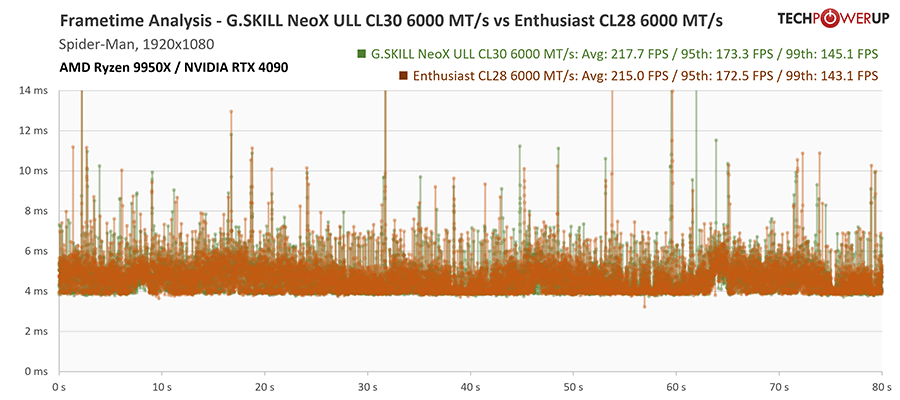
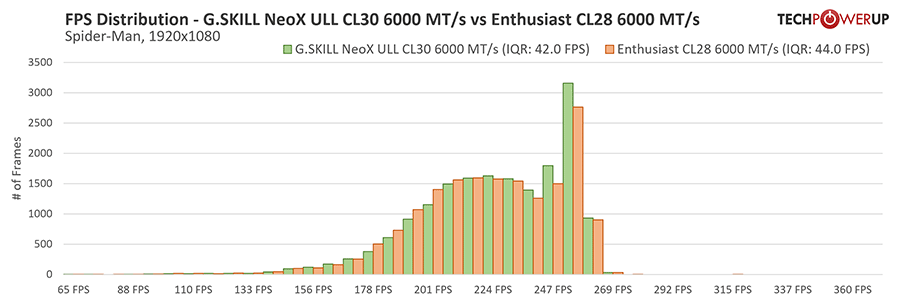
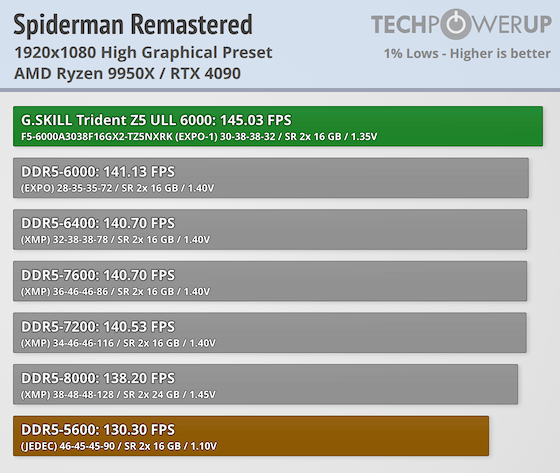
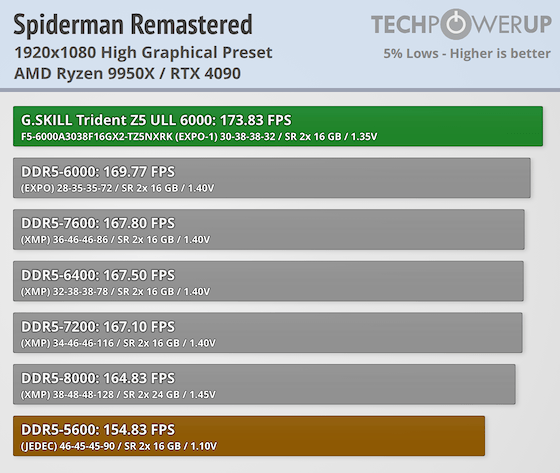
Spider-Man Remastered shows the same story. The G.Skill Trident Z5 ULL 6000 leads outright in 1% Lows and 5% Lows, beating standard DDR5-6000 CL28 EXPO by roughly 4 FPS and pulling further ahead of higher-frequency kits like DDR5-8000 and JEDEC DDR5-5600. The frametime comparison against the CL28 "Enthusiast" kit confirms this, with the NeoX ULL CL30 posting a slightly higher average (217.7 vs 215.0 FPS) and better 99th percentile (145.1 vs 143.1 FPS), with both kits showing similarly tight frametime consistency throughout the run. Like BG3 and CS2, Spider-Man Remastered rewards low-latency memory, giving the EXPO ULL kit a consistent edge over both looser-timing and higher-frequency alternatives.
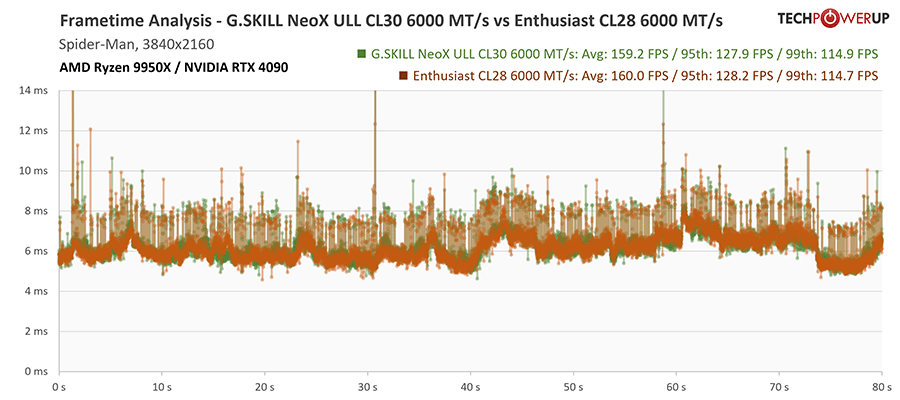
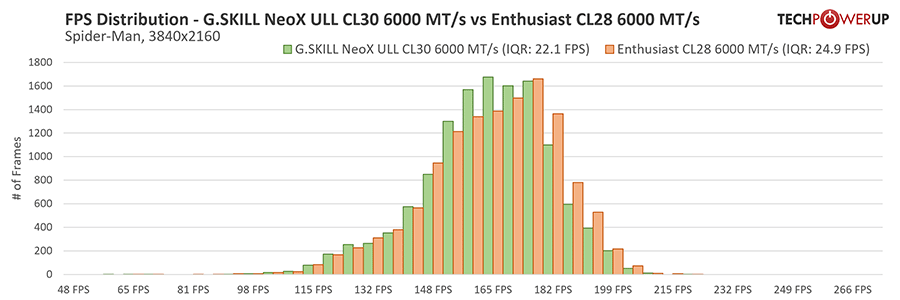

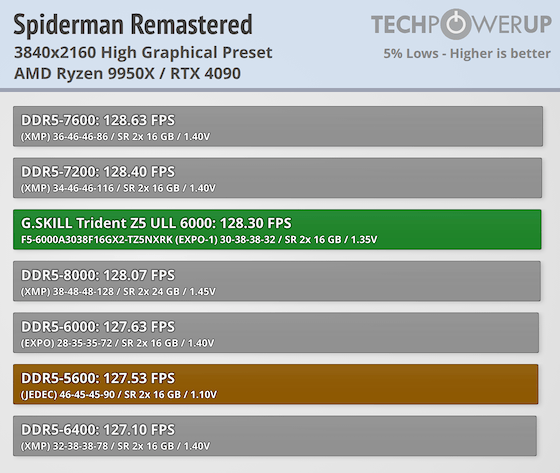
In typical fashion, as the resolution is bumped up, the frame rate inevitably takes a hit. This trend is evident across most of the memory kits featured in the charts, where the differences begin to shrink to within the margin of error. However, Spider-Man Remastered seems to hold its own, especially when paired with the RTX 4090. The performance still shows some flexibility depending on the memory speed and timings, suggesting there's room for optimization to squeeze out those extra frames.
Nov 22nd, 2026 02:00 PST
change timezone
Latest GPU Drivers
New Forum Posts
- Ryzen or Intel system (14)
- RX 580 2048SP 8GB - SK Hynix - Ardiyes - BIOS Needed (3)
- Honestly, do you care about GTA VI? (239)
- How to prevent OLED burn damage due to PC freezes or power outtages? (53)
- Your PC ATM (36447)
- SATA drive 1.4 GBps with Intel X25-E on Windows 98! (41)
- TPU's Nostalgic Hardware Club (22191)
- AI generated images... (231)
- RX 9000 series GPU Owners Club (2252)
- Introducing DST Bench : one of the most advanced disk benchmark and storage analyzer real-time software (7)
Popular Reviews
- Microsoft Surface Laptop Ultra Review - The Next-gen Arm Laptop
- Corsair RM1200e (Second Generation) Review
- Pulsar Office Tour & First Look at P1 Dual-Sensor Mouse
- Upcoming Hardware Launches 2027 (Updated Nov 2026)
- Ugreen NASync DXP4800 GT Review
- AMD Ryzen 7 9800X3D Review - The Best Gaming Processor
- Biwin Black Opal NV7400 2 TB Review
- AMD Zen 6 Technical Deep Dive
- Phantom Blade Zero Performance Benchmark Review - 35 GPUs Tested
- AMD Ryzen 7 5800X3D 10th Anniversary Review
TPU on YouTube
Controversial News Posts
- NVIDIA Co-Founder and CEO Jensen Huang Officially Resigns (492)
- Report: Jensen Huang Eyes NVIDIA Comeback (262)
- Open Letter Asking NVIDIA to Reinstate Jensen Huang Passes 115,000 Signatures (184)
- OpenAI CEO Argues Home PCs Waste the World's Limited DRAM Supply (152)
- NVIDIA Launches Investigation Into Jensen Huang's Relationship With Suspected Chinese Spy (136)
- Intel "Raptor Lake Next" 16-Core and 20-Core CPUs Surface (130)
- NVIDIA GeForce RTX 50-Series Scheduled for up to $500 Price Hike This Week (89)
- Intel Razor Lake Gets a 12 P-Core bLLC Chip With No E-Cores, Per Leak (86)