 3
G-Wolves Fenrir Asym 8K Review
(3 Comments) »Value and Conclusion
- The G-Wolves Fenrir Asym 8K is available for $159.00.
- True 8000 Hz wireless polling
- Very low click latency
- Very good sensor performance
- High button quality
- Good scroll wheel
- Good choice of components
- Lightweight
- Nicely gliding mouse feet
- Full software customizability
- Sets of replacement feet included
- Set of grip tape included
- Pricey
- Minor polling instability
- Included cables are either too short or too stiff
- Web driver not available as standalone app
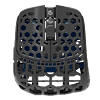
Historically, G-Wolves has been one of the few manufacturers committed to delivering mice that are purely designed for fingertip grip. Following the HSK 4K Pro and Hati-R 8K, the Fenrir Max 8K and Fenrir Asym 8K take a different approach than either of the aforementioned mice, though some similarities are present nonetheless. Compared to the HSK Pro 4K, the Fenrir Asym 8K is plain larger, with the increased width in particular being notable. In fact, the Fenrir Asym 8K is even wider than the Zaunkoenig M2K/M3K, which has been among the very few fingertip grip mice whose grip width matched that of a regular one. Unlike the M2K/M3K, the Fenrir Asym 8K has side buttons, and there is still a rather steep hump at the back, whose only purpose is to make room for these side buttons. The Fenrir Max 8K and Fenrir Asym 8K share their basic design, but balance things differently, with the Asym having a much lower profile, which has the main buttons sit much lower at the front, and the rather deep comfort grooves compound this effect even further. Whereas the sides of the Fenrir Max 8K are symmetrically designed, the Asym flares out at the back on the right, creating an arguably more ergonomic silhouette. In addition, where the Max has a virtually fully solid upper shell, the Asym has hexagonal holes all across the upper shell except for the sides, including on the entirety of the main buttons. As a result of these differences, the Fenrir Asym 8K ends up weighing marginally less at 21 g as opposed to the Max's 23 g. In terms of build quality and structural integrity, the Fenrir Asym 8K surprisingly enough does even better than the Max: there is no rattle when shaking, no creaking or flexing of the shell when applying lateral pressure, and actuating the side buttons by pressing below them cannot be done, regardless of force. As with previous G-Wolves releases, the PCB has been extended such that it supports the shell, whose walls otherwise would be too thin.
Due to its lower profile, the Fenrir Asym 8K utilizes different main button switches compared to the Max. Much like on the HTX Mini 8K, which too has very low sitting main buttons, the Fenrir Asym 8K comes with a pair of Omron D2LS-21 (20 M) switches, which are surface-mounted. Pre-travel is low to moderate, and post-travel low, resulting in a firm and snappy button response. Some lateral movement can be provoked, although it remains unnoticeable during actual use. The side buttons too are outfitted with surface-mounted Omron D2LS-21 switches, albeit of a lower rating. Pre- and post-travel are very low on these, and the actuation point is even across their entirety. For the scroll wheel, G-Wolves once again has opted for a TTC encoder, albeit of a different type (black), whose 4.5 mm size is necessitated by the lower profile. Of note is that this encoder can be difficult to replace, both due to its size and non-standard pin distance. In addition, the scroll wheel isn't fully inserted into the encoder, which is done on purpose, as otherwise the axle wouldn't reach the scroll wheel switch. Tactility is good on this one, with clearly defined steps allowing for controlled scrolling, and noise levels remain largely under control as well. Much like on previous G-Wolves releases, the bottom lacks indents for feet, allowing one to apply feet of non-default sizes and shapes. Aside from the preinstalled dot feet, two sets of larger feet are included with the mouse, along with three sets of dots. They're all made of pure PTFE, and glide very well. Of note is that the Fenrir Asym 8K lacks a sensor ring entirely, which isn't necessarily an issue, but having one would probably be better for users of soft mats in particular.
The Fenrir Asym 8K combines PixArt's latest PAW3950 sensor with a Nordic nRF52840 MCU. Compared to the previous 01.00.37 firmware, the latest 01.00.39 firmware introduces a novelty on G-Wolves mice, which is the so-called competitive mode. When enabled, this sets sensor run mode to corded, which prioritizes performance over battery life. At polling rates of 2000 Hz and higher, corded mode is already enabled by default and the setting accordingly does nothing, but at 1000 Hz and under, enabling corded mode essentially brings motion delay in line with polling rates of 2000 Hz and over. As such, this is a worthwhile setting, as it allows one to enjoy the lower motion delay brought by 2000 Hz and over without suffering the potential FPS hit induced by them. Click latency is the same across all polling rates anyway, so the only benefit polling rates of 2000 Hz and above have over polling rates of 1000 Hz and under with competitive mode enabled is higher positional accuracy, along with increased smoothness due to more frequent updates.
In terms of numbers, virtually nothing has changed compared to the 01.00.37 firmware. CPI deviation sits at +1.3%, which is significantly lower than on the Fenrir Max 8K and easily corrected. Polling stability continues to be a mixed bag. At and below 1000 Hz, polling is generally stable, although occasionally, longer sequences of off-period polls show up. Both 2000 and 4000 Hz show elevated variance, though 4000 Hz also suffers from off-period polls. On the other hand, 8000 Hz is perfectly stable, which is notable in that motion delay is the same across 2000, 4000, and 8000 Hz, as the Fenrir Asym 8K enjoys a lead of 0.8 ms over the Logitech G403 (control subject) without MotionSync. Since a PAW3950 is used, the target interval of 125 us is maintained at 8000 Hz even with MotionSync enabled. At 1000 Hz, this lead shrinks to just 0.4 ms, though as mentioned earlier, 0.8 ms too can be reached at 1000 Hz by enabling competitive mode. The Fenrir Asym 8K averages a click latency of 0.4 ms at the lowest debounce time setting across all polling rates, and since a flawlessly implemented slam-click prevention algorithm is present, there is no reason not to use 0 ms as long as no double-clicking emerges.
G-Wolves does not city any battery life numbers. That said, given that 80 hours were cited for the Hati-S Ultra at 1000 Hz—which used a 250 mAh battery—it is fair to assume that the Fenrir Asym 8K lands somewhere around the 66 hours mark, since a 200 mAh battery is utilized. Unfortunately, the percent-based battery life indicator still isn't much help in this regard, as it is simply not reliable enough to gauge anything. Charging isn't all that speedy on the Fenrir Asym 8K, but decent enough, though playing while charging won't be an option with the included cables anyway. The first one isn't all that flexible to begin with, but more importantly seriously short at 1.25 m, whereas the second one is a bit longer at 1.45 m yet even stiffer. As such, it is best to keep the Fenrir Asym 8K charged at all times to minimize forced downtime.
As with other recent G-Wolves releases, configuration on the Fenrir Asym 8K is done through a web driver. Due to using WebHID, this will only work in Chromium-based browsers such as Chromium or Edge. Hence, for those not already using these browsers, being directed towards a web driver requires installing an additional browser, which of course comes with its own resource footprint, much like standalone peripheral software would. In addition, if G-Wolves were to go defunct, or decide to no longer host the web driver, configuration would become impossible, as a local copy unfortunately won't work. This is doubly problematic in that the HTX Mini 8K doesn't even have a CPI button, so even something basic as changing CPI requires using software. As such, I consider the exclusive web driver a step back compared to the previous standalone application featured with earlier G-Wolves mice, and would welcome if G-Wolves would also release a desktop version of their web driver in the future. As for the driver itself, I couldn't find any bugs, and all the relevant options are present. The only minor issue is that setting changes can still be made after the mouse has entered sleep mode, yet won't be applied, which isn't communicated through the UI. An additional oddity is that any adjustment to the debounce settings will only take effect after the mouse has been lifted and reset once. Compared to earlier 3395 releases, two new settings exclusive to the 3950 are available on the Fenrir Asym 8K: lift-off distance may be set to 0.7 mm, and the sensor angle can be adjusted from -30° to 30° in increments of 1°.
Even among enthusiasts, pure fingertip grip mice are a niche, and since enthusiast mice are a niche already, the Fenrir Asym 8K essentially is a niche within a niche. Accordingly, it comes as no surprise to see this reflected in the price, which narrows the target audience even further. At $159.00, the Fenrir Asym 8K definitely does not appeal to everyone, especially given that it's not really suited for regular desktop usage or even casual gaming. Those committed to competitive gaming and fingertip grip gaming, however, will be hard-pressed to find anything surpassing the Fenrir Asym 8K for this use case, as it does pretty much everything one would want in a fingertip grip mouse, and does it well. The Zaunkoenig M2K (now M3K) is wired, has no side buttons, yet weighs more, and is even more expensive, and the Darmoshark M5 may cost less, but is much heavier and doesn't perform nearly as well. Truly, between the Fenrir Max 8K and Fenrir Asym 8K, G-Wolves has the fingertip grip mice market on lockdown, and accordingly earns our Recommended award, along with the Expensive badge.


Due to its lower profile, the Fenrir Asym 8K utilizes different main button switches compared to the Max. Much like on the HTX Mini 8K, which too has very low sitting main buttons, the Fenrir Asym 8K comes with a pair of Omron D2LS-21 (20 M) switches, which are surface-mounted. Pre-travel is low to moderate, and post-travel low, resulting in a firm and snappy button response. Some lateral movement can be provoked, although it remains unnoticeable during actual use. The side buttons too are outfitted with surface-mounted Omron D2LS-21 switches, albeit of a lower rating. Pre- and post-travel are very low on these, and the actuation point is even across their entirety. For the scroll wheel, G-Wolves once again has opted for a TTC encoder, albeit of a different type (black), whose 4.5 mm size is necessitated by the lower profile. Of note is that this encoder can be difficult to replace, both due to its size and non-standard pin distance. In addition, the scroll wheel isn't fully inserted into the encoder, which is done on purpose, as otherwise the axle wouldn't reach the scroll wheel switch. Tactility is good on this one, with clearly defined steps allowing for controlled scrolling, and noise levels remain largely under control as well. Much like on previous G-Wolves releases, the bottom lacks indents for feet, allowing one to apply feet of non-default sizes and shapes. Aside from the preinstalled dot feet, two sets of larger feet are included with the mouse, along with three sets of dots. They're all made of pure PTFE, and glide very well. Of note is that the Fenrir Asym 8K lacks a sensor ring entirely, which isn't necessarily an issue, but having one would probably be better for users of soft mats in particular.
The Fenrir Asym 8K combines PixArt's latest PAW3950 sensor with a Nordic nRF52840 MCU. Compared to the previous 01.00.37 firmware, the latest 01.00.39 firmware introduces a novelty on G-Wolves mice, which is the so-called competitive mode. When enabled, this sets sensor run mode to corded, which prioritizes performance over battery life. At polling rates of 2000 Hz and higher, corded mode is already enabled by default and the setting accordingly does nothing, but at 1000 Hz and under, enabling corded mode essentially brings motion delay in line with polling rates of 2000 Hz and over. As such, this is a worthwhile setting, as it allows one to enjoy the lower motion delay brought by 2000 Hz and over without suffering the potential FPS hit induced by them. Click latency is the same across all polling rates anyway, so the only benefit polling rates of 2000 Hz and above have over polling rates of 1000 Hz and under with competitive mode enabled is higher positional accuracy, along with increased smoothness due to more frequent updates.
In terms of numbers, virtually nothing has changed compared to the 01.00.37 firmware. CPI deviation sits at +1.3%, which is significantly lower than on the Fenrir Max 8K and easily corrected. Polling stability continues to be a mixed bag. At and below 1000 Hz, polling is generally stable, although occasionally, longer sequences of off-period polls show up. Both 2000 and 4000 Hz show elevated variance, though 4000 Hz also suffers from off-period polls. On the other hand, 8000 Hz is perfectly stable, which is notable in that motion delay is the same across 2000, 4000, and 8000 Hz, as the Fenrir Asym 8K enjoys a lead of 0.8 ms over the Logitech G403 (control subject) without MotionSync. Since a PAW3950 is used, the target interval of 125 us is maintained at 8000 Hz even with MotionSync enabled. At 1000 Hz, this lead shrinks to just 0.4 ms, though as mentioned earlier, 0.8 ms too can be reached at 1000 Hz by enabling competitive mode. The Fenrir Asym 8K averages a click latency of 0.4 ms at the lowest debounce time setting across all polling rates, and since a flawlessly implemented slam-click prevention algorithm is present, there is no reason not to use 0 ms as long as no double-clicking emerges.
G-Wolves does not city any battery life numbers. That said, given that 80 hours were cited for the Hati-S Ultra at 1000 Hz—which used a 250 mAh battery—it is fair to assume that the Fenrir Asym 8K lands somewhere around the 66 hours mark, since a 200 mAh battery is utilized. Unfortunately, the percent-based battery life indicator still isn't much help in this regard, as it is simply not reliable enough to gauge anything. Charging isn't all that speedy on the Fenrir Asym 8K, but decent enough, though playing while charging won't be an option with the included cables anyway. The first one isn't all that flexible to begin with, but more importantly seriously short at 1.25 m, whereas the second one is a bit longer at 1.45 m yet even stiffer. As such, it is best to keep the Fenrir Asym 8K charged at all times to minimize forced downtime.
As with other recent G-Wolves releases, configuration on the Fenrir Asym 8K is done through a web driver. Due to using WebHID, this will only work in Chromium-based browsers such as Chromium or Edge. Hence, for those not already using these browsers, being directed towards a web driver requires installing an additional browser, which of course comes with its own resource footprint, much like standalone peripheral software would. In addition, if G-Wolves were to go defunct, or decide to no longer host the web driver, configuration would become impossible, as a local copy unfortunately won't work. This is doubly problematic in that the HTX Mini 8K doesn't even have a CPI button, so even something basic as changing CPI requires using software. As such, I consider the exclusive web driver a step back compared to the previous standalone application featured with earlier G-Wolves mice, and would welcome if G-Wolves would also release a desktop version of their web driver in the future. As for the driver itself, I couldn't find any bugs, and all the relevant options are present. The only minor issue is that setting changes can still be made after the mouse has entered sleep mode, yet won't be applied, which isn't communicated through the UI. An additional oddity is that any adjustment to the debounce settings will only take effect after the mouse has been lifted and reset once. Compared to earlier 3395 releases, two new settings exclusive to the 3950 are available on the Fenrir Asym 8K: lift-off distance may be set to 0.7 mm, and the sensor angle can be adjusted from -30° to 30° in increments of 1°.
Even among enthusiasts, pure fingertip grip mice are a niche, and since enthusiast mice are a niche already, the Fenrir Asym 8K essentially is a niche within a niche. Accordingly, it comes as no surprise to see this reflected in the price, which narrows the target audience even further. At $159.00, the Fenrir Asym 8K definitely does not appeal to everyone, especially given that it's not really suited for regular desktop usage or even casual gaming. Those committed to competitive gaming and fingertip grip gaming, however, will be hard-pressed to find anything surpassing the Fenrir Asym 8K for this use case, as it does pretty much everything one would want in a fingertip grip mouse, and does it well. The Zaunkoenig M2K (now M3K) is wired, has no side buttons, yet weighs more, and is even more expensive, and the Darmoshark M5 may cost less, but is much heavier and doesn't perform nearly as well. Truly, between the Fenrir Max 8K and Fenrir Asym 8K, G-Wolves has the fingertip grip mice market on lockdown, and accordingly earns our Recommended award, along with the Expensive badge.
Nov 25th, 2026 08:16 CST
change timezone
Latest GPU Drivers
New Forum Posts
- Claude credits purchased on or after Dec. 7 now have an expiry date (0)
- Ryzen Owners Zen Garden (8566)
- WarpCoreBench scores! (104)
- Increasing Power Limit? (34)
- Sexy Hardware Close-Up Pic Clubhouse. (10344)
- {NA} 2026 Black November prices / deal (6)
- Smokin Hot Lappy (1)
- What is the latest game you finished or 100% (205)
- The time has come to upgrade...my desktop (20)
- Can you guess Which game it is? (358)
Popular Reviews
- ASRock X870E Challenger Wi-Fi White Review
- Microsoft Surface Laptop Ultra Review - The Next-gen Arm Laptop
- VZMORE AX9 Max Review
- Upcoming Hardware Launches 2027 (Updated Nov 2026)
- AMD Ryzen 7 9800X3D Review - The Best Gaming Processor
- AMD Zen 6 Technical Deep Dive
- Corsair RM1200e (Second Generation) Review
- Phantom Blade Zero Performance Benchmark Review - 35 GPUs Tested
- Pulsar Office Tour & First Look at P1 Dual-Sensor Mouse
- Ocypus lota P1000 Review
TPU on YouTube
Controversial News Posts
- Jensen Huang Reinstated as CEO of NVIDIA (555)
- NVIDIA Co-Founder and CEO Jensen Huang Officially Resigns (492)
- Report: Jensen Huang Eyes NVIDIA Comeback (281)
- Open Letter Asking NVIDIA to Reinstate Jensen Huang Passes 115,000 Signatures (184)
- OpenAI CEO Argues Home PCs Waste the World's Limited DRAM Supply (152)
- NVIDIA Launches Investigation Into Jensen Huang's Relationship With Suspected Chinese Spy (136)
- Intel "Raptor Lake Next" 16-Core and 20-Core CPUs Surface (130)
- Intel Razor Lake Gets a 12 P-Core bLLC Chip With No E-Cores, Per Leak (94)