 5
G-Wolves Lycan Review
(5 Comments) »Value and Conclusion
- The G-Wolves Lycan is available for $132.00.
- True 8000 Hz wireless polling
- Ultra-low click latency
- Good sensor performance
- Very high button quality
- Very good scroll wheel
- Good choice of components
- Lightweight
- Nicely gliding mouse feet
- Full software customizability
- Sets of replacement feet included
- Set of grip tape included
- Wireless polling instability
- Pricey
- Included cables are too short and too stiff
- Web driver not available as standalone app
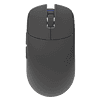
By now, G-Wolves has reached a level of weight optimization at which they are mostly competing with themselves. The latest result of these efforts is the Lycan, which at 29 g weighs essentially the same as 2024's Hati-R 8K, despite being medium instead of small-sized and having a solid top shell instead of a non-solid one. Much like previous G-Wolves mice, the Lycan is still using plain ABS plastic, yet employs a few new tricks to get the weight this low. Similarly to the Fenrir Pro, the PCB is screwed to posts found on the top shell, with the PCB itself being extended across the entire width of the mouse to provide structural rigidity. Whereas the PCB affords rigidity across the horizontal axis, the screw posts do the same across the vertical axis. In addition, a thin bar has been jammed horizontally across the width of the shell at the rear end of the PCB, which is similar to the design of the DAREU A950 Wing, yet at a much smaller scale. This design is aided by the fact that the shape of the Lycan is very simple and "boxy," with minimal curves that would require further stabilization. The result of these efforts: there is no rattle when shaking the mouse, no creaking or flexing of the shell when applying lateral pressure, and actuating the side buttons by pressing below them cannot be done regardless of the force being used.
In terms of switch assortment, the Lycan offers nothing new. Much like the HTX Ultra or HTM Plus, the Lycan comes with custom Huano switches with an orange plunger and orange transparent shell. These are so-called SPDT (single-pole, double-throw) switches, which allow for a click already being registered upon the top contact being opened instead of having to wait for the bottom contact to close, reducing switch-induced physical click latency in the process. The same principle is used for the "GX Speed" mode of (e.g.) the Endgame Gear OP1 8K, and reduces effective click latency by roughly 1.5–2 ms, which is substantial. SPDT mode can be enabled separately for the left and right main buttons, though there is no real reason not to have it enabled at all times. Button response is also great on these switches: Pre-travel is low and post-travel is very low, and lateral button movement stays minimal even when actively provoking it. The side buttons have been outfitted with surface-mounted Omron D2LS-21 switches, which score with minimal pre- and post-travel along with even actuation, though feedback is a bit lacking. The scroll wheel encoder is TTC's "Gold" (yellow core, blue dust cover) encoder in the 7 mm variant, whose noise levels are mostly under control, and whose tactility is good, with each step being reasonably well-separated. Unlike several previous G-Wolves mice, the Lycan has enough "real estate" on the bottom to allow for a pair of fitted feet, though by default, the Lycan comes with five dot feet, which are made of pure PTFE and glide very well. Several fitted and dot replacement sets are found in the box.
In the firmware department, the Lycan marks an important departure. The firmware is now provided by CompX, who are also doing the firmware for releases from Pulsar, ATK, and many others. While still very good in several departments, this new firmware also comes with some regressions compared to the previously used solution. While the Lycan still utilizes PixArt's PAW3950 sensor (upgraded to PAW3955 in currently available SKUs) and Nordic's nRF54L15 MCU, the high-speed MCU needed for realizing polling rates of 8000 Hz is now a CompX CX346T instead of a rebranded Artery AT32F405. CPI deviation matches the HTX Ultra and sits at -3.8%, which is corrected fairly easily. General tracking shows no issues with one exception, which ties into the broader issue of polling instability. In wired operation, polling is essentially stable aside from some instances of elevated noise, which don't amount to missed polls and hence may be ignored. In wireless operation, polling rates of 125, 250, 500, and 1000 Hz also show such noise, though this typically still doesn't amount to missed polls. At 2000 Hz, we're already seeing plenty of missed polls, and this only gets worse once we get to 4000 and 8000 Hz, where missed polls are so common that outliers are frequently present in tracking as well. This represents a major step back compared to the previous firmware solution, which delivered pristine tracking and flawlessly stable polling under the same conditions. At the same time, we're seeing exceptionally good motion delay numbers: in wireless operation, we're seeing an advantage of 1.1 ms over the Logitech G403 (control subject) as long as MotionSync is disabled and corded mode enabled, which is automatically the case at 2000, 4000, and 8000 Hz or can be forced at lower polling rates by enabling competitive mode. Click latency also lands below what other CompX mice have been able to muster: at 8000 Hz and running the lowest debounce time, 0.3 ms are averaged, which is 0.1 ms below the usual CompX number. My best guess is that performance has been prioritized unconditionally on this firmware, sacrificing robustness and therefore stability elsewhere. Whether this is a sound decision remains debatable. Of note is also that I've been able to measure the main button switches at below 1 V, whereas previous mice with the same switches were running at 1.9 V. Barring an error in measurement, this would mean that unintentional double-clicking may surface sooner rather than later. Other than that, there is no reason not to use the lowest debounce time value of 0 ms, as a flawlessly implemented slam-click prevention algorithm is present.
Although the switch to CompX also had some ramifications on the set of available options, configuration is still done through the same web driver as before. Due to using WebHID, the web driver will only work in Chromium-based browsers such as Chromium or Edge. All the important settings continue to be present, and I haven't been able to find any bugs. A percentage-based battery life indicator can also be found there, which is using increments of 10%. Even with increments this large, it tends to be rather inaccurate and unreliable, however. G-Wolves doesn't indicate battery life anywhere, but my testing suggests that at 8000 Hz with competitive mode enabled, which are the most draining settings, around 15 hours can be expected, which would be a step-down from the previous firmware solution, which did between 15 and 20 hours on the same 200 mAh capacity battery. As was the case before on previous G-Wolves mice, both the dedicated charging cable and the dedicated extension cable are too stiff and short (at 1.45 m and 1.25 m, respectively) to allow for playing while charging without feeling overly restricted, and since charging speed is slightly below average at around 0.2 A, keeping the Lycan at a healthy charge level is recommended.
Contrary to what one may expect, the prices for some G-Wolves mice keep going down instead of up. The HTX Ultra already was more affordable than previous releases at $139.00, and the Lycan drops another fraction to $132.00. Conceivably, the switch to CompX is what made this further price reduction possible, though said switch is also the source of the Lycan's biggest flaw. Whereas the previous firmware solution struck a nearly perfect balance between latency and stability, the new one prioritizes low numbers arguably too aggressively, achieving slightly better latency yet resulting in poor robustness. This item aside, the Lycan presents itself as a highly refined product, whose design is pushing the limits of what is possible in terms of lightweight engineering, and which shines with great buttons and a complete feature set. In fact, when it comes to the weight, G-Wolves and, by extension, the Lycan basically have no competition. As such, the Lycan earns our Recommended award.

In terms of switch assortment, the Lycan offers nothing new. Much like the HTX Ultra or HTM Plus, the Lycan comes with custom Huano switches with an orange plunger and orange transparent shell. These are so-called SPDT (single-pole, double-throw) switches, which allow for a click already being registered upon the top contact being opened instead of having to wait for the bottom contact to close, reducing switch-induced physical click latency in the process. The same principle is used for the "GX Speed" mode of (e.g.) the Endgame Gear OP1 8K, and reduces effective click latency by roughly 1.5–2 ms, which is substantial. SPDT mode can be enabled separately for the left and right main buttons, though there is no real reason not to have it enabled at all times. Button response is also great on these switches: Pre-travel is low and post-travel is very low, and lateral button movement stays minimal even when actively provoking it. The side buttons have been outfitted with surface-mounted Omron D2LS-21 switches, which score with minimal pre- and post-travel along with even actuation, though feedback is a bit lacking. The scroll wheel encoder is TTC's "Gold" (yellow core, blue dust cover) encoder in the 7 mm variant, whose noise levels are mostly under control, and whose tactility is good, with each step being reasonably well-separated. Unlike several previous G-Wolves mice, the Lycan has enough "real estate" on the bottom to allow for a pair of fitted feet, though by default, the Lycan comes with five dot feet, which are made of pure PTFE and glide very well. Several fitted and dot replacement sets are found in the box.
In the firmware department, the Lycan marks an important departure. The firmware is now provided by CompX, who are also doing the firmware for releases from Pulsar, ATK, and many others. While still very good in several departments, this new firmware also comes with some regressions compared to the previously used solution. While the Lycan still utilizes PixArt's PAW3950 sensor (upgraded to PAW3955 in currently available SKUs) and Nordic's nRF54L15 MCU, the high-speed MCU needed for realizing polling rates of 8000 Hz is now a CompX CX346T instead of a rebranded Artery AT32F405. CPI deviation matches the HTX Ultra and sits at -3.8%, which is corrected fairly easily. General tracking shows no issues with one exception, which ties into the broader issue of polling instability. In wired operation, polling is essentially stable aside from some instances of elevated noise, which don't amount to missed polls and hence may be ignored. In wireless operation, polling rates of 125, 250, 500, and 1000 Hz also show such noise, though this typically still doesn't amount to missed polls. At 2000 Hz, we're already seeing plenty of missed polls, and this only gets worse once we get to 4000 and 8000 Hz, where missed polls are so common that outliers are frequently present in tracking as well. This represents a major step back compared to the previous firmware solution, which delivered pristine tracking and flawlessly stable polling under the same conditions. At the same time, we're seeing exceptionally good motion delay numbers: in wireless operation, we're seeing an advantage of 1.1 ms over the Logitech G403 (control subject) as long as MotionSync is disabled and corded mode enabled, which is automatically the case at 2000, 4000, and 8000 Hz or can be forced at lower polling rates by enabling competitive mode. Click latency also lands below what other CompX mice have been able to muster: at 8000 Hz and running the lowest debounce time, 0.3 ms are averaged, which is 0.1 ms below the usual CompX number. My best guess is that performance has been prioritized unconditionally on this firmware, sacrificing robustness and therefore stability elsewhere. Whether this is a sound decision remains debatable. Of note is also that I've been able to measure the main button switches at below 1 V, whereas previous mice with the same switches were running at 1.9 V. Barring an error in measurement, this would mean that unintentional double-clicking may surface sooner rather than later. Other than that, there is no reason not to use the lowest debounce time value of 0 ms, as a flawlessly implemented slam-click prevention algorithm is present.
Although the switch to CompX also had some ramifications on the set of available options, configuration is still done through the same web driver as before. Due to using WebHID, the web driver will only work in Chromium-based browsers such as Chromium or Edge. All the important settings continue to be present, and I haven't been able to find any bugs. A percentage-based battery life indicator can also be found there, which is using increments of 10%. Even with increments this large, it tends to be rather inaccurate and unreliable, however. G-Wolves doesn't indicate battery life anywhere, but my testing suggests that at 8000 Hz with competitive mode enabled, which are the most draining settings, around 15 hours can be expected, which would be a step-down from the previous firmware solution, which did between 15 and 20 hours on the same 200 mAh capacity battery. As was the case before on previous G-Wolves mice, both the dedicated charging cable and the dedicated extension cable are too stiff and short (at 1.45 m and 1.25 m, respectively) to allow for playing while charging without feeling overly restricted, and since charging speed is slightly below average at around 0.2 A, keeping the Lycan at a healthy charge level is recommended.
Contrary to what one may expect, the prices for some G-Wolves mice keep going down instead of up. The HTX Ultra already was more affordable than previous releases at $139.00, and the Lycan drops another fraction to $132.00. Conceivably, the switch to CompX is what made this further price reduction possible, though said switch is also the source of the Lycan's biggest flaw. Whereas the previous firmware solution struck a nearly perfect balance between latency and stability, the new one prioritizes low numbers arguably too aggressively, achieving slightly better latency yet resulting in poor robustness. This item aside, the Lycan presents itself as a highly refined product, whose design is pushing the limits of what is possible in terms of lightweight engineering, and which shines with great buttons and a complete feature set. In fact, when it comes to the weight, G-Wolves and, by extension, the Lycan basically have no competition. As such, the Lycan earns our Recommended award.
Nov 25th, 2026 17:04 CST
change timezone
Latest GPU Drivers
New Forum Posts
- {NA} 2026 Black November prices / deal (7)
- TPU's Nostalgic Hardware Club (22208)
- Which ryzen am5 cpu ? (217)
- UPS what one to get? (74)
- More Nova Lake specs (5)
- Share your CPUZ Benchmarks! (2680)
- X79 and/or rampage IV OC'ing thread for those of us still left.... (2457)
- Asus Rog Maximus Z890 Extreme. (Various questions). (38)
- Can you guess Which game it is? (362)
- Claude credits purchased on or after Dec. 7 now have an expiry date (13)
Popular Reviews
- ASRock X870E Challenger Wi-Fi White Review
- Microsoft Surface Laptop Ultra Review - The Next-gen Arm Laptop
- VZMORE AX9 Max Review
- Upcoming Hardware Launches 2027 (Updated Nov 2026)
- AMD Ryzen 7 9800X3D Review - The Best Gaming Processor
- AMD Zen 6 Technical Deep Dive
- Corsair RM1200e (Second Generation) Review
- Phantom Blade Zero Performance Benchmark Review - 35 GPUs Tested
- Pulsar Office Tour & First Look at P1 Dual-Sensor Mouse
- Ocypus lota P1000 Review
TPU on YouTube
Controversial News Posts
- Jensen Huang Reinstated as CEO of NVIDIA (570)
- NVIDIA Co-Founder and CEO Jensen Huang Officially Resigns (492)
- Report: Jensen Huang Eyes NVIDIA Comeback (281)
- Open Letter Asking NVIDIA to Reinstate Jensen Huang Passes 115,000 Signatures (184)
- OpenAI CEO Argues Home PCs Waste the World's Limited DRAM Supply (152)
- NVIDIA Launches Investigation Into Jensen Huang's Relationship With Suspected Chinese Spy (136)
- Intel "Raptor Lake Next" 16-Core and 20-Core CPUs Surface (130)
- Intel Razor Lake Gets a 12 P-Core bLLC Chip With No E-Cores, Per Leak (94)