 1
Gamdias Notus M1-1201 ARGB 120 mm Fan Review
Value & Conclusion »Performance Testing
Please refer to this dedicated test setup page as it applies to this review as well.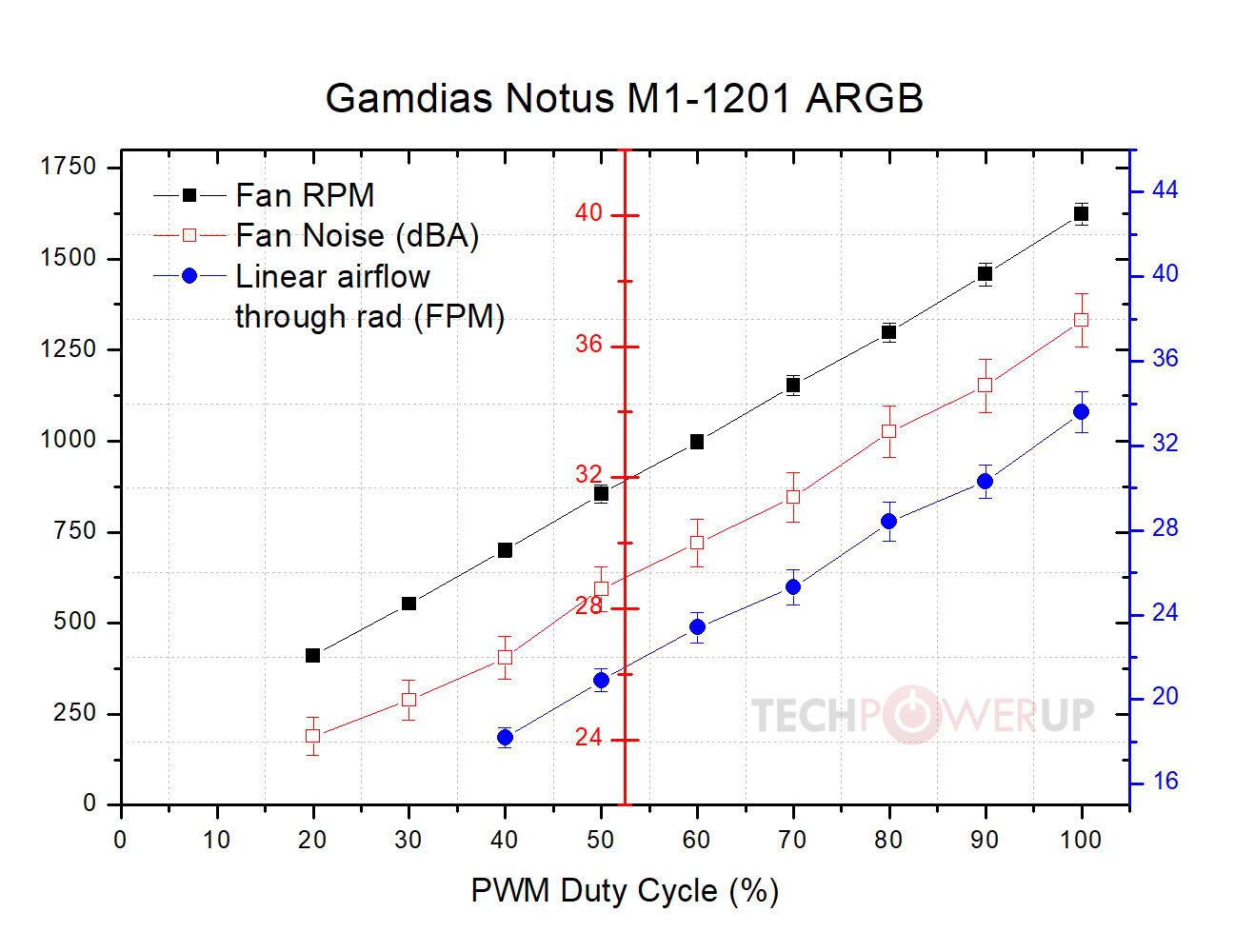
Gamdias rates the Notus M1-1201 ARGB fan with a speed range of 400 to 1600 (+/-10%) RPM, and the provided three fans went from an average of 1623 RPM at 100% PWM duty cycle to 411 RPM at 20%. This means the rated fan speed is more than valid here, and we do get a relatively long and incredibly linear range of PWM control too. It's not often we see fans stop spinning at ~1600 RPM these days, but I would say this should still suffice for DIY watercooling if you aren't chasing the lowest temperatures in your loop. Sample variation could be better though for the noise and airflow, although this was more a case of two similar fans and one less so. Context is needed to talk more about the fan's relative performance and noise, so I have comparison charts below for some fans tested at set RPM values, or as near as they can get to those.
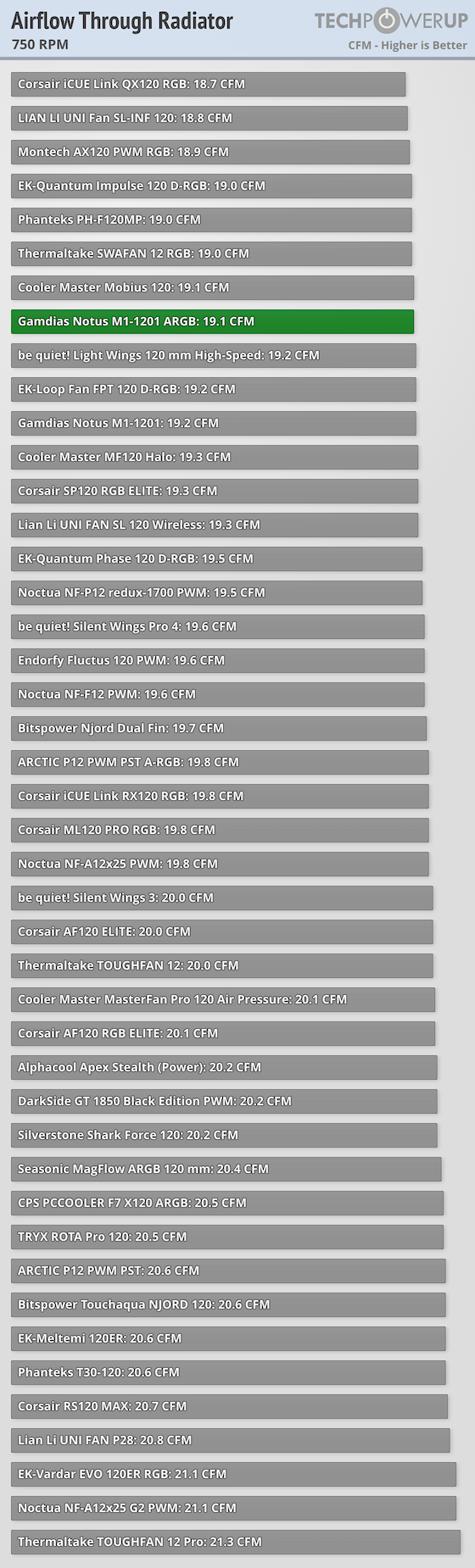
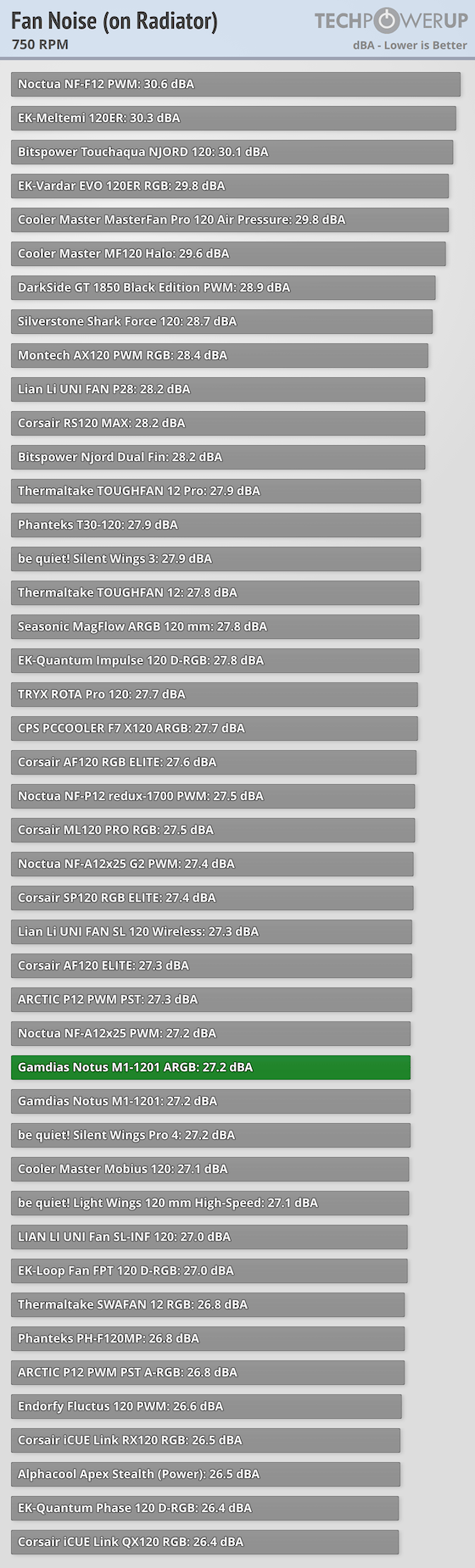
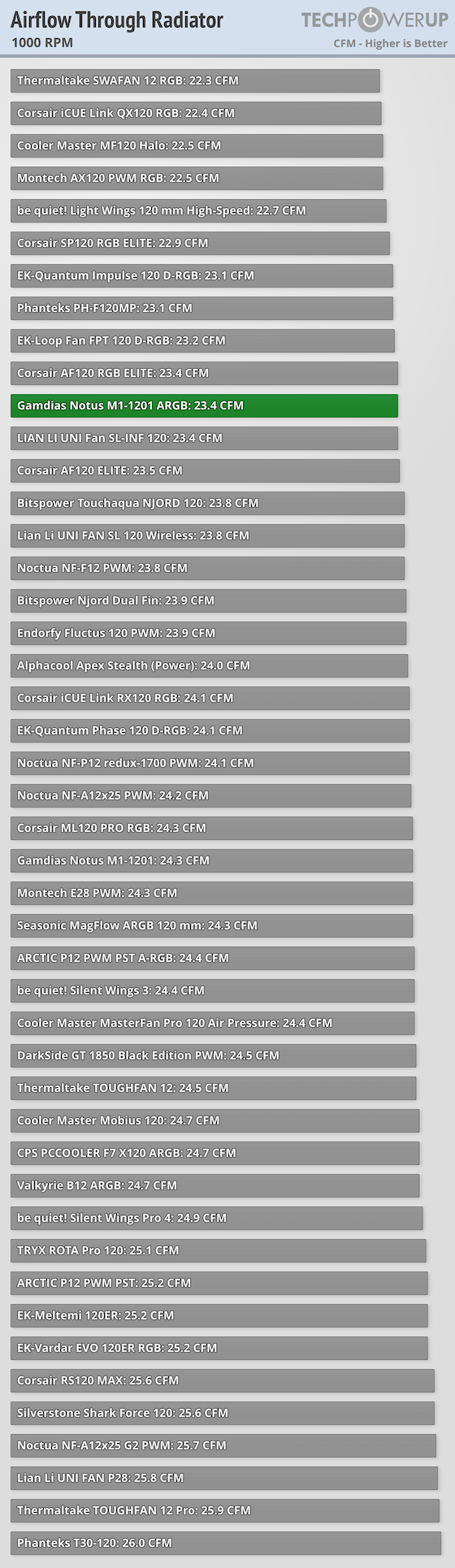
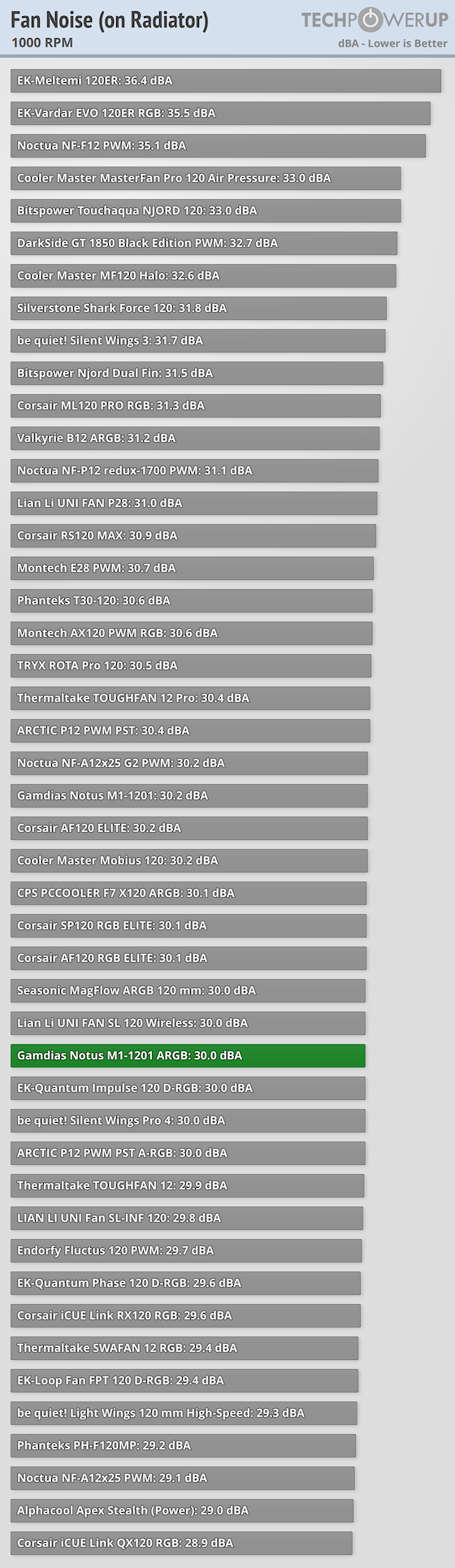
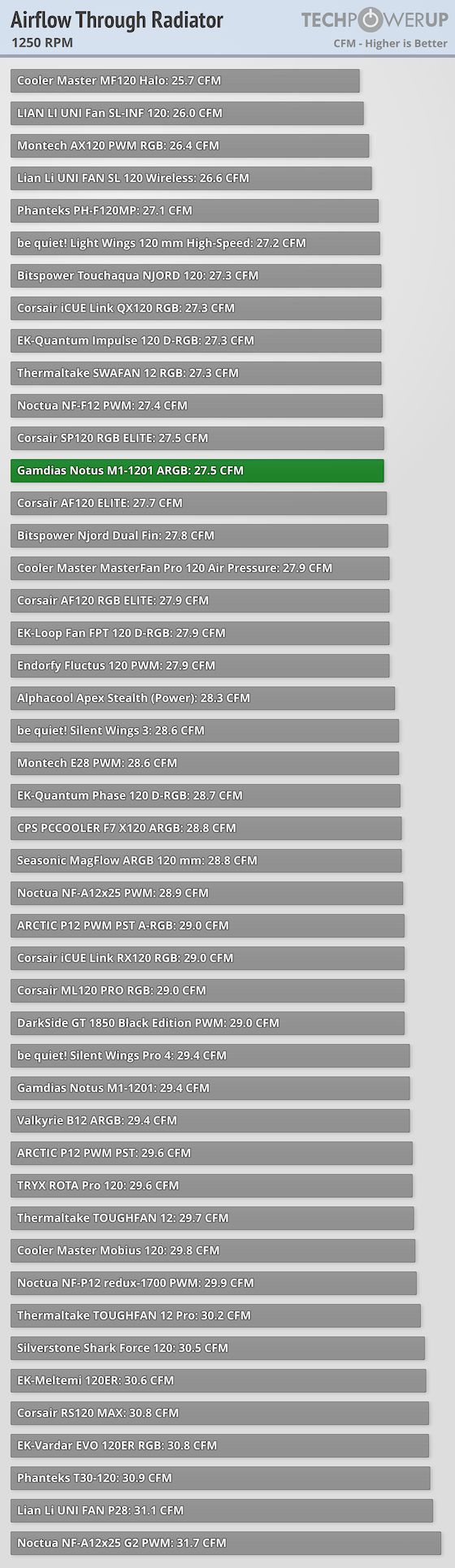
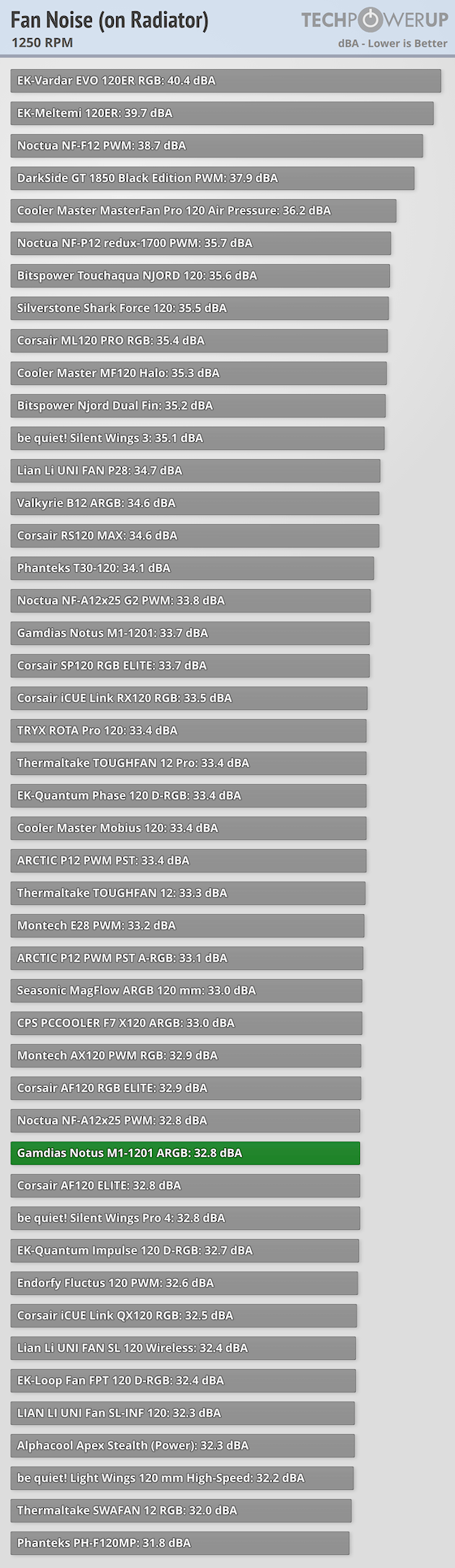
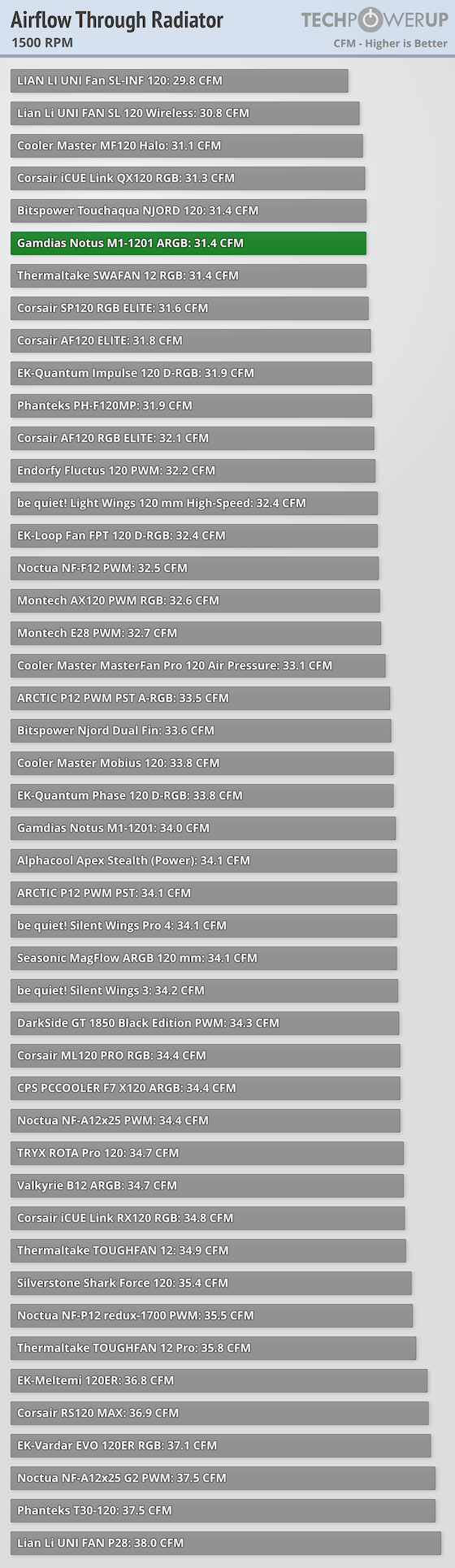
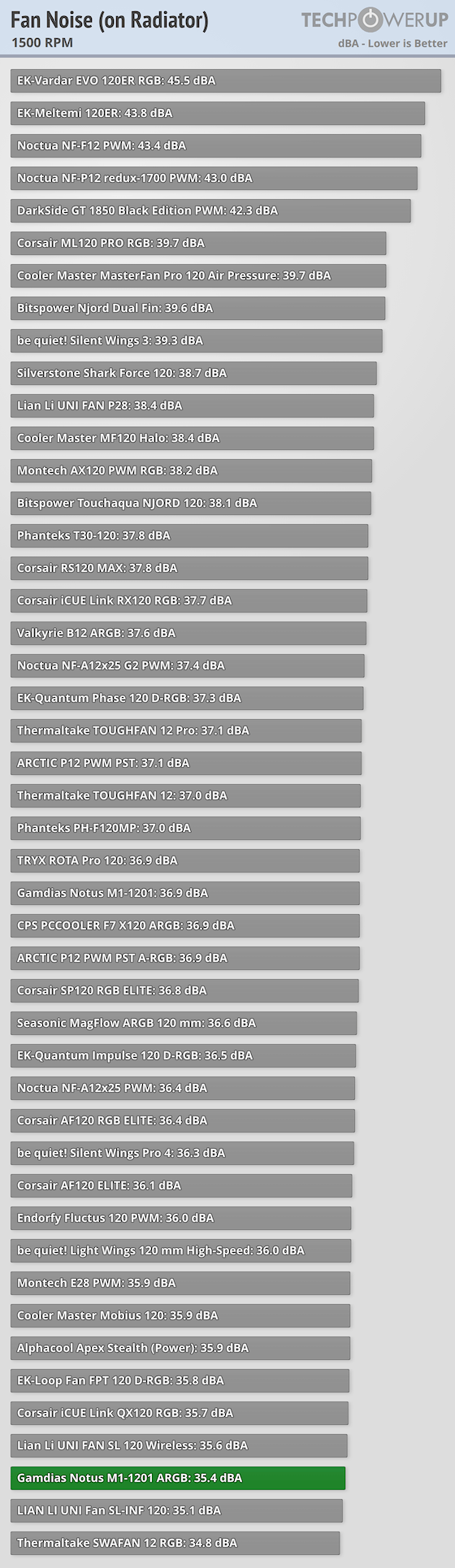
The charts above help compare the Gamdias Notus M1-1201 with other fans at different chosen RPM values reflecting usage scenarios most popular with watercooling, although some fans go higher, as is the case here. The charts are to be considered for comparison within this result set only and are not to be compared with results from another test elsewhere, owing to different testing conditions. Note that these are average values for all samples of each fan and do not reflect any sample variation, and I also suggest looking at RGB fans separately from the others given they tend to sacrifice some performance by having LEDs take up space where the rotor blades could have been pushing more air through. We can see this fan doesn't push the most air out across the board, although this comes with associated lower airflow noise too. There's a big difference between this ARGB fan and its non-LED sibling too, and overall I'd say the Gamdias Notus M1-1201 ARGB seems better suited for lower airflow restriction applications such as case ventilation or a single tower air cooler rather than a more dense radiator. Now consider the further dip in performance if you go with the reverse fan blade rotor, and you see why Gamdias chose to put it in the box as an accessory rather than sell it separately. One of the three fans also had a light droning sound at lower fan speeds out of the box, but this was addressed with a rotor re-installation/lubing.
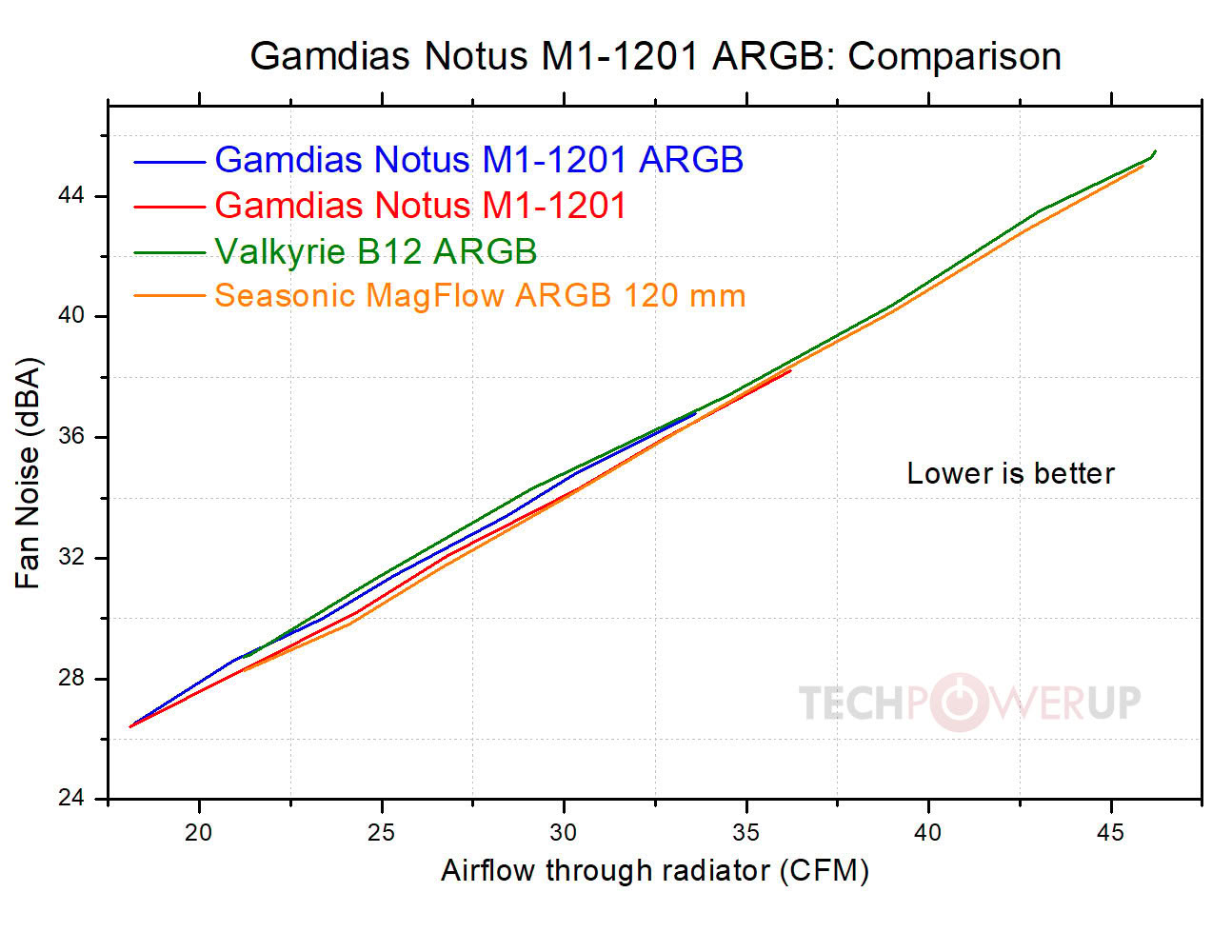
Instead of having CFM/dBA charts that can potentially be taken for more than they really offer, I am going to show a few other fans as a comparison for further context. These include the subject of this review—the Gamdias Notus M1-1201 ARGB—in addition to the non RGB Notus M1-1201, another recently tested value oriented RGB fan which is the Valkyrie B12 ARGB, and the Seasonic MagFlow ARGB. The Notus M1-1201 ARGB has a substantial dip in airflow compared to the non ARGB version as expected, although from a performance/noise basis it's not that far off. Overall the performance deficit is still higher than the reduction in fan noise from the lower amount of air pushed through though! The Notus M1-1201 ARGB does better than the Valkyrie B12 in this metric, yet it must be noted the latter can spin to a higher max RPM whereas this can go down to a lower speed—you may end up preferring one over the other. The Seasonic fan is somewhat different from other RGB fans in that it is not only 28 mm thick, but also shies away from using LEDs in the fan hub to focus on performance more.
Nov 19th, 2026 15:58 CST
change timezone
Latest GPU Drivers
New Forum Posts
- Honestly, do you care about GTA VI? (163)
- Windows 11 General Discussion (7736)
- Current Sales, Bundles, Giveaways (10448)
- Last game you purchased? (1409)
- WarpCoreBench scores! (76)
- Got the EOL 32GB TridentZ 6000 CL26 1.4V (12)
- Dell Workstation Owners Club (3516)
- Making a game in Godot engine (4)
- DTS DCH Driver for Realtek HDA [DTS:X APO4 + DTS Interactive] (2815)
- Security Apps (2)
Popular Reviews
- Acemagic Retro X3 Review
- Ugreen NASync DXP4800 GT Review
- Upcoming Hardware Launches 2027 (Updated Nov 2026)
- Pulsar Office Tour & First Look at P1 Dual-Sensor Mouse
- AMD Zen 6 Technical Deep Dive
- Biwin Black Opal NV7400 2 TB Review
- Sapphire Radeon RX 7700 XT Pure Review
- Sapphire Radeon RX 7700 XT Pulse Review
- AMD Ryzen 7 9800X3D Review - The Best Gaming Processor
- Chieftec Iceberg PRO 360 DARK Review
TPU on YouTube
Controversial News Posts
- NVIDIA Co-Founder and CEO Jensen Huang Officially Resigns (488)
- Report: Jensen Huang Eyes NVIDIA Comeback (223)
- Open Letter Asking NVIDIA to Reinstate Jensen Huang Passes 115,000 Signatures (184)
- OpenAI CEO Argues Home PCs Waste the World's Limited DRAM Supply (152)
- NVIDIA Launches Investigation Into Jensen Huang's Relationship With Suspected Chinese Spy (136)
- Intel "Raptor Lake Next" 16-Core and 20-Core CPUs Surface (130)
- Legendary Game Studio BioWare Shuts Down Following EA Layoffs (104)
- Dell CEO Says the Memory Shortage Will Get Worse in 2027 (95)