 19
Gigabyte Radeon RX 6900 XT Gaming OC Review
(19 Comments) »Introduction

The Gigabyte Radeon RX 6900 XT Gaming OC is the company's first custom-design RX 6900 XT "Big Navi" graphics card. It is positioned a notch below the company's flagship RX 6900 XT AORUS Master and designed for those wanting a simple, air-cooled custom-design RX 6900 XT card to get gaming. The company paired the RX 6900 XT with its latest-generation WindForce 3X cooling solution that made its debut with the NVIDIA RTX 30-series custom cards, and a custom-design PCB by Gigabyte that pulls power from a trio of 8-pin PCIe power connectors. The card also features a moderate factory overclock to sweeten the deal.

The Radeon RX 6900 XT is AMD's flagship graphics card for this generation and tops off a surprisingly fast graphics card series that restores competition to the high-end segment. Along with the RX 6800 series, it debuts the new RDNA 2 graphics architecture, which also powers the latest generation of game consoles, meaning optimizing for the architecture is easy since most game studios have a console-first development approach. This is also AMD's first graphics architecture with full DirectX 12 Ultimate readiness, combining real-time raytracing, variable-rate shading, mesh shaders, and sampler-feedback, uplifting the visual experience from standard DirectX 12.
Full real-time raytraced rendering is the holy-grail of 3D graphics, but beyond the capability of today's hardware. It is, however, possible to combine conventional raster 3D graphics with certain real-time raytraced elements, such as lighting, shadows, reflections, global illumination, etc., to significantly improve realism. Even this much raytracing requires enormous amounts of compute power. The most compute-intensive part, ray intersection, is processed by fixed-function hardware AMD calls Ray Accelerators. A by-product of this approach is the vast raster 3D performance uplift over the previous generation, which enables AMD to compete with NVIDIA at the high-end segment.
The Radeon RX 6900 XT is based on the new 7 nm "Navi 21" silicon, the same chip also powering the RX 6800 series, but maxes it out. It gets all 5,120 stream processors, 80 Ray Accelerators, 320 TMUs, and 128 ROPs that are physically present on the silicon. AMD doubled the memory amount over the past generation, giving the card 16 GB of it; however, the memory bus width remains at 256-bit. The company used the fastest JEDEC-standard 16 Gbps GDDR6 memory chips for 512 GB/s memory bandwidth and a new technology it calls Infinity Cache, a 128 MB on-die Level 3 cache that operates at 2 TB/s in conjunction with the GDDR6 memory to improve memory sub-system performance.
The Gigabyte RX 6900 XT Gaming OC features a rather simple design. Its WindForce 3X cooling solution consists of a set of aluminium fin stacks skewered by six copper heat pipes which make indirect contact with the GPU through a copper base plate. Three fans ventilate the heatsink. The fans turn in physically opposite directions of each other, yet guide air onto the heatsink. This has been done to reduce turbulence between the fans and lowers noise output. You also get factory-overclocked speeds of 2285 MHz (maximum boost clock) against the 2250 MHz reference. In this review, we take the card for a spin across our test bed to tell you if it has everything you need if all you want is an RX 6900 XT.
| Price | Shader Units | ROPs | Core Clock | Boost Clock | Memory Clock | GPU | Transistors | Memory | |
|---|---|---|---|---|---|---|---|---|---|
| RX Vega 64 | $400 | 4096 | 64 | 1247 MHz | 1546 MHz | 953 MHz | Vega 10 | 12500M | 8 GB, HBM2, 2048-bit |
| GTX 1080 Ti | $650 | 3584 | 88 | 1481 MHz | 1582 MHz | 1376 MHz | GP102 | 12000M | 11 GB, GDDR5X, 352-bit |
| RX 5700 XT | $370 | 2560 | 64 | 1605 MHz | 1755 MHz | 1750 MHz | Navi 10 | 10300M | 8 GB, GDDR6, 256-bit |
| RTX 2070 | $340 | 2304 | 64 | 1410 MHz | 1620 MHz | 1750 MHz | TU106 | 10800M | 8 GB, GDDR6, 256-bit |
| RTX 2070 Super | $450 | 2560 | 64 | 1605 MHz | 1770 MHz | 1750 MHz | TU104 | 13600M | 8 GB, GDDR6, 256-bit |
| Radeon VII | $680 | 3840 | 64 | 1802 MHz | N/A | 1000 MHz | Vega 20 | 13230M | 16 GB, HBM2, 4096-bit |
| RTX 2080 | $600 | 2944 | 64 | 1515 MHz | 1710 MHz | 1750 MHz | TU104 | 13600M | 8 GB, GDDR6, 256-bit |
| RTX 2080 Super | $690 | 3072 | 64 | 1650 MHz | 1815 MHz | 1940 MHz | TU104 | 13600M | 8 GB, GDDR6, 256-bit |
| RTX 3060 Ti | $800 | 4864 | 80 | 1410 MHz | 1665 MHz | 1750 MHz | GA104 | 17400M | 8 GB, GDDR6, 256-bit |
| RTX 2080 Ti | $1000 | 4352 | 88 | 1350 MHz | 1545 MHz | 1750 MHz | TU102 | 18600M | 11 GB, GDDR6, 352-bit |
| RTX 3070 | $850 | 5888 | 96 | 1500 MHz | 1725 MHz | 1750 MHz | GA104 | 17400M | 8 GB, GDDR6, 256-bit |
| RX 6800 | $950 | 3840 | 96 | 1815 MHz | 2105 MHz | 2000 MHz | Navi 21 | 26800M | 16 GB, GDDR6, 256-bit |
| RX 6800 XT | $1200 | 4608 | 128 | 2015 MHz | 2250 MHz | 2000 MHz | Navi 21 | 26800M | 16 GB, GDDR6, 256-bit |
| RTX 3080 | $1100 | 8704 | 96 | 1440 MHz | 1710 MHz | 1188 MHz | GA102 | 28000M | 10 GB, GDDR6X, 320-bit |
| RX 6900 XT | $1550 | 5120 | 128 | 2015 MHz | 2250 MHz | 2000 MHz | Navi 21 | 26800M | 16 GB, GDDR6, 256-bit |
| Gigabyte RX 6900 XT Gaming OC | $1550 | 5120 | 128 | 2050 MHz | 2285 MHz | 2000 MHz | Navi 21 | 26800M | 16 GB, GDDR6, 256-bit |
| RTX 3090 | $2000 | 10496 | 112 | 1395 MHz | 1695 MHz | 1219 MHz | GA102 | 28000M | 24 GB, GDDR6X, 384-bit |
Packaging
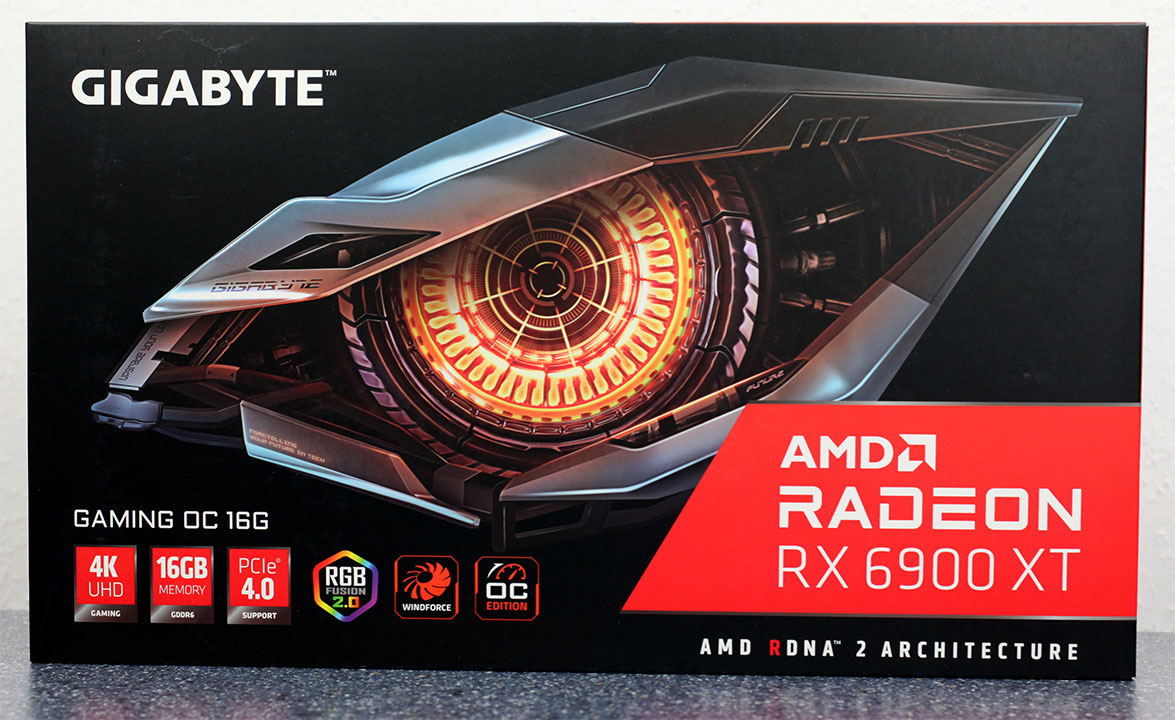

The Card


Gigabyte's card uses a mixture of black and gray highlights paired with a blocky industrial design. On the back, you'll find a high-quality metal backplate.


Dimensions of the card are 29 x 12 cm, and it weighs 1188 g.


Installation requires three slots in your system.

Display connectivity includes two standard DisplayPort 1.4 and two HDMI 2.1.

The card has three 8-pin power inputs. This configuration is rated for up to 525 W of power draw.

The AMD Radeon RX 6000 series doesn't support multi-GPU.

This BIOS switch lets you toggle between the default "OC" BIOS and a "Silent" BIOS, which runs a more relaxed fan curve. As our testing later on will show, differences are minimal, though.
Teardown


Gigabyte's heatsink uses six heatpipes and a copper plate that soaks up heat from the GPU and memory chips.


The backplate is made out of metal and protects the card against damage during installation and handling.
High-resolution PCB Pictures
These pictures are for the convenience of volt modders and people who would like to see all the finer details on the PCB. Feel free to link back to us and use these in your articles or forum posts.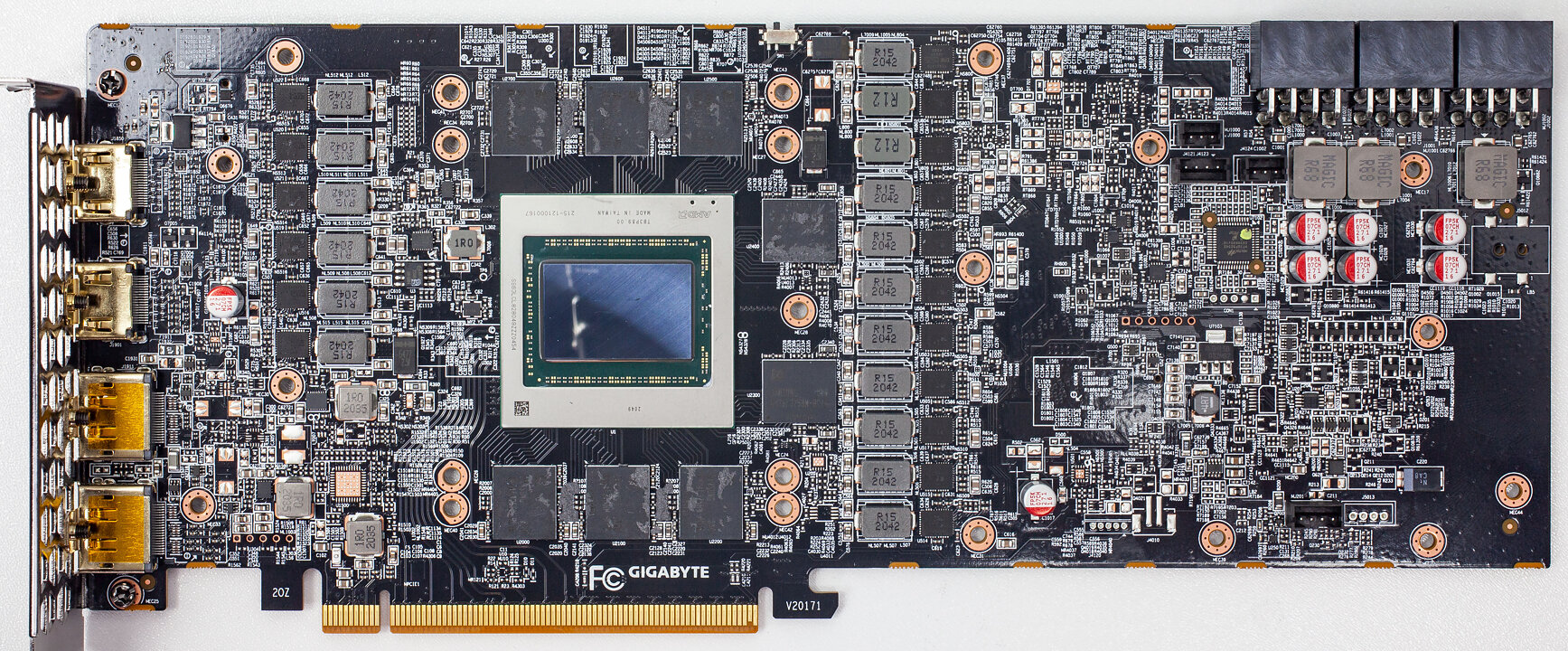

High-res versions are also available (front, back).
Our Patreon Silver Supporters can read articles in single-page format.
Nov 18th, 2026 21:14 PST
change timezone
Latest GPU Drivers
New Forum Posts
- Honestly, do you care about GTA VI? (151)
- Without Jensen, PC gaming will be (46)
- TPU's Nostalgic Hardware Club (22168)
- Dual B70 or Dual R9700 Pro on Linux (7)
- Time to upgrade CPU and MOBO (40)
- Windows 11 General Discussion (7730)
- 26.11.2 Adrenalin Edition is out (0)
- [Poll] 12V-2x6 Connector Protection: What Are You Using? (WireView / Ampinel / Equalizer / Other / Nothing) (42)
- Got a new laptop! What should I do with it? (6)
- What are you playing? (26235)
Popular Reviews
- Acemagic Retro X3 Review
- Upcoming Hardware Launches 2027 (Updated Nov 2026)
- Ugreen NASync DXP4800 GT Review
- AMD Zen 6 Technical Deep Dive
- Pulsar Office Tour & First Look at P1 Dual-Sensor Mouse
- Biwin Black Opal NV7400 2 TB Review
- Sapphire Radeon RX 7700 XT Pure Review
- Chieftec Iceberg PRO 360 DARK Review
- Sapphire Radeon RX 7700 XT Pulse Review
- ASUS ROG Strix B850-I Gaming Wi-Fi7 W Review
TPU on YouTube
Controversial News Posts
- NVIDIA Co-Founder and CEO Jensen Huang Officially Resigns (483)
- Report: Jensen Huang Eyes NVIDIA Comeback (196)
- Open Letter Asking NVIDIA to Reinstate Jensen Huang Passes 115,000 Signatures (184)
- OpenAI CEO Argues Home PCs Waste the World's Limited DRAM Supply (152)
- NVIDIA Launches Investigation Into Jensen Huang's Relationship With Suspected Chinese Spy (136)
- Intel "Raptor Lake Next" 16-Core and 20-Core CPUs Surface (130)
- Legendary Game Studio BioWare Shuts Down Following EA Layoffs (104)
- Dell CEO Says the Memory Shortage Will Get Worse in 2027 (95)