 6
GMKtec NucBox K16 Review
Value & Conclusion »Power and Noise Levels
Power and efficiency can be just as important as raw performance in a more compact system, so I measured how much the system draws under CPU stress, during GPU-heavy tests, while gaming, and during a 24-hour idle period.24-Hour Power Draw
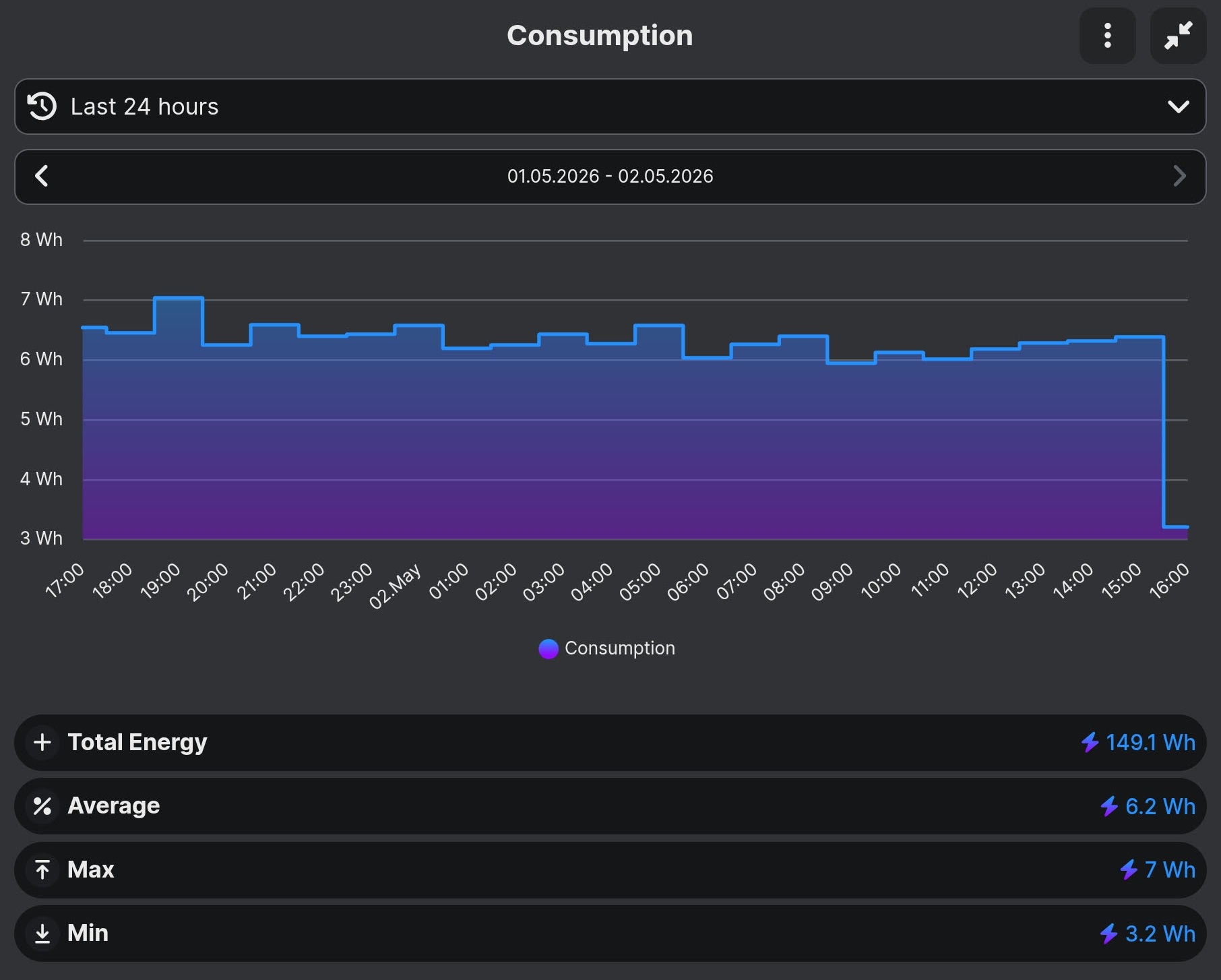
Over a full 24-hour idle period, the GMKtec K16 averages 6.2 W, with a peak of 7.0 W and a low point of 3.2 W. For most of the run, power draw sits around 6 to 6.5 W, with only minor fluctuations and a brief drop into a lower-power state near the end of the capture.
In context, this is an excellent result for a Mini-PC in this class. Systems with this level of CPU performance often idle slightly higher, so the K16's low and stable idle behavior suggests the platform is doing a good job of reducing clocks and settling into efficient low-power states when not under load.
At an average of 6.2 W, leaving the system idle around the clock would use roughly 54.3 kWh per year, which works out to about $8 to $10 annually, depending on local electricity rates. Overall, the K16 ranks among the more power-efficient Mini-PCs tested so far, particularly during idle and lighter everyday usage.
CPU and GPU Power Draw
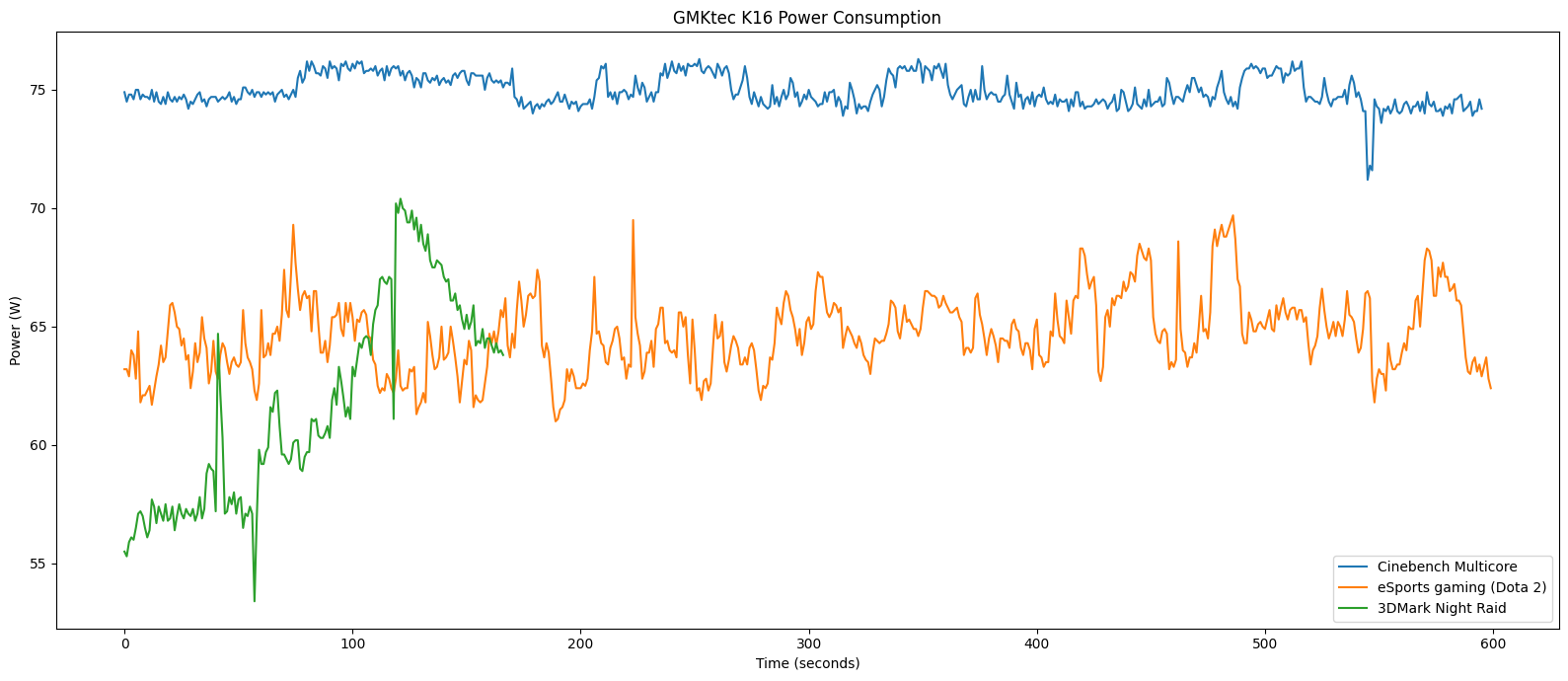
I looked at three different power scenarios to see how the system behaves under different types of load: an esports gaming run with Dota 2 to observe real-world gaming power and consistency, a GPU-focused pass using 3DMark Night Raid to show how the system ramps under heavy graphics demand, and a Cinebench multicore run that fully loads the CPU to measure sustained power delivery over time.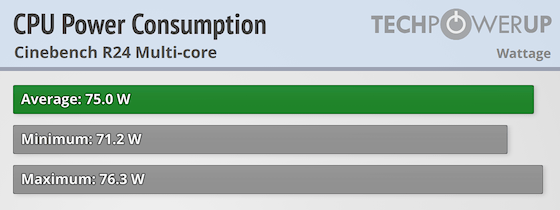
Cinebench (Multicore)
During the Cinebench multicore test, the K16 averages 75.0 W, with readings ranging from 71.2 W to 76.3 W. Power draw remains extremely stable throughout the run, indicating the system is able to sustain heavy all-core workloads without major fluctuations or aggressive throttling behavior.
eSports (Dota 2)
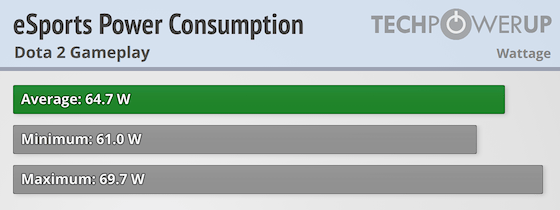
In the Dota 2 workload, the system averages 64.7 W, with readings between 61.0 W and 69.7 W. Power usage fluctuates moderately during gameplay as CPU and GPU demands shift, though overall behavior remains very consistent for an integrated graphics gaming workload.
3DMark (Night Raid)
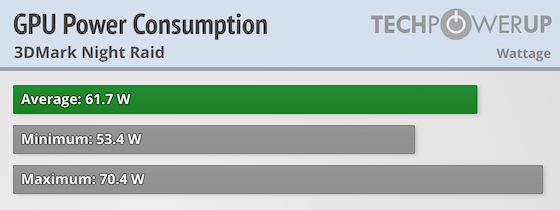
Running 3DMark Night Raid, the system averages 61.7 W, with readings between 53.4 W and 70.4 W. The wider spread reflects the burst-heavy nature of the benchmark, where GPU-intensive scenes briefly increase power draw before dropping during lighter portions of the test.
Here's a full view of the K16's power draw across all three profiles:
Noise Levels
Noise was measured using the usual digital sound level meter placed about 30 cm from the front of the case. In lighter day-to-day use, the K16 stays pretty quiet, hovering around the low 30 dB(A) range, which will easily fade into the background in a normal office or living room.Once the workload gets heavier, the K16 becomes a bit easier to hear. During gaming, benchmarking, and longer CPU or GPU loads, it climbed to 49 dB(A) in my testing, but the noise itself was still easy to tolerate. It never turned sharp or whiny during my time with it, and instead came through more as a steady airflow sound.
Nov 20th, 2026 15:35 PST
change timezone
Latest GPU Drivers
New Forum Posts
- How to prevent OLED burn damage due to PC freezes or power outtages? (49)
- RX 9000 series GPU Owners Club (2249)
- WarpCoreBench scores! (82)
- Honestly, do you care about GTA VI? (209)
- Logitech Headsets Modded Driver — Unlock Dolby in G HUB (23)
- 1 - 5 person file storage server equivalent accasible from anywhere + general VM server. (1)
- When you could finally run Crysis maxed out? (63)
- GTA VI (20)
- Anthrophics IPO (25)
- GeekMagic Ultra Smart WiFi Weather Station (8)
Popular Reviews
- AMD Zen 6 Technical Deep Dive
- Microsoft Surface Laptop Ultra Review - The Next-gen Arm Laptop
- Ugreen NASync DXP4800 GT Review
- Corsair RM1200e (Second Generation) Review
- Acemagic Retro X3 Review
- Upcoming Hardware Launches 2027 (Updated Nov 2026)
- Pulsar Office Tour & First Look at P1 Dual-Sensor Mouse
- Biwin Black Opal NV7400 2 TB Review
- AMD Ryzen 7 9800X3D Memory Performance Scaling
- AMD Ryzen 7 9800X3D Review - The Best Gaming Processor
TPU on YouTube
Controversial News Posts
- NVIDIA Co-Founder and CEO Jensen Huang Officially Resigns (491)
- Report: Jensen Huang Eyes NVIDIA Comeback (256)
- Open Letter Asking NVIDIA to Reinstate Jensen Huang Passes 115,000 Signatures (184)
- OpenAI CEO Argues Home PCs Waste the World's Limited DRAM Supply (152)
- NVIDIA Launches Investigation Into Jensen Huang's Relationship With Suspected Chinese Spy (136)
- Intel "Raptor Lake Next" 16-Core and 20-Core CPUs Surface (130)
- Legendary Game Studio BioWare Shuts Down Following EA Layoffs (104)
- Dell CEO Says the Memory Shortage Will Get Worse in 2027 (95)