 6
GMKtec NucBox K16 Review
AI Performance »Workstation Performance
SPECviewperf simulates professional workloads from applications like 3ds Max, CATIA, Maya, and SolidWorks. It measures how responsive a system is when working with complex models in CAD, animation, and visualization. Higher scores mean smoother, more responsive performance in that type of workload. Here is a run-down of what each viewset is testing:- 3dsmax-06: based on Autodesk 3ds Max, this stresses general 3D modeling and rendering performance, like moving large objects around in a scene.
- catia-05: derived from Dassault CATIA, widely used in aerospace and automotive design, this highlights CAD-style precision modeling.
- creo-02: from PTC Creo, another engineering design package, this is heavy on assemblies and parametric models.
- maya-05: mirrors Autodesk Maya, which is all about animation, rigging, and visual effects, making it a test of real-time artistic workflows.
- medical-02: simulates medical imaging and visualization (things like rotating MRI or CT scans).
- sw-04: short for SolidWorks, this represents mechanical CAD and engineering visualization, used heavily in product design
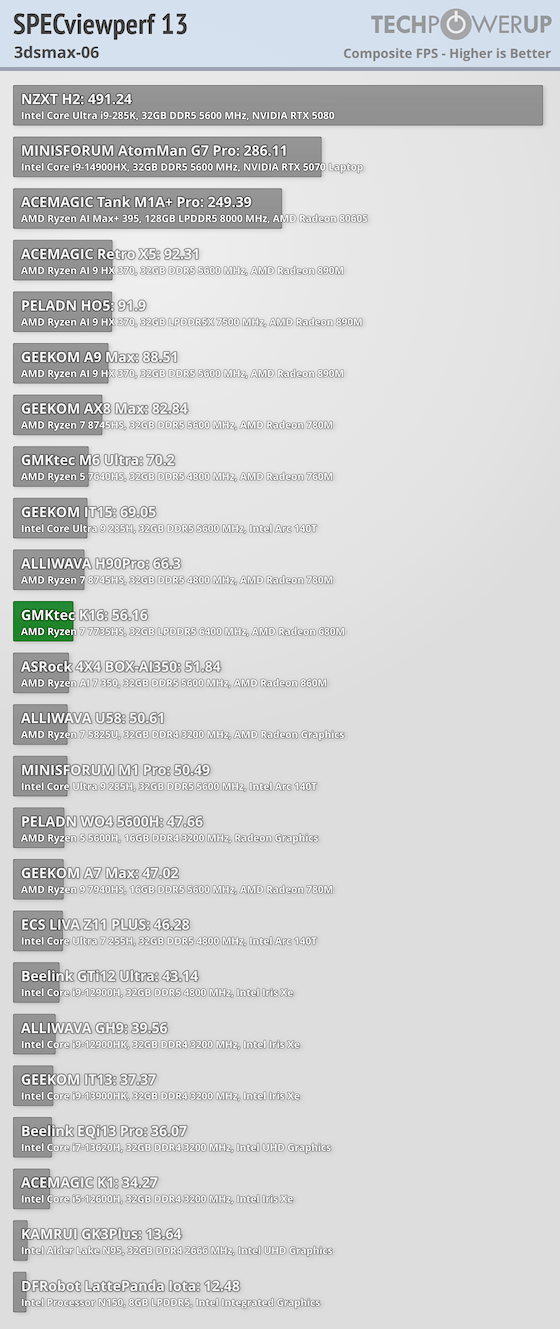
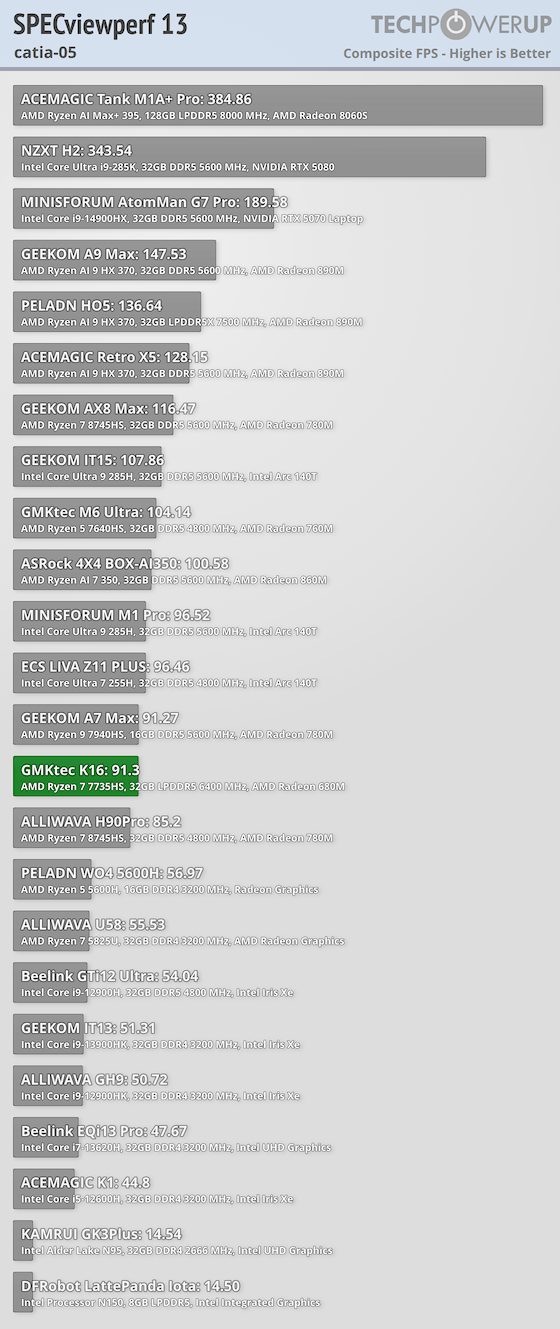
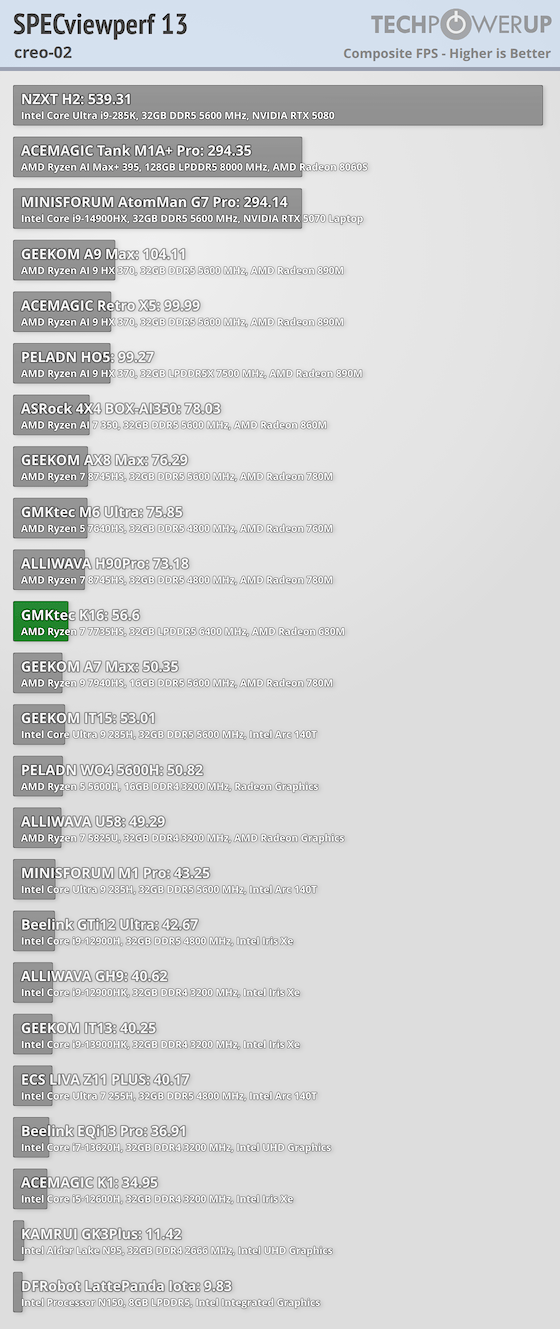

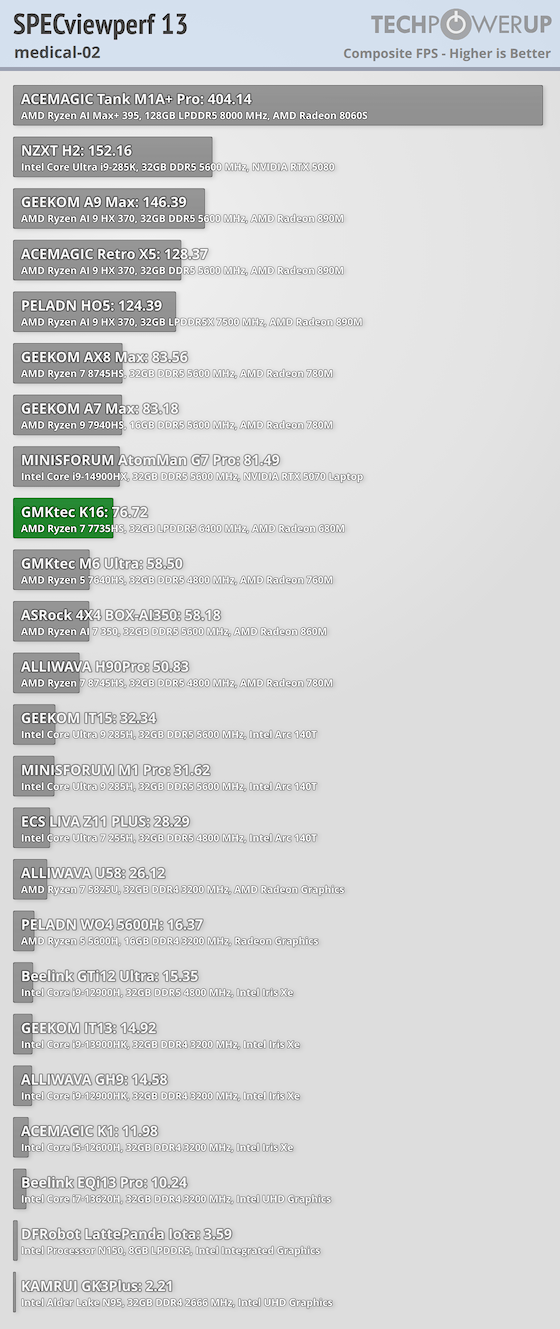
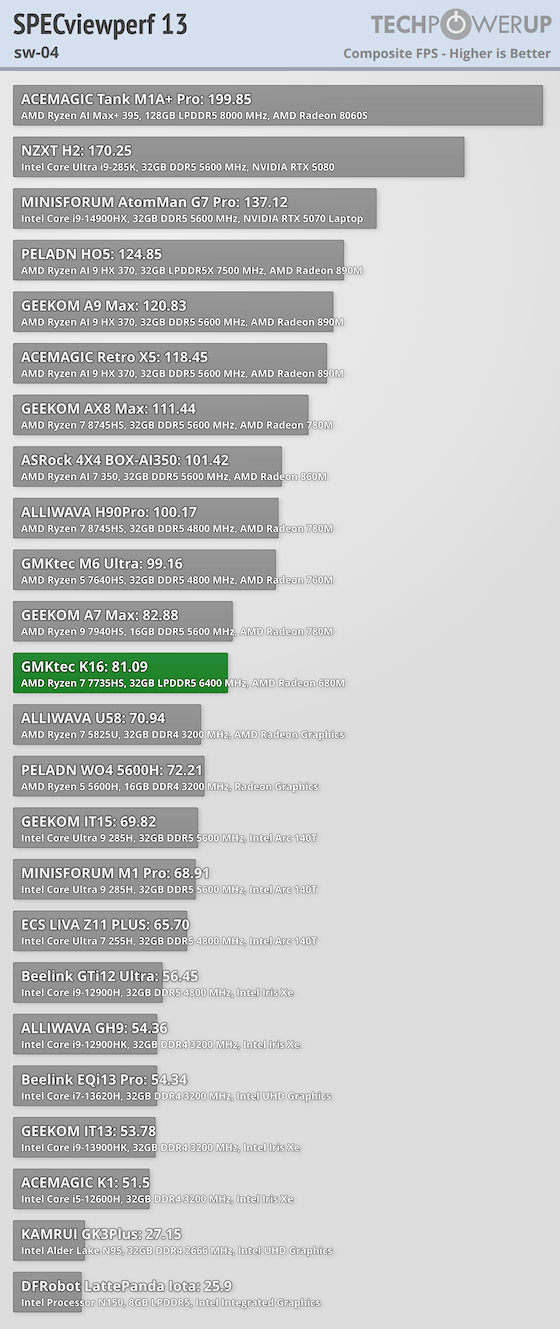
In SPECviewperf 13, the K16 scores 56.16 in 3dsmax-06, 91.3 in catia-05, 56.6 in creo-02, 69.26 in maya-05, 76.72 in medical-02, and 81.09 in sw-04. Those are respectable enough results for a Radeon 680M integrated graphics system, and in a few of these viewsets the K16 actually holds up better than some of its broader CPU benchmarks might suggest. Medical-02 and CATIA are among the better parts of the run, while the rest of the scores mostly place it in the middle of the pack.
Nov 20th, 2026 14:13 PST
change timezone
Latest GPU Drivers
New Forum Posts
- 1 - 5 person file storage server equivalent accasible from anywhere + general VM server. (0)
- WarpCoreBench scores! (81)
- How to prevent OLED burn damage due to PC freezes or power outtages? (48)
- Honestly, do you care about GTA VI? (208)
- When you could finally run Crysis maxed out? (63)
- GTA VI (20)
- Anthrophics IPO (25)
- GeekMagic Ultra Smart WiFi Weather Station (8)
- Very unusual two gaming-pc scenarios. (35)
- Can i play GTA 6 now? (Joke) (14)
Popular Reviews
- AMD Zen 6 Technical Deep Dive
- Ugreen NASync DXP4800 GT Review
- Microsoft Surface Laptop Ultra Review - The Next-gen Arm Laptop
- Corsair RM1200e (Second Generation) Review
- Acemagic Retro X3 Review
- Upcoming Hardware Launches 2027 (Updated Nov 2026)
- Pulsar Office Tour & First Look at P1 Dual-Sensor Mouse
- Biwin Black Opal NV7400 2 TB Review
- AMD Ryzen 7 9800X3D Memory Performance Scaling
- AMD Ryzen 7 9800X3D Review - The Best Gaming Processor
TPU on YouTube
Controversial News Posts
- NVIDIA Co-Founder and CEO Jensen Huang Officially Resigns (490)
- Report: Jensen Huang Eyes NVIDIA Comeback (255)
- Open Letter Asking NVIDIA to Reinstate Jensen Huang Passes 115,000 Signatures (184)
- OpenAI CEO Argues Home PCs Waste the World's Limited DRAM Supply (152)
- NVIDIA Launches Investigation Into Jensen Huang's Relationship With Suspected Chinese Spy (136)
- Intel "Raptor Lake Next" 16-Core and 20-Core CPUs Surface (130)
- Legendary Game Studio BioWare Shuts Down Following EA Layoffs (104)
- Dell CEO Says the Memory Shortage Will Get Worse in 2027 (95)