 0
Yuin OK2 Earphones Review
(0 Comments) »Introduction

Many of you are probably unfamiliar with the Head-Direct company. In short it is a online retailer that specializes in headphones and earphones. This company is the official retailer of many more or less unknown Asian brands like for example Yuin and Dowin. Head-Direct has a lot of interesting earphones and headphone amps.
The earphones I will be taking a look at today are called Yuin OK2s which is the OK1's little brother. Where the OK1s are high impedance the OK2s are made for use with most modern DAPs. The OK2’s impedance is only 16 Ohms like most ordinary earbuds made today. This makes them ideal for a somebody looking to upgrading their portable rig with a serious pair of earbuds. The OK2s can function both as normal earbuds and as in-ears which makes them quite unique.
The Package

The packaging is not final for the Yuin OK2s so the sample I just came in a number of small plastic bags. With the OK2s you get a lot of tips. You get three different sized single flange tips, one double flange tip, and a rubber earbud cover. Just like its bigger brother, the OK2s can be used both as canalphones and as earbuds. In order to convert them from earbuds to earphones all you got to do is screw on a plastic barrel and apply a tip on its end.
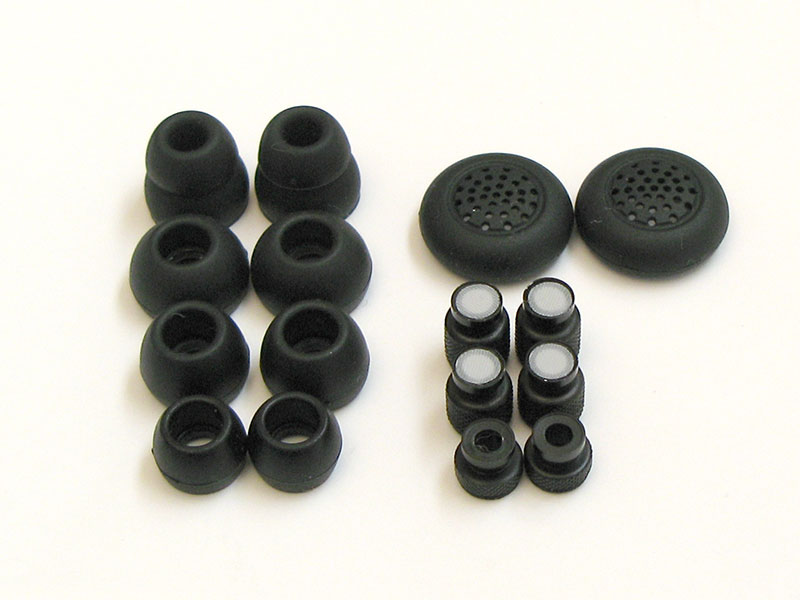
The tip selection that comes with the OK2s is the same as that of the OK1s. Only difference in the bundle is the lack of the 1/8" to 1/4" adapter. Since the OK2s are aimed at portable use it is a completely reasonable decision since all never DAPs have a 1/8" headphone out. Unlike the OK1s the OK2s have a fairly low impedance which makes them really easy to drive. The impedance rating listed is 16 Ohms and the efficiency is high. This is great because it allows you to run them off your DAP without having to lug around an amplifier to make them sound their best.
Closer Examination

Appearance wise there is no difference between the Yuin OK2s and the rest of the OK-series earphones. They all have the exact same exterior design and cable from what I can see. The cable has been improved a lot in comparison to the one of the old Yuin PK-series earphones. Where the PK-series earbuds had a flimsy plastic type cable the new OK-series earphones feature a nice solid cable with a rubber jacket. Another big change in the design is the fact that the OK2 earphones feature a metal rim around the sound hole. It is there so that you can screw on the different canalphone adapters.

The OK2s look quite good from the side. All of the earbuds in the OK-line look the same with the only difference being the OK1/2/3 logo on the side of the stem. The general build quality of the OK-series earbuds is really good. The joints are not seamless, but they are bonded together in a very durable manner. The plastic used seems fairly tough and it does not give way to pressure easily.

On each of the earbuds there is a small left / right indication marker. On the PK1s it was the same color as the logos on the side, but on the OKs it has been toned down a bit which is kind of annoying because it makes it harder to spot which earbud goes where. The problem is particularly apparent when you are in a poorly lit room.

The OK2's driver looks quite like the one in the OK1 earbuds. Even though they share the same design with the parabolic shaped surface they are not completely alike. The absolute biggest difference between the two versions of the driver is their impedance, where the OK1's driver is a 150 Ohm one, the OK2 has an impedance of only 16 Ohms. One of the areas has undergone major changes since the PK1 is the driver and the area around it. Instead of having a pierced plastic plate in front of the driver the new OK2s have metal grill and that is adhered to a metal rim. The metal that goes around the periphery of the earbud has small vents in it as well.

The canalphone adapters are screwed into a threaded hole just in front of the driver. This is an extremely easy task to do. The thread is made of metal just like the outer rim and since the adapters are made of plastic the chance of you ruining anything more than just a cheap adapter is relatively slim.


With the OK2s you get three different length canalphone adapters. The size difference between the short and the medium one is huge, whereas the size difference between the medium and long one is very small.


Above you can see the different adapters mounted in the OK2s. The right most picture shows them with the large canalphone adapter mounted. One of the problems with the design is that the adapters sit straight on the earbud so there is no offset angle. And since a human earcanal points down and backwards from the inner ear, it is hard to get a good seal. The problem is that in order to get the adapter to align with your earcanal you have to angle the body of the earphone and due to its design it will either push against your concha or the upper area of your earlobe. This causes the seal to break very easily.


The tip selection that comes with the OK2s is quite good. You get three pairs of single flange tips along with one pair of double flanges. Besides that you also get a pair of rubber earbud covers instead of the usual foam covers. The tips are the same size as the ones Ultimate Ears IEMs use so you should be able use some Comply T400 tips on these earphones.

The rubber covers function quite well and are very comfortable to use. They do have one small advantage over the foam covers and that is durability. Besides that they are a bit easier to clean.

The mini-jack is really slim and quite durable. The plastic is thick and the cable exits the jack through a rubber stress relief.
Our Patreon Silver Supporters can read articles in single-page format.
Nov 21st, 2026 10:32 PST
change timezone
Latest GPU Drivers
New Forum Posts
- UPS what one to get? (16)
- 1 - 5 person file storage server equivalent accasible from anywhere + general VM server. (3)
- Honestly, do you care about GTA VI? (225)
- Can you guess Which game it is? (341)
- RX 9000 series GPU Owners Club (2251)
- Windows 11 General Discussion (7746)
- How to prevent OLED burn damage due to PC freezes or power outtages? (51)
- TPU's Nostalgic Hardware Club (22182)
- [Poll] 12V-2x6 Connector Protection: What Are You Using? (WireView / Ampinel / Equalizer / Other / Nothing) (51)
- Cpu waterblock water shows some tinting = Bad? (19)
Popular Reviews
- Microsoft Surface Laptop Ultra Review - The Next-gen Arm Laptop
- Ugreen NASync DXP4800 GT Review
- Corsair RM1200e (Second Generation) Review
- Pulsar Office Tour & First Look at P1 Dual-Sensor Mouse
- Upcoming Hardware Launches 2027 (Updated Nov 2026)
- Acemagic Retro X3 Review
- Biwin Black Opal NV7400 2 TB Review
- AMD Ryzen 7 9800X3D Review - The Best Gaming Processor
- AMD Zen 6 Technical Deep Dive
- Chieftec Iceberg PRO 360 DARK Review
TPU on YouTube
Controversial News Posts
- NVIDIA Co-Founder and CEO Jensen Huang Officially Resigns (492)
- Report: Jensen Huang Eyes NVIDIA Comeback (259)
- Open Letter Asking NVIDIA to Reinstate Jensen Huang Passes 115,000 Signatures (184)
- OpenAI CEO Argues Home PCs Waste the World's Limited DRAM Supply (152)
- NVIDIA Launches Investigation Into Jensen Huang's Relationship With Suspected Chinese Spy (136)
- Intel "Raptor Lake Next" 16-Core and 20-Core CPUs Surface (130)
- NVIDIA GeForce RTX 50-Series Scheduled for up to $500 Price Hike This Week (89)
- Intel Razor Lake Gets a 12 P-Core bLLC Chip With No E-Cores, Per Leak (86)