 83
Intel Arc A750 & A770 Unboxing & Preview
(83 Comments) »Introduction

Player 3 has entered the game! While technically the Iris Xe Max (DG1) is its first discrete GPU in decades, the new Arc 7 series marks Intel's first attempt ever at the performance graphics segment, a hotly-contested one where gamers playing at 1080p or 1440p pick up a graphics card to max out their eye-candy with AAA games, or give themselves extreme frame-rates for competitive gaming. The new Arc "Alchemist" 7-series promises just this, and with the metaverse taking shape, Intel is gripped with the fear of missing out on a potentially massive hardware market.

We have with us the Intel Arc A750 and the Arc A770 Limited Edition. Both these cards meet the performance-segment goals for a graphics card, and come with a full DirectX 12 Ultimate feature-set, including hardware-accelerated ray tracing, and a feature competitive to DLSS and FSR—XeSS. We'll tell you a lot more about these in our full review of the two cards. For now, we've been allowed to show you the cards themselves!

The Intel Arc "Alchemist" 7-series media kit came in a large outer box, with several brown boxes inside. The brown boxes have printed surfaces on the inside. You're greeted with a slick graphic that reads "Let's Play." You open a couple of inner flaps to see the actual boxes of the graphics cards. There are separate such outer boxes for the A750 and A770 Limited Edition.


The actual inner (blue) boxes feel incredibly premium to the eye and touch; although they're made of simple paperboard. Each box opens out with a clamshell lid. Inside you're greeted with the card itself, nestled in foam. The lid has an insert marked "Let's Play," with some documentation inside.


As you pull the card out, there's another insert below, with another smaller box. This box contains a cable which connects the graphics card to one of the 9-pin USB 2.0 headers on your motherboard. This cable is only found in the box with the A770 Limited Edition, as that's the card with the elaborate ARGB LED lighting setup (which we're not allowed to show you just yet, but we will in our full review).
Goodies

There's more to this media kit than just the cards. Intel likes to hand out little mementos with its media kits, and this one has two really cute ones.


The first one is a delightful neon sign. This is a real neon sign made of a glass fluorescent tubes, and not a plastic LED diffuser made to look like a neon sign. It can be placed on the desk, or as a backdrop in video presentations.


The second of these is a really useful toolkit. This kit has everything one needs to disassemble the card, including its finer parts like the LED setup, or the fan impellers. It has all the bits one needs for PC building.
The Cards


Here they are, the Arc "Alchemist" A770 Limited Edition and Arc A750! Both cards are nearly identical in appearance when powered down, but the A770 is a whole different beast when installed (which we'll show you in our main review). It has an elaborate set of addressable RGB LEDs, with as many as 90 diodes lining the top, the backplate, the brand sign, and the fan intakes.
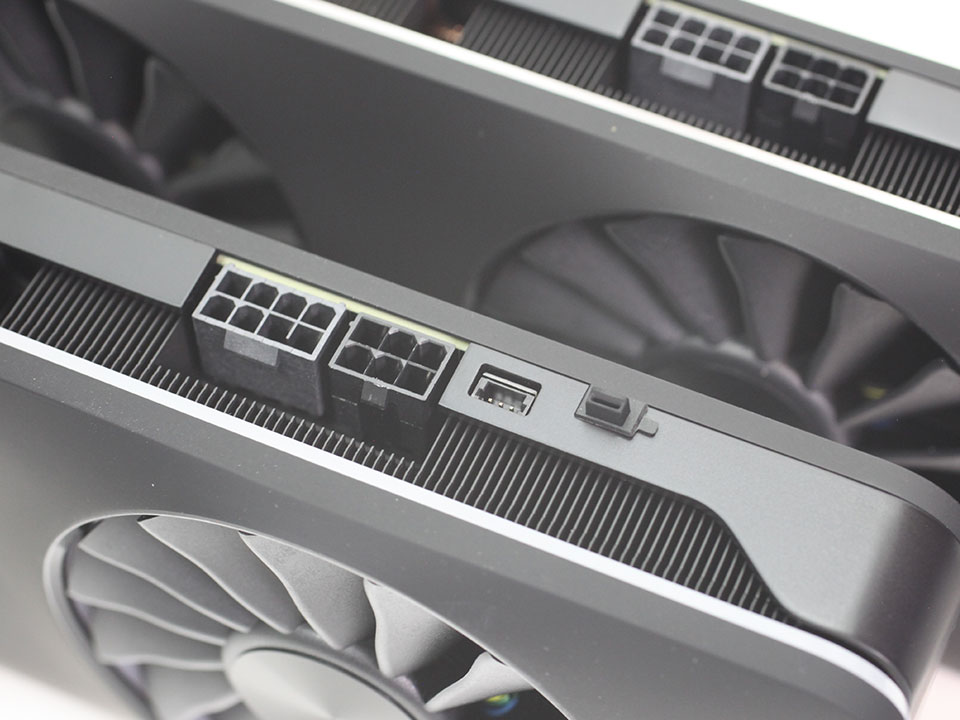

You can tell the A770 apart with a little rubber grommet next to the power connectors, which has that proprietary USB 2.0 connection to your motherboard. You need that connection for Arc Control software to interface with the RGB setup. This is a primitive way of controlling RGB on video cards, NVIDIA and AMD use I2C links from the GPU to an RGB controller on the card; and expose this device via the drivers to any custom software the AIB wants to bundle. Both cards come with an identical set of power connectors—a combination of 8-pin and 6-pin PCIe. This configuration is good for up to 300 W of power.

Display connectors on both cards include sets of three DisplayPort 2.0 and one HDMI 2.1. The card supports up to two 8K @ 60 Hz with HDR displays; or up to four 4K @ 120 Hz with HDR displays.
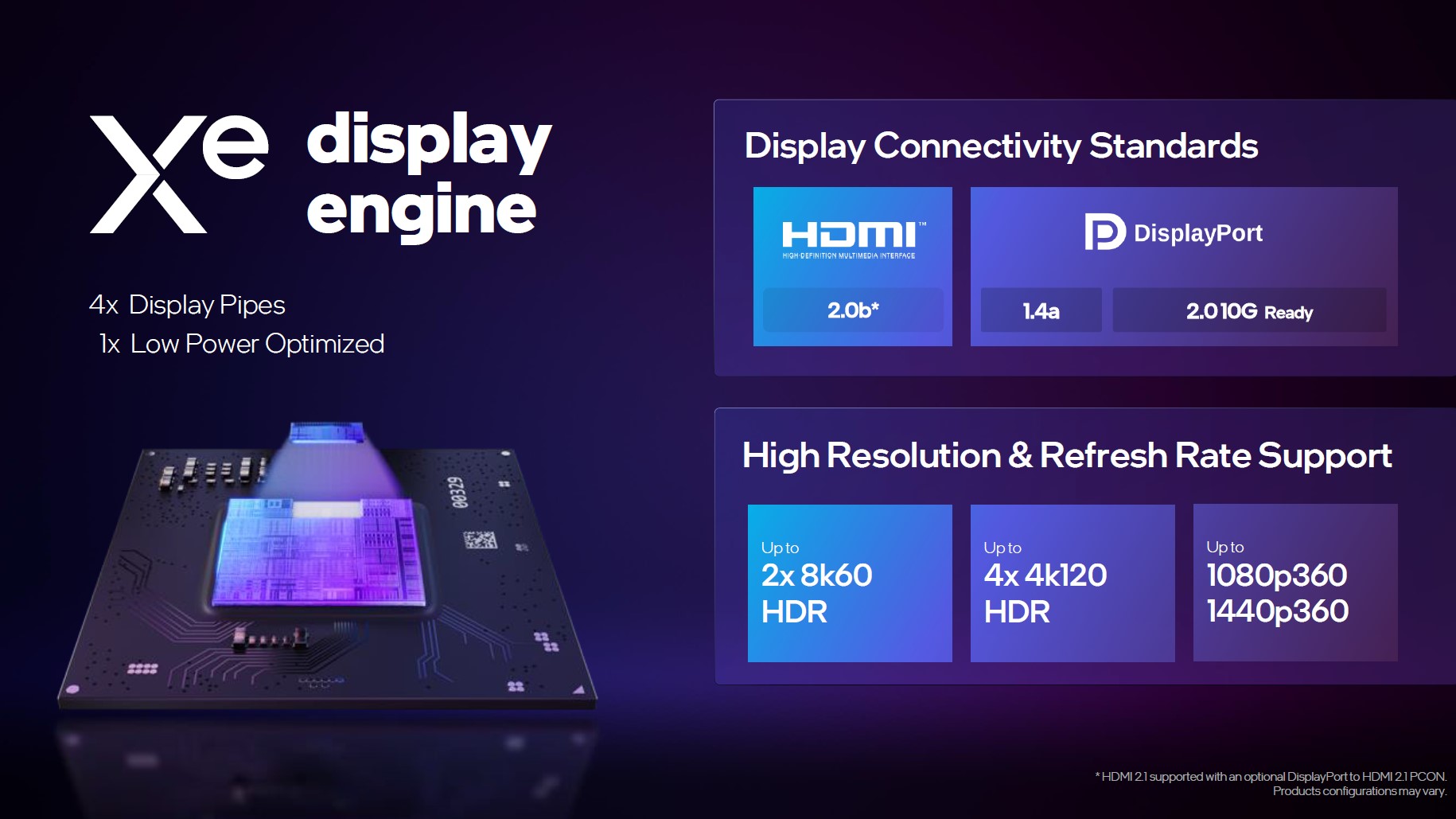
While the GPU natively supports an HDMI 2.0b connection, the reference-design card uses a PCON (protocol converter) chip to convert one of the DisplayPorts to an HDMI 2.1. This PCON is optional for custom-design cards, and AIBs can opt not to use it (wire out the native HDMI 2.0b). HDMI 2.1 is needed for fancy resolutions like 8K + HDR (10 bpc color), or 4K with a high refresh-rate.
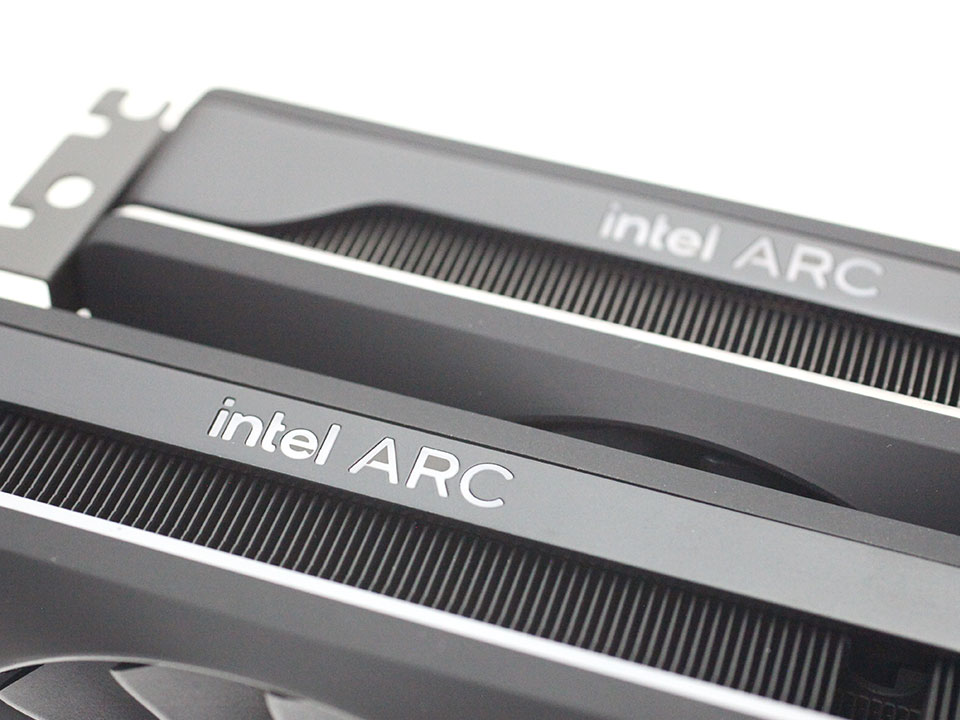


The cards are 26.7 cm long, 10 cm tall. Both are strictly 2-slot cards. Intel has shown off their disassembly shots.
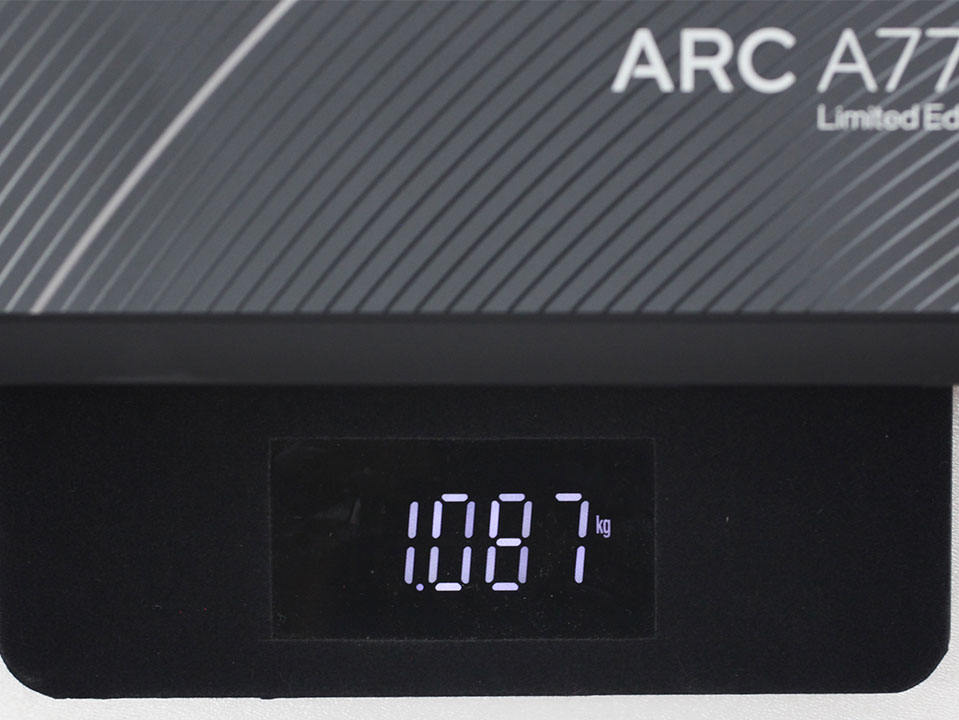

The A770 Limited Edition weighs 1.087 kg, while the A750 is a touch lighter at 1.062 kg. The weight difference is from the RGB lighting setup on the A770.

The card features an industry-standard PCI-Express 4.0 x16 bus interface. Intel is pretty vocal that you need PCI resizable-BAR enabled for this card to perform as advertised, and that you should avoid buying Arc "Alchemist" graphics cards altogether if your system lacks resizable-BAR.
Our Patreon Silver Supporters can read articles in single-page format.
Nov 19th, 2026 17:32 CST
change timezone
Latest GPU Drivers
New Forum Posts
- TPU's Nostalgic Hardware Club (22170)
- How to prevent OLED burn damage due to PC freezes or power outtages? (29)
- Security Apps (3)
- Got the EOL 32GB TridentZ 6000 CL26 1.4V (12)
- Honestly, do you care about GTA VI? (167)
- Dell Workstation Owners Club (3517)
- Making a game in Godot engine (6)
- Introducing DST Bench : one of the most advanced disk benchmark and storage analyzer real-time software (6)
- Windows 11 General Discussion (7736)
- Current Sales, Bundles, Giveaways (10448)
Popular Reviews
- Acemagic Retro X3 Review
- Ugreen NASync DXP4800 GT Review
- Upcoming Hardware Launches 2027 (Updated Nov 2026)
- Pulsar Office Tour & First Look at P1 Dual-Sensor Mouse
- AMD Zen 6 Technical Deep Dive
- Biwin Black Opal NV7400 2 TB Review
- Sapphire Radeon RX 7700 XT Pure Review
- Sapphire Radeon RX 7700 XT Pulse Review
- Corsair RM1200e (Second Generation) Review
- AMD Ryzen 7 9800X3D Review - The Best Gaming Processor
TPU on YouTube
Controversial News Posts
- NVIDIA Co-Founder and CEO Jensen Huang Officially Resigns (489)
- Report: Jensen Huang Eyes NVIDIA Comeback (223)
- Open Letter Asking NVIDIA to Reinstate Jensen Huang Passes 115,000 Signatures (184)
- OpenAI CEO Argues Home PCs Waste the World's Limited DRAM Supply (152)
- NVIDIA Launches Investigation Into Jensen Huang's Relationship With Suspected Chinese Spy (136)
- Intel "Raptor Lake Next" 16-Core and 20-Core CPUs Surface (130)
- Legendary Game Studio BioWare Shuts Down Following EA Layoffs (104)
- Dell CEO Says the Memory Shortage Will Get Worse in 2027 (95)