 79
Intel Core Ultra 5 250K Plus Review - Disrupting AMD's Entry-Level
Performance Summary »Clock Frequencies
The following chart shows how well the processor sustains its clock frequency and which boost clock speeds are achieved at various thread counts. This test uses a custom-coded application that mimics real-life performance—it is not a stress test like Prime95. Modern processors change their clocking behavior depending on the type of load, which is why we provide three plots with classic floating point math, SSE SIMD code, and modern AVX vector instructions. Each of the three test runs calculates the same result using the same algorithm, just with a different CPU instruction set.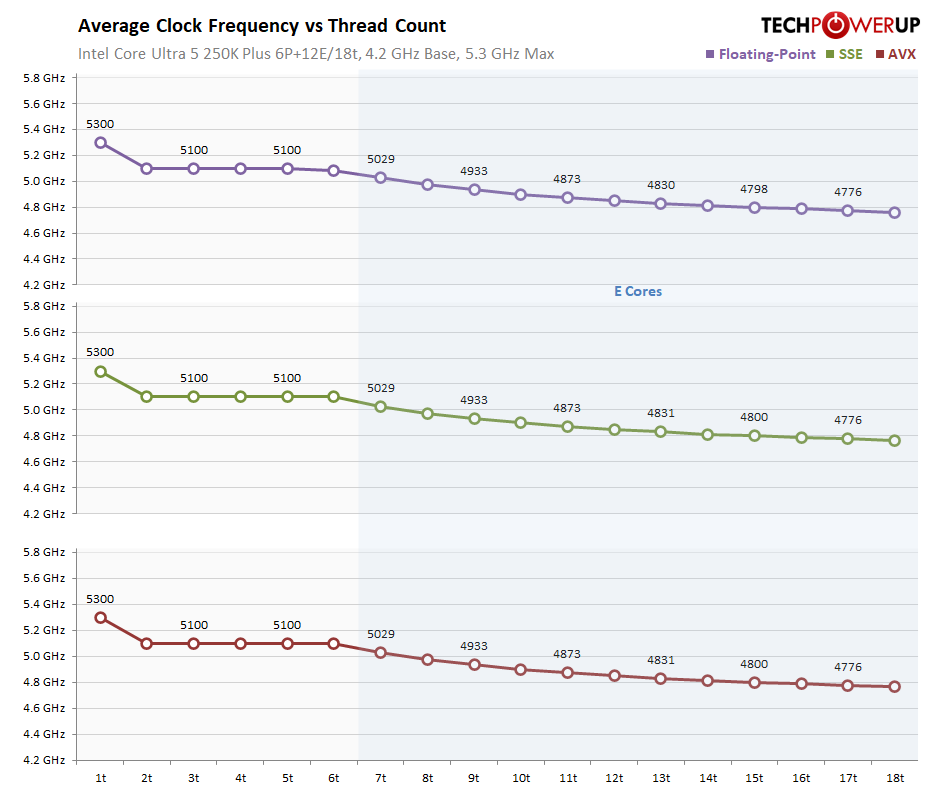
Note that the P-Cores are always clocked close to their maximum, even when multiple P-Cores are active. The gradual drop toward the right side is a little bit misleading, because we keep adding more E-Cores to the mix, which run at a lower frequency, dragging down the average.
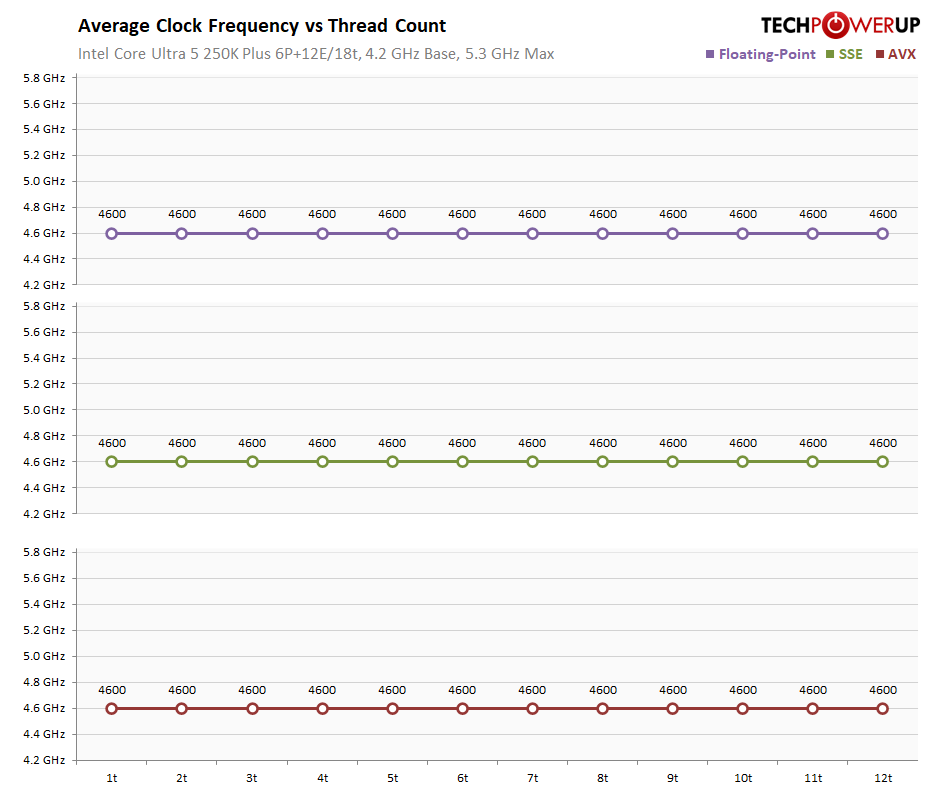
In this E-Cores only chart you can clearly see that the E-Cores are always running at 4.6 GHz when not idle, no matter how many of them are active.
Overclocking
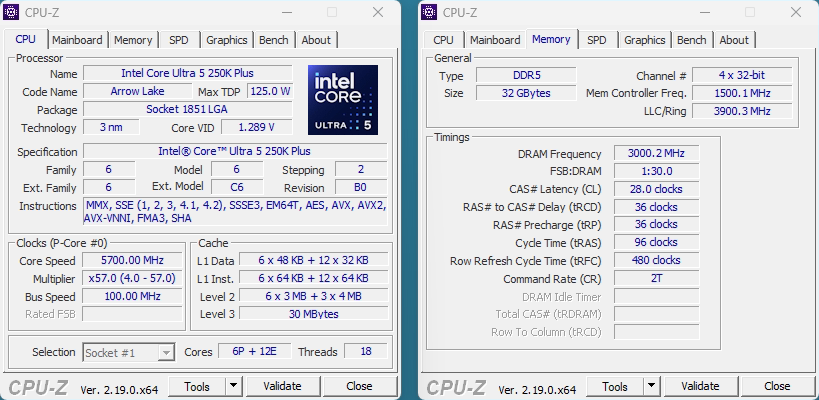
Overclocking the Intel Core Ultra 5 250K Plus is pretty easy, thanks to the unlocked multiplier. Due to its lower positioning, keeping it cool is very easy at stock. Intel has also increased the TjMax to 105 °C, which adds an extra +5 °C in thermal headroom. You can manually increase this limit to 115 °C. On AMD AM5 CPUs the limit is 95 °C, with no option to increase.
With Arrow Lake (and Arrow Lake Plus), you can adjust the voltage for the P-Cores and E-Cores separately, and also their overclocking frequencies. On top of that there are additional dials for the inter-tile clock frequency and others.
The OC testing in this review is designed to represent what a typical user can achieve without in-depth knowledge of secret overclocking techniques or dozens of hours to tweak the system for a long time. I set the voltage offsets to +100 mV for both core types and started increasing the CPU multiplier for the P-Cores only.
The maximum P-Core OC frequency that I got was 5.7 GHz on all cores, which is 400 MHz higher than the maximum Boost on two cores (5.3 GHz). This does require a bump in voltage though, +100 mV was stable, +75 mV was not. Very impressive—it's very unusual for an Intel CPU to be able to run all-cores at higher than the rated maximum boost.
Next, I started working on the E-Cores. However, I first lowered the P-Cores' multiplier to ensure that any instability wouldn't disrupt the E-Core overclocking.
E-Core overclocking topped out at 5.2 GHz—600 MHz higher than the out-of-the-box config—this definitely gains some extra performance. The cooling requirements went up even further now due to 100 mV offset on both core types—watercooling required, and increasing the thermal limit beyond 105 °C helps, too.
Overall this is excellent OC potential that makes the 250K Plus even more interesting for budget conscious buyers.
Nov 16th, 2026 08:35 CST
change timezone
Latest GPU Drivers
New Forum Posts
- need an ide to sata adapter that lets me burn cds on an ide cdrw drive (that doesn't power down while burning or copying) (55)
- Windows 11 General Discussion (7729)
- Honestly, do you care about GTA VI? (62)
- Meeting point of those who broke their GPUs. Please share what GPUs you've burned, shattered, ionized or melted accidentally. (36)
- What storage medium you lost the most data thus far from failure? HDD/SSD Flash, etc (53)
- Samsung MZ-HPU256T/004 (12)
- Recommendations Wanted - Affordable Enterprise SSD for Boot (10)
- Samsung 860 Evo MZ-76E2TO 2tb. 2018-10 (1)
- no "PhysX" workable (16)
- What can the FX 8320 do today? Here is the answer. (64)
Popular Reviews
- ASUS ROG Strix B850-I Gaming Wi-Fi7 W Review
- Corsair HX1000i Shift Crystal Review
- AMD Zen 6 Technical Deep Dive
- Upcoming Hardware Launches 2027 (Updated Nov 2026)
- Montech King 95 3D PRO Review
- NZXT C1200 Platinum Review
- Phantom Blade Zero Performance Benchmark Review - 35 GPUs Tested
- AMD Ryzen 7 9800X3D Review - The Best Gaming Processor
- NZXT H7 RGB+ Review
- NZXT H5 Review
TPU on YouTube
Controversial News Posts
- NVIDIA Co-Founder and CEO Jensen Huang Officially Resigns (431)
- Open Letter Asking NVIDIA to Reinstate Jensen Huang Passes 115,000 Signatures (184)
- OpenAI CEO Argues Home PCs Waste the World's Limited DRAM Supply (152)
- NVIDIA Launches Investigation Into Jensen Huang's Relationship With Suspected Chinese Spy (136)
- Intel "Raptor Lake Next" 16-Core and 20-Core CPUs Surface (130)
- Legendary Game Studio BioWare Shuts Down Following EA Layoffs (104)
- Dell CEO Says the Memory Shortage Will Get Worse in 2027 (95)
- NVIDIA GeForce RTX 50-Series Scheduled for up to $500 Price Hike This Week (89)