 2
Kinera YH802 Limited Edition Hybrid ANC TWS Earphones Review
Value & Conclusion »User Experience

Seen above is the right half of the Kinera YH802 installed on an artificial ear mold that is similar enough to my own average-sized ears. I used the pre-installed size M silicone ear tips for this photo, which is what I used for the rest of my testing as there are no other types of ear tips included in the box. The fit is quite good given the section that actually goes into the concha is smaller than on typical IEMs, with the outer surface directed more towards your mouth to pick up your voice for calls, as well as a physical host for ANC microphones. It will look like some of the Bluetooth communicators from yesteryear, but without the customary ear hook, with the custom hand-painted design. Passive isolation could be better, but this is solely due to the ear tips not being very good. Try tip-rolling, although there is active noise cancellation here. The vents on the shells don't affect isolation nearly as much as the ear-tip seal, and don't go about covering them either to try for a better seal. Generally speaking, I have no complaints about overall comfort. These weigh ~5.2 g each, making them low in density and not at all physically fatiguing.
Battery life is a key metric for TWS earphones, and these promise 8 hours of use when fully charged, which is usually a best-case scenario at lower volume and in SBC/AAC mode with ANC off. I got ~7–7.5 hours regularly with my typical use case, which isn't that far off from the promised numbers. This is because there is only SBC/AAC codec support to begin with, and these get plenty loud at ~60–70% on my phone and laptop alike. With ANC turned on, average battery life decreased to just under 5 hours, which is where some of the newer TWS sets outperform the Kinera YH802. As mentioned before, with the case and Kinera being on the cautious side in reporting how many charge cycles it provides, total battery life without ANC or transparency modes ends up north of 30 hours, which certainly helps. It would have been nice to see Kinera update the case with quick charging or wireless charging support, but you'll have to make do with the ~2-hour charging time for the case and ~1.5 hours for the earphones.
Audio Performance
Audio Hardware and Microphones
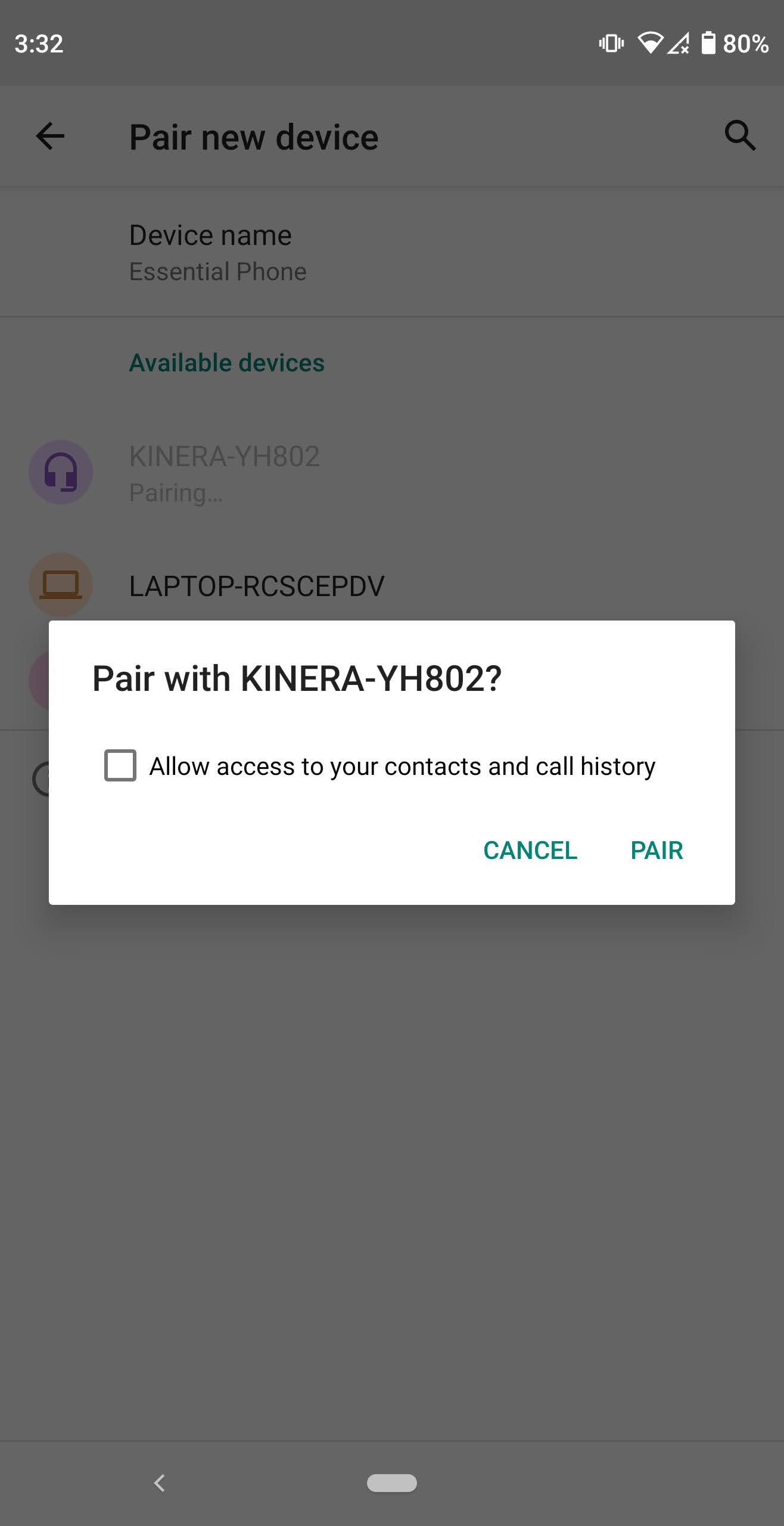
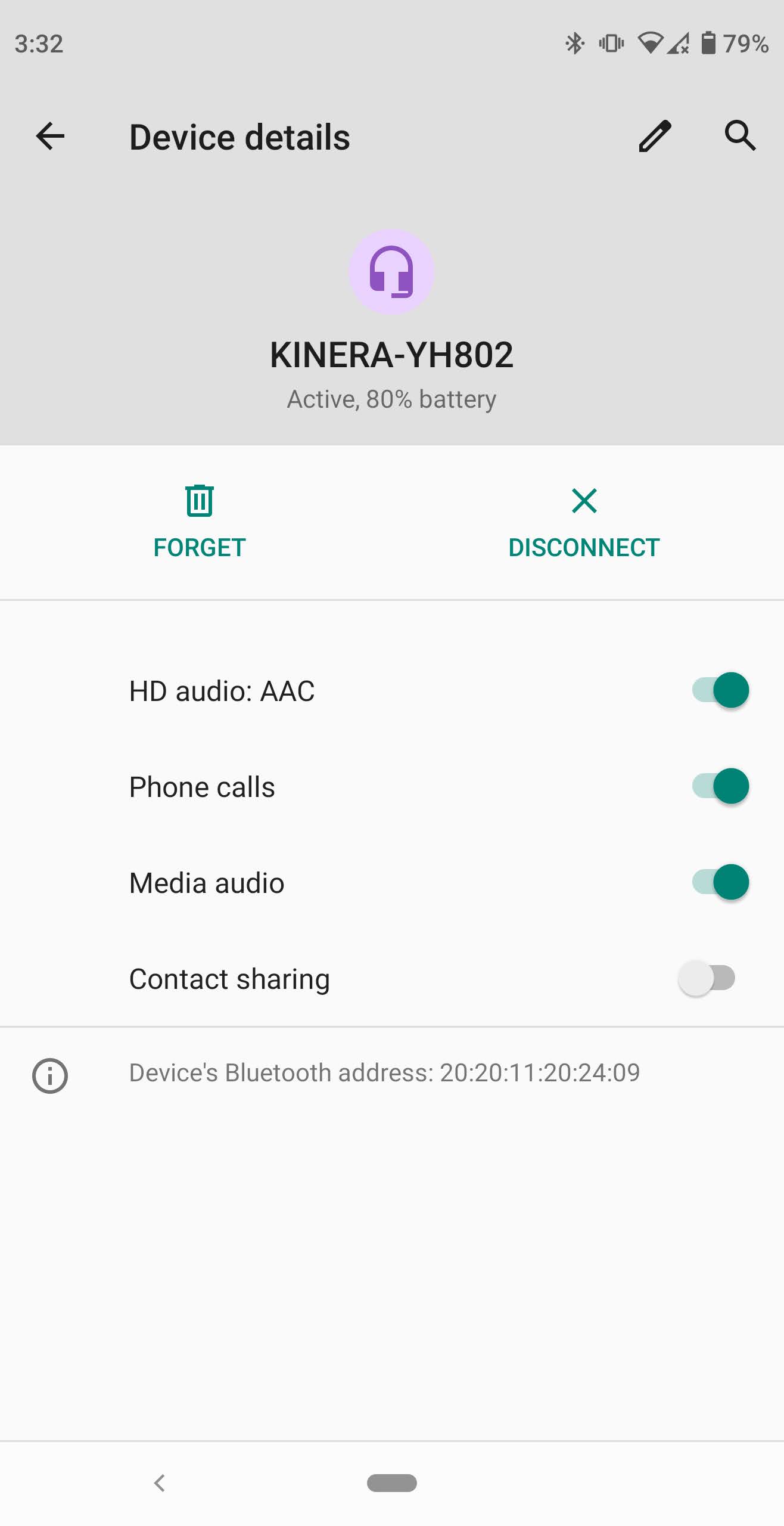
There is no mobile app support for the Kinera YH802 limited edition TWS earphones, making it another feature that hasn't changed from the previous edition. While still disappointing, this in itself isn't surprising given how many audiophile-brand IEM companies are getting into the TWS market without going further down the technological side of this market. Pairing these is also more involved to begin with, although it's more a waiting game owing to the YH802 supporting auto-pairing. This means the TWS set, when in pairing mode, dedicates the first ~10 seconds to finding a connection to a previously paired device before it shows up for pairing with a new device. You can also pair either channel in mono mode by simply taking it out of the case, and the Kinera YH802 allows for dual primary connections in addition to automatic switching of the primary and secondary sides depending on whether you are in mono or stereo mode.
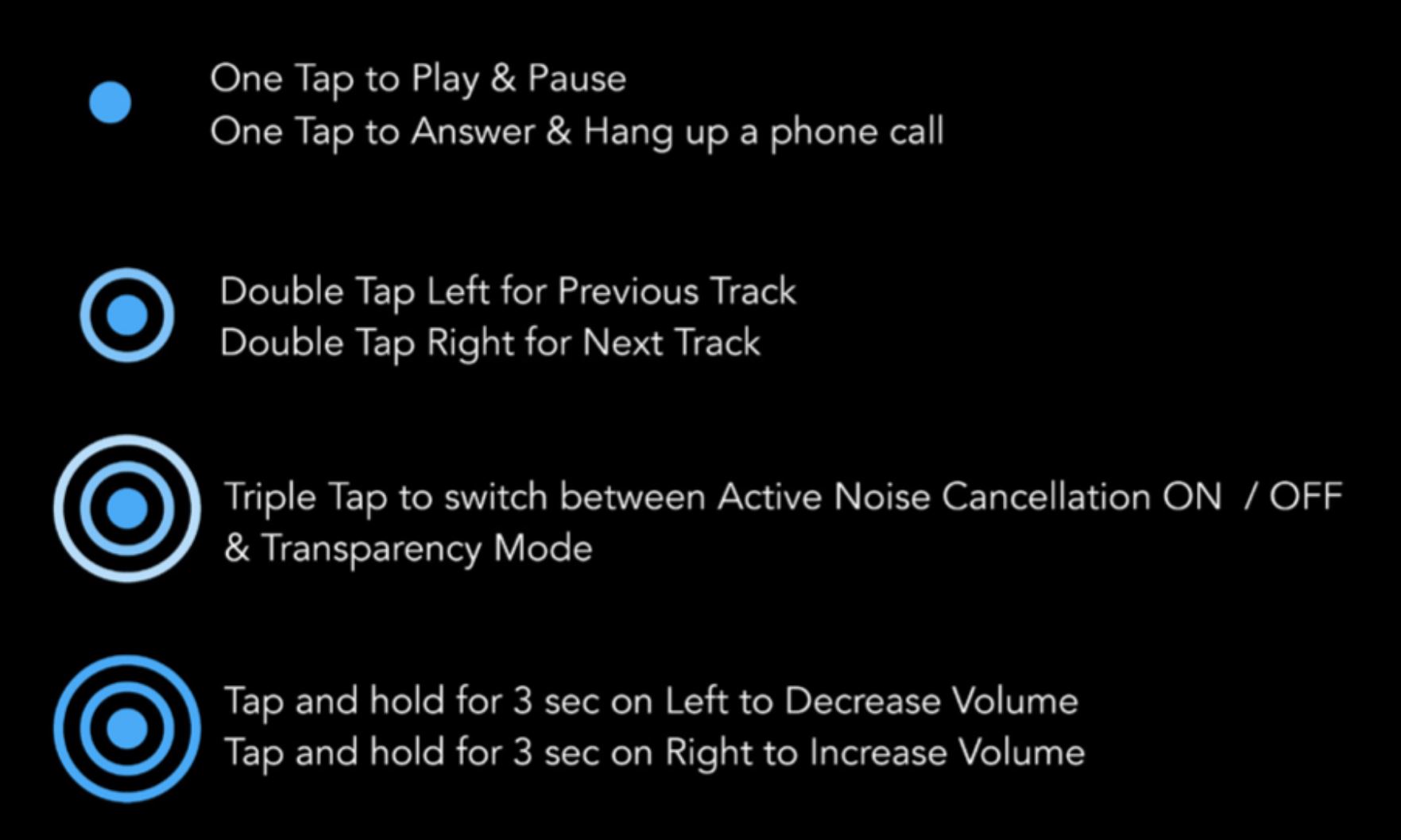
The lack of any codecs outside of AAC and SBC may also be disheartening, especially on Android and Windows, but the implementation of said codecs and drivers ultimately matters more, as we saw before with the HIFIMAN TWS800. But I do appreciate Kinera having programmed in touch controls to achieve a lot of things users may have wanted the app for, though you will still have to rely on something external for any EQ needs. The touch controls rely on the circular sensor pad we saw on the previous page, and it works well enough to where I am happy with it—certainly more so than the touch controls on most TWS earphones. The Kinera YH802 consistently recognized my single, double, or triple taps, with the latter handy for switching between the three operating modes: ANC on, Transparency on, and ANC off (standard). Volume control and media playback worked as expected, and I appreciate that tapping once is associated solely with calls since it can otherwise be misconstrued for when you want to tap and hold for volume control instead.
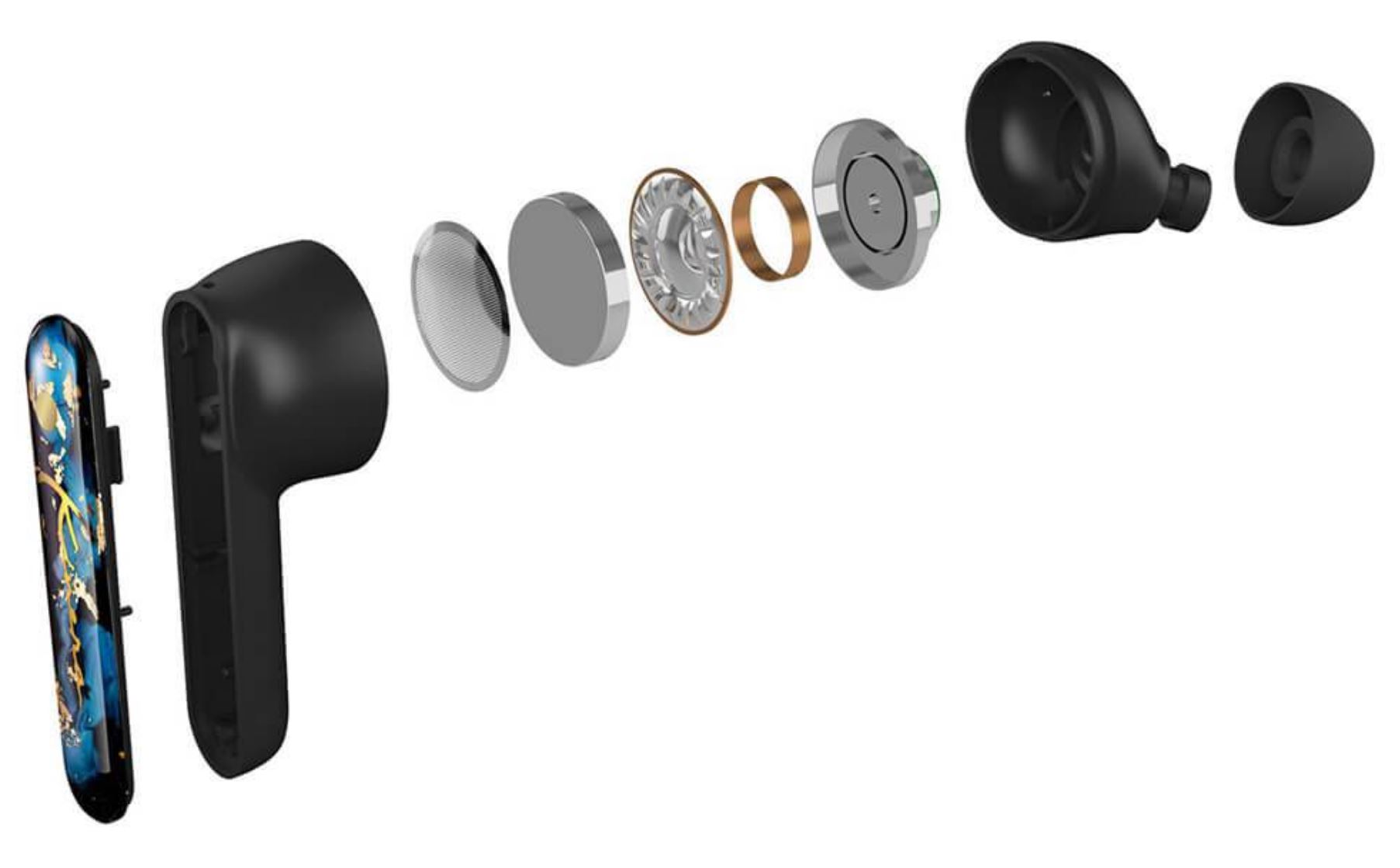
Kinera also shows its roots by providing more information about the drivers than others. The YH802 uses a custom-developed 10 mm dynamic driver using a PU (polyurathane) and PEK (polyether ether ketone) composite diaphragm. No word on the magnets used, but Kinera confirms the use of a pure copper voice coil that is all of 30 µm thick. We also do not know the Bluetooth chipset, just that it has a Bluetooth 5.0 transceiver inside. Likewise, there is no information on the driver impedance or sensitivity, although neither is as crucial for TWS earphones given the drivers are powered internally. There are a total of three microphones per channel, of which two are dedicated to the hybrid ANC modes. Kinera is claiming up to 35 dB of noise reduction in conjunction with DSP via the chipset, and the third microphone is used for voice communications, which it does quite well. In fact, it might be the best such implementation in a TWS set I have used to date, with voice clarity on online calls especially coming off nearly as well as the microphone on my phone. Not a high standard, but it's appreciated nonetheless.
Frequency Measurement and Listening
I will mention that I have a general preference for a warm-neutral signature emphasizing a slightly elevated bass and smooth treble range with detailed mids and good tonal separation. I also generally prefer instrumental music over vocals, with favored genres including jazz and classical music.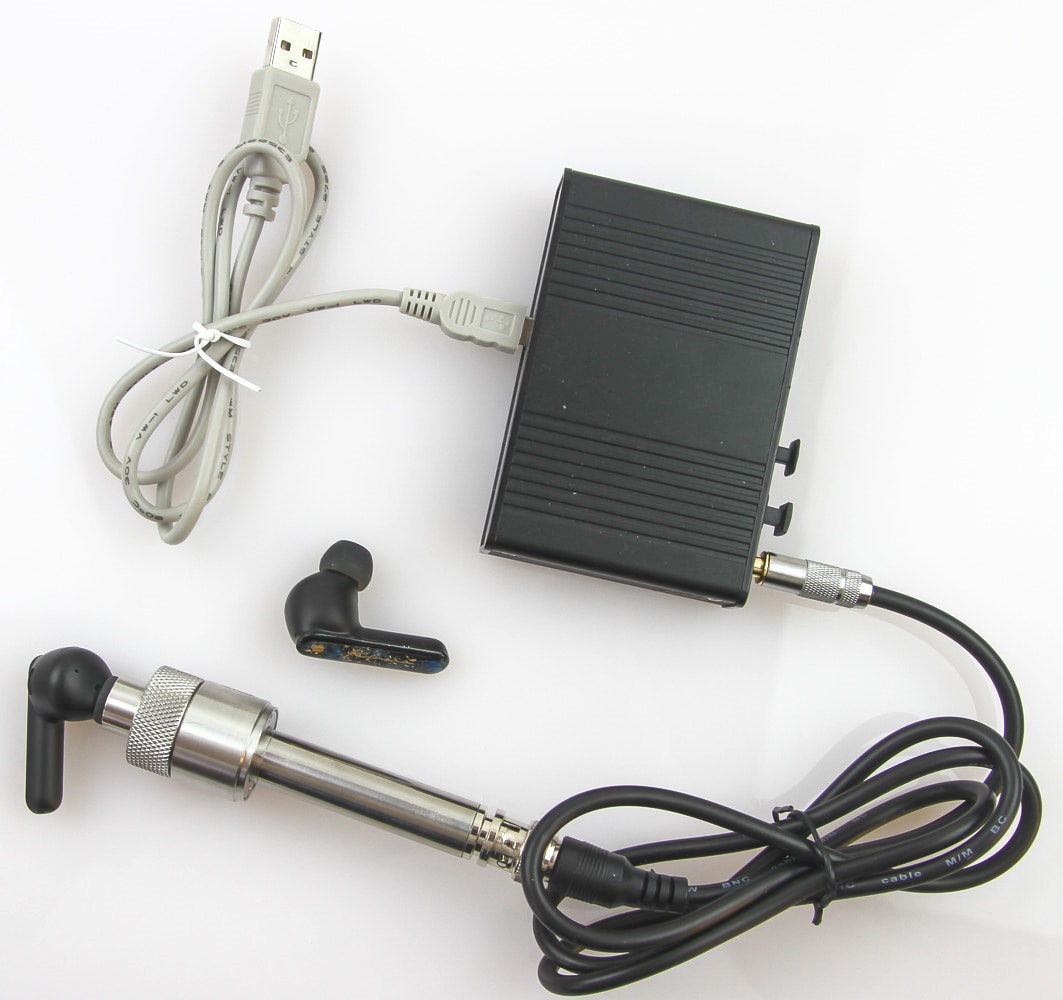
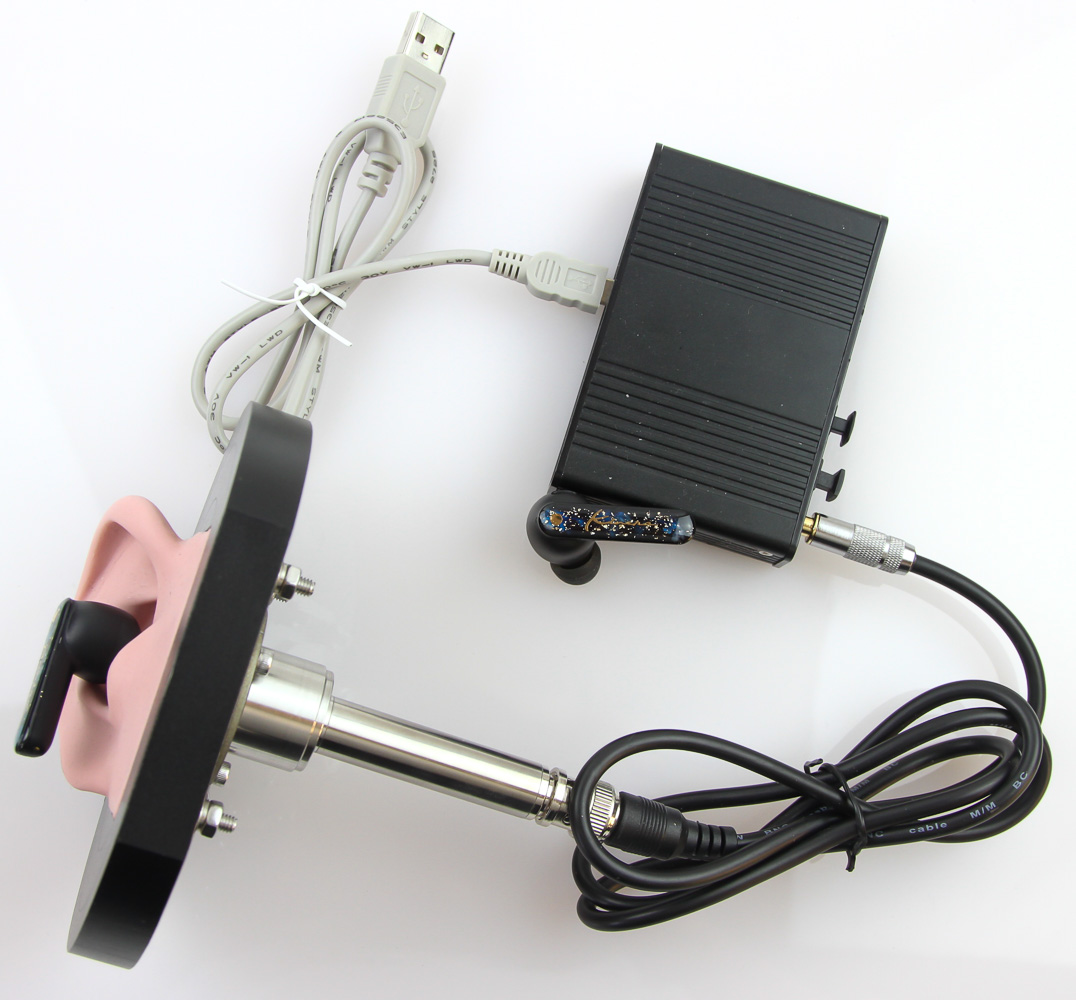
Our current testing methodology begins with a calibrated IEC711 audio coupler/artificial ear the earphones can feed into to where there is decent isolation similar to real ears. The audio coupler feeds into a USB sound card, which in turn goes to a laptop that has ARTA and REW running and these TWS earphones connected to the laptop through Bluetooth. I begin with an impulse measurement to test for signal fidelity, calibrate the sound card and channel output, account for floor noise, and finally test the frequency response of each channel separately. Octave smoothing is at the 1/12th setting, which nets a good balance of detail and noise not being identified as useful data. Also, the default tuning was used for testing, and no app-based settings were chosen unless specifically mentioned. Each sample of interest is tested thrice with separate mounts to account for any fit issues, and an average is taken of the three individual measurements for statistical accuracy. I am also using the pinna mold fitted to the audio coupler for a separate test to compare how these fare when installed in an ear and cheek geometry and not just the audio coupler by itself. The raw data is then exported from REW and plotted in OriginPro for an easier comparison.
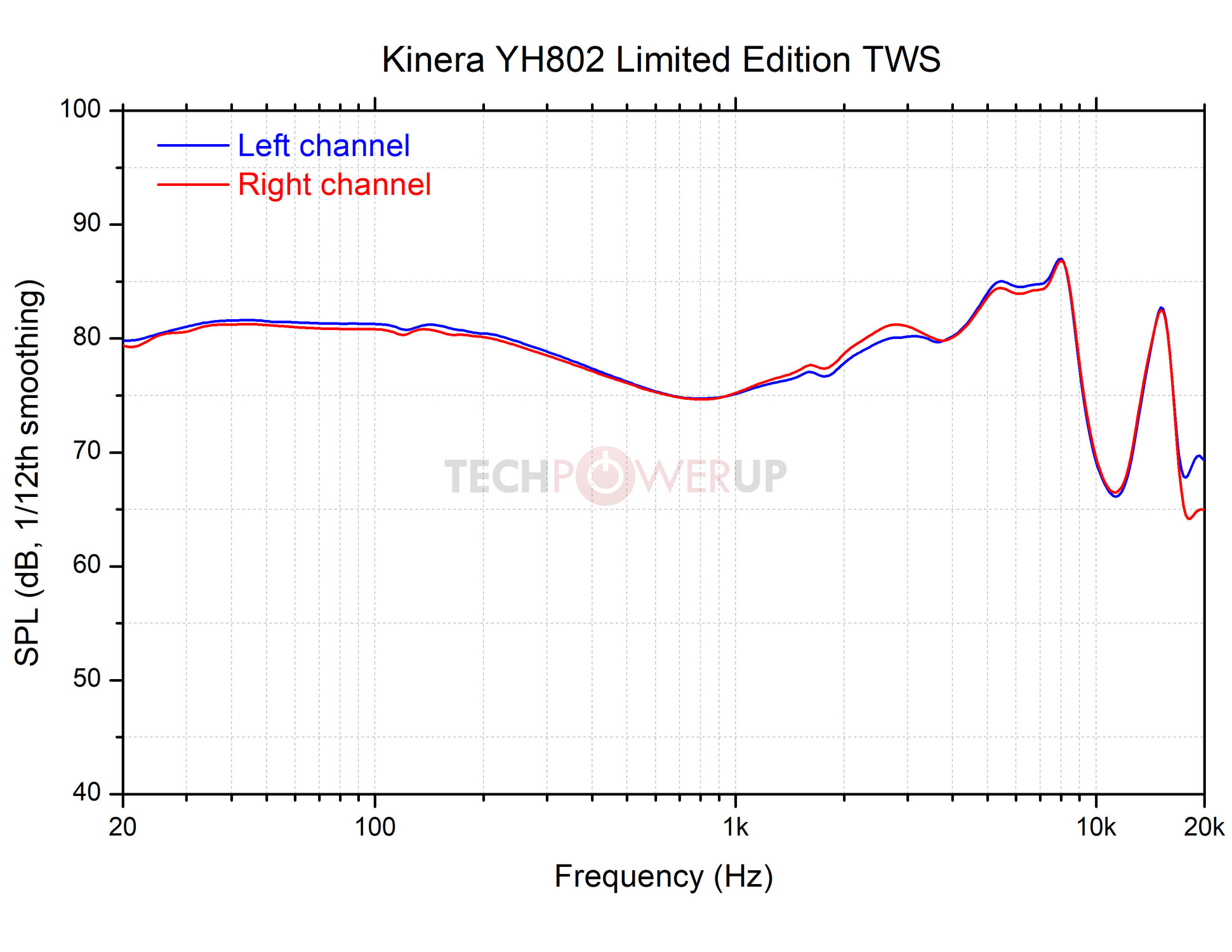
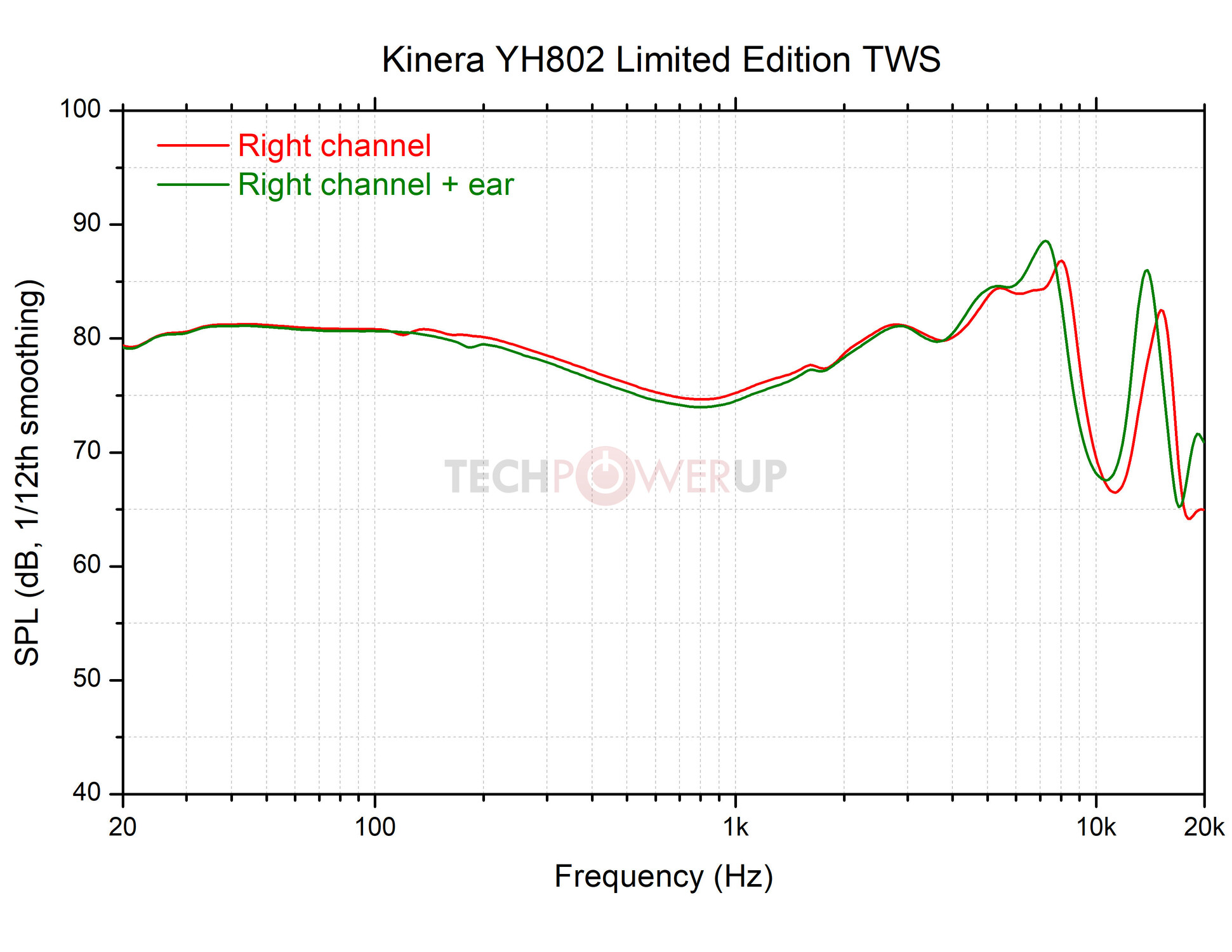
The IEC711 is such that you can't really compare these results with most other test setups, especially those using a head and torso simulator (HATS). The raw dB numbers are also quite contingent on the set volume, gain levels, and sensitivity of the system. What is more useful information is how the left and right channels work across the rated frequency response in the Kinera YH802, or at least the useful part of it. The left earbud was separately tested from the right one, and colored differently for contrast. I did my best to ensure an identical fit for both inside the IEC711 orifice, so note how the two channels measure very similarly across the entire range. The two channels are within +/-1 dB most of the way, except for in the pinna gain region from 1–4 kHz, but I would not fault Kinera for any perceived channel imbalance there. We see more of the same with the artificial pinna in place, but keep in mind that the resonance shift here is expected and influenced by the achieved seal and fit, so it's more an indicator of how good the fit was in the artificial pinna compared to the ideal case of the coupler orifice. There was no discernible break-in period or effect, so overall reproducibility and consistency are good since the average response for each channel is also basically the same across the three repeated tests. Keep in mind that with TWS earphones, connectivity and signal strength from the source are important, as is fit.
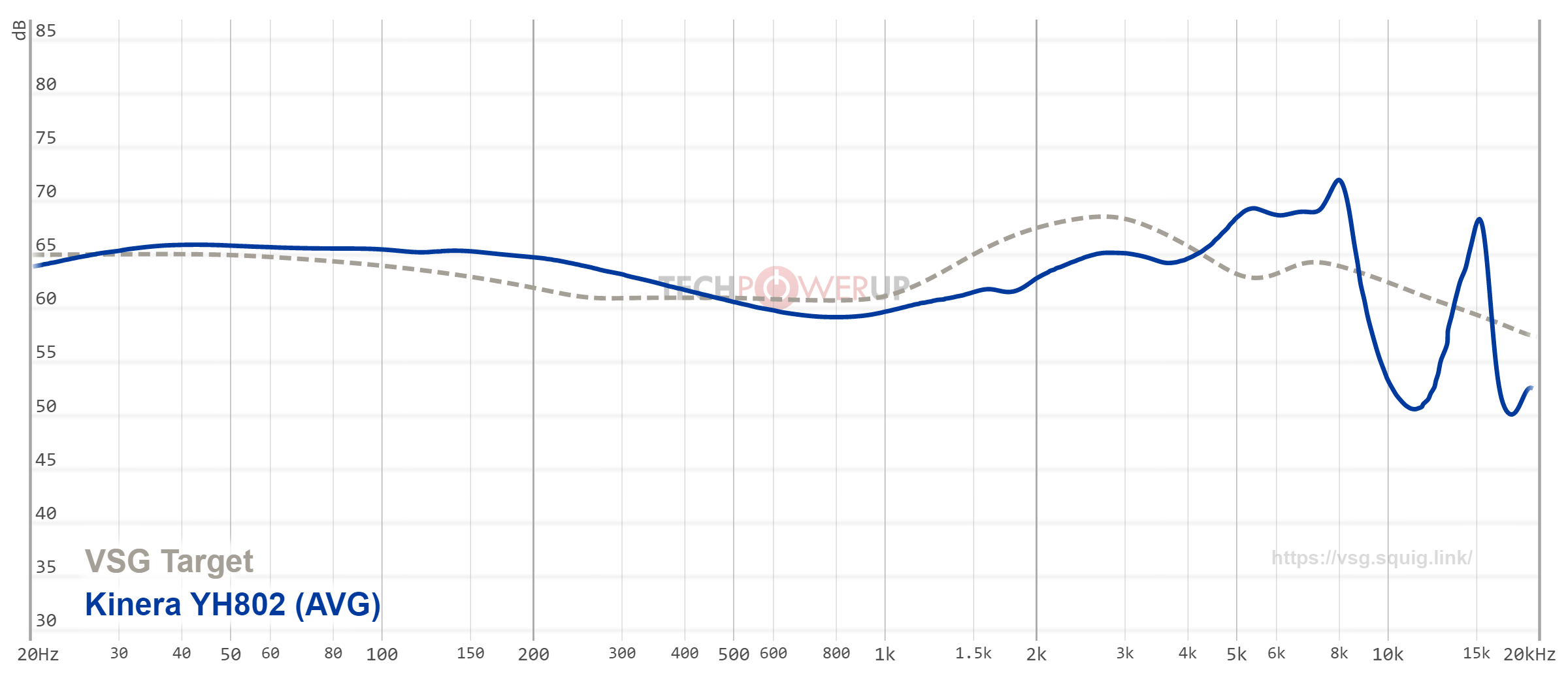
This is the average frequency response for both channels of the Kinera YH802 TWS earphones plotted against my personal target taken from VSG.squig.link, which also gives you an idea of my personal preferences to better correlate any possible biases. The tuning of a set of headphones or earphones does not have to match my target as long as it is tuned with some direction, makes sense, and is executed well. After all, no one set will appeal to everyone, and having different options is what makes this hobby so interesting and hard to quantify. Kinera has a frequency response curve of the YH802 limited edition on the product page, which is always nice to see, and it matches my findings almost perfectly for all but an emphasized 8 kHz peak courtesy the coupler resonance that is absent in the Kinera plot. Indeed, in practice, the 8 kHz region is not as emphasized as depicted by the measurement seen above—it's a lot more in line with the 5.5 kHz peak itself.
This does not mean the tuning is well executed overall, however. Kinera has a weird implementation that comes off anemic pretty much everywhere but in the mid/upper treble region. I don't particularly fancy much bass myself, but the tuning in the low frequencies might disappoint people looking for either a V-shaped or more analytical tuning. Sub-bass extension is fairly decent, with the rise starting at ~800 Hz and peaking with a 7 dB gain at ~40 Hz before slightly dipping lower than that. The bass elevation is steady all the way through ~200 Hz, though, making it seem bloated, but with a lack of impact. The mid-bass and lower mids are likely to be the areas of interest that might appeal to users, if there ever were any here, with decent resolution and channel separation lending favorably to the likes of rock music and old school funk. Country music also works well with male vocal-driven songs, and it is backed well by good imaging for instruments and vocals alike in the mids. The Kinera YH802 also takes fairly well to EQ via Poweramp on Android and Equalizer APO w/Peace GUI on Windows 10, which is all the more reason I wanted native app/equalizer support to help address some of the issues.
The soundstage is also more than adequately sized for TWS earphones, and I came out fairly pleased with the general technical prowess relative to other such TWS offerings I've tested, especially considering the Bluetooth and codec limitations and this being based on an older product. It's a shame then that things only get worse as you proceed up the frequency ladder, with whatever it is that Kinera thought out for pinna gain just not working at all. Even those who generally listen to more electronic music than the likes of jazz will find the 1–4 kHz region and female vocals just lacking in energy, and this is another region sorely in need of EQ or a re-tuning altogether from Kinera. Once again the YH802 took fairly well to a few EQ filters via parametric EQ, but a lot of work is needed to adjust the treble tuning to your needs. It's overly sharp at 5 kHz, I found it annoying even, and then continued to stay elevated to where it wasn't sibilant as much as making me re-consider this for classical music altogether. The treble extension is also somewhat weird in that Kinera decided to incorporate some air at the very end, which doesn't do much when the fundamentals are all over the place already.
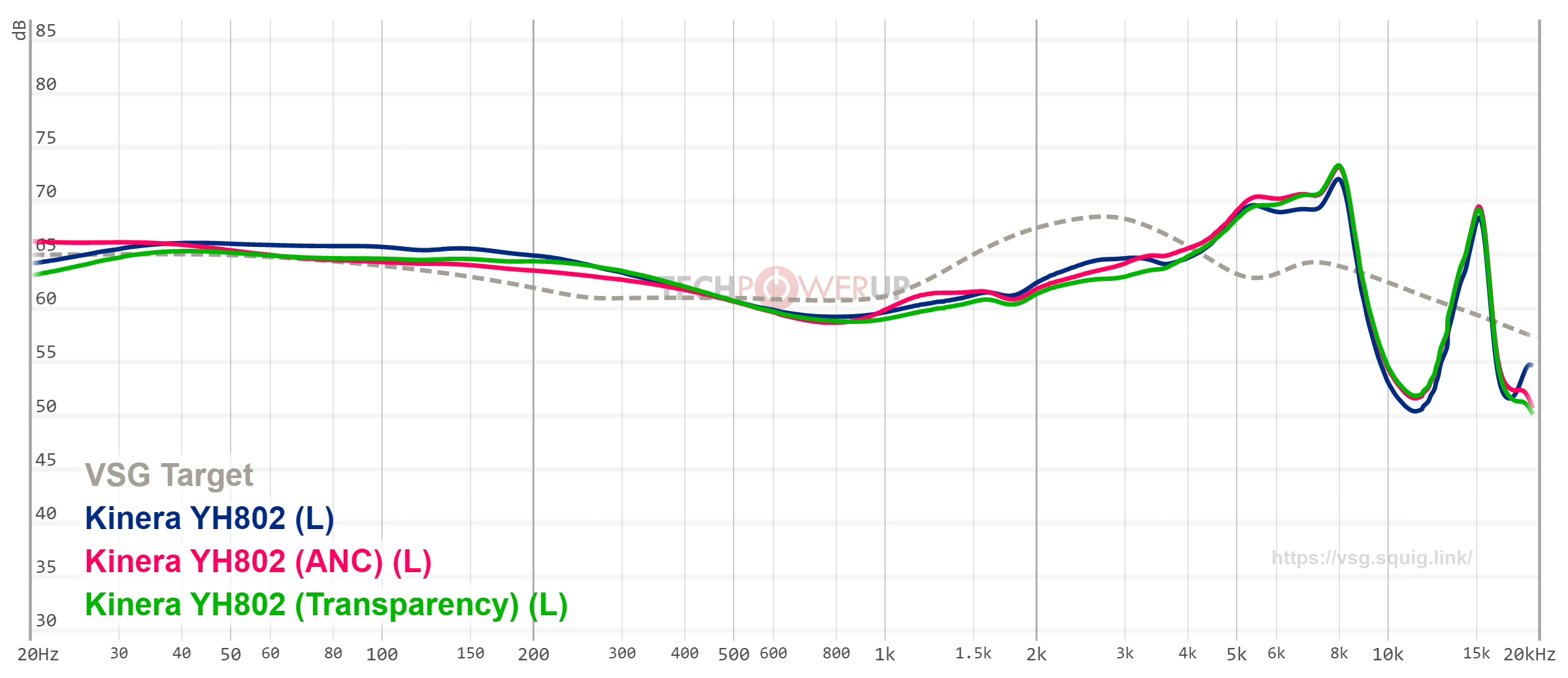
Note that I am simply testing the tuning profiles in the ANC and transparency modes, not the actual effect of the two modes. ANC with Bluetooth earphones tends to typically reduce bass SPL, and the YH802 is no exception with the highest decrease at ~100 Hz. Kinera rates a total of up to 35 dB noise reduction, but a lot of this is done by the passive isolation from the fit and seal in the ear canal. ANC still worked better than on many recently tested such devices, and the tuning in ANC mode aims to lift up the sub-bass and mid-bass to compensate for the expected decrease when the microphones do not pick up external stimuli to respond to, as is the case here. Transparency mode works by emphasizing the mids especially, allowing you to listen to your surroundings without removing the earphones. In this case, it is done by decreasing the bass and lower mids relative to the mids and upper mids, which does the job, I suppose.
Comparisons
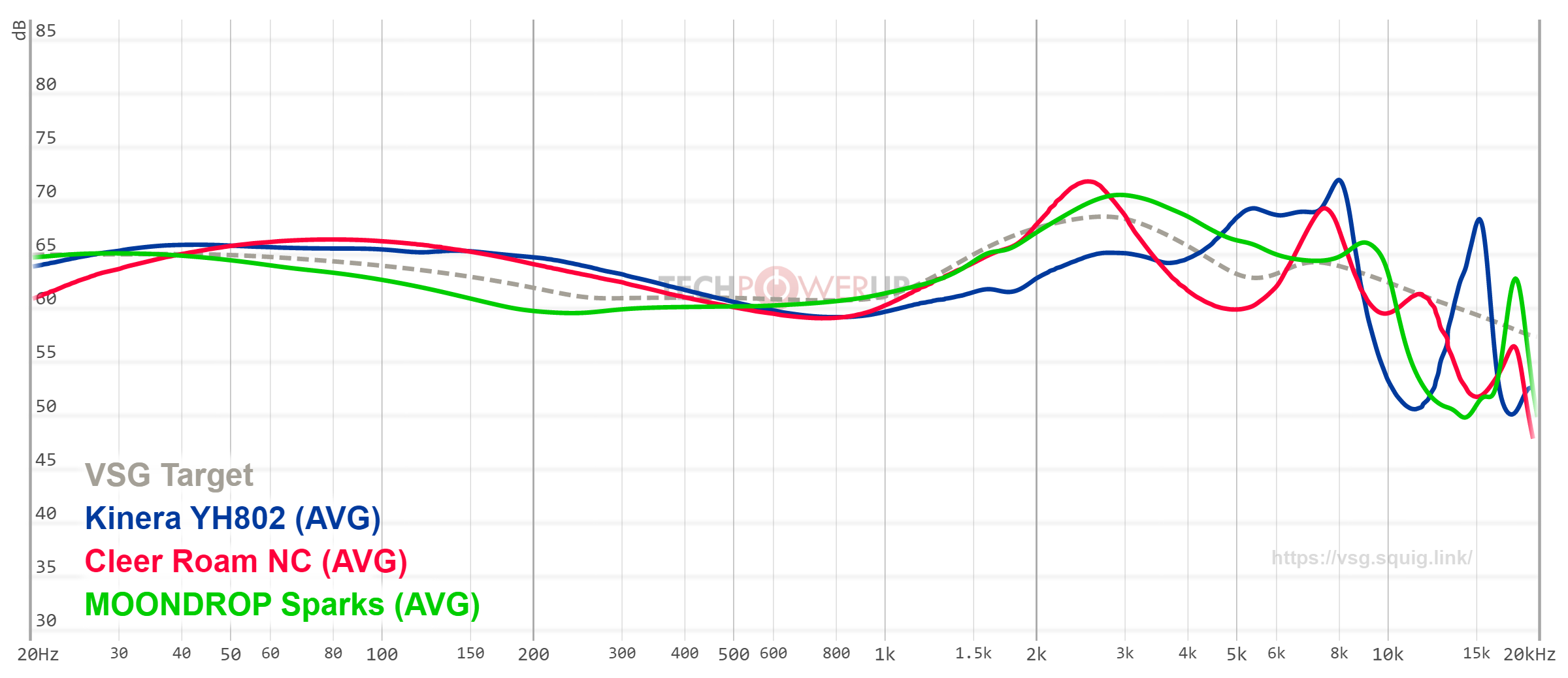
It should by now be evident that I thought the Kinera YH802 performed decently in terms of technicalities, but needs work with its tonality. The technological features, or lack thereof in some cases, mean users will have to go the hard way to EQ the tuning to meet their needs, which typically means it isn't going to happen realistically and is why I am left mostly disappointed with the Kinera YH802. Seen above are two other TWS products that cost far less but are tuned better. The Cleer Roam NC is a warm set similar to the YH802, and has lower sub-bass extension to make it come off more mid-bass focused. It also goes somewhat overboard in the upper mids for some, but executes the mids and treble better than Kinera did overall. The MOONDROP Sparks, on the other hand, is one of the very few well-tuned TWS sets if you are a proponent of the Harman tuning, or at least the MOONDROP VDSF target take on it. It's easily the best-tuned set of the three in my opinion, and hangs well in the technical side compared to the Kinera YH802. I'd take either of the two over the Kinera offering, and they also have native mobile app support for further customization. Then there are the likes of the Lypertek PurePlay Z3 2.0, which simply sweeps the floor with the YH802 in all regards except for aesthetics—the area that Kinera has made its own.
Nov 16th, 2026 01:25 CST
change timezone
Latest GPU Drivers
New Forum Posts
- Your PC ATM (36442)
- Will zen 6 mobos have anything extra vs current ones? (47)
- GPU Temperatures Rise Very Quickly in FurMark – Is This Normal? (9)
- [Community Benchmark] MrH OpenCL Benchmark 2.0e (Windows Only – CPU & GPU) (3)
- The Official Thermal Interface Material thread (2301)
- Asus Rog Maximus Z890 Extreme. (Various questions). (26)
- It’s been fascinating times in Retro agian r36s isn’t even worth 50-65 dollars no more and newly listed Rm36 64gb 4in IPS models for only 34 dollars. (6)
- Power supply noise stops when I move the mouse (10)
- Can you guess Which game it is? (320)
- What is the latest game you finished or 100% (203)
Popular Reviews
- ASUS ROG Strix B850-I Gaming Wi-Fi7 W Review
- Corsair HX1000i Shift Crystal Review
- AMD Zen 6 Technical Deep Dive
- Upcoming Hardware Launches 2027 (Updated Nov 2026)
- Montech King 95 3D PRO Review
- NZXT C1200 Platinum Review
- Phantom Blade Zero Performance Benchmark Review - 35 GPUs Tested
- AMD Ryzen 7 9800X3D Review - The Best Gaming Processor
- NZXT H5 Review
- NZXT H7 RGB+ Review
TPU on YouTube
Controversial News Posts
- NVIDIA Co-Founder and CEO Jensen Huang Officially Resigns (430)
- Open Letter Asking NVIDIA to Reinstate Jensen Huang Passes 115,000 Signatures (184)
- OpenAI CEO Argues Home PCs Waste the World's Limited DRAM Supply (152)
- NVIDIA Launches Investigation Into Jensen Huang's Relationship With Suspected Chinese Spy (136)
- Intel "Raptor Lake Next" 16-Core and 20-Core CPUs Surface (130)
- Legendary Game Studio BioWare Shuts Down Following EA Layoffs (104)
- Dell CEO Says the Memory Shortage Will Get Worse in 2027 (95)
- NVIDIA GeForce RTX 50-Series Scheduled for up to $500 Price Hike This Week (89)