 8
Lexar Hades OC RGB DDR4-3600 2x 16 GB Review
(8 Comments) »Introduction

Those who have found themselves in a local electronics store looking for a USB flash drive over the past decade might have seen Lexar-branded products on shelves. In the early days of home PCs, the company was a pioneer in flash memory. Later bought and owned by Micron Technology, the company again went up for sale in 2017. Longsys became the new owner, quickly expanding sales globally with numerous new product launches by rebranding some of the company's prior best sellers. Lexar has been known for its quality flash memory products for a number of years, which certainly holds true for many of the company's professional PRO line of flash memory products.
DDR4 has reached full maturity in the last year with kits coming out that give a new meaning to the word performance. However, a majority of consumers are not interested in buying the bleeding edge of today's technological advancements. Instead, many are looking for products that are more aesthetically pleasing and less of a hit to the wallet. This is not to say performance memory does not have its place among computer enthusiasts; however, it generally takes considerable time to get these types of kits operational at their respected frequencies and timings. Dealing with manually tweaking settings in the BIOS is why most of the market for DDR4 is not top-tier. If at all possible, less hassle and being Plug and Play is ideal.
Lexar once again is pushing into new territory with RGB-enhanced memory kits for home computers. These kits are sold as either 3200 MT/s or 3600 MT/s in 16 GB or 32 GB configurations. In this review, we will cover the Hades OC RGB 32 GB (2x 16 GB) kit rated for 3600 MT/s. Lexar's RGB portion supports lighting control software developed by the major motherboard manufacturers, including ASUS Aura Sync, GIGABYTE RGB Fusion, MSI Mystic Light Sync, and ASRock Polychrome Sync.

The Lexar Hades OC RGB kit I have for review today follows the new mid-tier standard for timings using 18-22-22-42 at a modest 1.35 V. This change is due to many of the ICs that have the ability for tighter timings either being reserved for premium kits for their wide binning range or simply being EOL and no longer in production. Going forward, we will start to see a lot more mainstream memory kits using similarly loose timings. Now that we know what we are reviewing, it is time to see what makes this Lexar kit stand out in an overcrowded market.
Specifications
| Specifications | |
|---|---|
| Manufacturer: | Lexar |
| Model: | LD4BU016G-R3600UDLH |
| Speed Rating: | DDR4-3600 MT/s |
| Rated Timings: | 18-22-22-42 |
| Tested Capacity: | 32 GB (2x 16GB) |
| Tested Voltage: | 1.35 V |
| PCB Type: | 8 layers |
| Registered/Unbuffered: | Unbuffered |
| Error Checking: | Non-ECC |
| IC Manufacturer: | SpecTek |
| Form Factor: | 288-pin DIMM |
| Warranty: | Lifetime Limited |
Packaging


The Lexar Hades OC RGB DDR4-3600 packaging covers the basics by listing the model, rated speed, and supported RGB motherboard software. However, "Mbps" is not the correct notation for system memory frequency. In fact, it is not an accurate denotation at all. This might be cause for concern for some and not a good start to this review! Not to worry though, my guess is that it is just a typo because it would make sense for flash memory type packaging. Someone simply didn't check with the engineering team before the print run.
Flip it around and the back has information on where to download the Lexar RGB software if you do not want to go with the RGB software provided by many of the motherboard manufacturers. Since this box has no cutout for the DIMM label, what is notable is the lack of any indication of memory timings anywhere on the box, including the barcode label. This makes it impossible to know without opening the packaging or visiting the Lexar website.

Cut the tape and take a look inside—the memory sticks are kept secure and protected from minor damage with a clamshell inside the outer box.
A Closer Look

The Lexar Hades OC RGB sticks have a rigidly angled, rectangular design with the illusion of real depth to the heatspreader if you are looking at it laying flat.
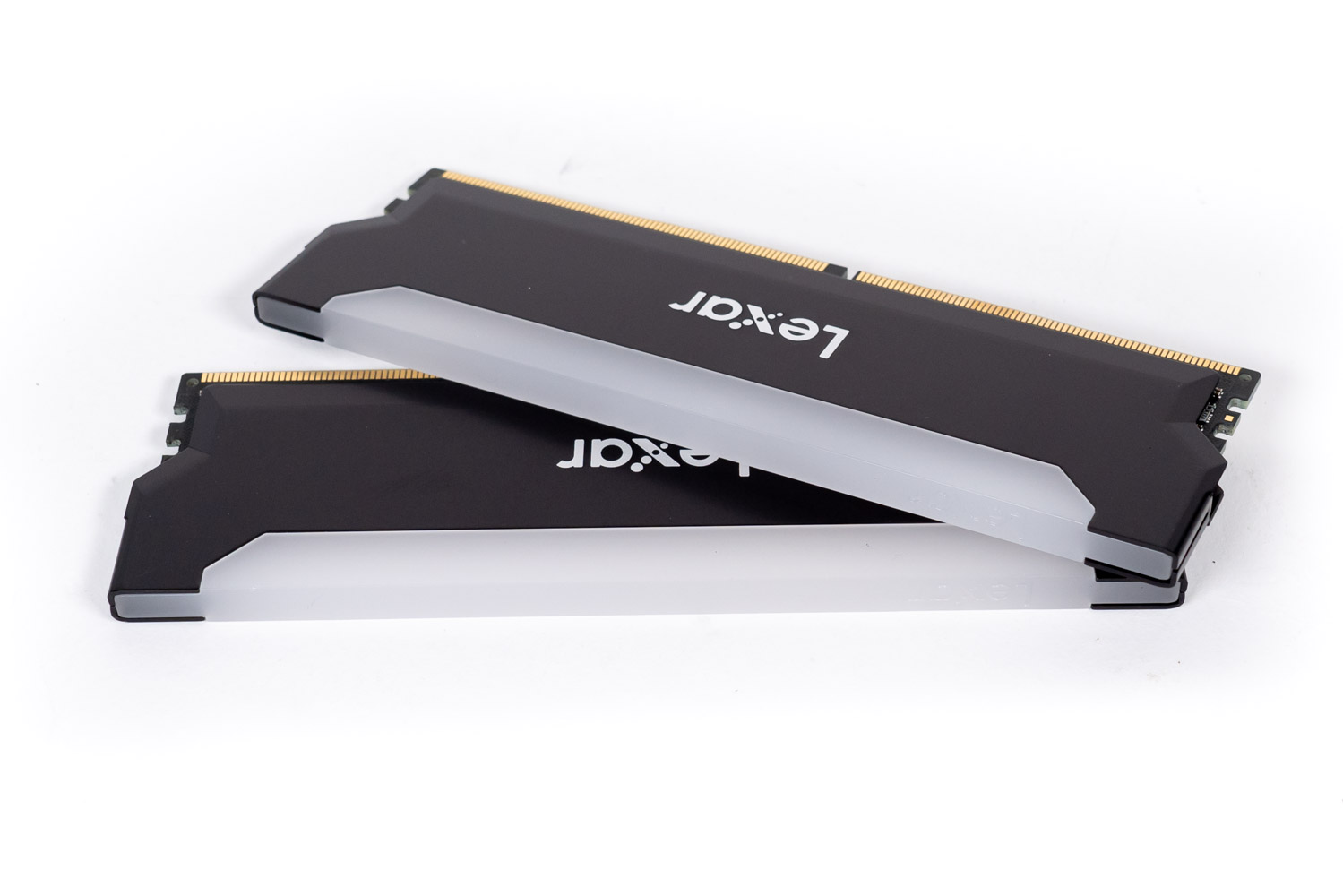
The RGB section on top is an opaque plastic that is flush with the heatspreader, allowing for a flat top and even soft lighting to spread and remove any direct harshness from each LED when lit up. This is personal preference, of course, but having single bright LEDs directly in your eyesight is distracting to say the least.

The heatspreader has a nice brushed metal finish and "Lexar" logo in the center of each side.

These DIMMs are labeled as 3600 M/T for the XMP profile using 18-22-22-42 timings and 1.35 V. This is an ideal starting point for AMD Zen 2 (3000 Series) and Zen 3 (5000 Series) Ryzen-based systems, mainly due to Infinity Fabric supporting 1800 MHz without the need for much or any additional voltage to the SoC. It is Plug and Play for the majority of these CPUs. The loose timings aren't that impressive, but 1800 MHz is a good starting point for PC performance enthusiasts.
On a second pass I noticed that the memory is mislabeled on the stick. PC4-3600 is incorrect. It should be PC4-28800 for DDR4 3600 MT/s since the number after "PC4" is the theoretical bandwidth of one DIMM in megabytes per second.

These are single-sided DIMMs with 8x 2 GB ICs. Instead of being dual-rank, it is still single-rank. An interesting design choice. Advantages of sticking to single rank are reduced access command latency when accessing data from the same group of banks and less stress on the CPU. However, this is often offset by looser timings and longer refresh cycles due to the density increase for each IC to fit on a single side of the PCB.
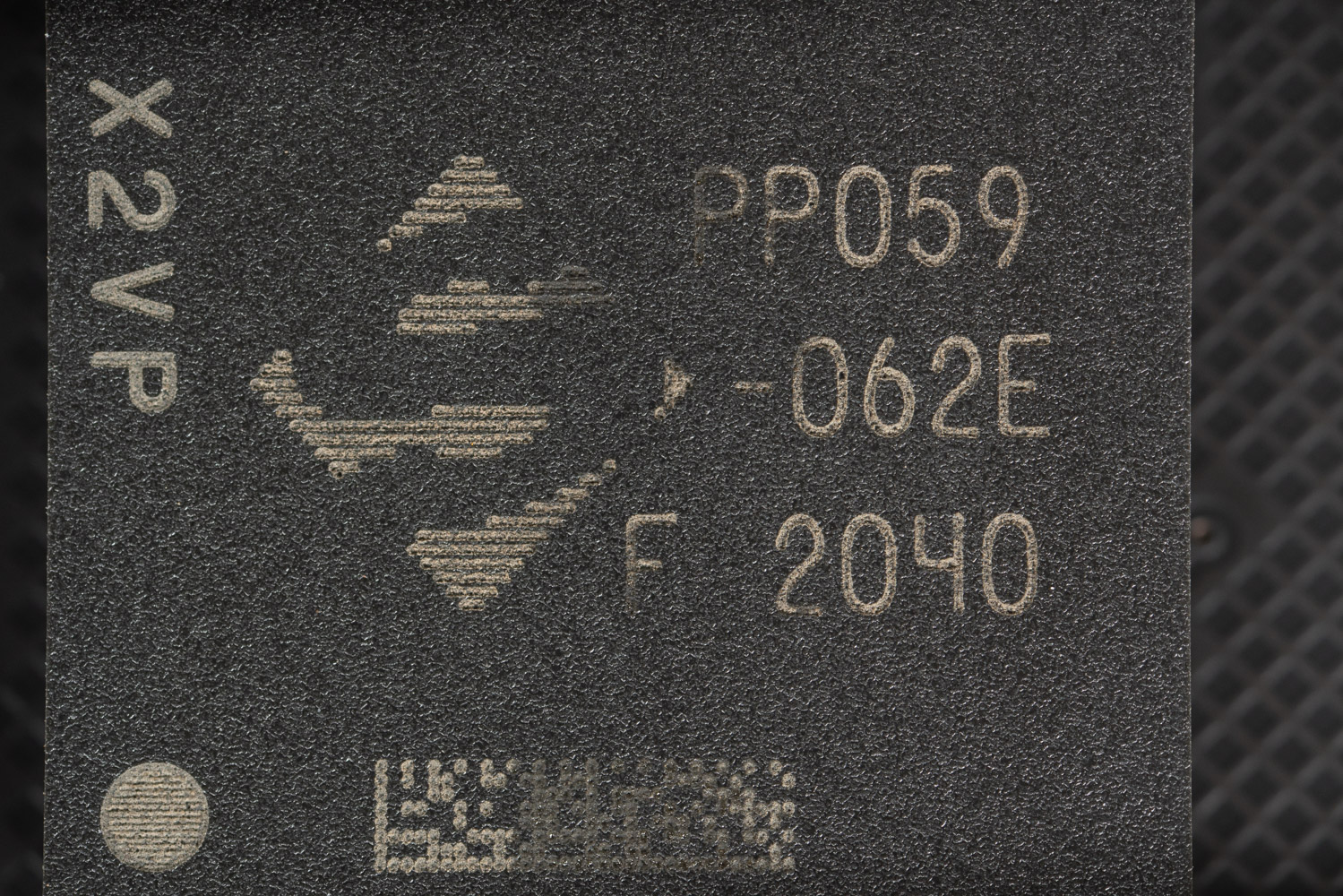
I was curious to see who the IC manufacturer was, which Lexar blanked out in the SPD data, leaving only the primary timings as a hint of what these could be. Lo and behold, I still do not know. That is officially due to the part number not getting a ping on the interwebs. These are not branded with a Lexar logo even though they are clearly just sourced, which makes my job a bit easier. A good hint is the big "S" for SpecTek, a Micron division who sources and sells what are considered generally lower-binned Micron ICs.
If you look closely at each IC, you can see a type of serial number on the side; V934, RNPG, X2VP, RNPG, VCF3, VCF3, T62R, or TGK4. According to these identifications, four of the eight SpecTek ICs on this DIMM came from different batches. Otherwise, they would all match, having come from the same tape reel.
I asked the Lexar representative, who could not confirm my findings due to the nature of how these are sourced. It is common for vendors to buy ICs in large quantities from different manufacturers and bin accordingly. Therefore, the next batch may use another manufacturer's ICs, or the same brand is sourced for the entire product cycle. It is impossible to know from this side of the table.
In all honesty, this only matters if you are into overclocking or tightening up the primary timings. A revision number on the DIMMs like Corsair uses would have been a nice touch to give you a heads up on what to expect. I do not see any issues that may come up from normal use, especially at the modest 1.35 V operating voltage. Remember these are backed by a limited lifetime warranty from Lexar. Just don't expect amazing overclocking abilities from SpecTek ICs.


The Lexar Hades OC RGB comes in at 48 grams on my scale, which is on the lighter side. For height, it is 45 mm when rounding up with my calipers. The ideal height is 40 mm or below for the widest range of compatibility with air coolers. I also suggest checking with the manufacturer for whatever air cooler you intend to use. Often, all you need to do is raise the attached fan height; other times, the actual heatsink fin-stack is in the way, preventing installation of the DIMMs altogether.
Our Patreon Silver Supporters can read articles in single-page format.
Nov 21st, 2026 11:36 PST
change timezone
Latest GPU Drivers
New Forum Posts
- UPS what one to get? (21)
- Can you guess Which game it is? (343)
- RX 580 2048SP 8GB - SK Hynix - Brand Unknown - BIOS Needed (0)
- Zen 3 IF/IMC degradation (243)
- State of the HPC-AI Market 2026: Processing Elements (0)
- 1 - 5 person file storage server equivalent accasible from anywhere + general VM server. (3)
- Honestly, do you care about GTA VI? (225)
- RX 9000 series GPU Owners Club (2251)
- Windows 11 General Discussion (7746)
- How to prevent OLED burn damage due to PC freezes or power outtages? (51)
Popular Reviews
- Microsoft Surface Laptop Ultra Review - The Next-gen Arm Laptop
- Ugreen NASync DXP4800 GT Review
- Corsair RM1200e (Second Generation) Review
- Pulsar Office Tour & First Look at P1 Dual-Sensor Mouse
- Upcoming Hardware Launches 2027 (Updated Nov 2026)
- Acemagic Retro X3 Review
- Biwin Black Opal NV7400 2 TB Review
- AMD Ryzen 7 9800X3D Review - The Best Gaming Processor
- AMD Zen 6 Technical Deep Dive
- Chieftec Iceberg PRO 360 DARK Review
TPU on YouTube
Controversial News Posts
- NVIDIA Co-Founder and CEO Jensen Huang Officially Resigns (492)
- Report: Jensen Huang Eyes NVIDIA Comeback (260)
- Open Letter Asking NVIDIA to Reinstate Jensen Huang Passes 115,000 Signatures (184)
- OpenAI CEO Argues Home PCs Waste the World's Limited DRAM Supply (152)
- NVIDIA Launches Investigation Into Jensen Huang's Relationship With Suspected Chinese Spy (136)
- Intel "Raptor Lake Next" 16-Core and 20-Core CPUs Surface (130)
- NVIDIA GeForce RTX 50-Series Scheduled for up to $500 Price Hike This Week (89)
- Intel Razor Lake Gets a 12 P-Core bLLC Chip With No E-Cores, Per Leak (86)