 7
Lian Li Edge Platinum V2 1350 W Review
Value & Conclusion »Result Summary
| Full-Range Load Testing (230 V) | |||||||||
|---|---|---|---|---|---|---|---|---|---|
| All-rail Load | 12 V | 5 V | 3.3 V | Power (DC/AC) | Efficiency | Fan Speed | Noise Level | Power Factor | |
| 0 % | 0.00 A | 0.00 A | 0.00 A | 0.00 W | 0.00 % | Fan Stop | 0.24 | ||
| 11.99 V | 5.02 V | 3.32 V | 6.30 W | ||||||
| 5 % | 5.62 A | 4.00 A | 6.06 A | 67.50 W | 81.95 % | Fan Stop | 0.83 | ||
| 12.01 V | 5.02 V | 3.32 V | 82.90 W | ||||||
| 10 % | 11.25 A | 4.00 A | 6.06 A | 135.00 W | 87.91 % | Fan Stop | 0.92 | ||
| 12.00 V | 5.02 V | 3.32 V | 154.70 W | ||||||
| 20 % | 22.50 A | 4.00 A | 6.06 A | 270.00 W | 91.16 % | Fan Stop | 0.96 | ||
| 11.99 V | 5.01 V | 3.31 V | 299.00 W | ||||||
| 30 % | 33.75 A | 4.00 A | 6.06 A | 405.00 W | 91.99 % | Fan Stop | 0.97 | ||
| 11.97 V | 5.01 V | 3.31 V | 445.50 W | ||||||
| 40 % | 45.00 A | 4.00 A | 6.06 A | 540.00 W | 92.26 % | Fan Stop | 0.98 | ||
| 11.95 V | 5.01 V | 3.31 V | 593.70 W | ||||||
| 50 % | 56.25 A | 4.00 A | 6.06 A | 675.00 W | 92.33 % | 668 RPM | 26.1 dBA | 0.98 | |
| 11.94 V | 5.00 V | 3.31 V | 743.30 W | ||||||
| 60 % | 67.50 A | 4.00 A | 6.06 A | 810.00 W | 92.34 % | 754 RPM | 26.4 dBA | 0.98 | |
| 11.92 V | 5.00 V | 3.30 V | 894.00 W | ||||||
| 70 % | 78.75 A | 4.00 A | 6.06 A | 945.00 W | 91.87 % | 900 RPM | 27.2 dBA | 0.98 | |
| 11.90 V | 5.00 V | 3.30 V | 1051.00 W | ||||||
| 80 % | 90.00 A | 4.00 A | 6.06 A | 1080.00 W | 91.51 % | 1234 RPM | 28.4 dBA | 0.98 | |
| 11.89 V | 5.01 V | 3.30 V | 1209.00 W | ||||||
| 90 % | 101.25 A | 4.00 A | 6.06 A | 1215.00 W | 91.28 % | 1457 RPM | 29.5 dBA | 0.98 | |
| 11.87 V | 5.02 V | 3.30 V | 1367.00 W | ||||||
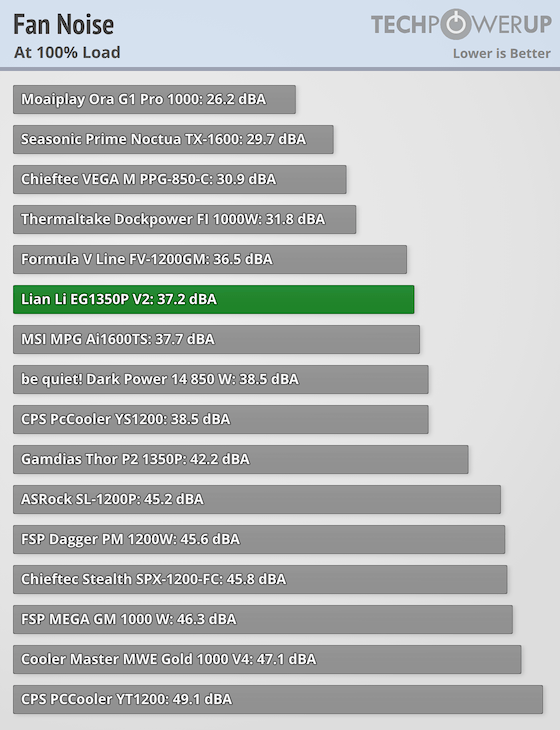
| 100 % | 112.50 A | 4.00 A | 6.06 A | 1350.00 W | 90.91 % | 1800 RPM | 37.2 dBA | 0.99 | |
| 11.86 V | 5.02 V | 3.30 V | 1529.00 W | ||||||
| 110 % | 123.75 A | 4.00 A | 6.06 A | 1485.00 W | 90.50 % | 2022 RPM | 42.5 dBA | 0.99 | |
| 11.84 V | 5.03 V | 3.30 V | 1694.00 W | ||||||
Efficiency
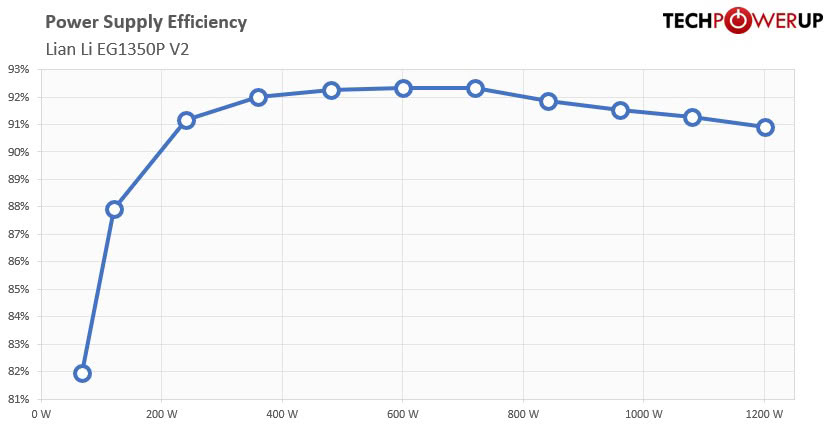
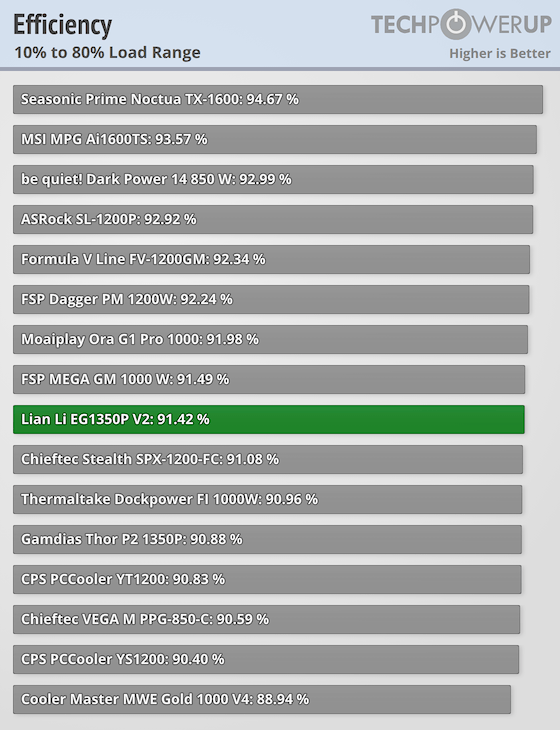
This is a solid efficiency result, performing well at low to mid-range loads and not dropping off too steeply as the load approaches full rated power.
This supply is rated as 80 Plus Platinum; however, this will be based on the 115 V measurements. Lian Li do not provide an 80 Plus rating at 230 V, so we will compare the measurements to the nearest standard that it passes.
| Rated Efficiency Validation (230 V) | ||||
|---|---|---|---|---|
| Certification: 80 Plus Gold | ||||
| Test Load | Required | Measured | Margin | Status |
| 20% | 90.00 % | 91.16 % | +1.16 % | Pass |
| 50% | 92.00 % | 92.33 % | +0.33 % | Pass |
| 100% | 89.00 % | 90.91 % | +1.91 % | Pass |
These results are actually quite close to an 80 Plus Platinum 230 V rating, with 20% only being 0.81% off, and 100% actually clearing by 0.91%; just the 50% result holds it firmly in the Gold standard at 230 V.
Fan Noise
Voltage Regulation
All ATX PSUs have a voltage regulation feedback loop, which increases the PWM duty cycle for each rail to account for voltage drop when current is drawn. However, most PSUs only measure voltage at the PSU output, rather than at the end of the cable going to the load. This means any voltage drop across the cable is not automatically adjusted for. The ATX 3.1 specification outlines a maximum allowed voltage drop at the load itself to ensure system stability.| Voltage Regulation & ATX 3.0 Compliance | |||||
|---|---|---|---|---|---|
| Test Load | Rail | Measured | ATX 3.0 Spec Limit | Margin | Status |
| Idle (0%) | +12V | 11.99 V | +5% / -8% | -0.08 % | Pass |
| +5V | 5.02 V | ±5% | +0.40 % | Pass | |
| +3.3V | 3.32 V | ±5% | +0.61 % | Pass | |
| 100% Load | +12V | 11.86 V | +5% / -8% | -1.17 % | Pass |
| +5V | 5.02 V | ±5% | +0.40 % | Pass | |
| +3.3V | 3.30 V | ±5% | 0.00 % | Pass | |
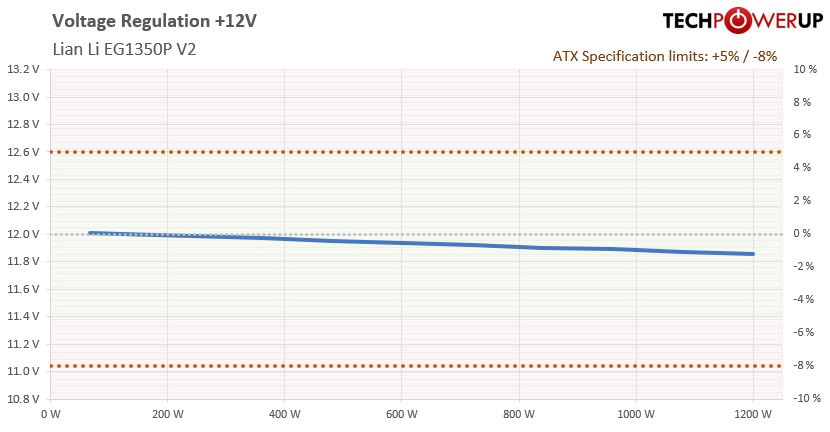
All rails are kept lovely and stable throughout testing, and all are well within ATX specification.
Cable Quality
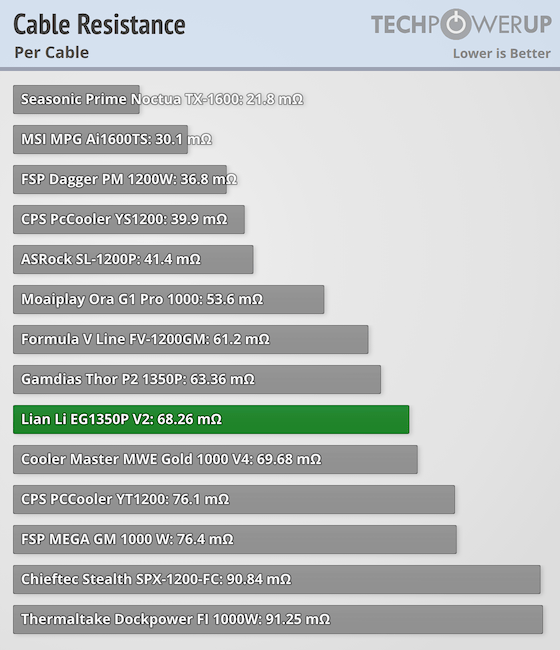
Although voltage regulation inside modern PSUs is extremely stable, voltage drop and thus power losses will occur across the cables as current is drawn through them. This results in a lower voltage available to the system components than what is actually measured at the PSU outputs. Thicker cables will cause less voltage drop and more power to the components. Any power lost across the cables is wasted as heat in the wire itself. By measuring the voltage drop at a known load, we can calculate the resistance of the cables.| Cable Losses at Full Load | |
|---|---|
| Applied 12 V Load | 112.50 A |
| Measured @ Supply | 12.02 V |
| Measured @ Load | 11.86 V |
| Power Lost in Cable | 18.00 W |
| Per-Cable Resistance | 68.26 mΩ |
| Cable Temperature | 46.5 °C |
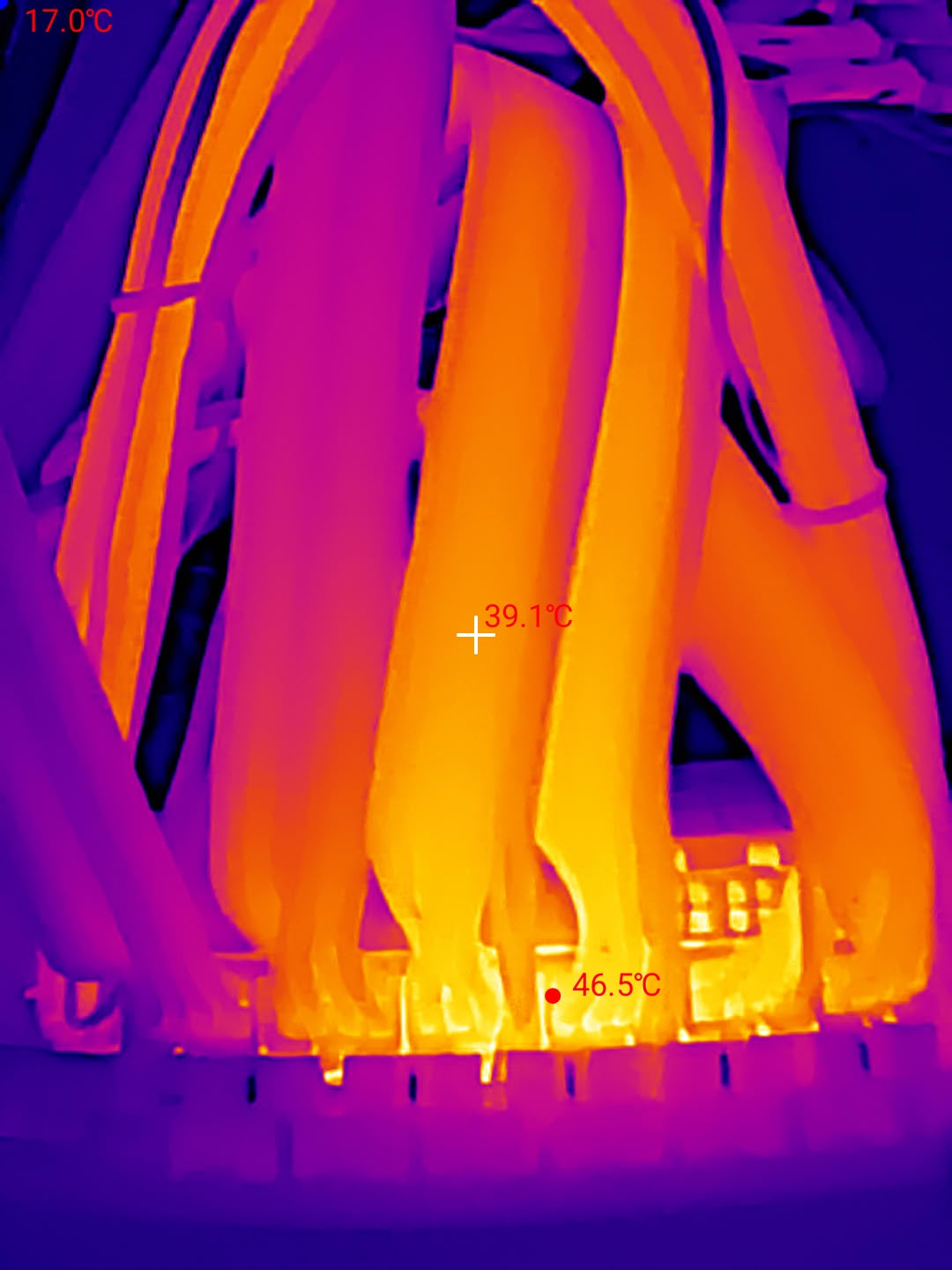
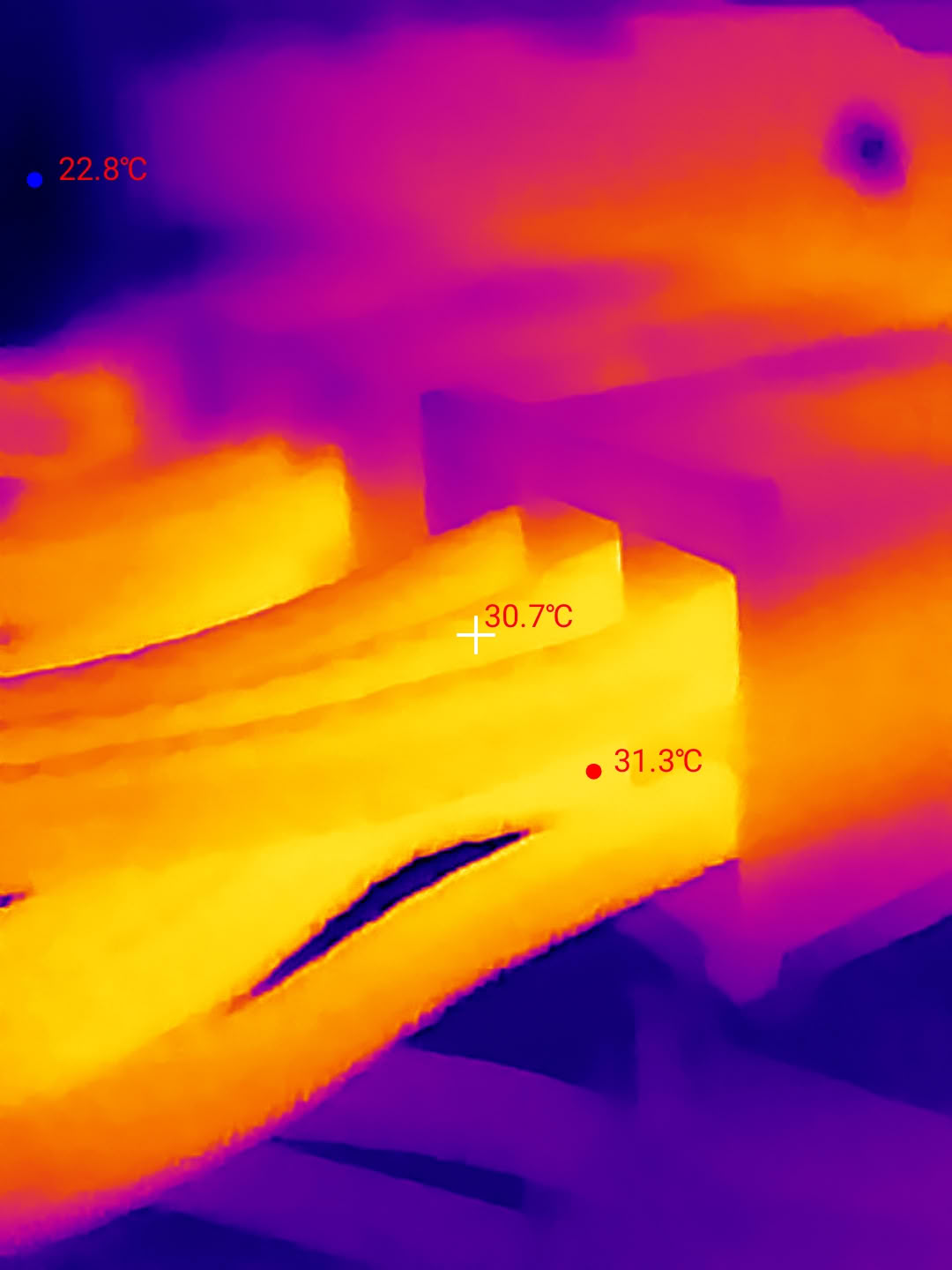
Cable resistance is overall okay, although the current seems to favor the center connectors on the PSU, leading to higher temperatures than elsewhere.
| 12V2X6 Cable Resistance | |
|---|---|
| Applied 12 V Load | 600 W 50 A |
| Measured @ Supply | 12.00 V |
| Measured @ Load | 11.86 V |
| Power Lost in Cable | 13.50 W |
| Per-Cable Resistance | 64.84 mΩ |
| Cable Temperature | 37.6°C |
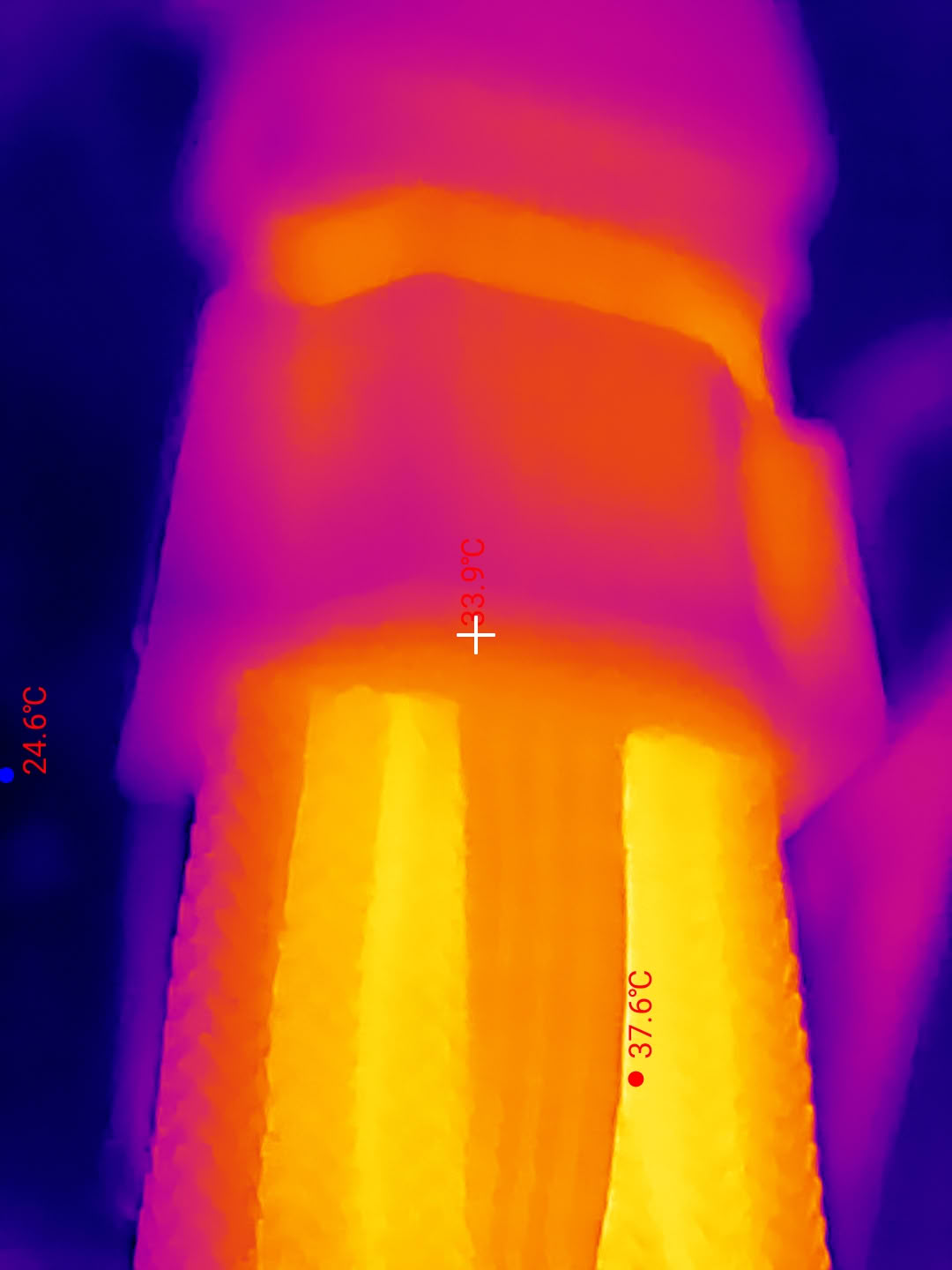
Testing the 12V-2x6 connector alone at 600 W, we can see that the wire gauge and resistance are the same as the other power cables. Temperature and power loss are both acceptable and should not be a concern.
Ripple
Ideally you want the DC voltage delivered by your power supply to be a completely flat line when looking through an oscilloscope. However, due to the switching nature of the ATX power supply and the less than ideal real world behavior of all the components involved, we get very small fluctuations in the voltage output, known as ripple and noise. The ATX spec allows a ripple of up to 120 mV for the +12 V rail and 50 mV for the minor rails.| Ripple (mV) | ||||
|---|---|---|---|---|
| Test Load | 12 V | 5 V | 3.3 V | Status |
| 5% | 17 mV | 8 mV | 14 mV | Pass |
| 10% | 15 mV | 9 mV | 12 mV | Pass |
| 20% | 18 mV | 12 mV | 11 mV | Pass |
| 30% | 23 mV | 12 mV | 12 mV | Pass |
| 40% | 19 mV | 12 mV | 16 mV | Pass |
| 50% | 25 mV | 16 mV | 16 mV | Pass |
| 60% | 27 mV | 14 mV | 17 mV | Pass |
| 70% | 25 mV | 13 mV | 18 mV | Pass |
| 80% | 28 mV | 17 mV | 20 mV | Pass |
| 90% | 28 mV | 18 mV | 17 mV | Pass |
| 100% | 30 mV | 16 mV | 18 mV | Pass |
| 110% | 33 mV | 16 mV | 19 mV | Pass |
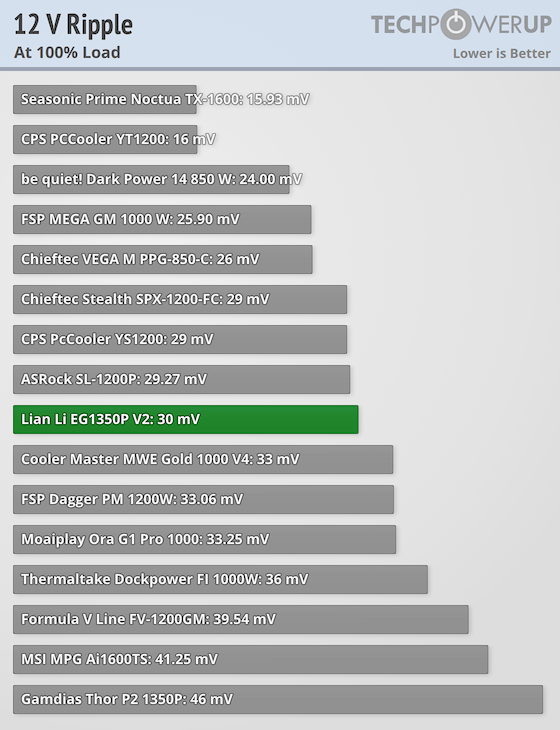
This is a solid ripple control result considering the power density and layout of this model. There should be no concerns here on any of the three main rails regardless of load.
Short Circuit Protection
Short circuit protection is one of the most fundamental and important protections for a power supply. If a short circuit is detected on any rails, the PSU should turn off and prevent damage to itself and other components.| Short Circuit Protection | |
|---|---|
| +12 V rail | Operational |
| +5 V rail | Operational |
| +3.3 V rail | Operational |
SCP worked as expected with the unit.
Nov 16th, 2026 04:32 CST
change timezone
Latest GPU Drivers
New Forum Posts
- Advice for my PC upgrade (1)
- What can the FX 8320 do today? Here is the answer. (61)
- GPU Temperatures Rise Very Quickly in FurMark – Is This Normal? (13)
- I pushed the limits with an AMD Ryzen 7 5700G Apu (1)
- a note from zachary85's son (10)
- Is a C6K 2026 or a400m worth coming from a samsung bu8000 ? (0)
- [Community Benchmark] MrH OpenCL Benchmark 2.0e (Windows Only – CPU & GPU) (4)
- Your PC ATM (36443)
- Asus Rog Maximus Z890 Extreme. (Various questions). (27)
- GIGABYTE - H55N-USB3 ITX Upgrade experience (0)
Popular Reviews
- ASUS ROG Strix B850-I Gaming Wi-Fi7 W Review
- Corsair HX1000i Shift Crystal Review
- AMD Zen 6 Technical Deep Dive
- Upcoming Hardware Launches 2027 (Updated Nov 2026)
- Montech King 95 3D PRO Review
- NZXT C1200 Platinum Review
- Phantom Blade Zero Performance Benchmark Review - 35 GPUs Tested
- AMD Ryzen 7 9800X3D Review - The Best Gaming Processor
- NZXT H7 RGB+ Review
- NZXT H5 Review
TPU on YouTube
Controversial News Posts
- NVIDIA Co-Founder and CEO Jensen Huang Officially Resigns (430)
- Open Letter Asking NVIDIA to Reinstate Jensen Huang Passes 115,000 Signatures (184)
- OpenAI CEO Argues Home PCs Waste the World's Limited DRAM Supply (152)
- NVIDIA Launches Investigation Into Jensen Huang's Relationship With Suspected Chinese Spy (136)
- Intel "Raptor Lake Next" 16-Core and 20-Core CPUs Surface (130)
- Legendary Game Studio BioWare Shuts Down Following EA Layoffs (104)
- Dell CEO Says the Memory Shortage Will Get Worse in 2027 (95)
- NVIDIA GeForce RTX 50-Series Scheduled for up to $500 Price Hike This Week (89)