 6
Montech TEN Review
(6 Comments) »Value and Conclusion
- The Montech TEN has a MSRP of US$69.99 excl. taxes.
- Only $70
- Flexible and adjustable internal layout
- Excellent radiator and GPU support
- Massive cooling potential
- Tool-free panels
- Decent build quality
- Vertical GPU-capable
- Up to two 3.5" hard disk mounts
- Plenty of Velcro cable ties included
- Instructions lack clarity and detail in various areas
- No riser cable included
- Meager CPU air cooler clearance
- ATX PSUs can severely restrict GPU, hard disk and radiator options
- GPU support bracket is poorly designed and not very secure
- Switching layouts can be tedious and time-consuming
- Hard disks only use push-fit mounts so could come loose if case is transported
- Cable tidying and routing can be tricky with no out-of-sight stowage areas
- Not particularly compact
- Fingerprint magnet
- Limited out-of-the-box cooling
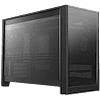
While it might be a far less popular form factor than ATX, we've enjoyed some unique and flexible microATX cases recently that offer a variety of options when it comes to layout, hardware support and even orientation. The Montech Ten focuses more on the former two and really goes to town when it comes to providing ways to maximize hardware support, whether it's leaning towards radiator clearance or four-slot GPUs. It would be pretty easy given its very affordable price tag to end the review here with a glowing recommendation in terms of flexibility and value. That would be doing would-be owners a disservice, because for all its great value, flexibility and hardware support, there are issues that can make the TEN quite hard to get along with. We'll detail those in a minute, but first is the good news. Being able to offer support for the biggest GPUs and at the same time house a 360 mm radiator is an impressive feat for a microATX case. The build quality at this price is decent too, and its tool-free panels sweeten that appeal.
Expecting fan hubs or RGB lighting is unrealistic, but we get removable dust filters, a USB 3.2 Gen 2x2 20 Gbps Type-C port and useful accessories such as Velcro cable ties and a GPU support. There are also well thought-through additions, such as the radiator offset plates and anti-vibration rubber mounts on the side panels. It just feels like you're dealing with more than a metal box, and something someone who knew what they were doing has actually put some effort into designing. Of course, the TEN's primary feature is its adjustable layout, but it's also part of its biggest flaws. There are almost too many positives and negatives to count here, but overall it's an innovative albeit complex approach to catering to three different hardware requirements. Complex here mostly means that for a newcomer, it's likely to be quite tricky and daunting to wrap your head around.
The best parts are arguably M2 and I3 modes, or in other words, liquid cooling and Mini-ITX focused modes. These offer exceptional radiator and GPU support, and in M2 mode, horizontal GPU mode does not require a riser cable. This is where much of the praise ends and criticism begins. So many of the TEN's configurations require a riser cable that not including one in the box feels like the wrong choice, even though the low price was clearly a priority. I3 mode for example, needs a riser cable wherever you put the GPU. The M1 or air-cooling mode doesn't really excel as much as the other two modes in that despite its shortcomings, it offers no more CPU clearance than the M2 liquid cooling mode. Even that, at just 155 mm, is going to be quite restricting too, although there are admittedly plenty of decent coolers at all price points that will fit.
As mentioned a few times, using an ATX PSU will massively reduce the case's flexibility depending on the mode you're in. And this is the crux of the case's big problem. The manual, website and videos aren't nearly detailed enough on aspects such as the impact of PSU size and comments we've seen there seem to agree too. It took a day of working with the case and pulling it apart, switching between modes and moving PSU enclosures, GPUs and radiators around to get a clear picture of how things work, but for someone looking to build a PC in an hour as you would with a normal case, things could quickly become frustrating. Thankfully, the issue isn't with the case itself, it's with what information is on offer to help you plan your build. The simple fact is the competition does this guidance better, even with similarly-flexible cases, which usually make it very clear what PSU you should opt for, how this impacts other hardware, and what cooling and storage hardware you can fit inside. Several scenarios encountered aren't mentioned in the manual at all, so we can absolutely understand any frustration for owners or would-be owners. If anything, Montech undersells its flexibility as a result. Some well-made and detailed 3D render videos could have been a huge help here.
The TEN is also not particularly compact. It's close to 30 liters with protrusions and even the main chamber on its own is over a liter bigger than the Lian Li B4-mATX - itself not a particularly small case, and the TEN has a larger footprint too. The Lian Li case can also switch to vertical tower mode and take up even less desk space, besides having greater CPU cooler clearance. But it simply can't compete with the TEN in terms of GPU depth and length and possible fan and radiator mounts and clearances. Bigger simply results in better in that sense.
As well as recommending an SFX PSU, it's also necessary to add additional fans. The Lian Li case's extra fan, albeit a slim one, did see lower temperatures in most tests and the NZXT H2 Flow in a couple too despite one of its panels being glass. Overall, though, the TEN is a mostly fun and flexible case to work with, but you'll need to dedicate a weekend rather than just a couple of hours to get the most out of it, and be prepared to raise more than a few eyebrows at the instruction manual. Once you get the hang of it, though, its smiles per dollar are practically unbeatable.


Expecting fan hubs or RGB lighting is unrealistic, but we get removable dust filters, a USB 3.2 Gen 2x2 20 Gbps Type-C port and useful accessories such as Velcro cable ties and a GPU support. There are also well thought-through additions, such as the radiator offset plates and anti-vibration rubber mounts on the side panels. It just feels like you're dealing with more than a metal box, and something someone who knew what they were doing has actually put some effort into designing. Of course, the TEN's primary feature is its adjustable layout, but it's also part of its biggest flaws. There are almost too many positives and negatives to count here, but overall it's an innovative albeit complex approach to catering to three different hardware requirements. Complex here mostly means that for a newcomer, it's likely to be quite tricky and daunting to wrap your head around.
The best parts are arguably M2 and I3 modes, or in other words, liquid cooling and Mini-ITX focused modes. These offer exceptional radiator and GPU support, and in M2 mode, horizontal GPU mode does not require a riser cable. This is where much of the praise ends and criticism begins. So many of the TEN's configurations require a riser cable that not including one in the box feels like the wrong choice, even though the low price was clearly a priority. I3 mode for example, needs a riser cable wherever you put the GPU. The M1 or air-cooling mode doesn't really excel as much as the other two modes in that despite its shortcomings, it offers no more CPU clearance than the M2 liquid cooling mode. Even that, at just 155 mm, is going to be quite restricting too, although there are admittedly plenty of decent coolers at all price points that will fit.
As mentioned a few times, using an ATX PSU will massively reduce the case's flexibility depending on the mode you're in. And this is the crux of the case's big problem. The manual, website and videos aren't nearly detailed enough on aspects such as the impact of PSU size and comments we've seen there seem to agree too. It took a day of working with the case and pulling it apart, switching between modes and moving PSU enclosures, GPUs and radiators around to get a clear picture of how things work, but for someone looking to build a PC in an hour as you would with a normal case, things could quickly become frustrating. Thankfully, the issue isn't with the case itself, it's with what information is on offer to help you plan your build. The simple fact is the competition does this guidance better, even with similarly-flexible cases, which usually make it very clear what PSU you should opt for, how this impacts other hardware, and what cooling and storage hardware you can fit inside. Several scenarios encountered aren't mentioned in the manual at all, so we can absolutely understand any frustration for owners or would-be owners. If anything, Montech undersells its flexibility as a result. Some well-made and detailed 3D render videos could have been a huge help here.
The TEN is also not particularly compact. It's close to 30 liters with protrusions and even the main chamber on its own is over a liter bigger than the Lian Li B4-mATX - itself not a particularly small case, and the TEN has a larger footprint too. The Lian Li case can also switch to vertical tower mode and take up even less desk space, besides having greater CPU cooler clearance. But it simply can't compete with the TEN in terms of GPU depth and length and possible fan and radiator mounts and clearances. Bigger simply results in better in that sense.
As well as recommending an SFX PSU, it's also necessary to add additional fans. The Lian Li case's extra fan, albeit a slim one, did see lower temperatures in most tests and the NZXT H2 Flow in a couple too despite one of its panels being glass. Overall, though, the TEN is a mostly fun and flexible case to work with, but you'll need to dedicate a weekend rather than just a couple of hours to get the most out of it, and be prepared to raise more than a few eyebrows at the instruction manual. Once you get the hang of it, though, its smiles per dollar are practically unbeatable.
Nov 25th, 2026 17:26 CST
change timezone
Latest GPU Drivers
New Forum Posts
- Which ryzen am5 cpu ? (219)
- {NA} 2026 Black November prices / deal (7)
- TPU's Nostalgic Hardware Club (22208)
- UPS what one to get? (74)
- More Nova Lake specs (5)
- Share your CPUZ Benchmarks! (2680)
- X79 and/or rampage IV OC'ing thread for those of us still left.... (2457)
- Asus Rog Maximus Z890 Extreme. (Various questions). (38)
- Can you guess Which game it is? (362)
- Claude credits purchased on or after Dec. 7 now have an expiry date (13)
Popular Reviews
- ASRock X870E Challenger Wi-Fi White Review
- Microsoft Surface Laptop Ultra Review - The Next-gen Arm Laptop
- VZMORE AX9 Max Review
- Upcoming Hardware Launches 2027 (Updated Nov 2026)
- AMD Ryzen 7 9800X3D Review - The Best Gaming Processor
- AMD Zen 6 Technical Deep Dive
- Corsair RM1200e (Second Generation) Review
- Phantom Blade Zero Performance Benchmark Review - 35 GPUs Tested
- Pulsar Office Tour & First Look at P1 Dual-Sensor Mouse
- Ocypus lota P1000 Review
TPU on YouTube
Controversial News Posts
- Jensen Huang Reinstated as CEO of NVIDIA (571)
- NVIDIA Co-Founder and CEO Jensen Huang Officially Resigns (492)
- Report: Jensen Huang Eyes NVIDIA Comeback (281)
- Open Letter Asking NVIDIA to Reinstate Jensen Huang Passes 115,000 Signatures (184)
- OpenAI CEO Argues Home PCs Waste the World's Limited DRAM Supply (152)
- NVIDIA Launches Investigation Into Jensen Huang's Relationship With Suspected Chinese Spy (136)
- Intel "Raptor Lake Next" 16-Core and 20-Core CPUs Surface (130)
- Intel Razor Lake Gets a 12 P-Core bLLC Chip With No E-Cores, Per Leak (94)