 66
MSI GeForce RTX 3050 Gaming X Review
(66 Comments) »Introduction

MSI's GeForce RTX 3050 Gaming X is the company's most premium version of the GeForce RTX 3050. NVIDIA announced the GeForce RTX 3050 at CES Las Vegas just a few days ago. Earlier this week, the review embargo has lifted, but the MSI RTX 3050 Gaming X was stuck in customs for another day. The GeForce RTX 3050 is the most affordable desktop graphics card based on the Ampere architecture and meant for 1080p gaming with fairly high details—ray tracing is very much possible, but you'll need to tone down the settings or make good use of the DLSS feature. A section of the market will see this more as an affordable Ampere meant for 1080p gaming, particularly e-sports.
The RTX 3050 is based on the same 8 nm GA106 silicon as the RTX 3060, but with huge differences in specifications. While the latter nearly maxes out the GA106, featuring 3,584 out of 3,840 CUDA cores present on the chip, the RTX 3050 is carved out by disabling a third of the streaming multiprocessors (SM), resulting in 2,560 CUDA cores, 20 RT cores, and 80 Tensor cores. Keeping with the theme of "two-thirds," the RTX 3050 only gets 8 GB of memory compared to 12 GB on the RTX 3060. The memory bus width is proportionately narrowed to 128-bit and uses slower 14 Gbps memory chips (compared to 15 Gbps on the RTX 3060).

The most remarkable difference in specifications between the RTX 3050 and RTX 3060 has to be the PCI-Express bus width, which has been halved to PCI-Express 4.0 x8. The GA106 very much does support 16 lanes, and every custom-design board, including this one, has rudimentary PCB traces for all 16 lanes, but only 8 lanes are enabled. NVIDIA explains this by stating that "dropping to 8 PCIe lanes improves supply. It allows us to source a wider variety of chips for the life of the product." In other words, the company is currently consuming all the GA106 inventory that didn't make the cut for the RTX 3060, and in the future could carve RTX 3050 cards out of the smaller GA107 silicon, which physically has 3,072 CUDA cores, a 128-bit GDDR6 memory bus, and, more importantly, an 8-lane PCIe Gen 4 bus. Such a switch should result in no change to performance.
MSI has paired the RTX 3050 Gaming X with a large dual-fan, triple-slot cooling solution. The card draws power from a single 8-pin PCIe power connector. Display outputs include three DisplayPort 1.4a and an HDMI 2.1. The Gaming X is overclocked out of the box, to a rated boost frequency of 1845 MHz, up 68 MHz from the 1777 MHz NVIDIA baseline. In terms of pricing, the card comes at an MSRP of $379, a significant increase over the NVIDIA RTX 3050 MSRP of $250. Currently, the card is listed for $420, out of stock, but Europe has some cards, at €500. We expect a market price of $500 or above.
| Price | Cores | ROPs | Core Clock | Boost Clock | Memory Clock | GPU | Transistors | Memory | |
|---|---|---|---|---|---|---|---|---|---|
| GTX 1650 Super | $400 | 1280 | 32 | 1530 MHz | 1725 MHz | 1500 MHz | TU116 | 6600M | 4 GB, GDDR6, 128-bit |
| GTX 1660 | $480 | 1408 | 48 | 1530 MHz | 1785 MHz | 2000 MHz | TU116 | 6600M | 6 GB, GDDR5, 192-bit |
| RX Vega 56 | $800 | 3584 | 64 | 1156 MHz | 1471 MHz | 800 MHz | Vega 10 | 12500M | 8 GB, HBM2, 2048-bit |
| GTX 1660 Super | $550 | 1408 | 48 | 1530 MHz | 1785 MHz | 1750 MHz | TU116 | 6600M | 6 GB, GDDR6, 192-bit |
| GTX 1660 Ti | $500 | 1536 | 48 | 1500 MHz | 1770 MHz | 1500 MHz | TU116 | 6600M | 6 GB, GDDR6, 192-bit |
| RX 5600 XT | $700 | 2304 | 64 | 1375 MHz | 1560 MHz | 1500 MHz | Navi 10 | 10300M | 6 GB, GDDR6, 192-bit |
| RX 6500 XT | $350 | 1024 | 32 | 2685 MHz | 2825 MHz | 2248 MHz | Navi 24 | 5400M | 4 GB, GDDR6, 64-bit |
| RTX 2060 | $570 | 1920 | 48 | 1365 MHz | 1680 MHz | 1750 MHz | TU106 | 10800M | 6 GB, GDDR6, 192-bit |
| RX 5700 | $950 | 2304 | 64 | 1465 MHz | 1625 MHz | 1750 MHz | Navi 10 | 10300M | 8 GB, GDDR6, 256-bit |
| RTX 2060 Super | $800 | 2176 | 64 | 1470 MHz | 1650 MHz | 1750 MHz | TU106 | 10800M | 8 GB, GDDR6, 256-bit |
| RX Vega 64 | $850 | 4096 | 64 | 1247 MHz | 1546 MHz | 953 MHz | Vega 10 | 12500M | 8 GB, HBM2, 2048-bit |
| RX 5700 XT | $1000 | 2560 | 64 | 1605 MHz | 1755 MHz | 1750 MHz | Navi 10 | 10300M | 8 GB, GDDR6, 256-bit |
| RTX 3050 | $500 MSRP: $250 | 2560 | 32 | 1552 MHz | 1777 MHz | 1750 MHz | GA106 | 12000M | 8 GB, GDDR6, 128-bit |
| MSI RTX 3050 Gaming X | $500 MSRP: $380 | 2560 | 32 | 1552 MHz | 1845 MHz | 1750 MHz | GA106 | 12000M | 8 GB, GDDR6, 128-bit |
| RTX 2070 | $750 | 2304 | 64 | 1410 MHz | 1620 MHz | 1750 MHz | TU106 | 10800M | 8 GB, GDDR6, 256-bit |
| RX 6600 | $570 | 1792 | 64 | 2044 MHz | 2491 MHz | 1750 MHz | Navi 23 | 11060M | 8 GB, GDDR6, 128-bit |
| RTX 3060 | $750 | 3584 | 48 | 1320 MHz | 1777 MHz | 1875 MHz | GA106 | 12000M | 12 GB, GDDR6, 192-bit |
| RTX 2070 Super | $800 | 2560 | 64 | 1605 MHz | 1770 MHz | 1750 MHz | TU104 | 13600M | 8 GB, GDDR6, 256-bit |
| Radeon VII | $800 | 3840 | 64 | 1400 MHz | 1800 MHz | 1000 MHz | Vega 20 | 13230M | 16 GB, HBM2, 4096-bit |
| RX 6600 XT | $600 | 2048 | 64 | 2359 MHz | 2589 MHz | 2000 MHz | Navi 23 | 11060M | 8 GB, GDDR6, 128-bit |
Packaging


The Card
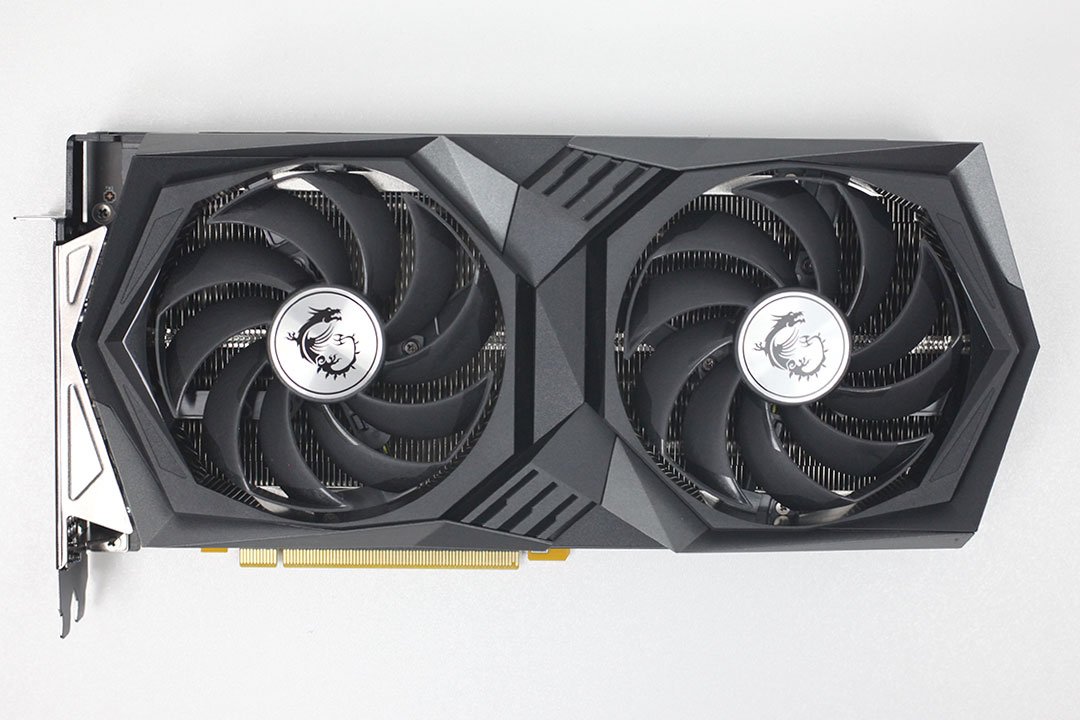


No doubt, this card is instantly recognizable as an MSI graphics card from the GeForce 30 Series. The primary color is black, with silvery highlights on the front and back. On the other side of the card, you'll find a high-quality metal backplate.


Dimensions of the card are 27.5 x 13.0 cm, and it weighs 942 g.


Installation requires three slots in your system.

Display connectivity options include one HDMI 2.1 and three DisplayPort 1.4a ports.

The card has one 8-pin power input. This configuration is rated for up to 225 W of power draw.

The GeForce RTX 3050 does not support SLI.
Teardown


MSI's cooler uses three heatpipes, two of which are extra long. The heatsink base provides cooling for the memory chips and VRM circuitry, too.


Once the main cooler is removed, a metal bar that runs along the top edge becomes visible. It's for stabilization, to protect against warping.


The backplate is made out of metal and protects the card against damage during installation and handling.
High-resolution PCB Pictures
These pictures are for the convenience of volt modders and people who would like to see all the finer details on the PCB. Feel free to link back to us and use these in your articles, videos or forum posts.
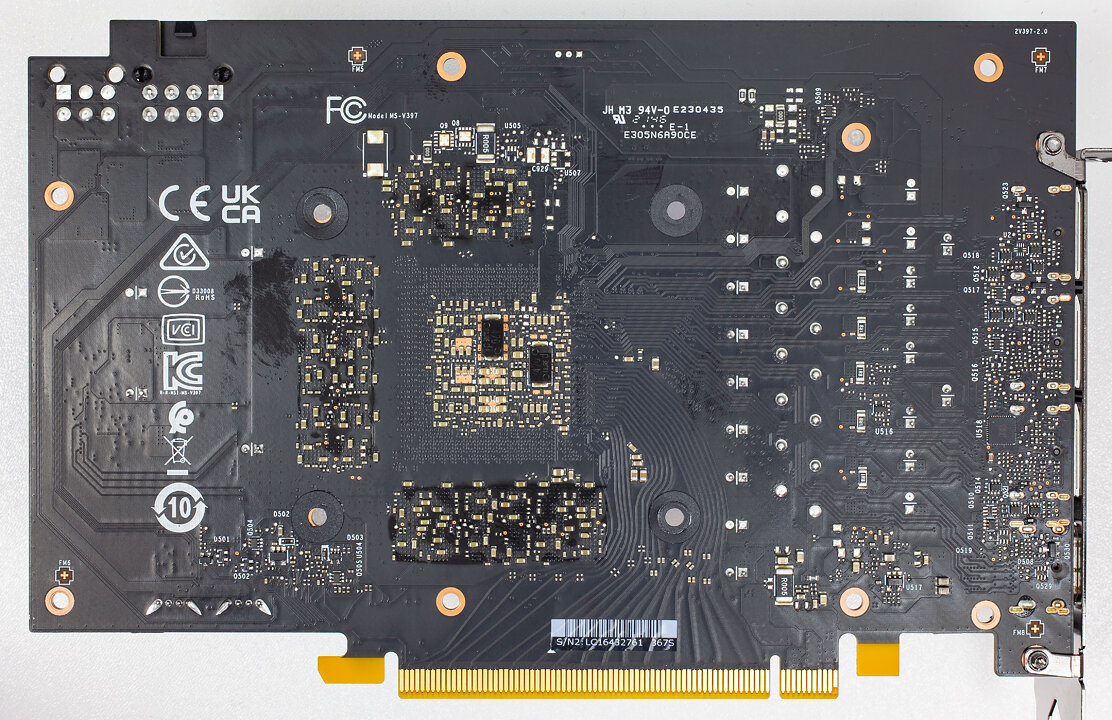
High-res versions are also available (front, back).
Circuit Board (PCB) Analysis


The GPU VRM is a five phase-design controlled by an uPI uP9512R controller.

Alpha and Omega AOZ5332QI DrMOS chips are used for GPU voltage; they are rated for up to 50 A output current.
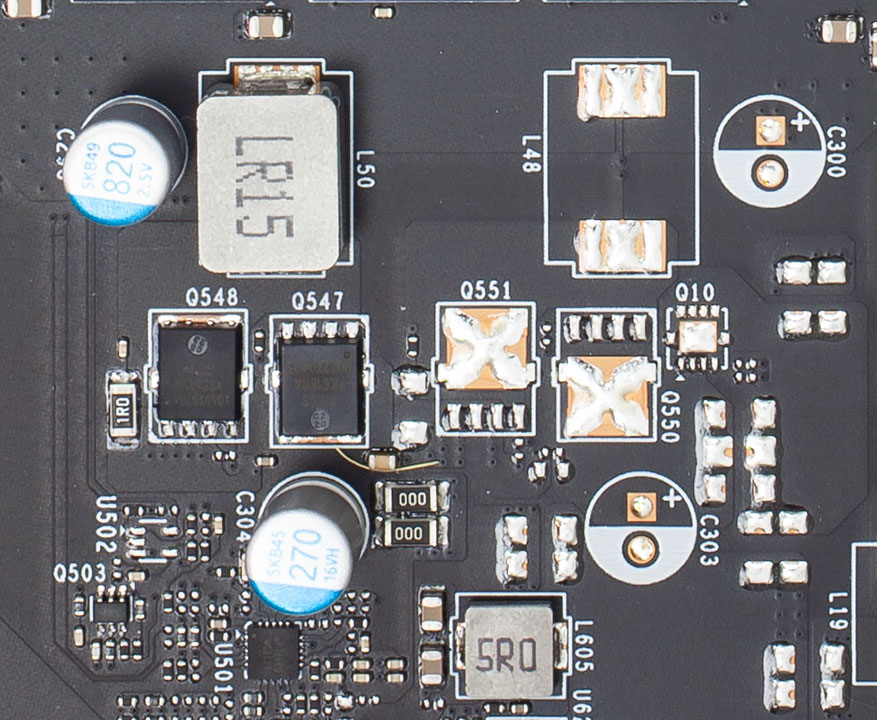

The memory VRM is single-phase and managed by a uPI uP1666Q controller.

For memory, a classic dual MOSFET configuration is used, provided by Nikosem PK698SA and PK9168A, which are rated for 40 A.
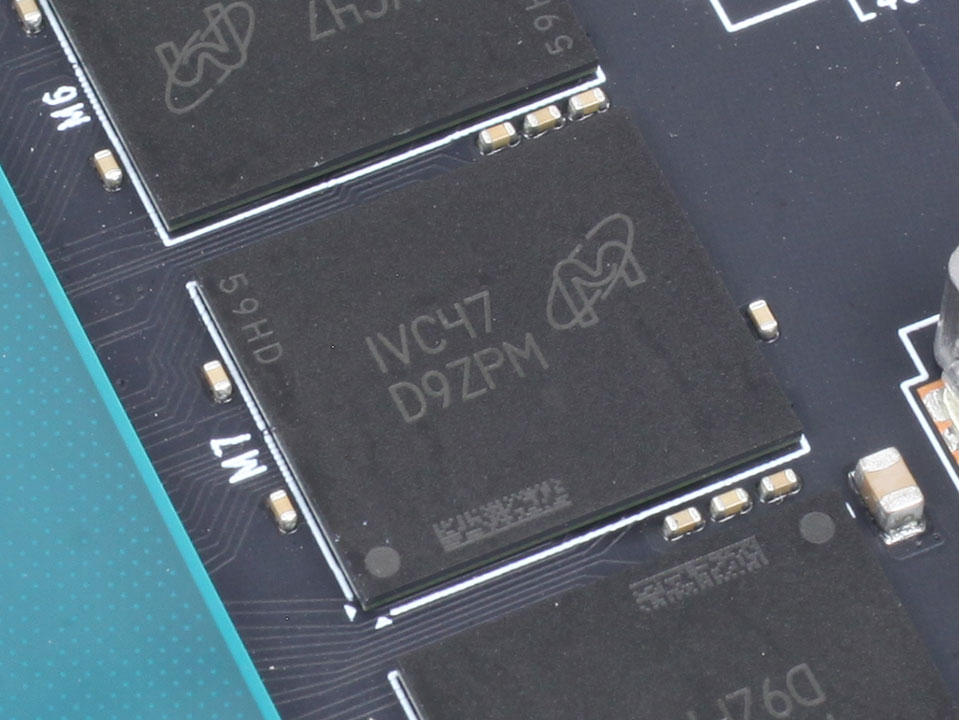
The GDDR6 memory chips are made by Micron and carry the model number D9ZPM, which decodes to MT61K512M32KPA-14:C. They are specified to run at 1750 MHz (14 Gbps GDDR6 effective).

NVIDIA's GA106 graphics processor is made using Samsung's 8 nanometer node and has a transistor count of 12 billion with a die size of 276 mm².
Our Patreon Silver Supporters can read articles in single-page format.
Nov 18th, 2026 10:15 CST
change timezone
Latest GPU Drivers
New Forum Posts
- My Final Barrier to Exclusively Using Linux has Fallen (Azure Virtual Desktops) (0)
- Will zen 6 mobos have anything extra vs current ones? (56)
- Last game you purchased? (1404)
- Time to upgrade CPU and MOBO (27)
- Very unusual two gaming-pc scenarios. (0)
- [Poll] 12V-2x6 Connector Protection: What Are You Using? (WireView / Ampinel / Equalizer / Other / Nothing) (36)
- WarpCoreBench scores! (61)
- X99 Club (188)
- Wireless Internet sharing between PC and router both-ways, is it possible? (16)
- Without Jensen, PC gaming will be (43)
Popular Reviews
- Acemagic Retro X3 Review
- Upcoming Hardware Launches 2027 (Updated Nov 2026)
- AMD Zen 6 Technical Deep Dive
- ASUS ROG Strix B850-I Gaming Wi-Fi7 W Review
- Corsair HX1000i Shift Crystal Review
- Biwin Black Opal NV7400 2 TB Review
- Chieftec Iceberg PRO 360 DARK Review
- AMD Ryzen 7 9800X3D Review - The Best Gaming Processor
- Phantom Blade Zero Performance Benchmark Review - 35 GPUs Tested
- Montech King 95 3D PRO Review
TPU on YouTube
Controversial News Posts
- NVIDIA Co-Founder and CEO Jensen Huang Officially Resigns (474)
- Open Letter Asking NVIDIA to Reinstate Jensen Huang Passes 115,000 Signatures (184)
- Report: Jensen Huang Eyes NVIDIA Comeback (179)
- OpenAI CEO Argues Home PCs Waste the World's Limited DRAM Supply (152)
- NVIDIA Launches Investigation Into Jensen Huang's Relationship With Suspected Chinese Spy (136)
- Intel "Raptor Lake Next" 16-Core and 20-Core CPUs Surface (130)
- Legendary Game Studio BioWare Shuts Down Following EA Layoffs (104)
- Dell CEO Says the Memory Shortage Will Get Worse in 2027 (95)