 44
MSI GeForce RTX 3080 Gaming X Trio Review
(44 Comments) »Introduction

The MSI GeForce RTX 3080 Gaming X Trio is the company's premium offering based on NVIDIA's landmark RTX 3080 "Ampere" graphics card released earlier this week. The Gaming X brand represents a category-defining line of graphics cards by MSI that combine premium factory-overclocked performance with aesthetics that go with contemporary DIY gaming PC builds. The new Gaming X board design sees the use of a large triple-slot, triple-fan cooling solution to tame the overclocked RTX 3080, along with more visible ARGB lighting elements than the previous generation. The company figured out that when installed in the case, the backplate and top of the card are more visible than the front with the fan intakes. We also see better symmetry in the design and arrangement of the three fans.
The GeForce RTX 3080 is being labeled by NVIDIA as their new flagship product, with a promise of bringing AAA 4K UHD gaming with raytracing at price-points previously held by 1440p-class graphics cards. The RTX 3080 is also designed to offer high refresh-rate gameplay at 1440p and 1080p resolutions. The new Ampere graphics architecture by NVIDIA heralds the 2nd generation of the company's path-breaking RTX real-time raytracing technology. NVIDIA perfected a means of combining traditional raster 3D graphics with certain real-time raytraced elements, such as lighting, shadow, reflections, ambient occlusion, and global illumination, to make the hybrid raster+raytraced 3D scene as true to life as possible.

The 2nd generation RTX technology with Ampere sees NVIDIA introduce a new double-throughput CUDA core that can process concurrent FP32+INT32 operations; the 2nd generation RT core has fixed-function hardware to process temporal elements of raytracing, enabling new RTX effects, such as raytraced motion blur, an effect that was earlier post-processed and inaccurate; and the new 3rd generation Tensor core that shares much of its design with the heavy-duty Tensor cores of the A100 Tensor Core AI HPC processor NVIDIA launched this Spring, which leverages the sparsity phenomenon in deep-learning neural nets to increase AI inference performance by an order of magnitude.
NVIDIA has also more than doubled the SIMD horsepower of the RTX 3080 over its predecessor, the RTX 2080, with a staggering 8,704 CUDA cores, 68 RT cores, 272 tensor cores, 272 TMUs, and 96 ROPs. To feed all this compute muscle, NVIDIA has also significantly upgraded the memory solution—10 GB of new GDDR6X memory clocked at 19 Gbps over a 320-bit wide memory interface, which works out to 760 GB/s of bandwidth, a 70% increase over the previous generation. The new "GA102" silicon at the heart of the RTX 3080 is built on a new 8 nm silicon fabrication process Samsung designed specially for NVIDIA. The card also takes advantage of PCI-Express 4.0 x16, which means it is ready for new-generation desktop platforms.
The MSI GeForce RTX 3080 Gaming X Trio builds on NVIDIA's strengths with a powerful new board design capable of powering the RTX 3080 with up to 525 W of power even though the chip's TDP is around 340 W. The card sticks to conventional 8-pin PCIe power inputs, and its cooling solution features multiple aluminium fin stacks held together by seven 6 mm-thick copper heat pipes that make direct contact with the GPU at the base; these are ventilated by 95 mm fans.
With a length of 32 cm, the card isn't extremely long, which should have it fit inside most mid-tower cases. MSI is bolstering the RTX 3080 with factory-overclocked speeds of 1815 MHz GPU Boost (vs. 1710 MHz reference). The memory is left untouched. MSI is pricing the Gaming X Trio at $760, a $60 premium over the NVIDIA baseline price of $700 for the RTX 3080. In this review, we put the MSI GeForce RTX 3080 Gaming X Trio through its paces to see if it is a better value proposition than the RTX 3080 Founders Edition we reviewed yesterday.
| Price | Shader Units | ROPs | Core Clock | Boost Clock | Memory Clock | GPU | Transistors | Memory | |
|---|---|---|---|---|---|---|---|---|---|
| GTX 1080 Ti | $650 | 3584 | 88 | 1481 MHz | 1582 MHz | 1376 MHz | GP102 | 12000M | 11 GB, GDDR5X, 352-bit |
| RX 5700 XT | $370 | 2560 | 64 | 1605 MHz | 1755 MHz | 1750 MHz | Navi 10 | 10300M | 8 GB, GDDR6, 256-bit |
| RTX 2070 | $340 | 2304 | 64 | 1410 MHz | 1620 MHz | 1750 MHz | TU106 | 10800M | 8 GB, GDDR6, 256-bit |
| RTX 2070 Super | $450 | 2560 | 64 | 1605 MHz | 1770 MHz | 1750 MHz | TU104 | 13600M | 8 GB, GDDR6, 256-bit |
| Radeon VII | $680 | 3840 | 64 | 1802 MHz | N/A | 1000 MHz | Vega 20 | 13230M | 16 GB, HBM2, 4096-bit |
| RTX 2080 | $600 | 2944 | 64 | 1515 MHz | 1710 MHz | 1750 MHz | TU104 | 13600M | 8 GB, GDDR6, 256-bit |
| RTX 2080 Super | $690 | 3072 | 64 | 1650 MHz | 1815 MHz | 1940 MHz | TU104 | 13600M | 8 GB, GDDR6, 256-bit |
| RTX 2080 Ti | $1000 | 4352 | 88 | 1350 MHz | 1545 MHz | 1750 MHz | TU102 | 18600M | 11 GB, GDDR6, 352-bit |
| RTX 3070 | $500 | 5888 | 96 | 1500 MHz | 1725 MHz | 1750 MHz | GA104 | 17400M | 8 GB, GDDR6, 256-bit |
| RTX 3080 | $700 | 8704 | 96 | 1440 MHz | 1710 MHz | 1188 MHz | GA102 | 28000M | 10 GB, GDDR6X, 320-bit |
| MSI RTX 3080 Gaming X Trio | $760 | 8704 | 96 | 1485 MHz | 1815 MHz | 1188 MHz | GA102 | 28000M | 10 GB, GDDR6X, 320-bit |
| RTX 3090 | $1500 | 10496 | 112 | 1395 MHz | 1695 MHz | 1219 MHz | GA102 | 28000M | 24 GB, GDDR6X, 384-bit |
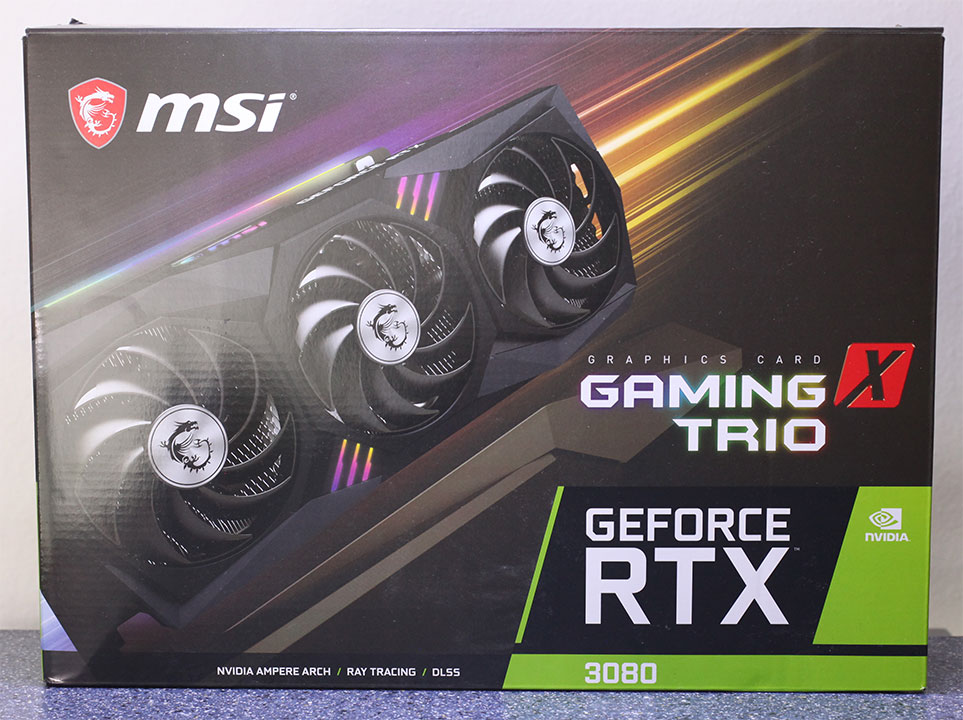
Packaging

The Card
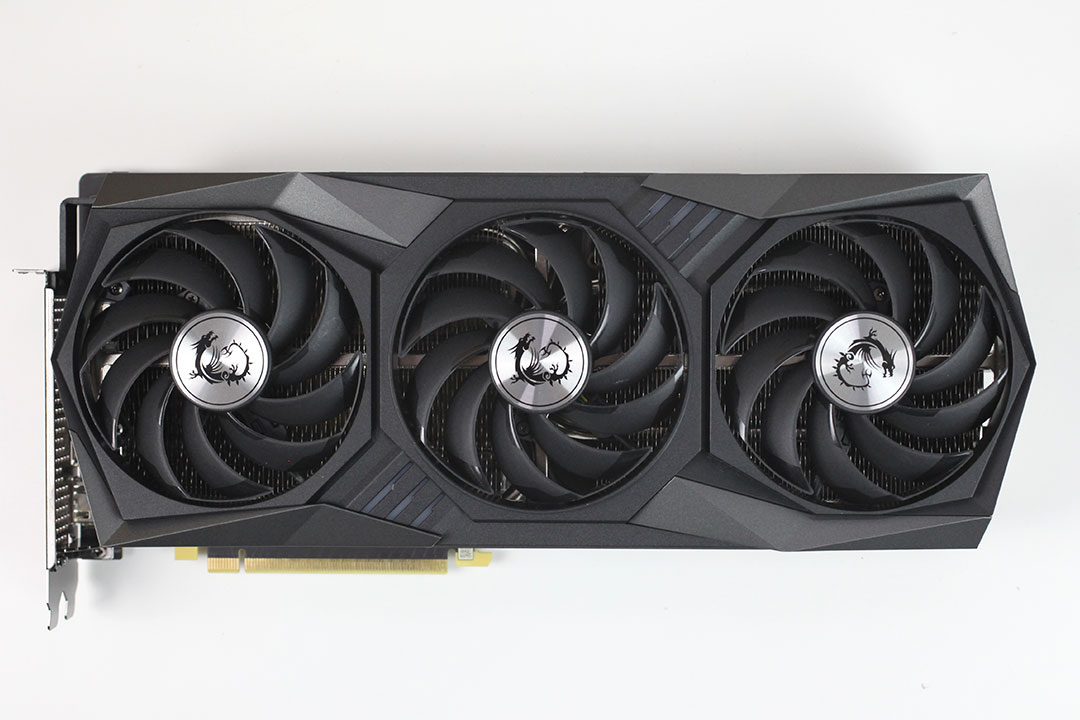
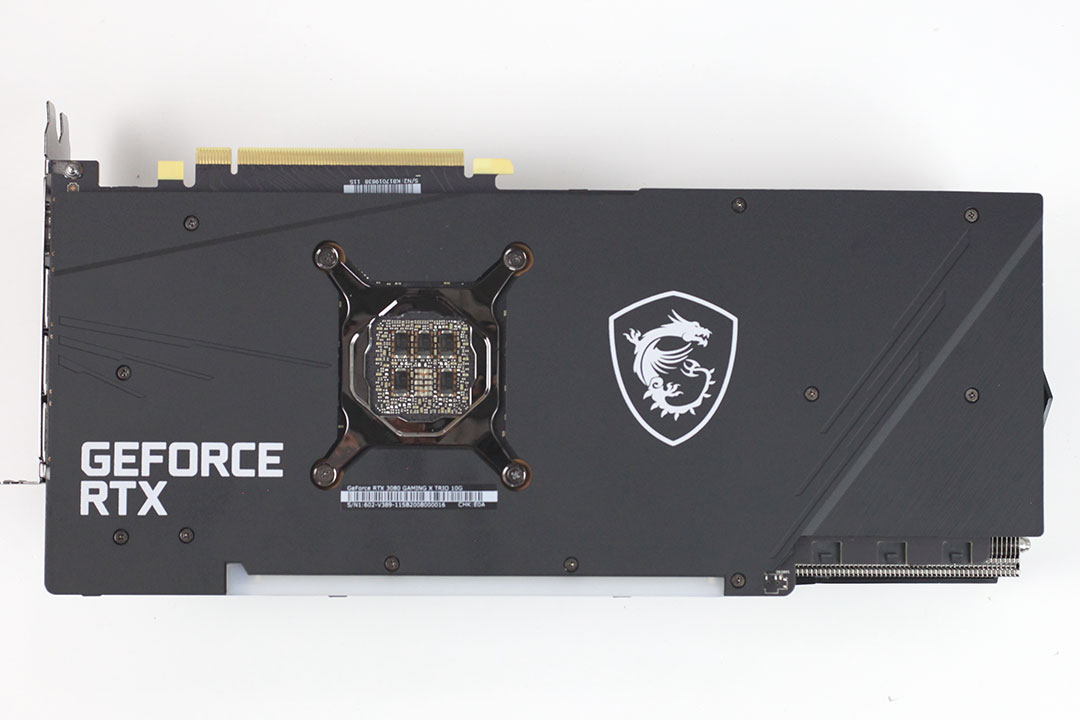
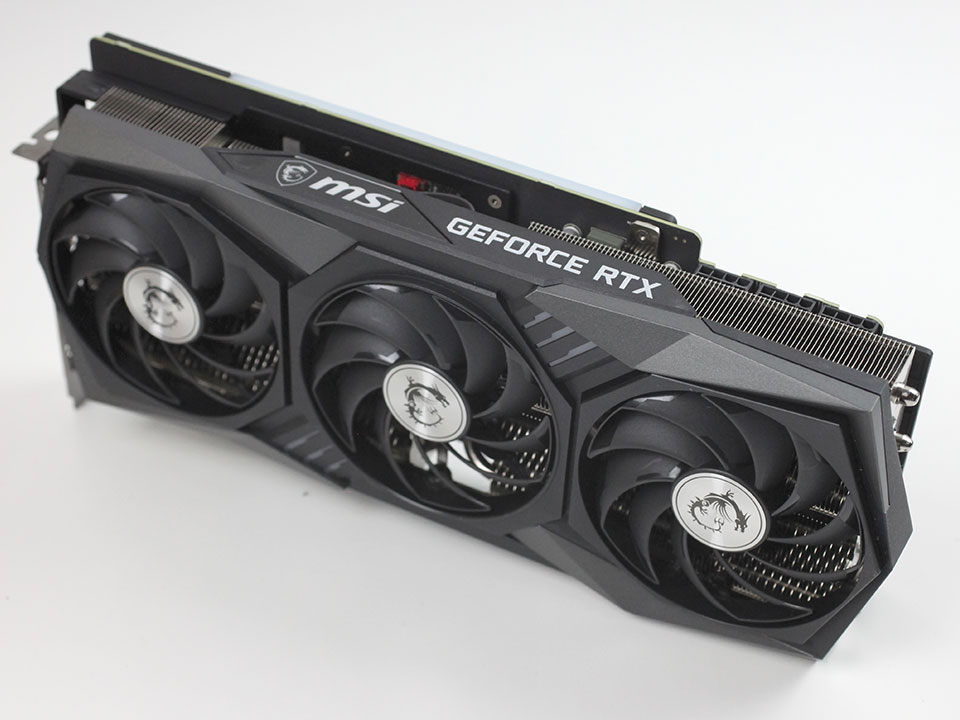
The MSI GeForce RTX 3080 Gaming X Trio is a large piece of hardware, a no holes barred implementation of the RTX 3080 with a hearty triple-slot, triple-fan cooling solution. Unlike past generations, the bulk of the card's RGB bling has been moved towards the top-edge of the card, near the backplate, as those parts of the card are more readily visible to you in a typical windowed case than the front-end with the fans. There are still some ARGB streaks near the fans.

Dimensions of the card are 32 x 14 cm.


Installation requires three slots in your system.

Display connectivity options include three standard DisplayPort 1.4a and one HDMI 2.1. Interestingly, the USB-C port for VR headsets, which NVIDIA introduced on Turing Founders Editions, has been removed—guess it didn't take off as planned. The DisplayPort 1.4a outputs support Display Stream Compression (DSC) 1.2a, which lets you connect 4K displays at 120 Hz and 8K displays at 60 Hz. Ampere can drive two 8K displays at 60 Hz with just one cable per display.
Ampere is the first GPU to support HDMI 2.1, which increases bandwidth to 48 Gbps to support higher resolutions, like 4K144 and 8K30, with a single cable. With DSC, this goes up to 4K240 and 8K120. NVIDIA's new NVENC/NVDEC video engine is optimized to handle video tasks with minimal CPU load. The highlight here is added support for AV1 decode. Just like on Turing, you may also decode MPEG-2, VC1, VP8, VP9, H.264, and H.265 natively, at up to 8K@12-bit.
The encoder is identical to Turing. It supports H.264, H.265 and lossless at up to 8K@10-bit.

Unlike the NVIDIA Founders Edition card that introduces the new 12-pin power input, MSI sticks to industry standard 8-pin PCIe power inputs, but there are three of them. Combined with PCIe slot power, this configuration is rated for 525 W. MSI's own typical board power number for this card is 340 W, or 20 W higher than reference.

The GeForce RTX 3080 does not support SLI. Its bigger brother, the RTX 3090, has SLI support. As both are based on the GA102 GPU, it's purely a segmentation choice. Multi-GPU really isn't supported widely anymore, so it's no big deal.
Teardown
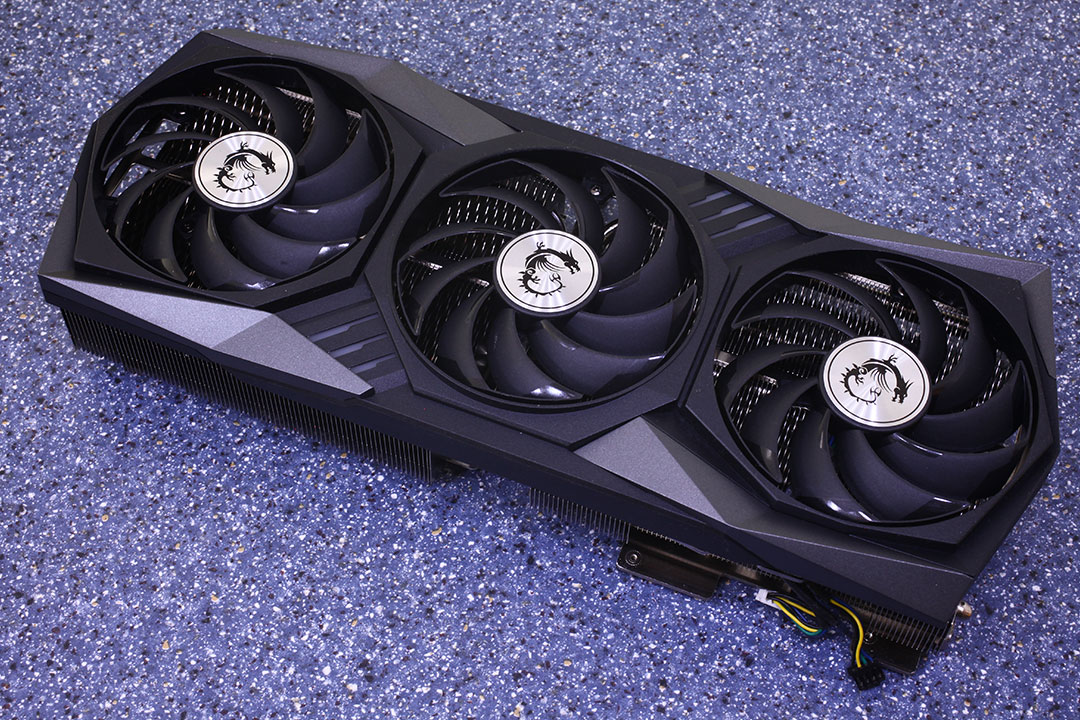

Disassembling the MSI Gaming X Trio is a breeze, no guitar picks needed. You simply undo a bunch of screws to remove the backplate, and then turn a second set of screws to pull out the cooling solution. The cooler comes out in one clean piece, leaving behind the PCB and a base plate.


A small base plate is used as a heat spreader for some of the VRM MOSFETs. This plate also counteracts PCB bending.


This isn't any other backplate, MSI markets this as a "graphene backplate" on its website, "A lightweight composite backplate" that "reinforces the length of the graphics card while providing thermal conduction properties." Before we had our hands on this card, we were frankly taken aback by this claim. Graphene remains an exotic and expensive new material. The card even felt different to the touch. It's only when we took the card apart that we noticed that the other side of this back-plate had many shapes and markings resembling normal ABS plastic backplates. So we took a sharp object and started scratching its surface.

There. The graphene composite sitting under a layer of plastic paint. I tested the electrical resistance, which is an excellent indicator of whether something is plastic or graphene/graphite. The paint is non-conductive, but the scratched part conducts electricity. I further tested heat transfer with a heat gun—it heats up slightly faster than a piece of plastic, but not as fast as metal, which is another indication that the material is not graphene. It seem to be graphite mixed with plastic, which is an industry standard method to construct carbon parts.
High-resolution PCB Pictures
These pictures are for the convenience of volt modders and people who would like to see all the finer details on the PCB. Feel free to link back to us and use these in your articles or forum posts.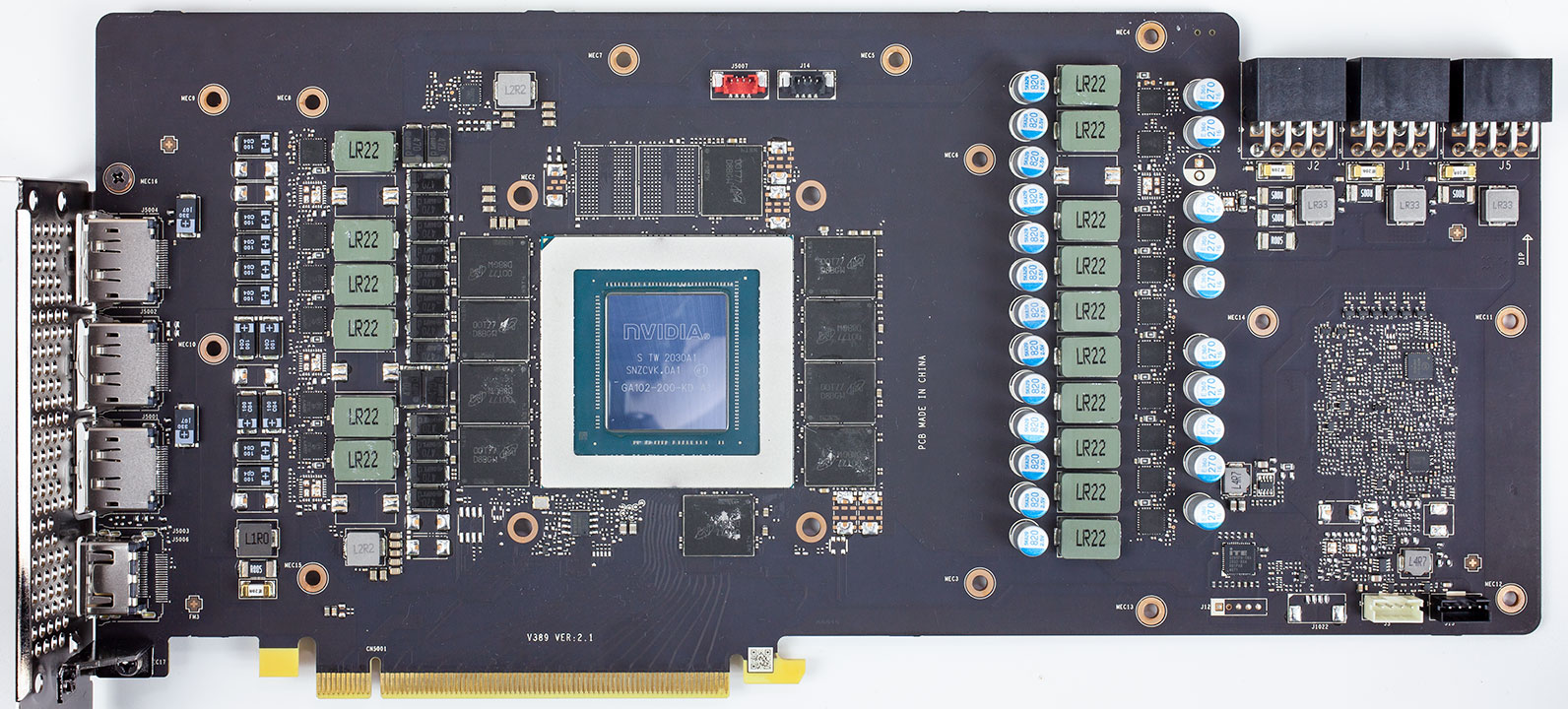
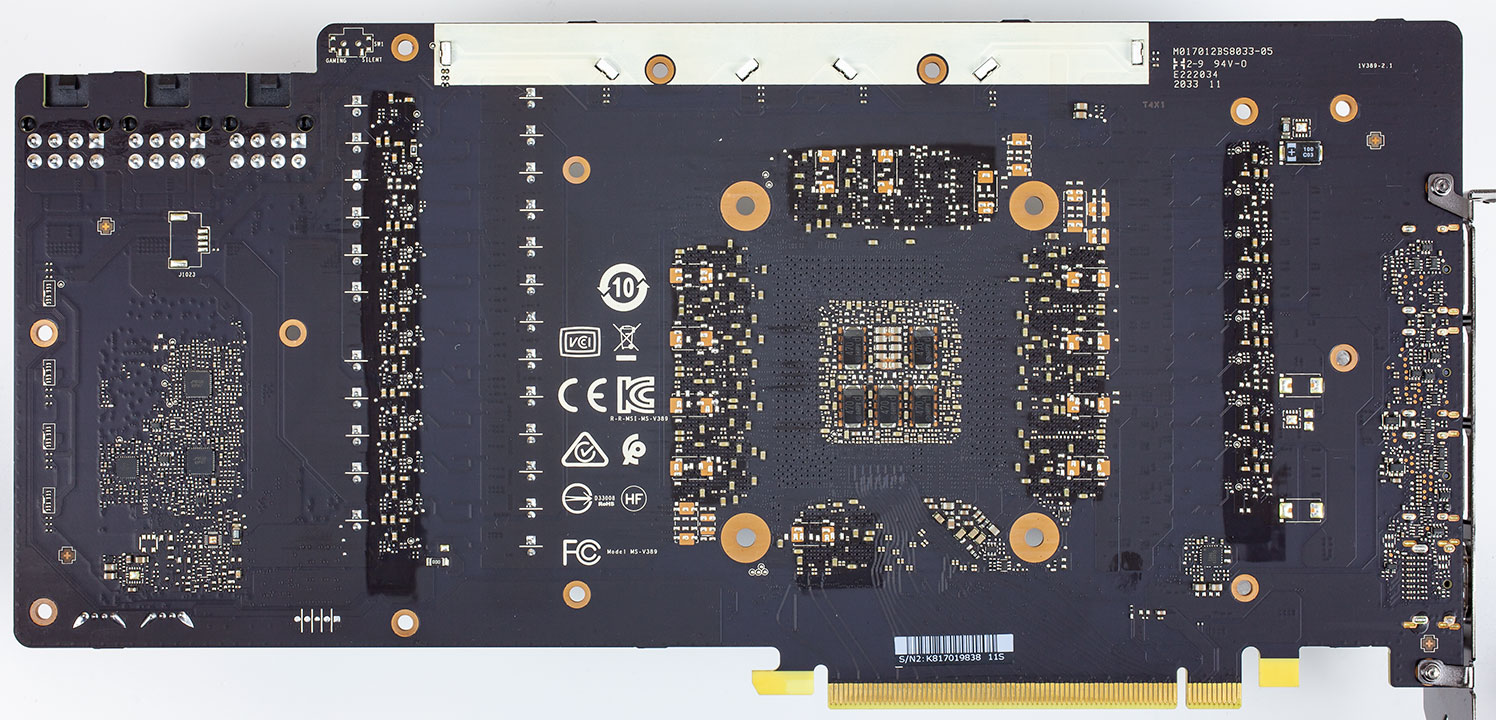
High-res versions are also available (front, back).
Our Patreon Silver Supporters can read articles in single-page format.
Nov 12th, 2026 18:26 PST
change timezone
Latest GPU Drivers
New Forum Posts
- Microsoft Exchange/365 outages? (11)
- WarpCoreBench scores! (26)
- Ryzen 7 8700G OC (5)
- Your PC ATM (36412)
- When you could finally run Crysis maxed out? (61)
- Warning for Windows 10 and 11 users running newer AMD GPU drivers (52)
- The program has not been updated for 533 days. (10)
- Minimax H3 bench (4)
- At a loss what keyboard to try. (89)
- budget home NAS – X79, X99 or another platform? (145)
Popular Reviews
- AMD Zen 6 Technical Deep Dive
- NZXT C1200 Platinum Review
- Upcoming Hardware Launches 2027 (Updated Nov 2026)
- Corsair HX1000i Shift Crystal Review
- NZXT H7 RGB+ Review
- Montech King 95 3D PRO Review
- NZXT H5 Review
- Phantom Blade Zero Performance Benchmark Review - 35 GPUs Tested
- XPG NIMBUS PLUS Review - Mid-range Chair With Strong Competitors
- Gigabyte Z890I Aorus Ultra Review
TPU on YouTube
Controversial News Posts
- NVIDIA Co-Founder and CEO Jensen Huang Officially Resigns (270)
- OpenAI CEO Argues Home PCs Waste the World's Limited DRAM Supply (152)
- NVIDIA Launches Investigation Into Jensen Huang's Relationship With Suspected Chinese Spy (136)
- Intel "Raptor Lake Next" 16-Core and 20-Core CPUs Surface (130)
- Legendary Game Studio BioWare Shuts Down Following EA Layoffs (104)
- Dell CEO Says the Memory Shortage Will Get Worse in 2027 (95)
- NVIDIA GeForce RTX 50-Series Scheduled for up to $500 Price Hike This Week (89)
- Modder Fits RTX 5090 With Four 8-Pin Connectors, Halving Current per Wire (80)