 115
MSI GeForce RTX 3080 Suprim X Review - The Biggest Graphics Card in the World
(115 Comments) »Introduction

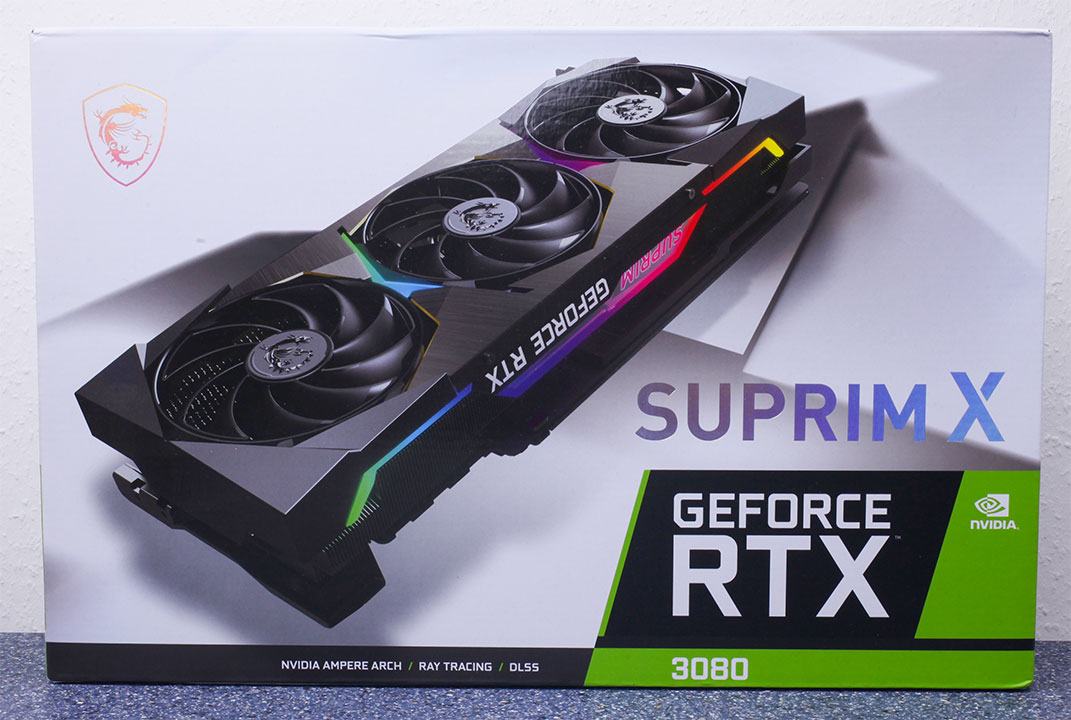
MSI GeForce RTX 3080 Suprim X graphics is the company's new premium custom-design implementation of the RTX 3080 "Ampere." With it, the company is debuting its new "Suprim" brand extension positioned a notch above the MSI Gaming X Trio line of graphics cards. It's likely that Suprim X is the new Gaming Z since the company in the past probably had to fight the perception that Gaming Z is just an overclocked Gaming X when in fact it would usually come with certain physical improvements. In addition to a more upmarket design than the Gaming X Trio, the RTX 3080 Suprim X comes with higher clock speeds and a handful exclusive features. MSI is reserving the Suprim X treatment for high-end GPUs only, beginning with the RTX 3090, RTX 3080, and RTX 3070. In this review, we take a look at the RTX 3080 Suprim X, but we'll also have a review of the RTX 3090 Suprim for you soon.
The GeForce RTX 3080 is the first "Ampere" graphics card based on NVIDIA's first consumer graphics architecture in close to two years. The company was first to introduce real-time raytracing for gaming with its path-breaking RTX 20-series "Turing" in 2018, and "Ampere" is an exercise in making raytracing have much less of a performance impact than with the previous generation. While purely raytraced interactive 3D remains a very long-term engineering goal due to the enormity of required compute power, NVIDIA realized that conventional raster 3D can be combined with certain raytraced elements, such as lighting, shadows, reflections, global illumination, and ambient occlusion, to uplift graphics realism way beyond what's possible with raster 3D, even with the latest DirectX 12 feature set, and innovated the RTX technology. With "Ampere," NVIDIA is introducing its 2nd generation, which adds even more hardware-accelerated RTX effects and improves performance. The RTX 3080 is designed to make AAA gaming with raytracing possible at 4K (UHD) at 60 Hz.

The new GeForce "Ampere" graphics architecture marks the debut of 2nd generation RTX, which combines new "Ampere" CUDA cores that double throughput over the previous generation by leveraging concurrent FP32+INT32 math operations per clock cycle, new 2nd generation RT cores, which double the BVH traversal and intersection performance over "Turing" RT cores and add new fixed-function hardware that enables raytraced motion-blur; and the new 3rd generation Tensor core inspired by the cores that power the A100 Tensor Core HPC processor, which leverage the sparsity phenomenon in deep-learning neural networks to increase AI inference performance by an order of magnitude over the previous generation. NVIDIA leverages AI to power its raytracing denoiser and enable its DLSS performance enhancement. With "Ampere," NVIDIA is introducing 8K DLSS, which lets you play at 8K resolution.
The GeForce RTX 3080 features close to triple the number of CUDA cores as the RTX 2080, at 8,704 vs. 2,944. It also features 68 2nd Gen RT cores, 272 3rd Gen Tensor cores, 272 TMUs, and 96 ROPs. To keep all this compute muscle fed with a steady stream of data, NVIDIA partnered with Micron Technology to innovate an exclusive new memory technology it calls GDDR6X, which on the RTX 3080 offers staggering data rates of 19 Gbps, instead of up to 16 Gbps of conventional GDDR6. NVIDIA is also widening the memory bus to 320-bit and increasing the memory amount to 10 GB. The RTX 3080 enjoys 760 GB/s of memory bandwidth. There several other next-gen technologies, such as support for the new PCI-Express 4.0 x16 bus, latest DisplayPort 1.4a and HDMI 2.1 connectors that support 8K over a single cable, and AV1 decode acceleration. The RTX 3080 is based on the same "big" silicon as the RTX 3090, the "GA102" built on the Samsung 8 FFN silicon fabrication process.
The MSI GeForce RTX 3080 Suprim X is possibly the only custom-design card that can give the NVIDIA Founders Edition a run for its money in a beauty contest. Top-grade brushed aluminium finishes off the cooler shroud and backplate, crafted to perfection and covering a meaty aluminium fin-stack heatsink that pulls heat over squared "core pipe" heat-pipes which make better contact with the GPU over a nickel-plated copper base plate and high conductivity thermal compound. The fin-stack is ventilated by a trio of evenly sized TorX 4.0 fans that feature webbed impellers for guided axial airflow and double-ball bearings. The cooler also features a flattened heat pipe dedicated to pulling heat from the memory chips on the PCB.
MSI is giving the RTX 3080 Suprim X its highest factory overclock thus far, with GPU Boost set at 1905 MHz—compared to the 1710 MHz reference and 1815 MHz of the RTX 3080 Gaming X Trio. It's also the most expensive air-cooled RTX 3080 from MSI, priced at $900, a $200 premium over the Founders Edition and $140 premium over the Gaming X Trio. In this review, we take a very close look at the MSI GeForce RTX 3080 Suprim X to tell you if this huge premium is justified.
| Price | Shader Units | ROPs | Core Clock | Boost Clock | Memory Clock | GPU | Transistors | Memory | |
|---|---|---|---|---|---|---|---|---|---|
| GTX 1080 Ti | $650 | 3584 | 88 | 1481 MHz | 1582 MHz | 1376 MHz | GP102 | 12000M | 11 GB, GDDR5X, 352-bit |
| RX 5700 XT | $370 | 2560 | 64 | 1605 MHz | 1755 MHz | 1750 MHz | Navi 10 | 10300M | 8 GB, GDDR6, 256-bit |
| RTX 2070 | $340 | 2304 | 64 | 1410 MHz | 1620 MHz | 1750 MHz | TU106 | 10800M | 8 GB, GDDR6, 256-bit |
| RTX 2070 Super | $450 | 2560 | 64 | 1605 MHz | 1770 MHz | 1750 MHz | TU104 | 13600M | 8 GB, GDDR6, 256-bit |
| Radeon VII | $680 | 3840 | 64 | 1802 MHz | N/A | 1000 MHz | Vega 20 | 13230M | 16 GB, HBM2, 4096-bit |
| RTX 2080 | $600 | 2944 | 64 | 1515 MHz | 1710 MHz | 1750 MHz | TU104 | 13600M | 8 GB, GDDR6, 256-bit |
| RTX 2080 Super | $690 | 3072 | 64 | 1650 MHz | 1815 MHz | 1940 MHz | TU104 | 13600M | 8 GB, GDDR6, 256-bit |
| RTX 2080 Ti | $1000 | 4352 | 88 | 1350 MHz | 1545 MHz | 1750 MHz | TU102 | 18600M | 11 GB, GDDR6, 352-bit |
| RTX 3070 | $500 | 5888 | 96 | 1500 MHz | 1725 MHz | 1750 MHz | GA104 | 17400M | 8 GB, GDDR6, 256-bit |
| RX 6800 | $580 | 3840 | 96 | 1815 MHz | 2105 MHz | 2000 MHz | Navi 21 | 23000M | 16 GB, GDDR6, 256-bit |
| RX 6800 XT | $650 | 4608 | 128 | 2015 MHz | 2250 MHz | 2000 MHz | Navi 21 | 23000M | 16 GB, GDDR6, 256-bit |
| RTX 3080 | $700 | 8704 | 96 | 1440 MHz | 1710 MHz | 1188 MHz | GA102 | 28000M | 10 GB, GDDR6X, 320-bit |
| MSI RTX 3080 Suprim X | $900 | 8704 | 96 | 1440 MHz | 1905 MHz | 1188 MHz | GA102 | 28000M | 10 GB, GDDR6X, 320-bit |
| RTX 3090 | $1500 | 10496 | 112 | 1395 MHz | 1695 MHz | 1219 MHz | GA102 | 28000M | 24 GB, GDDR6X, 384-bit |
Packaging

The Card

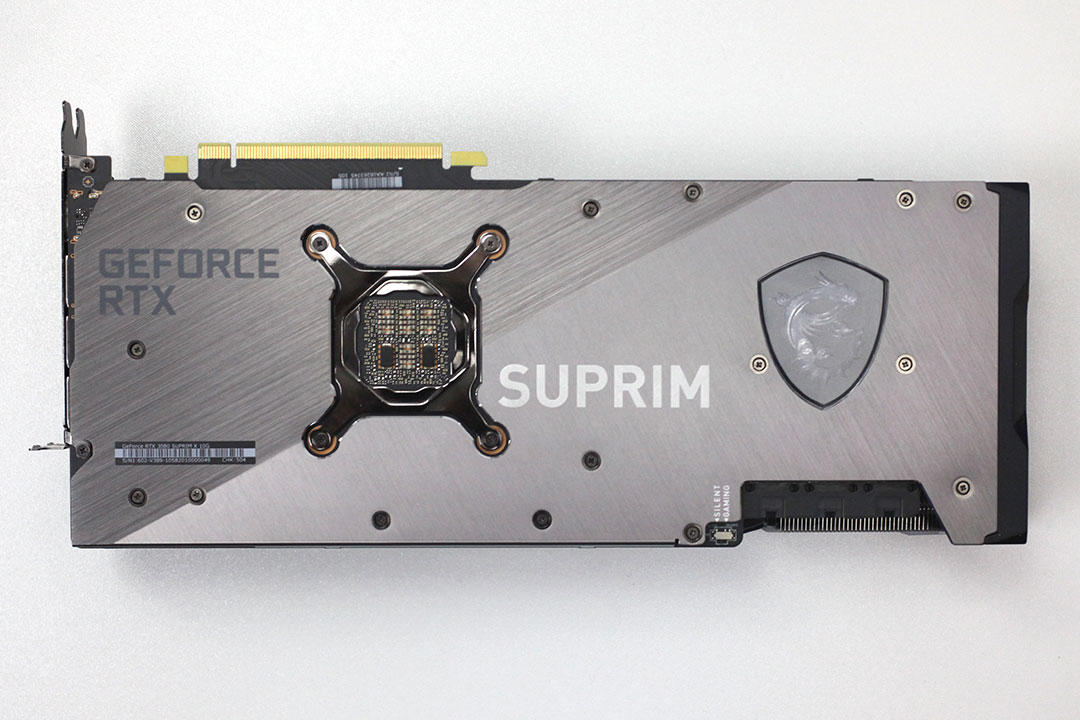

The MSI GeForce RTX 3080 Suprim X is possibly the largest graphics card in the market, with dimensions and aesthetics that make the already large RTX 3080 Gaming X Trio look much smaller. A premium brushed aluminium shroud dominates much of the card, with cleverly designed cutouts for the vents and some sharp edges and RGB LED diffusers. The amount of RGB bling is about the same as for the Gaming X Trio, but somehow comes across as more subtle and classy.

Dimensions of the card are 33.5 x 14 cm. This is a very long card, please beware of the dimensions.

See what I mean? The Suprim X is huge, noticeably bigger than the Gaming X Trio or even RTX 3090 FE. The two small cards on the left? Those are the RTX 3080 Founders Edition and Radeon RX 6800 XT—not so small at all.
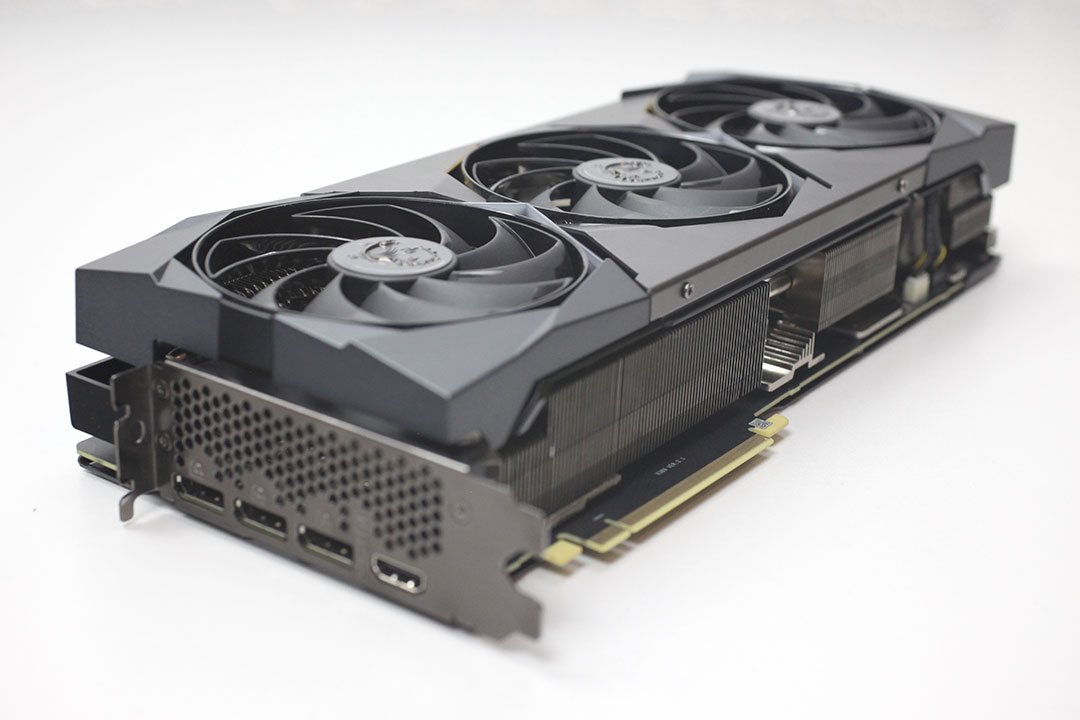

Installation requires three slots in your system.

Display connectivity options include three standard DisplayPort 1.4a and one HDMI 2.1. Interestingly, the USB-C port for VR headsets, which NVIDIA introduced on the Turing Founders Editions, has been removed—guess it didn't take off as planned. The DisplayPort 1.4a outputs support Display Stream Compression (DSC) 1.2a, which lets you connect 4K displays at 120 Hz and 8K displays at 60 Hz. Ampere can drive two 8K displays at 60 Hz with just one cable per display.
Ampere is the first GPU to support HDMI 2.1, which increases bandwidth to 48 Gbps to support higher resolutions, like 4K144 and 8K30, with a single cable. With DSC, this goes up to 4K240 and 8K120. NVIDIA's new NVENC/NVDEC video engine is optimized to handle video tasks with minimal CPU load. The highlight here is added support for AV1 decode. Just like on Turing, you may also decode MPEG-2, VC1, VP8, VP9, H.264, and H.265 natively, at up to 8K@12-bit.
The encoder is identical to Turing. It supports H.264, H.265, and lossless at up to 8K@10-bit.

This BIOS switch lets you toggle between the default (silent) BIOS and a "gaming" BIOS, which runs a more aggressive fan curve for lower temperatures. Both BIOSes have idle fan stop. As you can see on page 30, the gaming BIOS runs slightly higher clocks.

Unlike the NVIDIA Founders Edition card that introduces the new 12-pin power input, MSI sticks to the industry standard 8-pin PCIe power inputs, but there are three of these. Combined with PCIe slot power, this configuration is rated for 525 W.

The GeForce RTX 3080 does not support SLI. Its bigger brother, the RTX 3090, has SLI support. As both are based on the GA102 GPU, it's purely a segmentation choice. Multi-GPU really isn't supported widely anymore, so it's no big deal.
Teardown


The MSI Suprim X cooling solution for the RTX 3080 features two large aluminium fin-stacks at either ends of seven square heat pipes. A mirror-finish, nickel-plated copper base pulls heat from the GPU, while a flattened heat pipe runs around this plate, pulling heat from the surrounding memory chips. Thermal pads for the memory make contact with both this heat pipe and the GPU base plate.

Here, you can see the square heatpipes—note how snugly they use the available space.

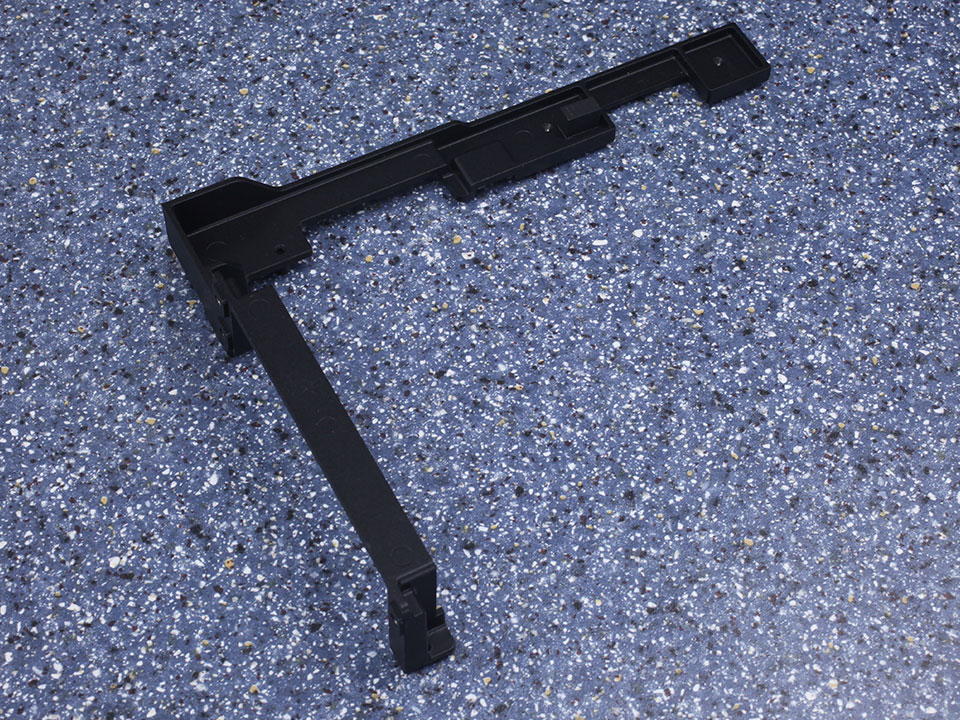

An L-shaped metal bit provides structural reinforcement for the card, counteracting PCB bending over time.


The backplate is made out of aluminium and features a groovy-looking, illuminated MSI Gaming logo ornament. Although there are no memory chips on the reverse side of the RTX 3080 Suprim X PCB, the backplate also features thermal pads that make contact with the PCB to pull some heat from the memory and VRM areas.
High-resolution PCB Pictures
These pictures are for the convenience of volt modders and people who would like to see all the finer details on the PCB. Feel free to link back to us and use these in your articles or forum posts.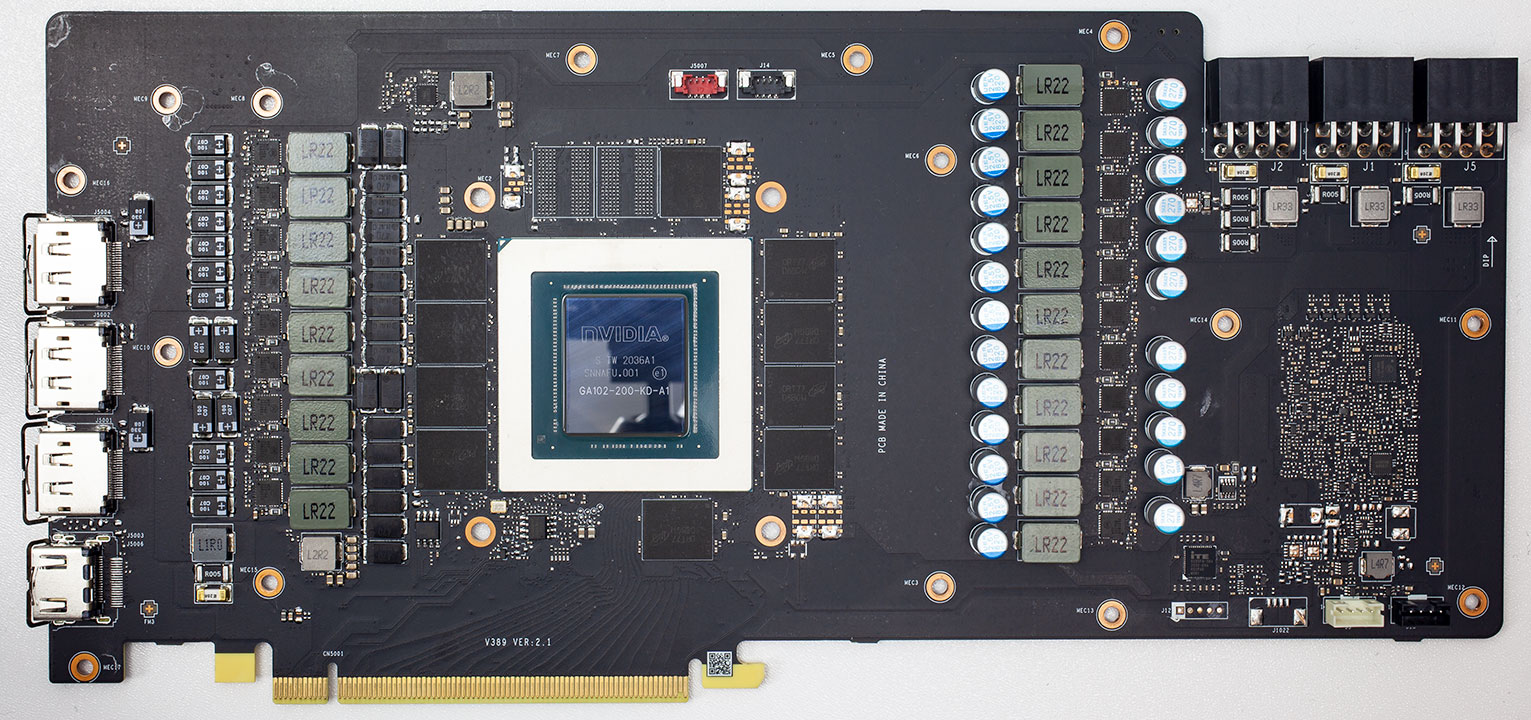
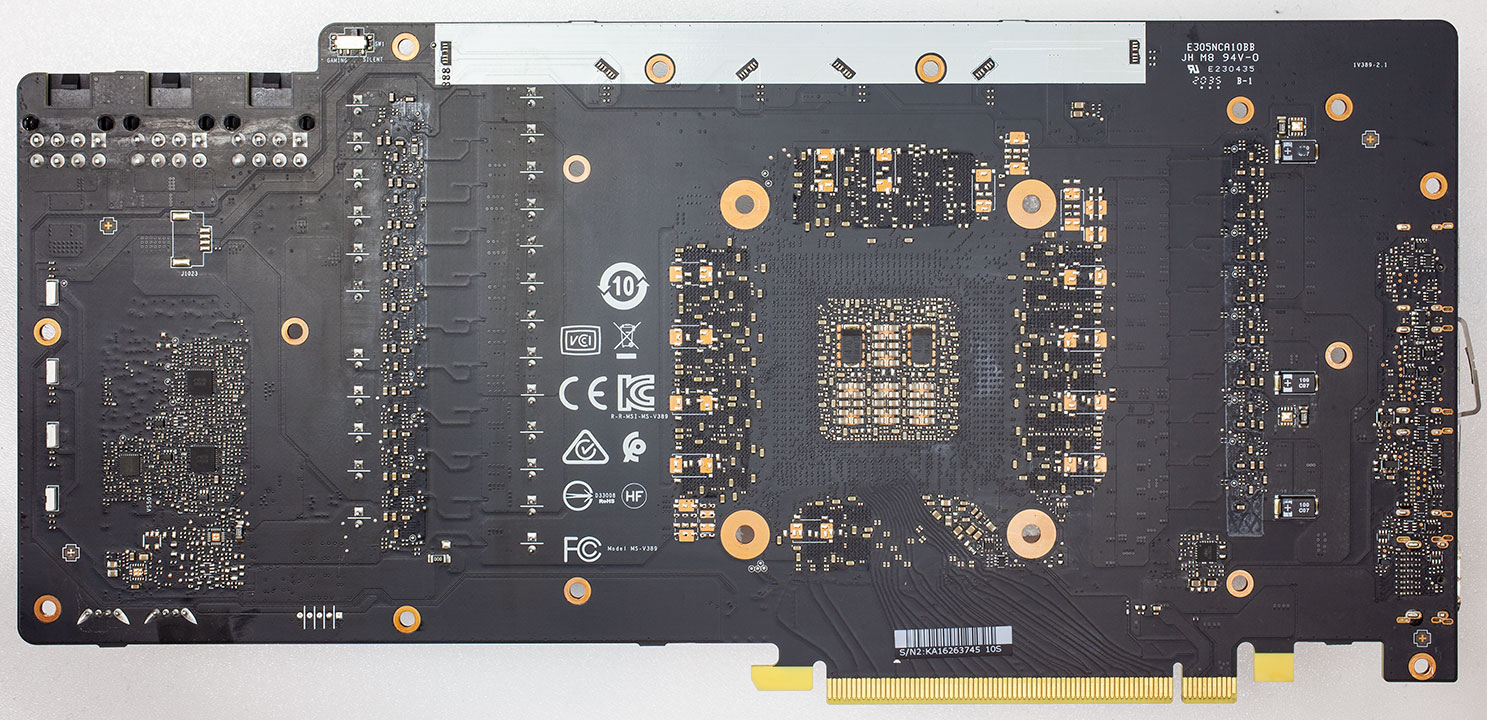
High-res versions are also available (front, back).
Our Patreon Silver Supporters can read articles in single-page format.
Nov 17th, 2026 22:06 CST
change timezone
Latest GPU Drivers
New Forum Posts
- Slow SSD read speeds - help! (16)
- Without Jensen, PC gaming will be (37)
- Will zen 6 mobos have anything extra vs current ones? (52)
- Hi, just to say thanks and who I am (3)
- 9070 GRE 3.9ghz validation reached. (19)
- [testers wanted] Qsurfer My own QNAP Nas explorer/Search tool (8)
- Lenovo Legion Pro 5 Audio Nightmare: Fan Noise, Harsh Voice & Massive DPC Latency (Help!) (2)
- Help with fixing Overclock (8)
- WarpCoreBench scores! (56)
- Ryzen 7 8700G OC (9)
Popular Reviews
- Acemagic Retro X3 Review
- Upcoming Hardware Launches 2027 (Updated Nov 2026)
- AMD Zen 6 Technical Deep Dive
- ASUS ROG Strix B850-I Gaming Wi-Fi7 W Review
- Corsair HX1000i Shift Crystal Review
- Chieftec Iceberg PRO 360 DARK Review
- AMD Ryzen 7 9800X3D Review - The Best Gaming Processor
- Phantom Blade Zero Performance Benchmark Review - 35 GPUs Tested
- Montech King 95 3D PRO Review
- Biwin Black Opal NV7400 2 TB Review
TPU on YouTube
Controversial News Posts
- NVIDIA Co-Founder and CEO Jensen Huang Officially Resigns (464)
- Open Letter Asking NVIDIA to Reinstate Jensen Huang Passes 115,000 Signatures (184)
- OpenAI CEO Argues Home PCs Waste the World's Limited DRAM Supply (152)
- Report: Jensen Huang Eyes NVIDIA Comeback (137)
- NVIDIA Launches Investigation Into Jensen Huang's Relationship With Suspected Chinese Spy (136)
- Intel "Raptor Lake Next" 16-Core and 20-Core CPUs Surface (130)
- Legendary Game Studio BioWare Shuts Down Following EA Layoffs (104)
- Dell CEO Says the Memory Shortage Will Get Worse in 2027 (95)